Jesus Is Denied by Peter: An In-Depth Look at Peter’s Denial of Jesus
Peter's denial of Jesus is one of the most debated and profound moments in the gospel narratives. It sits at the crossroads of fear, loyalty, misunderstanding, and mercy. This article explores the denial of Jesus by Peter from multiple angles—historical context, gospel accounts, theological significance, and lasting implications for readers and believers. By tracing the threads of Peter's denial across the four canonical gospels, we gain a clearer sense of how a devotee can falter under pressure, and how divine grace can meet a fractured heart with restoration.
Context and Setting: What Led to the Denial?
To understand the denial by Peter, one must begin with the momentous events surrounding Jesus’ arrest and trial. The night began with Jesus' arrest in Gethsemane, after which he was subjected to a perilous sequence of interrogations and accusations. The mood was tense, the stakes high, and the atmosphere charged with expectations among Jesus’ followers. Peter, one of Jesus’ closest disciples, had pledged unwavering loyalty earlier in the ministry, yet he found himself unprepared for the peril that unfolded. The primary human dynamic in play is fear—fear of suffering, fear of accusation, and fear of being associated with a crucified Messiah in a city hostile to Jesus. In such circumstances, Peter's denial becomes not merely a personal lapse, but a dramatic illustration of human frailty under pressure.
Another dimension to consider is the cultural and social context of the trial. In the first-century Mediterranean world, honor and association carried weight. Saying “I do not know him” or disassociating from a criminal could be a survival strategy. Yet the gospels insist that the same Peter who declared willingness to die with Jesus (in one of the gospel accounts) faltered when confronted with a servant girl, a bystander’s question, or a petty accusation. The tension between loyalty and fear is at the heart of the episode commonly referred to as Peter's denial of Jesus.
The Narrative Across the Gospels: Variations and Common Ground
All four gospels include the event of Peter's denial, but each presents a distinctive emphasis. The differences are not contradictions so much as complementary portraits that illuminate different facets of the same incident. Readers who study the parallel accounts can better appreciate the multi-layered meaning of Peter's three denials and the ultimate response of Jesus to him after the Resurrection.
Matthew’s Account: Denial in the Court of the High Priest
In Matthew's narrative, the denial occurs in the courtyard of the high priest during Jesus’ trial before the Sanhedrin. Peter is confronted by bystanders who identify him as a follower of Jesus. Three separate denials are recorded, culminating in the third denial just as the rooster crows—a signal linked to Jesus’ earlier prophecy that before the rooster crows, Peter would deny him three times. Matthew emphasizes the fulfillment of Jesus’ prophecy and the stark contrast between Peter’s earlier bold insistence and his present fear. The emphasis on the crowd’s recognition and the intimate dialogue with a servant girl underscore the social dynamics at play: public exposure, personal reputation, and the danger of association with a figure deemed controversial or dangerous by authorities.
Mark’s Account: A Tighter, Urgent Portrait
Mark’s gospel presents a brisk retelling that highlights the immediacy of the denials and the pressure of the moment. The sequence of Peter’s denials unfolds in close proximity to Jesus’ trial, with Mark underscoring the rapid escalation of fear and the intelligence of those who challenge Peter’s allegiance. The wording in Mark often emphasizes the voices of onlookers who recognize Peter as a follower of Jesus, prompting the three denials in quick succession. The account also connects Peter’s reaction to the prophetic prediction, though the emphasis on the peeling away of courage is kept tight and urgent, mirroring the hurried pace of events in the trial scene.
Luke’s Account: The Human Face of Fear and the Look of Jesus
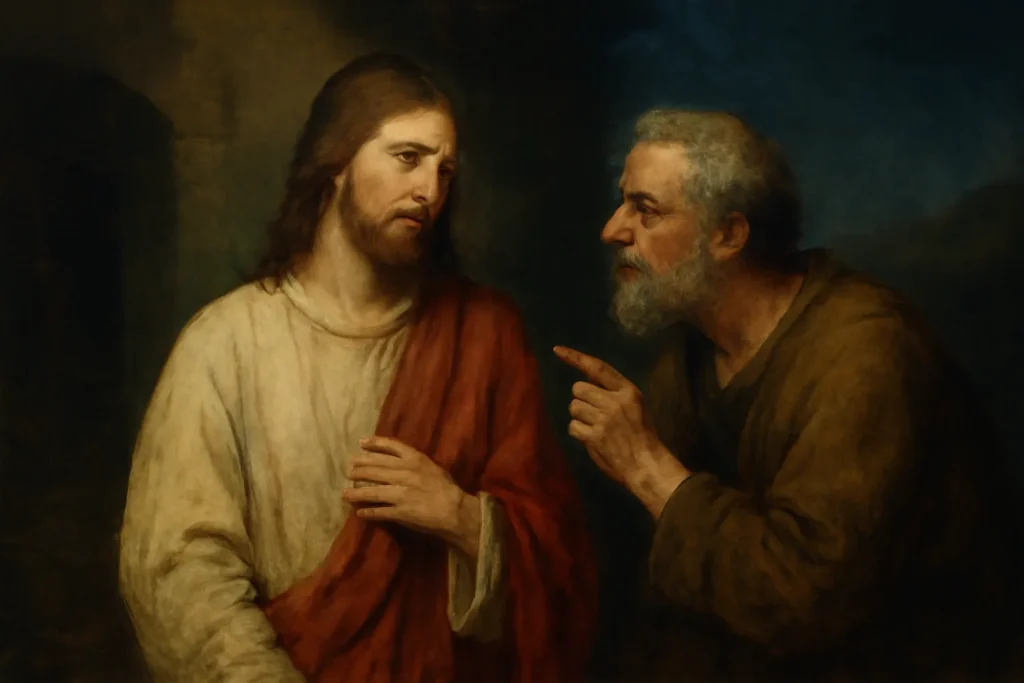
Luke’s version adds a poignant relational dimension. In Luke 22:61-62, the text notes that “the Lord turned and looked straight at Peter.” That gaze is a powerful literary and theological moment, inviting readers to consider how Jesus’ awareness and mercy intersect with Peter’s fear. Luke’s portrayal emphasizes the internal emotional life of Peter—his weeping after realizing the gravity of his denial—and highlights the personal cost of fear, even for a devoted disciple. This gospel also situates the denials within a broader theme of discipleship, repentance, and the path toward restoration.
John’s Account: Personal Encounters and the Narrative of Initiation
John’s gospel weaves the denial into a slightly different fabric, with a strong emphasis on the relationship between Peter and Jesus in the courtyard of the high priest. John’s account includes specific interactions between Jesus’ followers and the temple authorities, and it places a distinct emphasis on the progression of Peter’s test and Jesus’ earlier predictions. The denial unfolds in a context that foregrounds the intimate question of allegiance: Will Peter remain loyal when the public conversation about Jesus turns dangerous? In John, the denial is part of a larger Johannine theology that includes the ongoing call to witness, repentance, and the eventual restoration for Peter in the post-resurrection scenes.
Across these accounts, a shared skeleton remains: Peter’s fear leads to denial, the denial occurs under observation by servants and bystanders, and a prophetic warning about the rooster’s crow frames the moment. The differences between the accounts invite readers to reflect on the broader message about human weakness, divine knowledge, and the possibility of reconciliation.
The Rooster and the Denials: The Symbolism of the Crow
A central motif in the story is the crowing rooster, a sign that has both literal and symbolic significance. In several gospel narratives, Jesus had warned Peter that he would deny him three times before the rooster crowed. The rooster’s crow is a natural reminder of the human tendency to falter in moments of fear, yet it also functions as a divinely ordained signal that the moment of truth has arrived. The symbolism extends beyond a single event: it reflects the interplay between human frailty and the inexorable timing of divine providence. The crow thus becomes a reminder of both failure and potential for restorative grace. Some scholars see the rooster’s crow as a motif that Dante or Augustine might interpret as an invitation to humility and renewed dependence on God.
In the different gospels, the timing of the rooster’s crow varies slightly, but the theological message remains consistent: Peter's denial is real, but it is not the end of the story. The faithful understanding of this moment involves recognizing the depth of human weakness while also grasping the breadth of mercy that follows during the post-resurrection interactions between Jesus and Peter.
When the denial by Peter ended, the immediate emotional and psychological aftermath was severe. In Luke’s account, Peter’s reaction—his weeping—expresses a deep contrition that aligns with themes of repentance and mercy. The other gospels imply sorrow and introspection, even when the narrative resumes later with Peter’s role in the early church and in Jesus’ post-resurrection appearances. The denial created a gap in the disciples’ fellowship that had to be bridged by grace, not simply by human resolve. The episode thus becomes a turning point that invites readers to consider the trajectory of a disciple from failure to restoration.
For readers looking at the broader arc of the Gospel narrative, the denial is not merely a moral warning; it is a doorway into understanding the nature of kinship with Jesus. It reveals that discipleship is a process—often messy and incomplete—yet still oriented toward the restoration and mission that Jesus entrusts to his followers after his resurrection. The denial also serves as a pedagogical moment for communities of faith who wrestle with fear, public perception, and faithfulness in dangerous or challenging contexts.
Several theological threads are woven into the account of Peter's denial. First, the event foregrounds human fragility in the face of pressure, yet it does not erase the possibility of grace. Second, the narrative demonstrates that true discipleship is measured not by perfection in a moment of fear, but by perseverance through failure and the willingness to be renewed. Third, the episode highlights the intimate relationship between Jesus and his followers: even when Peter fails, Jesus remains deeply engaged with Peter and is prepared to restore him through forgiveness and commissioning.
Scholars have found in this story a model of repentance that is not merely contrition in isolation but an invitation to a renewed vocation. The scene of the rooster’s crow and Jesus’ gaze (as told by Luke) is often read as a mercy-filled encounter: Jesus does not disown Peter; instead, he invites a return to trust and to the mission Jesus has given. In this sense, the denial by Peter is not the final word about Peter’s identity. Rather, it is a moment that leads toward the church’s continuity through confession, restoration, and mission.
The gospel tradition moves quickly from the denial to a later path of restoration. In the post-resurrection appearances, the resurrected Jesus engages with Peter in a way that redefines their relationship and Peter’s vocation. The most famous restoration scene occurs in the Johannine sequence, where Jesus inquires of Peter about love and commissions him with the shepherding task: “Feed my sheep” (John 21:15-17). This exchange reframes Peter's denial not as a permanent mark on his identity but as a catalyst that prompts a deeper commitment to Jesus and to the community entrusted with his message. In this light, the denial is transformed by grace into a renewed public ministry—one that shares in Jesus’ suffering and participates in his mission to the world.
The theme of restoration also resonates with other biblical narratives where a leader falters, yet grace prevails. This continuity across the biblical corpus offers a pattern: first comes failure, then mercy, then renewed purpose. In the life of the church, this pattern has informed pastoral care, counseling, and discipline—emphasizing confession, forgiveness, and reintegration into service.
What does the story of Peter’s denial say to contemporary readers and communities of faith? Several practical implications emerge:
Honest assessment: Followers are called to acknowledge their weaknesses and to name fears honestly, rather than presenting a facade of unwavering strength.
Grace under pressure: The possibility of mercy remains even after profound failure; forgiveness does not erase consequences but opens a path to renewed service.
Vocation despite failure: The call to mission persists beyond a moment of fear; restoration can reorient a leader toward serving with humility and authenticity.
Community care: The church is called to support those who stumble, helping them move from guilt to growth through accountability, forgiveness, and reintegration.
Humility and courage: The contrast between Peter’s bravado and his faltering reveals that true courage includes admitting vulnerability and seeking reconciliation through God’s strength.
Across centuries, interpreters have used the episode to illuminate themes of human weakness, repentance, and grace. Sermons often frame the denial as a cautionary tale about relying on personal bravado rather than on divine strength. Commentaries emphasize the continuity between Peter’s failure and his leadership in the early church, arguing that the grace extended to Peter becomes a model for pastorally addressing failure in modern ministry. In art and literature, the moment is depicted with moving poignancy: the gaze of Jesus, the tremor of Peter’s voice, and the echo of the rooster’s crow have inspired paintings, literary reflections, and musical compositions that invite audiences to contemplate forgiveness and renewal.
As with any well-known biblical episode, several misconceptions have circulated. Here are a few clarifications to help readers approach the narrative with accuracy and nuance:
Misconception: Peter’s denial was intentional treachery born of malice. Clarification: The gospels present Peter as acting out of fear and confusion in a dangerous moment, not as someone who plans to betray Jesus. The episode emphasizes human weakness under pressure rather than premeditated betrayal.
Misconception: The rooster’s crow is always literal in all versions. Clarification: While the rooster’s crow is a common element in several gospel accounts, the exact timing and emphasis vary among the synoptic gospels and John, reflecting different theological aims rather than conflicting historical records.
Misconception: Denial marks the end of Peter’s story. Clarification: The narrative arc is more complex: denial is followed by repentance, restoration, and a prominent place in the early church’s leadership. The episode becomes a foundation for teaching about mercy, forgiveness, and renewed call.
Misconception: The denials occurred in isolation from the other disciples. Clarification: The accounts emphasize the communal nature of the moment, including how various bystanders and authorities interacted with Peter and how the broader group responded in the aftermath.
Scholars and devotional writers alike often point to two enduring reasons why Peter's denial remains a central focus in Christian thought. First, it humanizes discipleship by showing that even the closest followers can falter under pressure. Second, it foregrounds God’s grace as a transformative force that does not abandon those who fail but calls them to renewed service. The scene invites readers to examine their own commitments, to confront fear that undermines loyalty, and to imagine how grace might reorient one’s life toward a constructive and faithful mission. In this sense, the denial by Peter functions as a pedagogical tool—an invitation to humility, repentance, and perseverance in the face of fear.
From a practical and pastoral perspective, the story offers several actionable insights:
Self-awareness: Recognize the conditions that trigger fear or defensiveness, and seek accountability within a supportive community.
Mercy and forgiveness: Understand that reconciliation is possible, and that restoration often requires confession, repentance, and commitment to a renewed purpose.
Trust in grace: Place ultimate trust in God’s mercy rather than relying solely on one’s own courage or performance.
Public witness: Acknowledge the tension between private fidelity and public testimony, and how integrity can be sustained in diverse contexts.
For readers who wish to explore the episode in more depth, here is a compact guide to the most relevant passages, with a focus on Peter’s denial across the four canonical accounts:
Matthew 26:69-75 – Denial in the high priest's courtyard; the rooster crows after the third denial; Peter’s sorrow and the fulfillment of the prophecy.
Mark 14:66-72 – The rapid sequence of denials; emphasis on the bystanders’ recognition and the crowd’s dynamics, with the second and third denials framing the moment.
Luke 22:54-62 – The encounter with the gaze of Jesus; Peter’s weeping; the narrative foregrounds mercy, repentance, and the painful self-evaluation that follows fear-based failure.
John 18:15-27 – An account focused on personal interactions in the courtyard; the denials are embedded in a broader Johannine emphasis on witness, truth, and the preparing of Peter for ministry.
The episode of Peter's denial sits within a larger biblical pattern in which failure and grace intersect. Other biblical figures—David, Samson, and even Paul in moments of weakness—offer parallel moments where human frailty prompts a deeper reliance on divine mercy. The restoration of Peter, especially in the post-resurrection chapters, becomes a living illustration of forgiveness, reinstatement, and the commissioning of leadership. The arc from denial to restoration can be read as a trajectory that affirms both the seriousness of sin and the potency of grace to renew a mission and to repair a life’s direction toward the purposes of God.
In early Christian ethics, the story of Peter's denial was used to teach about perseverance, humility, and forgiveness within the community. It served as a counterbalance to any sense of spiritual arrogance and emphasized that true discipleship is marked by repentance after failure. Church fathers and later theologians often cited Peter’s restoration as evidence that the church is a hospital for sinners and a gymnasium for moral and spiritual growth—the place where accountability, healing, and recommissioning occur.
After the Resurrection, Peter emerges as a central figure in the early church’s leadership. The transition from denial to leadership is not simply about personal resilience; it also reflects the redemptive pattern that characterizes the gospel narrative: failure is real, grace is available, and a renewed vocation can emerge. Peter’s later leadership—facing persecution, preaching boldly, and guiding the church in Jerusalem and beyond—offers a compelling example of how a person’s most painful moment can be transformed into a cornerstone for public faith and ministry.
For contemporary readers, the story of Peter’s denial invites two practical commitments: authenticity and restoration. Authentic faith means acknowledging fear and limitations openly, rather than masking them with bravado or social bravado. Restoration means that communities and spiritual leaders must exhibit mercy and provide pathways to restored service. When churches cultivate a culture that embraces confession, forgiveness, and re-commissioning, they echo the deeper truth embedded in this episode: grace does not erase responsibility; it empowers renewed purpose in the service of God and neighbor.
In sum, Jesus is denied by Peter is not merely a record of a moment of weakness; it is a doorway into the enduring drama of faith, failure, forgiveness, and vocation. The episode, across its four gospel presentations, offers a multi-faceted lens on what it means to be human—and what it means to be called by God despite human fragility. It is, at heart, a story about turning away from fear toward a future in which grace redefines identity and mission for Peter, and for all who seek to follow Jesus.
The denial of Jesus by Peter remains a focal point for Christians seeking to understand the tension between human weakness and divine mercy. It is a narrative that speaks to lived experience: moments when we falter under pressure, moments when fear seems to outweigh courage, and moments when a look, a word, or a memory reminds us of a higher calling. By examining the three denials and their aftermath, readers are invited to embrace a robust vision of discipleship—one that does not reject failure, but rather uses it as a catalyst for repentance, renewal, and recommissioning. In that sense, the story of Peter’s denial is not only about a particular apostle in the first century; it is a message that resonates across time for anyone who seeks to follow Jesus with honesty, courage, and hope.









Leave a Reply