Leviticus Bible study: themes, structure, and meaning
Leviticus Bible study: themes, structure, and meaning
A useful Leviticus Bible study begins with one central idea: the book explains how a holy God lives among an imperfect people. Its sacrifices, priestly instructions, purity rules, festivals, and ethical commands are not random regulations. Together, they describe worship, community life, repentance, and the call to become a holy people.
Leviticus can feel difficult because it assumes knowledge of Israel’s tabernacle, priests, animals, and ritual customs. Read within the larger story of Exodus and Numbers, however, the book becomes more coherent. Exodus describes God establishing his dwelling among Israel; Leviticus explains how Israel approaches that presence; Numbers continues the story as the people travel toward the promised land.
Leviticus is the third book of the Bible and the third book of the Pentateuch, the first five books traditionally associated with Moses. The narrative is set at Mount Sinai, after Israel has been rescued from slavery and after the tabernacle has been constructed.
The book answers several practical questions. How can sinful people approach God? How should priests serve? What makes a person or object clean or unclean? How should the community treat neighbors, foreigners, the poor, and vulnerable people? How can Israel live differently from surrounding nations?
Its repeated concern is God’s holiness. In Leviticus, holiness means being set apart for God and ordered according to his purposes. It includes worship, but it also reaches into food, sexuality, business practices, justice, family life, festivals, and care for the land.
Reading key: Do not treat Leviticus as a disconnected list of ancient rules. Read each command in relation to God’s presence, Israel’s covenant, and the need for worship and community life to be ordered around holiness.
How Leviticus fits into the Bible’s larger story
Leviticus follows the dramatic events of Exodus. God has delivered Israel from Egypt, made a covenant with the nation, and given instructions for the tabernacle. At the end of Exodus, God’s glory fills that sanctuary. Leviticus then begins with God speaking from the tent of meeting, showing that the book concerns access to the divine presence.
That setting explains why the book gives so much attention to sacrifice and priestly service. God’s presence is a gift, but it is not treated casually. Israel needs a way to deal with sin, impurity, broken relationships, and the boundaries between ordinary and sacred things.
Leviticus also prepares readers for themes developed later in Scripture. The prophets connect holiness with justice and mercy. The New Testament interprets Jesus’ death, priesthood, and covenant through sacrificial and priestly imagery. Those later interpretations should be studied alongside Leviticus rather than used to skip over what the original book says to ancient Israel.
A helpful reading sequence is:
Exodus 25–40: Learn why the tabernacle matters and how it is constructed.
Leviticus: Study the worship, purity, holiness, and covenant instructions given at Sinai.
Numbers: Observe how these instructions relate to Israel’s life in the wilderness.
Hebrews and the Gospels: Explore how later Christian writings connect Leviticus with Jesus, sacrifice, and priesthood.
How the sacrifices in Leviticus express worship and restoration
Leviticus 1–7 describes several offerings. These sacrifices had different purposes, so treating every offering as simply “paying for sin” misses important distinctions. The offerings involve worship, thanksgiving, fellowship, purification, and restitution.
The burnt offering represents complete dedication
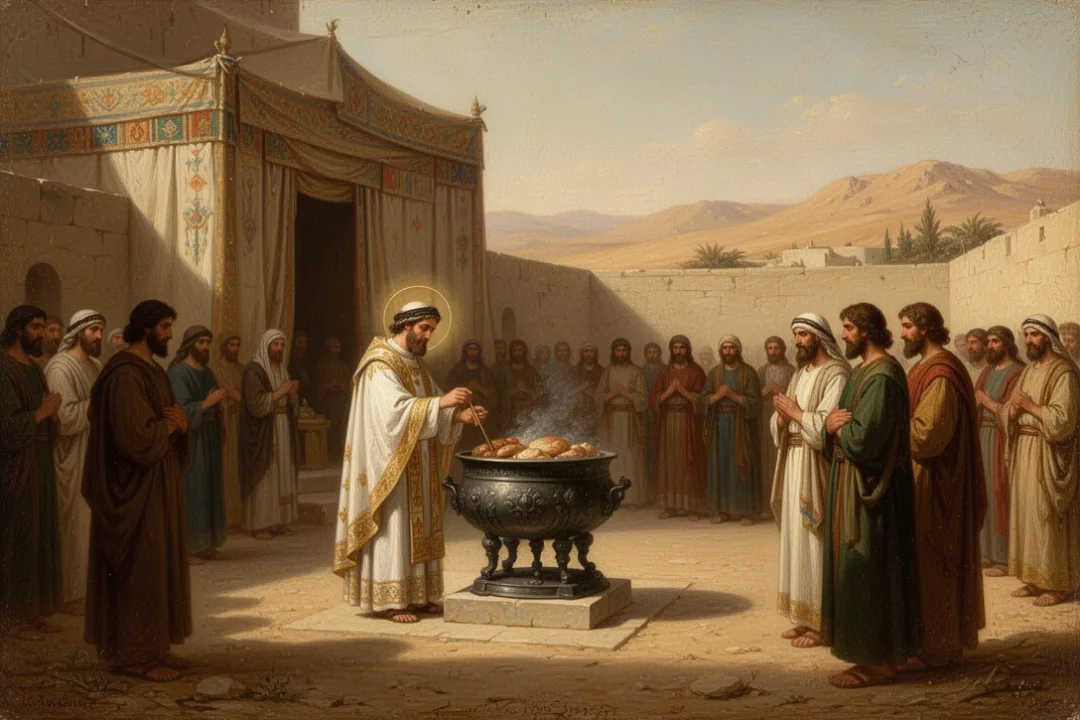
The burnt offering, described in Leviticus 1, was wholly offered on the altar. Its complete consumption communicated surrender and dedication to God. The worshiper brought an animal that met the required conditions, and the ritual included the presentation of blood and the burning of the offering.
The passage also allows different animals according to a worshiper’s means. That detail shows that participation in worship was not limited to the wealthy. The form of the offering varied, while the act of approaching God remained available within the covenant system.
The grain offering expresses tribute and gratitude
Leviticus 2 describes the grain offering, made from fine flour, oil, and incense. Part was burned on the altar, while the remainder belonged to the priests. It could accompany animal sacrifices and represented the presentation of the fruits of human work.
Because grain was a basic source of food, this offering connected worship with daily provision. Israel’s worship was not limited to dramatic moments; ordinary harvest and labor could be brought before God as gifts of gratitude.
The fellowship offering celebrates shared peace
The fellowship offering, or peace offering, appears in Leviticus 3 and 7. Unlike the whole burnt offering, some of the meat could be eaten by the worshiper and others who participated in the meal. The ritual created a shared celebration in God’s presence.
This offering shows that biblical worship includes communion and joyful fellowship, not only confession. Meals can reinforce peace between people and remind a community that its blessings come from God.
The sin offering addresses impurity and wrongdoing
Leviticus 4–5 describes offerings often called sin offerings. These dealt with certain unintentional sins and ritual impurities. The required offering could differ depending on the person’s status, including provisions for those with fewer resources.
The text distinguishes between deliberate rebellion and offenses committed unintentionally. That distinction does not make unintentional wrongdoing meaningless. It recognizes that harm and impurity can affect the community even when a person did not openly defy God.
The guilt offering includes restitution
The guilt offering, explained in Leviticus 5–6, is associated with particular offenses against sacred things or other people. In cases involving loss or damage, the worshiper was required to repay what was owed and add an additional amount.
This is a significant moral principle: worship cannot be separated from repairing harm. A religious ritual did not erase the responsibility to make restitution. Confession, sacrifice, and practical restoration belonged together.
What priests do in Leviticus
Leviticus 8–10 focuses on the ordination and duties of Aaron and his sons. The priests serve as representatives of the people and caretakers of the sanctuary. They handle offerings, teach distinctions between holy and ordinary things, and help Israel maintain proper worship.
Priestly service requires both skill and reverence. The priests are not free to improvise sacred rituals according to personal preference. The account of Nadab and Abihu in Leviticus 10 shows the seriousness with which the book treats unauthorized worship, although readers should avoid using this episode to justify fear-based control in religious settings.
Leviticus also presents priests as teachers. They help the people distinguish between clean and unclean, holy and common. Their work is therefore not only ceremonial. It includes instruction, discernment, and responsibility for the spiritual health of the community.
The priestly role also has limits. Aaron and his family serve within a system established by God; they do not become independent owners of sacred power. The regulations place boundaries around their conduct, their access to holy spaces, and their treatment of offerings.
Clean and unclean in Leviticus 11–15
Leviticus 11–15 contains laws about animals, childbirth, skin conditions, mildew, bodily discharges, and cleansing rituals. These chapters are often misunderstood because modern readers may hear “unclean” as a synonym for “immoral.” In Leviticus, ritual uncleanness is not always personal sin.
A person could become unclean through natural bodily processes such as childbirth or menstruation. Contact with a corpse and certain skin conditions could also affect ritual status. These conditions did not necessarily mean that the person had committed a moral offense.
Ritual impurity restricted access to sacred space for a time and required an appropriate process of cleansing. The system taught Israel to recognize boundaries surrounding God’s sanctuary. It also gave the community a vocabulary for conditions that affected worship and social participation.
Some purity laws concern food and animals, while others concern the body and the home. The repeated concern is that the sanctuary and the community must not be treated as ordinary. The rituals provided a structured way for people to return to participation after a period of impurity.
Readers should resist two opposite mistakes. One mistake is to dismiss these laws as meaningless superstition. The other is to assume that every ancient category maps directly onto modern medical or moral categories. The text should first be understood within Israel’s covenant worship before applications are considered.
Why the Day of Atonement is central to Leviticus
Leviticus 16 describes the Day of Atonement, a major annual ceremony for cleansing the sanctuary, the priests, and the people. The high priest enters the Most Holy Place according to carefully defined instructions and presents offerings for the community’s sins and impurities.
The ritual includes two goats. One is sacrificed, while the other is sent away into the wilderness after the people’s sins are symbolically placed upon it. The ceremony communicates that sin is addressed both through purification and through removal from the community’s relationship with God.
The Day of Atonement also reveals that Israel’s problem is larger than individual mistakes. The sanctuary itself requires cleansing because the people’s sins and impurities have affected the place where God dwells. Atonement therefore concerns the restoration of the entire covenant relationship.
For Christian readers, Leviticus 16 is especially important when studying Hebrews and the New Testament’s interpretation of Jesus’ death. Christians differ in how they explain the details of atonement, but the shared connection is clear: later Christian writers use Leviticus’ priestly and sacrificial categories to explain Christ’s saving work.
Study question: Ask what each ritual restores. Does it restore a person’s access to worship, repair a wrong, cleanse the sanctuary, renew fellowship, or mark dedication to God?
How Leviticus defines holiness in everyday life
Leviticus 17–27 is often called the Holiness Code because it develops the command for Israel to be holy. Holiness is not restricted to priests or sanctuary ceremonies. It shapes sexual ethics, family relationships, treatment of workers, honesty in business, care for the poor, and respect for God’s name.
Leviticus 19 is especially important for understanding this connection. It brings together commands about honoring parents, keeping the Sabbath, rejecting idols, leaving portions of harvest for poor people and foreigners, refusing theft and deception, paying workers promptly, and treating neighbors fairly.
The command to love one’s neighbor in Leviticus 19:18 is not presented as a vague feeling. It is connected with concrete behavior, including refusing revenge, avoiding slander, correcting wrongdoing responsibly, and not exploiting others. Holiness becomes visible through fairness, restraint, generosity, and truthful speech.
Leviticus also includes strong concern for the resident foreigner. The people are instructed to treat the foreigner among them as a neighbor and to remember their own history as vulnerable outsiders in Egypt. That connection between memory and ethics remains one of the book’s clearest moral insights.
Land, debt, and economic justice in Leviticus 25
Leviticus 25 describes Sabbath years and the Jubilee. The land is to receive a period of rest, and Israel is reminded that the land ultimately belongs to God. This challenges the idea that people possess land with absolute, unrestricted control.
The Jubilee regulations address the loss of family land and the enslavement of impoverished Israelites. They seek to prevent economic collapse from becoming permanently inherited. The exact historical operation of these laws is debated, but their social vision is clear: poverty should not become an endless system of domination.
These commands also place limits on accumulation. Economic life is accountable to God, and a community must consider what happens when some members lose property, security, or freedom. Leviticus therefore belongs in conversations about justice as well as worship.
When applying these principles today, avoid claiming that a modern economic program is identical to the Jubilee. Instead, ask what values the text establishes: debt should not erase human dignity, land and resources carry social responsibilities, and the vulnerable should not be treated as disposable.
How to study difficult laws without ignoring context
Some passages in Leviticus raise difficult questions about sexuality, punishment, food, disability, sacrifice, and the treatment of outsiders. A responsible study does not hide these passages, but neither does it isolate one sentence from the covenant and literary setting.
Begin by identifying who is addressed, what problem the command addresses, and where the command sits in the structure of the book. Ask whether the passage concerns ritual status, moral conduct, priestly office, civil penalties, or a particular sanctuary practice.
Then compare related passages in the Pentateuch and later biblical writings. The Bible itself develops, repeats, adapts, and interprets laws in different settings. A careful reader can acknowledge genuine tension without forcing every passage into a simplistic answer.
For Christians, another question is how Jesus and the apostles interpret Israel’s laws. New Testament passages such as Mark 7, Acts 10, Romans 14, Galatians 3, and Hebrews use different arguments and address different issues. They should not be blended into one general claim that “the Old Testament law no longer matters.”
A practical method for a Leviticus Bible study
A chapter-by-chapter reading works best when you track repeated words and movements. Keep a notebook with four columns: ritual action, stated purpose, people affected, and theological theme. This turns unfamiliar details into observations you can revisit.
Read the whole passage first. Notice repetitions, changes in speaker, and references to the tent, altar, priests, blood, cleansing, or holiness.
Mark the participants. Identify the worshiper, priest, high priest, congregation, foreigner, poor person, or family member involved.
Ask what is being restored. Determine whether the ritual addresses guilt, impurity, fellowship, dedication, justice, or access to sacred space.
Connect the passage to its neighbors. Leviticus often places related instructions together, such as offerings followed by priestly duties.
Compare translations carefully. Terms such as clean, unclean, sin, guilt, atonement, and holiness can carry broader meanings than everyday English suggests.
Apply the principle with restraint. Move from the ancient setting to a modern value without pretending that every ritual has a direct modern equivalent.
Common mistakes to avoid when reading Leviticus
Reading it without Exodus: The tabernacle and God’s dwelling are essential background.
Calling every regulation a moral command: Some laws concern ritual status, priestly procedure, or sanctuary boundaries.
Assuming unclean means sinful: Childbirth, illness, and bodily processes could create ritual impurity without moral blame.
Reducing sacrifice to punishment: Offerings also express dedication, gratitude, fellowship, purification, and restitution.
Ignoring economic justice: Holiness includes honest wages, fair treatment, generosity, and protection for vulnerable people.
Applying laws without identifying the covenant: Israel’s national and sanctuary regulations should not be transferred mechanically to another society.
Skipping hard passages: Difficult texts require more context and humility, not selective reading.
Forcing a Christian interpretation too early: Study what Leviticus meant in its own setting before tracing later connections to Christ.
Questions to ask during group discussion
Leviticus works well in a study group when discussion moves beyond whether a rule feels strange. The goal is to observe the text, understand its world, and consider its theological and ethical implications.
What does this passage say about God’s presence among the people?
Who is responsible for carrying out the command, and who benefits from it?
What distinction does the passage make between holy and common, clean and unclean, or faithful and unfaithful?
How does the command protect worshipers, priests, families, workers, foreigners, or the poor?
What does the passage reveal about confession, forgiveness, restitution, or restored fellowship?
How do later biblical books use or reinterpret this passage?
What modern application follows from the text’s principle rather than merely copying its ancient form?
A group should also make room for uncertainty. Some Hebrew terms and ritual details are difficult, and responsible study resources do not always agree. Disagreement can be productive when participants distinguish what the text clearly says from what they are inferring.
Major themes to carry through the book
God’s presence explains the urgency of Leviticus. The sanctuary is not simply a religious building; it represents God dwelling among Israel. The regulations protect and sustain that relationship.
Atonement describes the repair and cleansing of what sin and impurity have damaged. The book portrays forgiveness as costly, ordered, and connected with restored access to God and community.
Holiness joins worship with ethics. Israel is called to reflect God’s distinct character through both ritual obedience and treatment of other people.
Community responsibility appears throughout the book. Individual actions affect families, worship, land, and the wider nation. Leviticus does not imagine spirituality as a private matter detached from public life.
Limits and mercy exist together. The laws establish firm boundaries, yet they also provide paths for cleansing, restoration, forgiveness, and renewed participation. The book’s strictness should be read alongside its concern for access, repair, and communal stability.
As you study, return to these themes rather than trying to remember every ritual detail equally. Leviticus becomes clearer when each chapter is read as part of a sustained answer to one question: how can a covenant community live near a holy God while receiving forgiveness and practicing holiness?
Frequently asked questions
Why is Leviticus so difficult to understand?
Leviticus assumes familiarity with the tabernacle, ancient sacrifice, priestly duties, and Israel’s covenant identity. Its vocabulary also uses “clean” and “unclean” in ways that do not always match modern ideas of morality or hygiene. Reading Exodus first, tracking repeated themes, and separating ritual impurity from deliberate sin makes the book much easier to follow.
Do Christians still need to obey the laws in Leviticus?
Christians differ in how they relate specific Old Testament laws to Christian practice. Many understand the sacrificial and ceremonial system through the life, death, and resurrection of Jesus, while continuing to learn from Leviticus’ teachings about holiness, justice, worship, and care for the vulnerable. The New Testament’s own interpretations should guide Christian application rather than simple one-to-one copying.
What is the most important chapter in Leviticus?
No single chapter contains the whole message, but Leviticus 16 is central because it explains the Day of Atonement and the cleansing of the sanctuary and people. Leviticus 19 is also especially significant because it connects holiness with practical ethics, including honesty, neighbor-love, generosity, and fair treatment of foreigners and workers.
How long should a Leviticus Bible study take?
A focused personal reading can be completed in several sessions, but a thoughtful group study may take four to eight weeks. One useful plan covers offerings, priesthood, purity, the Day of Atonement, holiness laws, festivals, land regulations, and covenant warnings in separate meetings. Allow extra time for difficult passages and cross-references.











Leave a Reply