Leviticus in the Bible: Meaning, themes, and how to read it
Leviticus in the Bible: Meaning, themes, and how to read it
When you open the Bible and reach Leviticus, you may wonder why the book spends so much time on sacrifices, skin diseases, priests, and food rules. The short answer is that Leviticus explains how ancient Israel was to live near the presence of a holy God. Its laws shaped worship, community life, moral conduct, and religious identity.
Leviticus is the third book of the Bible and the third book of the Pentateuch, the first five books traditionally associated with Moses. It follows Exodus, where God delivers Israel from Egypt and establishes the tabernacle. Leviticus then addresses a practical question: How can a sinful people worship and live with a holy God?
Leviticus focuses on holiness, meaning being set apart for God and living in a way that reflects that relationship. The book is not simply a random collection of ancient regulations. Its instructions form a system for worship, purity, justice, priestly service, sacred time, and life together.
The name “Leviticus” comes through the Greek tradition and relates to the Levites, the Israelite tribe connected with religious service. The book itself gives special attention to the priests, who came from the family of Aaron, but its laws address the whole community. Many passages begin by addressing the Israelites generally, while others speak specifically to priests.
Leviticus contains 27 chapters. Much of it consists of laws and ritual instructions, but those laws are framed by a larger story. God has rescued Israel, entered into a covenant with the people, and made his presence known among them. The book teaches that this relationship affects every part of life.
Central idea: Leviticus teaches that approaching God requires reverence, atonement, purity, and faithful living, while also showing that holiness must shape how people treat one another.
How Leviticus fits into the first five books of the Bible
Leviticus makes more sense when you read it alongside Genesis and Exodus. Genesis introduces creation, human rebellion, the patriarchs, and God’s promises to Abraham’s family. Exodus tells how God brings that family out of slavery, forms them into a people, gives them covenant commands, and establishes the tabernacle.
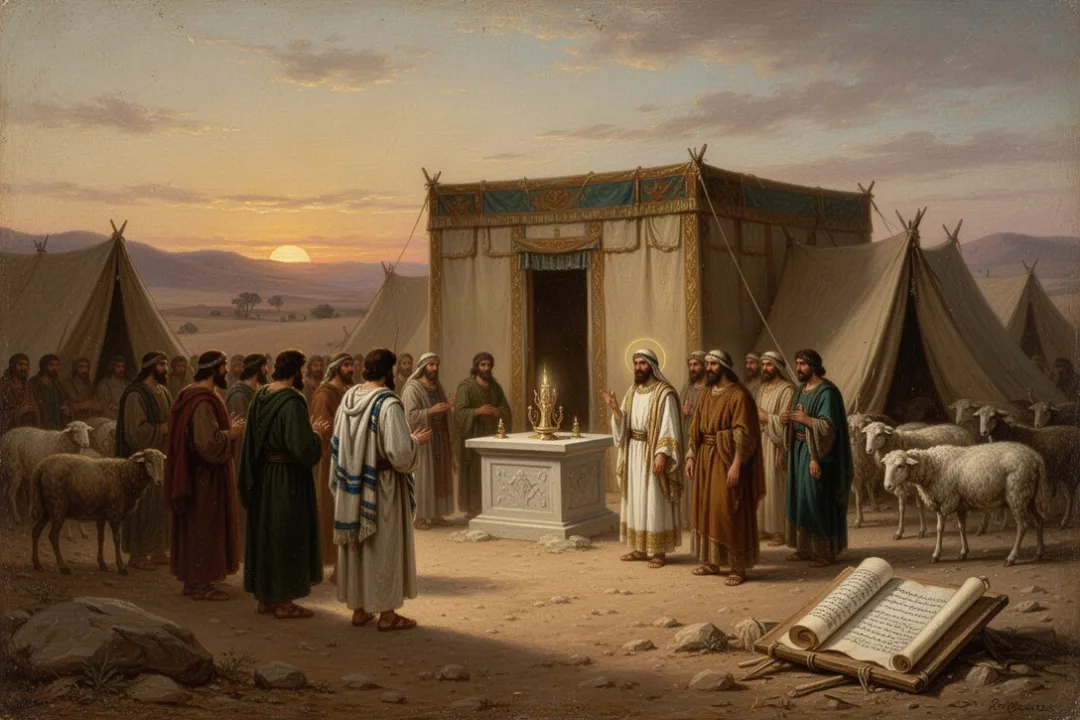
Leviticus stands between the construction of the tabernacle and Israel’s later journey through the wilderness in Numbers. The tabernacle represents God’s dwelling among Israel. That presence is a blessing, but it also creates a problem: God is holy, while human beings and the community are capable of sin and impurity.
The book of Numbers continues the wilderness story, including Israel’s travel and repeated failures. Deuteronomy later presents Moses’ teaching to the next generation before they enter the promised land. Leviticus supplies the worship and holiness framework that connects the rescue from Egypt with life as God’s covenant people.
A step-by-step guide to reading Leviticus
You do not need to treat every chapter as if it answers the same question. A useful reading plan is to identify the subject of each major section and then ask how it contributes to the book’s central concern.
Begin with the setting: Israel is gathered at Mount Sinai, and the tabernacle has been established as the place associated with God’s presence.
Identify the kind of instruction: Ask whether a passage concerns offerings, priests, purity, morality, sacred time, or life in the land.
Notice the repeated purpose: Many laws protect the holiness of worship and the well-being of the community.
Read individual commands in context: A food regulation, a priestly requirement, and a command against exploitation do not serve exactly the same function.
Follow the movement toward holiness: The book begins with access to God through offerings and ends with covenant faithfulness, blessings, warnings, and vows.
Connect Leviticus with the rest of the Bible: Later prophets, Jesus, and the New Testament writers refer to sacrifice, priesthood, purity, atonement, and holiness in ways that build on this book.
It also helps to separate description from application. Leviticus describes the worship system given to ancient Israel. Readers today may draw theological and moral lessons from it, but they should not assume that every regulation applies directly in the same form to modern life.
What the five main sections of Leviticus cover
The book’s structure gives you a reliable map. Some passages overlap in theme, but these sections show how the material develops.
Chapters 1–7: offerings and sacrifices
Chapters 8–10: the ordination of Aaron and his sons, followed by a serious priestly failure
Chapters 11–15: clean and unclean animals, bodily conditions, and purification
Chapter 16: the Day of Atonement
Chapters 17–26: the holiness code, including worship, sexual conduct, justice, festivals, sabbatical years, and the covenant
Chapter 27: vows and things dedicated to God
This outline prevents a common mistake: reading Leviticus only as a book about animal sacrifice. Sacrifice is foundational, but the book also addresses economic behavior, family relationships, worship practices, treatment of workers, care for the poor, and the use of land.
Why the sacrifices in Leviticus matter
The opening chapters describe several offerings. These include burnt offerings, grain offerings, well-being or fellowship offerings, purification offerings, and reparation offerings. The names and details differ by translation, and the functions are not identical.
A burnt offering involved an animal being entirely offered on the altar and could express dedication or atonement. A grain offering consisted of produce from the harvest. A fellowship offering was associated with shared communion and thanksgiving. Purification and reparation offerings addressed wrongdoing, ritual impurity, or damage requiring restoration, depending on the situation.
The sacrifices show that worship in Leviticus is not casual or merely private. The worshiper brings an appropriate offering, priests carry out the ritual, and blood has a central role in the altar service. In the book’s symbolism, blood represents life and is connected with atonement. Leviticus 17:11 explains this relationship; the verse should be read as a theological statement within Israel’s sacrificial system, not as a general scientific claim.
The offerings also reveal that sin can affect more than a person’s private feelings. Wrongdoing can damage relationships, defile sacred space, create obligations, and require restitution. Leviticus therefore connects forgiveness with responsibility. In cases involving property or fraud, making things right is part of the response.
Reading tip: Do not reduce every sacrifice to one simple meaning. Leviticus presents different offerings for different circumstances, including dedication, thanksgiving, purification, atonement, and reparation.
What priests do in Leviticus
Priests serve as mediators within Israel’s worship system. They present offerings, maintain the altar, teach distinctions between holy and ordinary things, and inspect certain conditions involving skin, clothing, or buildings. Their work requires both ritual competence and personal discipline.
Chapters 8 and 9 describe the ordination of Aaron and his sons. These ceremonies mark them as people dedicated to priestly service. The rituals include washing, special clothing, anointing, sacrifices, and the application of blood in ceremonial ways. Their office is not presented as a personal privilege alone; it carries responsibility for the worship of the entire community.
Chapter 10 tells of Nadab and Abihu, two sons of Aaron, who offer unauthorized fire before God and die. The passage is difficult, but its message within the book is clear: holy service is not to be treated carelessly. Priests must distinguish between what is holy and what is common, and they must teach the people those distinctions.
Leviticus does not portray priests as beyond accountability. Their position brings greater obligations. The detailed rules for priestly conduct, bodily conditions, mourning, marriage, and offerings underline the seriousness of representing the community before God.
Clean and unclean in Leviticus
The words clean and unclean in Leviticus often refer to ritual status, not automatically to moral goodness or personal wickedness. A person could become unclean through childbirth, contact with a corpse, a bodily discharge, or a skin condition. These states could be temporary and could end through waiting, washing, offerings, or examination by a priest.
Food laws in chapter 11 distinguish animals that Israelites could eat from those they could not. The chapter discusses land animals, water creatures, birds, and small creatures. The specific classifications belong to Israel’s covenant life and helped shape the community’s identity.
Chapters 12–15 address childbirth, skin conditions, mildew-like problems in clothing or houses, and bodily discharges. Some translations use the term “leprosy” for certain conditions, but the ancient categories do not map neatly onto modern medical diagnoses. A priest’s examination functioned as a religious and community determination of status, not as modern clinical treatment.
Ritual impurity did not always mean that someone had committed a sin. It often described an unsuitable state for entering sacred space or participating in particular forms of worship. This distinction matters because it keeps readers from equating every mention of uncleanness with moral condemnation.
Why the Day of Atonement is central
Leviticus 16 describes the Day of Atonement, often called Yom Kippur. This annual ceremony addresses the impurities and sins associated with the people, the sanctuary, and the priesthood. It is the most elaborate ritual in the book and serves as a focal point for understanding atonement.
On this day, the high priest performs special rites that include sacrifices and entry into the innermost sacred area. He first deals with his own sin and then with the sin of the community. Two male goats are central to the ceremony: one is sacrificed, while the other is symbolically associated with the people’s wrongdoing and sent away into the wilderness.
The familiar English word scapegoat comes from the translation tradition surrounding this passage. In Leviticus, the ritual portrays the removal of Israel’s sins from the community. It is not a license to blame a random person for social problems; it belongs to a formal act of worship directed by the high priest.
The Day of Atonement shows that reconciliation is not limited to individual confession. The whole community needs cleansing, and the sanctuary itself must be addressed because Israel’s sin affects the place associated with God’s presence. Leviticus presents atonement as both forgiveness and restoration of sacred order.
What “Be holy” means in Leviticus
Leviticus 19 contains one of the book’s most important commands: Israel is to be holy because God is holy. Holiness here is not limited to ceremonies. It includes honest business practices, respect for parents, care for the poor, fair treatment of workers, rejection of revenge, and love for one’s neighbor.
Leviticus 19:18 is especially significant because it commands Israelites to love their neighbors as themselves. In its immediate setting, the command addresses resentment, retaliation, and the treatment of fellow members of the community. Jesus later cites this command alongside love for God, and other New Testament writers treat it as a central expression of faithful living.
Leviticus also commands landowners to leave part of their harvest for poor people and immigrants to gather. This practice, often called gleaning, builds economic care into agricultural life. The poor are not described as objects of occasional charity only; the community’s harvesting system is designed to provide access to food.
Other instructions prohibit dishonest scales, exploitation of workers, false testimony, and withholding wages. These laws show that holiness includes economic integrity. Worship cannot be separated from the way people handle money, labor, property, and power.
Sexual ethics and community boundaries in Leviticus
Leviticus 18 and 20 contain laws concerning sexual relationships, marriage boundaries, adultery, incest, and practices associated with neighboring peoples. The passages are among the most discussed and debated parts of the book, both within religious communities and in wider public conversations.
These chapters need to be read in their ancient covenant setting. They define Israel’s communal boundaries and contrast Israel’s conduct with practices attributed to the surrounding nations. They also connect sexual behavior with the holiness of the land and the identity of the people.
Readers should avoid treating the passages as isolated slogans. Questions about translation, ancient social structures, the meaning of specific Hebrew terms, and the relationship between Israel’s covenant law and later Christian teaching all require careful study. At the same time, the broad concern is plain: Leviticus treats sexual behavior as morally significant and calls the community to standards that protect covenant identity and family relationships.
Why Leviticus includes festivals and sacred time
Leviticus 23 lists Israel’s appointed festivals. These include the Sabbath, Passover and Unleavened Bread, the Feast of Weeks, the Feast of Trumpets, the Day of Atonement, and the Feast of Booths. Each festival marks a distinct part of Israel’s worship and memory.
Sacred time teaches that the people’s calendar belongs to God. The Sabbath interrupts ordinary labor, while the annual festivals connect worship with deliverance from Egypt, harvest, repentance, and God’s provision. Worship is therefore organized not only around a place but also around rhythms of rest and remembrance.
The chapter also repeats concern for the poor by linking harvest practices with the command not to gather every last portion of the field. Religious celebration does not cancel social responsibility. The festival calendar joins public worship, historical memory, agricultural life, and generosity.
What the Sabbath and Jubilee laws teach
Leviticus 25 expands the idea of Sabbath from one day each week to the land itself. Every seventh year, the land is to receive a Sabbath rest. Israel is told not to treat the soil as an unlimited resource under ordinary agricultural control.
The chapter then describes the Jubilee, a special period associated with the restoration of ancestral land and the release of certain forms of economic bondage. The text presents the land as belonging ultimately to God, while Israel lives on it as resident dependents rather than absolute owners.
These laws challenge permanent accumulation of land and people’s reduction to economic assets. They recognize that poverty, debt, and loss of land can distort a community over time. The Jubilee principle expresses a vision of economic restraint, social restoration, and God’s ownership.
Interpreters disagree about how fully these laws were practiced in Israel’s history and how they should be applied today. Even so, their ethical direction is difficult to miss: land, labor, debt, and wealth are not outside the concerns of worship.
How Leviticus relates to Christians and the New Testament
Christians read Leviticus as part of the Bible’s larger story, but Christian traditions differ on how its laws apply after the life, death, and resurrection of Jesus. The New Testament presents Jesus in relation to sacrifice, priesthood, purity, covenant, and atonement. Hebrews, for example, reflects extensively on the tabernacle and sacrificial system while presenting Jesus’ work as unique and definitive.
The Gospels also show Jesus engaging questions about purity, Sabbath, healing, food, and holiness. His actions do not treat holiness as unimportant. Instead, they challenge interpretations that use religious boundaries to neglect mercy, while calling people to an even deeper purity of heart and conduct.
Many Christians distinguish among moral laws, ceremonial laws, and civil laws, though the Bible itself does not always label them in those categories. Some Christian traditions emphasize that Christ fulfills the sacrificial and priestly system; others maintain different views about specific commandments. Responsible reading recognizes both the continuity of biblical holiness and the changes introduced by the new covenant.
Leviticus should not be used to attack Jewish practice or suggest that Judaism is merely an obsolete religion. Leviticus remains part of the Hebrew Bible and Jewish Scripture, and Jewish interpretation has developed rich ways of understanding its laws, worship, ethics, and holiness.
Common mistakes when reading Leviticus
Several assumptions can make the book harder to understand than it needs to be. Correcting them creates a more accurate and respectful reading.
<strong“Moral and ritual” are not always opposites: Leviticus separates categories for particular purposes, but its ritual laws often communicate theological and communal values.
Unclean does not always mean sinful: Many forms of ritual impurity are temporary conditions rather than evidence of wrongdoing.
The sacrifices are not merely payments: They express worship, dedication, thanksgiving, purification, atonement, and restored relationships in different ways.
The book is not only about priests: Its laws address the entire nation, including farmers, workers, families, immigrants, creditors, and the poor.
Ancient medical language needs care: Terms translated as skin disease or leprosy should not automatically be identified with modern illnesses.
Modern readers should not isolate individual verses: A command gains meaning from the surrounding covenant, worship system, literary section, and biblical context.
Practical questions to ask while reading Leviticus
A careful reader can gain more from Leviticus by asking focused questions rather than trying to make immediate modern parallels. Keep a short list beside you as you read.
What problem does this instruction address: guilt, impurity, worship, exploitation, conflict, or community identity?
Who is responsible for carrying it out: the individual worshiper, a priest, a family, a landowner, or the whole community?
Does the passage describe a repeated daily practice, an annual ceremony, or an exceptional event?
What does the command reveal about God’s holiness and presence?
Does the passage protect vulnerable people or regulate power?
How does the passage connect with Exodus, Numbers, the prophets, the Gospels, or the New Testament letters?
It is also useful to read Leviticus aloud in sections rather than forcing yourself through a long uninterrupted sitting. Chapters 1–7 can be read as a unit about offerings, chapters 8–10 as a narrative about priestly service, and chapters 17–26 as a sustained teaching section about holiness.
Why Leviticus still matters
Leviticus matters because it refuses to separate spiritual life from ordinary conduct. It places worship beside wages, sacrifices beside harvests, priestly service beside treatment of strangers, and sacred festivals beside rest for workers and land.
The book also gives language for thinking about atonement, access to God, communal responsibility, ethical holiness, and limits on power. Even readers who do not practice Israel’s ancient sacrificial system can see how seriously Leviticus treats guilt, restoration, justice, and the consequences of human behavior.
Its central challenge is not simply to memorize old regulations. It is to recognize that a relationship with God, in the biblical account, creates a distinct way of worship and a distinct way of living. Leviticus asks readers to consider how reverence, mercy, integrity, responsibility, and care for others belong together.
Where to begin if Leviticus feels difficult
If the book feels unfamiliar, start with Leviticus 19 for its connection between holiness and neighborly conduct. Then read Leviticus 16 to understand the Day of Atonement, followed by chapters 1–7 for the offerings. Reading Exodus 25–40 first can also clarify why the tabernacle and priesthood occupy so much attention.
Use a reliable study Bible or commentary when a passage involves ancient ritual terms, measurements, bodily conditions, or difficult translations. Compare several translations, but remember that translation differences do not erase the need for historical and literary context.
Leviticus becomes more coherent when you read it as a book about God’s presence and Israel’s response. Its sacrifices, purity laws, festivals, justice commands, and priestly instructions all contribute to that question: how can a community live faithfully in the presence of a holy God?
Frequently asked questions
Why is Leviticus so difficult for many Bible readers?
Leviticus uses ancient sacrificial, priestly, agricultural, and purity categories that are unfamiliar to most modern readers. Its detailed instructions also assume knowledge of the tabernacle and Israel’s covenant setting. Reading it alongside Exodus, using section headings, and distinguishing ritual status from moral guilt can make the book much easier to follow.
Are Christians required to obey the laws in Leviticus?
Christian traditions answer this differently, but most understand the sacrificial and priestly laws through the New Testament’s teaching about Jesus and the new covenant. Christians generally continue to study Leviticus for its theology and ethical principles without treating every ancient regulation as a direct modern requirement.
What is the most important chapter in Leviticus?
No single chapter explains everything, but Leviticus 19 is especially significant because it connects holiness with honesty, compassion, justice, neighborly love, and care for vulnerable people. Leviticus 16 is central for understanding atonement, while chapters 1–7 explain the major offerings that shape the book’s worship system.
Does Leviticus only focus on religious rituals?
No. Ritual worship is a major subject, but Leviticus also addresses labor, land, debt, food, sexual conduct, economic honesty, treatment of immigrants, care for the poor, festivals, and rest. Its broad message is that holiness affects both how people approach God and how they live with one another.










Leave a Reply