Nebuchadnezzar II: Babylon’s greatest king explained
Nebuchadnezzar II: Babylon’s greatest king explained
Nebuchadnezzar II was the longest-reigning and most influential king of the Neo-Babylonian Empire. From approximately 605 to 562 BCE, he expanded Babylonian power across the ancient Near East and transformed Babylon into a monumental capital.
His reputation comes from several overlapping traditions. Ancient Babylonian records present him as a successful ruler, military commander, builder, and devoted worshiper of the god Marduk. The Hebrew Bible remembers him primarily through the conquest of Jerusalem, the destruction of the First Temple, and the exile of Judean elites. Greek and Roman writers later associated his reign with Babylon’s extraordinary monuments, including the Ishtar Gate and, possibly, the Hanging Gardens.
Nebuchadnezzar II ruled during the Neo-Babylonian period, also called the Chaldean Dynasty by some ancient and modern writers. His reign followed the collapse of Assyrian dominance in Mesopotamia. Babylon, rather than Assyria, became the main imperial power in the region.
His father, Nabopolassar, founded the Neo-Babylonian Empire after leading a revolt against Assyria. With support from the Medes, Nabopolassar helped destroy the Assyrian capital Nineveh in 612 BCE. Nebuchadnezzar served as crown prince and military commander during the final campaigns against Assyria.
In 605 BCE, Nebuchadnezzar commanded Babylonian forces at the Battle of Carchemish, where they defeated an Egyptian-led army. This victory helped establish Babylonian control over much of Syria and the Levant. When Nabopolassar died later that year, Nebuchadnezzar returned to Babylon and became king.
The dates of ancient events are sometimes reconstructed from several kinds of evidence, including royal inscriptions, later historical accounts, astronomical observations, and biblical records. His reign is generally placed from 605 to 562 BCE, making it one of the best-documented periods in ancient Babylonian history.
The central fact: Nebuchadnezzar was not only a biblical figure. He was a historically attested emperor whose building projects, military campaigns, and administrative records shaped the final major phase of Babylonian power.
How Nebuchadnezzar II expanded the Babylonian Empire
Nebuchadnezzar inherited an empire that was still consolidating its authority. The territories west of Mesopotamia had changed hands repeatedly among Assyria, Egypt, and Babylon. His early reign therefore involved both military campaigns and efforts to make Babylonian rule durable.
After Carchemish, Babylonian influence extended through Syria and toward the eastern Mediterranean coast. Local rulers sometimes accepted Babylonian authority, while others rebelled or sought assistance from Egypt. Nebuchadnezzar responded with campaigns designed to restore control over strategic cities and trade routes.
Jerusalem came under Babylonian pressure more than once. The city was captured in 597 BCE, after which King Jehoiachin and other members of the ruling and skilled classes were taken to Babylon. Zedekiah was installed as king, but another revolt followed. Babylonian forces later besieged Jerusalem again, and the city fell in 587 or 586 BCE, depending on the chronological system used.
The second conquest brought the destruction of Jerusalem and its temple, along with another deportation. These events are described in biblical books such as 2 Kings and Jeremiah and are also consistent with the broader pattern of Neo-Babylonian imperial policy. Deportation was a common ancient strategy for weakening rebellion and relocating valuable labor.
Babylonian rule did not mean that every person in a conquered region was removed. Deportations usually targeted rulers, soldiers, craftsmen, administrators, and other groups considered politically important or economically useful. Many communities remained in their ancestral lands while living under imperial taxation and oversight.
Why Jerusalem mattered to Nebuchadnezzar’s empire
Jerusalem was strategically significant because it sat within the corridor linking Mesopotamia with Egypt. A rebellious kingdom there could threaten Babylonian communications and encourage other western territories to resist. The conflict was therefore part of a larger imperial struggle, not an isolated dispute.
For Judeans, however, the consequences were religious, political, and cultural. The destruction of the temple challenged the central institution of national worship, while exile disrupted the monarchy and the social order. Later Jewish traditions interpreted these events through questions of covenant, judgment, identity, and restoration.
The biblical book of Daniel places Nebuchadnezzar at the center of several dramatic stories, including dreams, royal pride, and a period of humiliation. These narratives are theological literature rather than straightforward court biographies. They should be read alongside, rather than simply equated with, Babylonian royal inscriptions.
What Babylon looked like under Nebuchadnezzar II
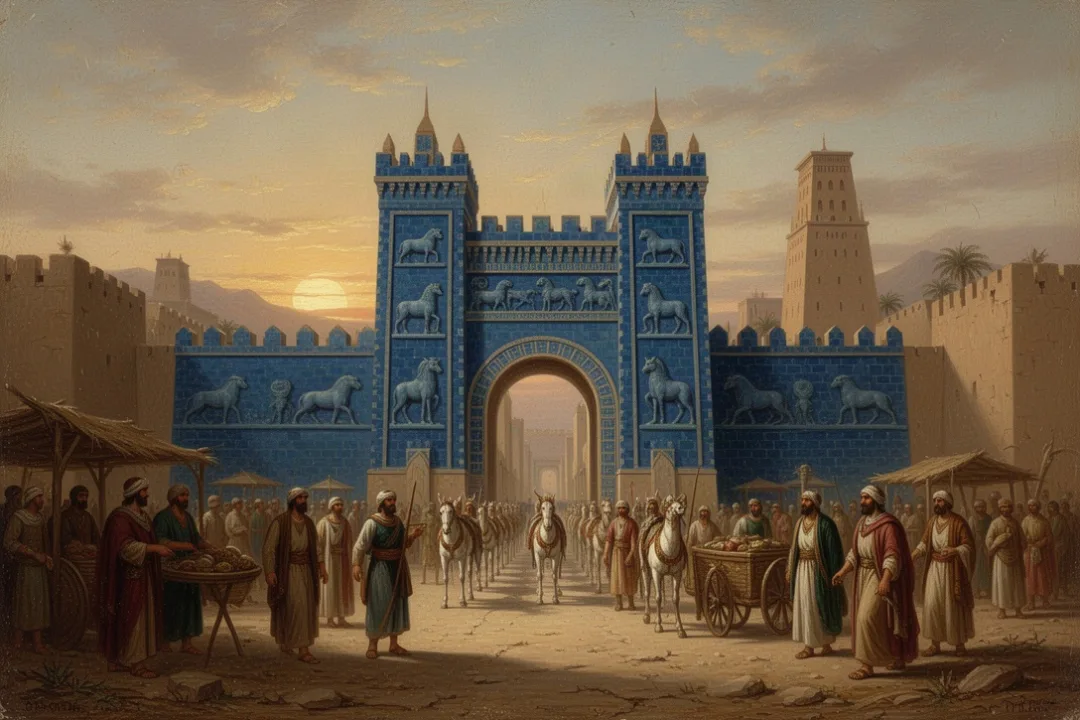
Nebuchadnezzar’s most visible achievement was the redevelopment of Babylon. Earlier rulers had already made the city important, but he expanded its walls, temples, streets, gates, and ceremonial spaces on a remarkable scale.
Babylon stood along the Euphrates River in southern Mesopotamia, in present-day Iraq. Its location supported agriculture, transport, and regional trade. The city was also a religious center, especially for the worship of Marduk, the chief god of Babylonian state religion.
Royal inscriptions repeatedly emphasize that Nebuchadnezzar repaired and enlarged the city for the honor of the gods and the welfare of its people. Such statements were also political messages. A king demonstrated legitimacy by restoring temples, maintaining canals, protecting walls, and presenting himself as the chosen guardian of divine order.
The city’s major features included a large defensive wall system, the processional way, the Ishtar Gate, and the temple complex known as the Esagila. The ziggurat associated with Marduk’s worship, called Etemenanki, dominated the religious landscape. Some scholars connect this structure with the biblical image of the Tower of Babel, although the biblical account is not a direct architectural description of the monument.
The Ishtar Gate and Babylon’s processional way
The Ishtar Gate was one of Babylon’s most recognizable entrances. It was decorated with glazed blue bricks and images of bulls and mušḫuššu dragons, animals associated with major deities. The gate formed part of a ceremonial route used during important religious festivals.
The colored bricks were more than decoration. They communicated royal wealth, technical skill, and divine protection. Visitors approaching the city would encounter a carefully staged sequence of walls, gates, images, and monumental buildings that presented Babylon as the center of an ordered universe.
A reconstructed section of the Ishtar Gate is displayed in the Pergamon Museum in Berlin. The reconstruction is based on excavated materials and archaeological research, but it should not be mistaken for the complete ancient gate in its original location.
Why Nebuchadnezzar built so extensively
Monumental construction served several purposes at once:
Religious purpose: Temples and processional spaces honored the gods and supported major rituals.
Political purpose: Large projects demonstrated the king’s authority and his ability to organize labor and resources.
Economic purpose: Construction supported workshops, transport networks, agricultural administration, and skilled employment.
Defensive purpose: Walls, gates, and controlled routes helped protect the capital.
Propaganda purpose: Inscriptions presented Nebuchadnezzar as the restorer and protector of Babylon.
Royal building inscriptions often use first-person language in which Nebuchadnezzar describes his work. They are valuable evidence, but they are not neutral reports. They emphasize success, devotion, and completion while saying little about the hardships faced by workers or communities supplying materials and labor.
Did Nebuchadnezzar II build the Hanging Gardens?
The Hanging Gardens are traditionally counted among the Seven Wonders of the Ancient World, and many popular accounts credit Nebuchadnezzar II with building them for a Median queen. The evidence is less secure than the tradition suggests.
No surviving Babylonian inscription clearly identifies a garden matching the later descriptions. Greek writers such as Berossus, as quoted by later authors, and Diodorus Siculus associated the gardens with Babylon, but their accounts were written after Nebuchadnezzar’s lifetime. Their descriptions may preserve genuine traditions, yet they cannot be confirmed in the same way as the Ishtar Gate or the city’s temples.
Archaeologists have proposed that the gardens may have stood in Babylon, perhaps near the royal palace, but their exact location remains uncertain. Another possibility is that later writers confused Babylon with Nineveh, where Assyrian kings created impressive irrigated gardens. Ancient royal gardens existed in both cities, so the broader idea is plausible even though the specific monument remains unverified.
Use careful wording: Nebuchadnezzar is traditionally associated with the Hanging Gardens, but historians cannot confirm that he built them. His documented Babylonian building projects are already extensive without treating the gardens as certain.
What Babylonian records reveal about Nebuchadnezzar
Most direct evidence about Nebuchadnezzar comes from cuneiform inscriptions written on clay cylinders, bricks, foundation deposits, and other objects. These texts often record the construction or restoration of temples, walls, gates, and canals.
His inscriptions frequently describe Marduk as the god who selected him to rule. Nebuchadnezzar presents himself as a careful builder who restored sacred places, used durable materials, and completed projects begun by earlier kings. The wording reflects Mesopotamian royal tradition, in which the king’s success depended on divine favor and proper care of the gods’ houses.
Administrative tablets provide a different perspective. They record rations, deliveries, contracts, and institutional transactions. One well-known group of texts mentions rations for foreign captives and high-status individuals living in Babylon. These records help historians understand how the empire managed displaced populations, although they do not describe every aspect of exile or daily life.
Babylonian sources also show that the empire depended on organized institutions rather than the king’s personal decisions alone. Temples managed land and labor, officials handled taxation and storage, and scribes preserved legal and economic transactions. Nebuchadnezzar stood at the top of this system, but governance required a large administrative network.
How biblical accounts portray Nebuchadnezzar II
The Hebrew Bible gives Nebuchadnezzar a complex role. He appears as the ruler who destroys Jerusalem and carries away its people, but he also becomes an instrument through which divine judgment is carried out against other nations. His power is presented as real but ultimately limited.
In the book of Jeremiah, Nebuchadnezzar is a major agent in the political upheavals of the region. The book of 2 Kings describes the fall of Jerusalem and the deportation of its population. The book of Daniel presents court stories in which Nebuchadnezzar receives dreams, confronts questions of human pride, and eventually recognizes a power greater than his own.
One famous Daniel story describes the king suffering a period of extraordinary humiliation before his reason and kingship are restored. Scholars debate how the narrative relates to historical events. Some have connected it loosely with a fragmentary text known as the Nabonidus prayer, which describes a Babylonian king experiencing an unusual period away from the capital. That text concerns Nabonidus, Nebuchadnezzar’s successor, so the identification is not certain.
The biblical portrayal should not be reduced to a simple claim that every detail is either a modern biography or pure invention. It is a theological interpretation of imperial history. It preserves memories of Babylonian power while using Nebuchadnezzar’s story to explore pride, judgment, sovereignty, and the vulnerability of kings.
What happened after Nebuchadnezzar’s death
Nebuchadnezzar died in 562 BCE after more than four decades on the throne. His death did not immediately destroy the empire, but the succession that followed was less stable and less durable.
His son Amel-Marduk ruled for a short time before being overthrown by his brother-in-law Neriglissar. Neriglissar also reigned briefly. He was followed by Labashi-Marduk, who was deposed after a very short reign. Nabonidus then became king and ruled until the Persian conquest.
This rapid succession contrasts with Nebuchadnezzar’s long reign and helps explain why later Babylonian authority weakened. The empire remained wealthy and influential, but court politics, regional pressures, and questions of succession reduced its political resilience.
In 539 BCE, the Persian king Cyrus II conquered Babylon. The conquest ended the Neo-Babylonian Empire as an independent imperial power. Babylon itself remained an important city under Persian rule, but Nebuchadnezzar’s dynasty no longer controlled it.
Common mistakes when learning about Nebuchadnezzar II
Nebuchadnezzar’s fame has produced many simplified claims. These distinctions make it easier to separate securely supported history from later interpretation.
Do not confuse Nebuchadnezzar II with Nebuchadnezzar I. Nebuchadnezzar I ruled centuries earlier and belonged to a different Babylonian dynasty.
Do not treat the Bible as his only source. Babylonian inscriptions, administrative tablets, archaeology, and later classical accounts also provide evidence.
Do not state that the Hanging Gardens are proven. Their traditional association with Nebuchadnezzar remains uncertain.
Do not assume every deported person was enslaved. Deportees could include elites, soldiers, craftsmen, and families placed in controlled communities with varying legal and economic conditions.
Do not describe Babylon as a purely fictional city. Archaeological remains and written records confirm its importance and large-scale construction.
Do not use one date for Jerusalem’s destruction without explanation. Many references give 587 or 586 BCE because ancient chronological systems are reconstructed in different ways.
Do not treat royal inscriptions as objective biographies. They are official statements designed to praise the king and his relationship with the gods.
Do not assume the biblical Daniel was written as a Babylonian archive. Its stories communicate religious teachings and should be interpreted within their literary and theological setting.
How to study Nebuchadnezzar II responsibly
A reliable approach begins by separating contemporary evidence from later accounts. Contemporary Babylonian texts are closest to his reign, but they usually focus on construction, worship, and administration. Biblical books preserve the perspective of communities affected by Babylonian conquest, while Greek and Roman writers transmit traditions from later centuries.
It also helps to ask what kind of evidence each source provides. A foundation cylinder can confirm a building project but cannot tell you how ordinary residents experienced the city. A biblical narrative can preserve the memory of conquest while presenting it through a theological argument. Archaeological remains can reveal urban planning, but their interpretation depends on excavation context and comparison with written records.
When comparing accounts, pay attention to three questions:
When was the source created? A text written during Nebuchadnezzar’s reign differs from one composed centuries later.
What was the source meant to do? A royal inscription, ration list, prophetic text, and later history have different purposes.
What can the evidence actually establish? A claim may be plausible without being proven, especially when archaeological remains are incomplete.
This method produces a more accurate picture of Nebuchadnezzar. He was a powerful imperial monarch, a major patron of Babylonian architecture, and the ruler responsible for devastating campaigns in the Levant. Those descriptions can all be true at the same time.
Why Nebuchadnezzar II still matters
Nebuchadnezzar matters because his reign connects several major themes in ancient history: the rise of empires, the movement of displaced peoples, the development of monumental cities, and the political use of religion and architecture.
His Babylon also illustrates how an ancient capital could function as more than a royal residence. It was a sacred center, administrative headquarters, economic hub, military stronghold, and carefully designed stage for imperial identity. The city’s walls and gates projected security, while its temples linked the king’s authority to the gods.
For the history of Judaism, the Babylonian conquest was a turning point. Exile forced Judean communities to preserve religious traditions without an independent kingdom or temple in Jerusalem. The experience influenced biblical interpretation, communal memory, and later ideas about restoration.
For the history of the ancient Near East, Nebuchadnezzar’s reign marks the height of Babylonian power before the Persian takeover. His empire was relatively short-lived, but the city and the ruler’s name survived through inscriptions, religious texts, classical histories, archaeological discoveries, and modern scholarship.
The most balanced view sees Nebuchadnezzar II neither as a legendary monster nor as a purely glamorous city builder. He was an effective and ambitious king whose victories and construction projects strengthened Babylon while imposing severe costs on conquered peoples. Understanding both sides is essential to understanding his historical importance.
Frequently asked questions
Was Nebuchadnezzar II a real historical person?
Yes. Nebuchadnezzar II is supported by Babylonian royal inscriptions, administrative tablets, archaeological evidence, and references in later historical and biblical writings. These sources identify him as the Neo-Babylonian king who ruled approximately from 605 to 562 BCE. They also document his building activity, religious patronage, and campaigns in the Levant, including the conquest of Jerusalem.
What was Nebuchadnezzar II famous for building?
He was famous for transforming Babylon through major construction projects, including walls, temples, ceremonial routes, and the Ishtar Gate. He also restored the Esagila temple complex and expanded other sacred and civic structures. The Hanging Gardens are traditionally attributed to him, but historians cannot confirm that he built them or even that they stood in Babylon.
Did Nebuchadnezzar II destroy Jerusalem?
Babylonian forces under Nebuchadnezzar captured Jerusalem twice. The first capture occurred in 597 BCE, followed by the deportation of King Jehoiachin and other prominent people. After a later revolt, Babylonian troops captured and destroyed the city in 587 or 586 BCE, dates that vary according to chronological reconstruction. The First Temple was destroyed during this second conquest.
How did Nebuchadnezzar II die?
The surviving evidence does not give a detailed account of his death. He died in Babylon in 562 BCE after a reign of more than forty years. His son Amel-Marduk succeeded him, but the dynasty soon experienced rapid changes in leadership. Babylon remained powerful for a time, yet the empire was eventually conquered by Cyrus II of Persia in 539 BCE.










Leave a Reply