Have you encountered the phrase “old lights and new lights” in a Masonic book, lodge discussion, or historical account and wondered whether it refers to candles, symbols, or teachings? In Freemasonry, the terms usually describe two kinds of guidance: the older moral and religious foundations associated with the fraternity, and later explanations or developments added through Masonic practice. They are related, but they are not interchangeable.
The phrase does not have one universal definition across every jurisdiction. Its meaning depends on the period, the author, and the Masonic tradition being discussed. A careful reading usually distinguishes between the authority of the “old lights” and the interpretive role of the “new lights.”
What “old lights and new lights” means in Masonic language
“Lights” means sources of understanding or instruction. The word is used symbolically: light represents knowledge, moral clarity, and spiritual understanding. In the broadest sense, old lights are the established sources on which Masonic teaching rests, while new lights are later insights, explanations, or systems that help members understand those foundations.
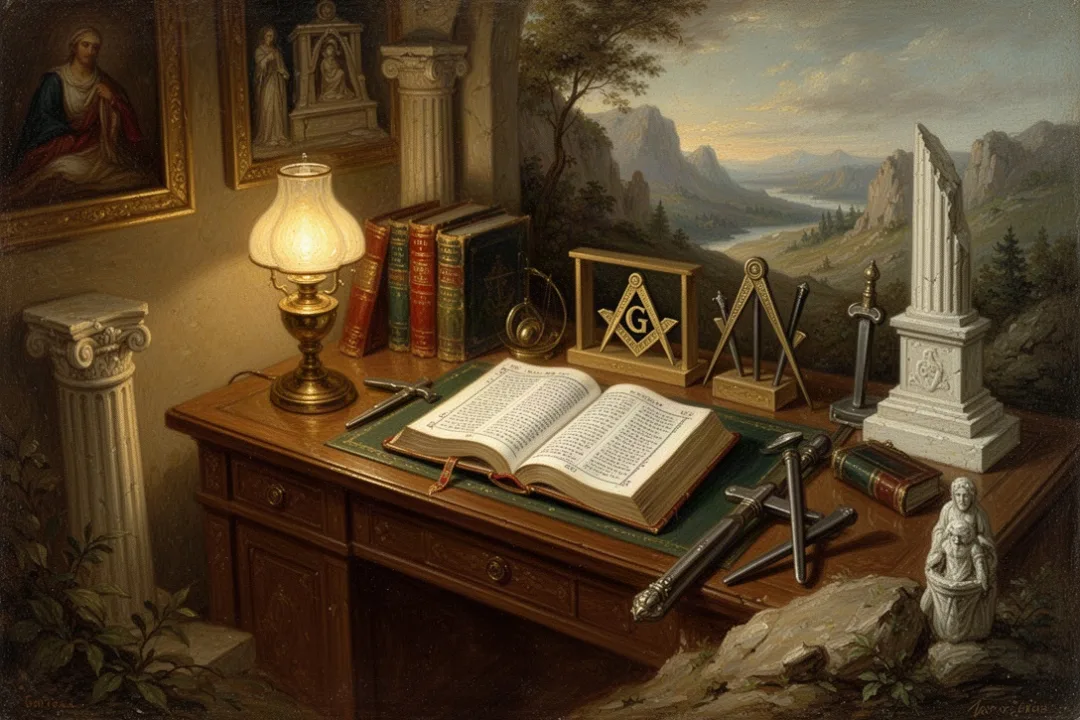
In many Masonic explanations, the Volume of Sacred Law is treated as an old light. Depending on the lodge, this may be the Bible, the Quran, the Hebrew Bible, the Bhagavad Gita, or another sacred text recognized by its members. Freemasonry does not use the same book in every country or jurisdiction, but it commonly expects candidates to acknowledge a moral or divine order.
The “new lights” may refer to the craft’s ceremonies, lectures, symbols, and moral instruction. Some writers use the term for Masonic ritual itself. Others apply it to later interpretations of ancient wisdom, philosophical reflections, or the practical lessons drawn from lodge work.
Core distinction: Old lights are generally treated as foundational sources of moral or spiritual truth; new lights are later explanations and applications that guide a Mason in understanding those foundations.
Why the phrase can have more than one meaning
Freemasonry developed over centuries rather than through one central founder or single worldwide authority. Grand lodges govern their own jurisdictions, and writers from different periods have used the same expression in slightly different ways. A definition found in an eighteenth-century pamphlet may not match a twentieth-century Masonic encyclopedia.
The phrase also overlaps with ordinary religious language. In Christian history, “old lights” and “new lights” have sometimes described people who defended established doctrine and people who promoted newer interpretations or forms of religious practice. In that setting, the terms can suggest a dispute. In a Masonic setting, they more often describe layers of instruction, though historical debates are also possible.
Before interpreting the expression, identify three things:
Who uses the phrase? A lodge officer, historian, ritualist, theologian, or critic may use it differently.
What period is being discussed? Early speculative Masonry, nineteenth-century Freemasonry, and contemporary lodges have distinct vocabularies.
What kind of source contains it? Ritual, a lodge education paper, a history book, and an anti-Masonic tract may not share the same assumptions.
That context prevents a common mistake: treating one author’s definition as an official definition for every Masonic body. There is no single worldwide Masonic headquarters that standardizes every term used by every lodge.
How old lights function as foundations
Old lights are best understood as the principles that a Masonic system regards as prior to its own ceremonies. They are not necessarily “old” because they belong to one specific historical document. Rather, they are old in the sense of being inherited, established, and foundational.
For many regular Masonic jurisdictions, the most visible old light is the Volume of Sacred Law opened during lodge meetings and used in obligations or ceremonies. Its presence signals that Masonic morality is not meant to be merely personal preference. A Mason is expected to take moral duty seriously and to recognize accountability beyond the lodge room.
Old lights may also include broad moral commitments such as:
Truthfulness: treating honesty as a duty rather than a convenience.
Justice: acting fairly toward people with different status, wealth, or beliefs.
Charity: responding to suffering with practical help and compassion.
Self-command: restraining anger, greed, pride, and other destructive impulses.
Reverence: acknowledging a higher moral order without requiring every member to describe it in identical terms.
These principles are not exclusive to Freemasonry. Their Masonic significance comes from the way they are gathered into a system of symbolic education and personal discipline. A lodge does not claim to replace a member’s religion. Instead, it commonly presents moral lessons that members are expected to apply within their own faith and daily lives.
How new lights develop through ritual and interpretation
New lights are the forms of instruction that make inherited principles usable in a particular Masonic setting. Ritual gives members symbols, actions, questions, and lectures through which they consider moral ideas. The ceremony does not create the underlying duty to be honest or charitable, but it can give that duty a memorable structure.
A Masonic lecture might explain the meaning of a tool, a building image, a movement through the lodge, or a sequence of questions. These explanations are new lights in a practical sense: they cast the older principles into a particular symbolic language. Members then interpret those symbols through study, discussion, and experience.
Different Masonic traditions may place different emphasis on this process. One jurisdiction may focus on formal ritual and authorized lectures. Another may encourage historical research, philosophical discussion, or comparative study. Both may consider themselves faithful to old foundations while using different new lights to explain them.
New lights can therefore include:
Ritual explanations attached to degrees and lodge ceremonies.
Symbolic interpretations of architectural tools, measurements, and building imagery.
Lectures and charges that connect ceremony with conduct.
Lodge education programs that explore Masonic history and philosophy.
Personal insights formed when a member applies a lesson to work, family, citizenship, or service.
Calling these things “new” does not automatically mean they are modern or superior. It means they are mediating explanations—ways of bringing an established moral idea into a new setting or making it understandable to a new generation.
Old lights, new lights, and the Volume of Sacred Law
The Volume of Sacred Law deserves special attention because it is often the clearest point where the two categories meet. The sacred text represents a source of authority that the lodge does not claim to invent. Masonic ritual and commentary then draw moral themes from that broader source and place them in a ceremonial framework.
This relationship is not the same as saying that Freemasonry has one common theology. Lodges may differ in which sacred book is used, how it is read, and how explicitly religious language appears in instruction. In many jurisdictions, the essential requirement is that a member affirm belief in a Supreme Being or higher moral authority, while the specific religious tradition remains personal.
For that reason, it is misleading to describe the “new lights” as a replacement for scripture. In jurisdictions that require a sacred volume, the ritual is generally presented as supporting moral reflection, not as a new revelation. Masonic symbols may illustrate a lesson, but they do not automatically carry the authority that a member’s faith assigns to sacred scripture.
A useful way to see the relationship is:
The sacred text supplies a foundation. It gives the member a religious or moral frame of reference.
Masonic ritual supplies a method. It uses ceremony and symbolism to encourage reflection.
Personal conduct supplies the test. The value of the lesson appears in how the member behaves outside the lodge.
This distinction matters when reading claims that Freemasonry has its own secret religion. The existence of symbolic teaching does not by itself prove that a lodge intends to replace a member’s faith. The answer depends on the jurisdiction, the lodge’s rules, and the actual source being examined.
How the terms relate to Masonic secrecy
People sometimes connect old lights and new lights with the secrecy of Masonic ritual. That connection is understandable, but the terms do not simply mean “public knowledge” and “secret knowledge.” Masonic lodges have traditionally kept certain modes of recognition, ceremonial details, and proceedings private, yet privacy is not the same as a claim that members possess a hidden revelation.
Old lights may be public religious or moral sources. New lights may be expressed through private ceremonies, but their ethical themes are often familiar: integrity, brotherhood, duty, fairness, and service. The private form of instruction can make a lesson more personal without making the underlying moral principle exclusive.
It is also useful to separate three ideas that are often blended together:
Confidentiality: agreeing not to disclose certain lodge procedures or personal discussions.
Symbolism: using images and ceremonies to communicate moral ideas indirectly.
Esoteric interpretation: studying deeper or less obvious meanings in a symbol or ritual.
A lodge may practice all three, but none should be assumed to mean that new lights override old lights. In a traditional framework, new interpretation remains accountable to the moral and religious principles that give the ceremony its purpose.
How historical changes affected the idea of new lights
Freemasonry changed as it moved from early modern Europe into the modern period. Rituals were standardized differently, new grand lodges formed, printed exposures and commentaries circulated, and Masonic writers debated the relationship between craft tradition, Christianity, natural religion, and moral philosophy.
Those changes gave “new lights” a historical dimension. A newer ritual edition, a revised lecture, or an emerging philosophical explanation could be described as a new light by supporters. Critics might use the same language to suggest that an innovation departed from an older standard. The term can therefore be descriptive or argumentative, depending on the writer’s purpose.
When researching an old Masonic text, ask these questions:
What Masonic jurisdiction produced it? Ritual terms vary between grand lodges.
When was it written or printed? Vocabulary changes over time.
Is the author describing practice or advocating reform? A proposal is not evidence that every lodge followed it.
Does the author define “lights”? Some writers assume readers already know the expression.
Are the terms being used literally, symbolically, or polemically? The surrounding paragraphs usually provide the clue.
This method is more reliable than searching for one fixed dictionary definition. Historical Masonic language often depends on local custom, and the same phrase can carry different weight in a ritual manual and a private philosophical essay.
How old lights and new lights differ from “ancient landmarks”
Another source of confusion is the phrase “ancient landmarks.” The two expressions may appear together, but they are not identical. Ancient landmarks generally refer to longstanding principles or customs considered essential to a Masonic system. Old lights more often point to established sources of moral or religious illumination.
Neither term has one universally accepted list across all grand lodges. Some Masonic jurisdictions publish statements about landmarks; others rely more heavily on inherited practice. A writer may describe a landmark as an old light, but that does not mean the two terms are interchangeable.
The difference can be stated simply:
Old lights usually concern the foundations that illuminate Masonic duty and belief.
New lights usually concern later instruction, interpretation, or application.
Ancient landmarks usually concern enduring institutional principles, customs, or boundaries.
These categories overlap because all three involve continuity. They should still be kept separate when a precise historical or ritual explanation is needed.
How to apply the distinction when reading a Masonic source
Suppose a book says that a particular teaching is a “new light.” Do not assume the author is calling it false, revolutionary, or secret. First determine whether the phrase means a later explanation, a revised ritual practice, a philosophical interpretation, or a theological innovation.
Then compare the teaching with the source’s stated foundations. Does it support the lodge’s emphasis on moral conduct? Does it agree with the jurisdiction’s rules? Does it treat sacred scripture and personal faith respectfully? Does the author present it as one interpretation or as a binding requirement?
A practical reading process looks like this:
Copy the sentence containing the phrase. Nearby wording may define it indirectly.
Read the surrounding section. A single quotation can make a neutral term sound controversial.
Identify the speaker. Ritual officers, historians, and critics may use different vocabulary.
Check the jurisdiction and date. Local and historical context often settles the ambiguity.
Separate description from judgment. “New” may describe chronology, not quality.
Compare practice with theory. What a writer says about Freemasonry may not reflect what every lodge does.
This approach is especially useful online, where short quotations are often removed from their original context. A statement about old lights and new lights may be discussing ritual development, not making a claim about the nature of religion or the legitimacy of a lodge.
What the phrase means for a modern lodge member
For a contemporary member, the distinction can be practical rather than merely historical. Old lights remind you that Masonic instruction is tied to enduring obligations: honesty, fairness, restraint, and service. New lights encourage you to keep studying and to translate those principles into the circumstances of your own life.
That does not mean every personal interpretation is equally consistent with Masonic tradition. A useful interpretation should be grounded in the lodge’s recognized teachings, compatible with its rules, and visible in responsible conduct. Novelty alone does not make an idea valuable.
Members can use the distinction in several ways:
During ritual study: ask which lesson is inherited and which explanation was added later.
During lodge discussion: distinguish personal opinion from an official jurisdictional position.
During historical research: identify whether a writer is recording custom or proposing change.
During personal reflection: connect symbolic instruction with an actual decision or responsibility.
The best result is balance. Old lights without thoughtful application can become empty repetition. New lights without respect for foundational principles can become personal speculation detached from the tradition.
How the phrase is used outside Freemasonry
If you found the expression in a religious history text rather than a Masonic source, the meaning may be different. “Old lights” can refer to defenders of inherited doctrine, while “new lights” can refer to reformers or teachers who emphasize a newer interpretation. In some settings, the labels were used during disputes over preaching, church authority, revival, or doctrinal change.
Outside a specific historical movement, the phrase may simply contrast traditional understanding with new interpretation. The terms are not automatically positive or negative. Supporters of change may call their approach new light; opponents may describe it as departure from established truth.
Look for clues such as references to a denomination, revival, church controversy, scripture, or named religious leaders. References to degrees, lodges, officers, landmarks, or the Volume of Sacred Law point more strongly toward a Masonic context.
Research tip: Never define the phrase from the words alone. The surrounding source should tell you whether “old lights” and “new lights” refer to Masonic instruction, religious controversy, or a general contrast between tradition and innovation.
Why the distinction still matters
The phrase remains useful because it describes a recurring problem in any tradition: how to preserve a foundation while explaining it to people living in different circumstances. Every generation inherits language, ceremonies, and principles, then asks how those inherited forms should be understood and practiced.
In a Masonic setting, old lights protect continuity. They keep moral instruction connected to a broader religious and ethical framework rather than allowing every lodge or member to invent a private system. New lights provide interpretation. They help members engage with inherited symbols, historical questions, and contemporary responsibilities without assuming that tradition can speak only in its oldest wording.
Understanding both sides also encourages intellectual caution. A new explanation may clarify an old principle, but it may also reflect the biases of its author or period. An old formula may preserve valuable wisdom, but it may require context before a modern reader can understand its intended meaning.
So, when you see “old lights and new lights,” read it as a question about foundations and interpretation. In most Masonic uses, the old lights represent the established moral or sacred sources that orient the fraternity, while the new lights represent the rituals, lectures, symbols, and later insights that help members apply those sources. The precise meaning belongs to the text and jurisdiction where the phrase appears.
Frequently asked questions
Are old lights and new lights official Masonic terms everywhere?
No. The expression appears in Masonic writing and discussion, but its use is not standardized across every grand lodge. One author may mean sacred scripture and ritual instruction, while another may mean older and newer interpretations of Masonic tradition. The jurisdiction, date, and surrounding passage are necessary for an accurate reading.
Does “new light” mean a new religion within Freemasonry?
Generally, no. In many Masonic contexts, new light means a later explanation, ritual lesson, or philosophical interpretation. It usually does not claim to replace a member’s religion or sacred text. Local rules differ, so a specific lodge document should be read on its own terms rather than judged by the phrase alone.
Is the Bible always considered the old light in Freemasonry?
Not universally. Many lodges use the Bible, but Freemasonry operates through separate jurisdictions, and some lodges use another sacred book appropriate to their members. The broader idea is the Volume of Sacred Law or an accepted sacred text, not one mandatory book for every Masonic body worldwide.
How can I tell which meaning applies in a historical source?
Examine the author, publication date, jurisdiction, and nearby vocabulary. References to lodges, degrees, ritual, officers, or the Volume of Sacred Law suggest a Masonic meaning. References to denominations, preaching, revival, or doctrinal disputes may indicate religious history. The surrounding paragraphs are usually more reliable than the phrase by itself.









Leave a Reply