The Bible does not name the author of Esther. Although the book identifies Mordecai as someone who recorded events and sent letters, it never directly says that he wrote the entire book.
The book of Esther is unusual because it tells a complete story without naming its writer. It opens in the Persian royal court, follows Esther’s rise to queenship, describes Haman’s plan against the Jews, and ends with the establishment of Purim. At no point does the narrator identify himself or herself.
That means the safest answer to who wrote the Bible book of Esther is an unknown Jewish author. The writer may have drawn on court records, family traditions, community memories, or earlier written accounts, but the text does not provide enough information to identify that person.
The narrator writes in the third person and presents the story with knowledge of private conversations, royal decisions, and events in several locations. Those features tell you something about the book’s style, but they do not prove that the author personally witnessed everything described or belonged to the royal court.
Direct answer: Esther has no named biblical author. Mordecai recorded certain events and sent official letters, but the text does not explicitly identify him as the writer of the whole book.
Why Mordecai is sometimes considered the author
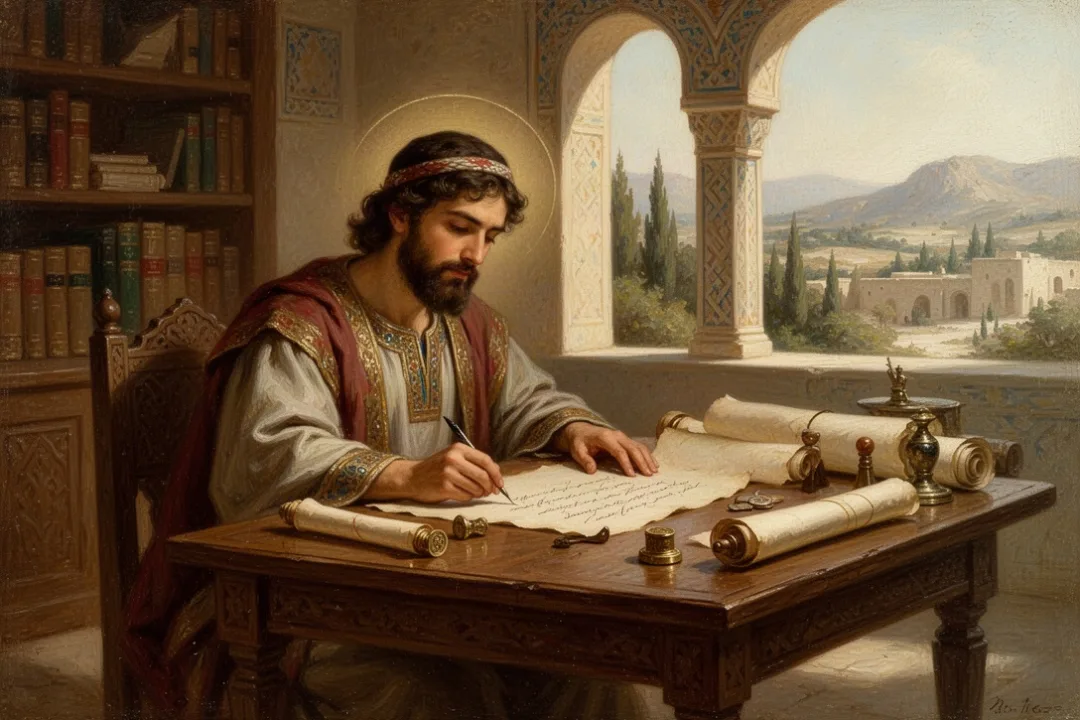
Mordecai is closely connected with the written material in the final chapters. After the Jews are delivered from Haman’s plot, Esther and Mordecai establish instructions concerning Purim. Esther 9:20 says that Mordecai recorded these events and sent letters to Jewish communities throughout the Persian Empire.
This detail has led some readers to conclude that Mordecai wrote Esther, or at least supplied the original record behind it. He was a central participant in the events, had access to royal information, and held an official position after Haman’s downfall. Those circumstances make him a plausible source for parts of the story.
Still, plausible source is not the same as confirmed author. The wording about Mordecai recording events appears near the end of the narrative and is specifically associated with the letters and observance of Purim. It does not clearly claim that he composed every chapter, selected every detail, or wrote the final form of the book.
A later editor could have shaped Mordecai’s records into the book as it now stands. Another possibility is that the author used Mordecai’s letters alongside other traditions. Since the text does not explain its composition, readers should avoid stating Mordecai’s authorship as a certainty.
What Jewish tradition says about the book of Esther
Jewish tradition has offered more than one way to describe the book’s origin. In rabbinic discussions, Esther is associated with Mordecai and Esther, as well as with the group known as the Men of the Great Assembly. These traditions emphasize that the story was preserved, shaped, and formally recognized within the Jewish community.
The Babylonian Talmud, in Bava Batra 15a, discusses the writers or transmitters connected with several biblical books. Esther is linked there with the Men of the Great Assembly, while Mordecai and Esther are also treated as central figures in preserving the account. The passage is part of rabbinic interpretation, not a statement found inside the biblical book itself.
The phrase Men of the Great Assembly refers in Jewish tradition to an authoritative group associated with the period after the Babylonian exile. Traditional accounts describe this group as helping preserve, organize, or authorize sacred writings. Modern scholars debate how the group should be understood historically, so the tradition should not be presented as a simple modern identification of one named author.
Jewish interpretation also gives special weight to the role of Esther and Mordecai in establishing Purim. The book itself presents them as issuing letters and confirming the practice. For that reason, traditional readers may describe them as authors, editors, or authoritative transmitters of the story, even though the narrative does not offer a formal author’s name.
What historical clues suggest about the writer
Although the author is anonymous, the book contains clues about the writer’s interests and setting. Esther shows detailed knowledge of Persian administration, royal banquets, court procedures, official decrees, and the geography of the empire. It also explains some Persian customs and practices for readers who may not have lived in the royal court.
The story is set during the reign of Ahasuerus, commonly identified with the Persian king Xerxes I, who ruled from 486 to 465 BCE. That identification comes from comparing the Hebrew name in Esther with Persian history and the Greek form of the king’s name. The setting, however, does not establish when or by whom the book was written.
The author also appears to write for Jewish readers familiar with life outside the land of Judah. The narrative takes place primarily in Susa, the Persian capital, and portrays Jewish communities spread throughout the empire. Its attention to diaspora Jewish life may reflect a community interested in explaining the origin and importance of Purim to Jews living far from Jerusalem.
Some scholars see the author as someone familiar with Persian institutions, while others think the apparent administrative details could have been gathered from documents or common knowledge. Either way, these clues suggest a knowledgeable writer, not an identifiable individual.
When the book of Esther was probably written
The story takes place in the Persian period, but the final book was probably written later. The narrative looks back on the reign of Ahasuerus and explains the continuing celebration of Purim, which suggests that the festival was already established when the work reached its final form.
Scholars commonly place the composition of the Hebrew version somewhere in the later Persian period or the early Hellenistic period, broadly within the late fourth or third century BCE. The exact date remains uncertain. A proposed date depends on how a reader evaluates the book’s language, historical details, relationship to Persian records, and references to the ongoing festival.
The difference between the time of the events and the time of composition matters. Mordecai may have preserved records close to the events, while a later writer or editor could have arranged them into the literary form known as Esther. The existence of an earlier source would not automatically prove that its compiler wrote the final biblical book.
Some readers argue that the book was composed soon after the Persian period because it appears familiar with Persian court life. Others place it later, during the Hellenistic era, because of its language and literary features. These proposals remain matters of historical discussion rather than settled facts.
Why the Hebrew text does not identify its author
Many biblical books do not name their writers, and Esther belongs to that group. Ancient works were not always introduced with a modern-style title page or author biography. A community could preserve a text because of its content, authority, and use in worship or public reading without preserving the identity of its original composer.
Esther may also have developed through several stages. A local account of the deliverance of Persian Jews could have circulated before being expanded into a broader narrative. Official letters about Purim, oral traditions about Esther and Mordecai, and written storytelling may all have contributed to the final text.
The book’s polished structure supports the possibility of literary shaping. It repeats banquets, reversals, royal decrees, sleeplessness, public honors, and changes in status. These patterns create a carefully arranged narrative, but they do not reveal whether one author composed the entire work or whether an editor organized earlier material.
The narrator’s anonymity may also be deliberate. The book directs attention toward the survival of the Jewish people and the reversal of danger rather than toward the writer’s personal authority. Its lack of a named author does not make the work historically or religiously meaningless; it simply limits what can be said with confidence about its human composition.
How the Greek additions affect the authorship question
Esther exists in more than one ancient form. The Hebrew version is shorter and has a distinctive feature: it never directly uses the name of God. The Greek version contains additional passages, including prayers, dreams, letters, and explicit religious language.
These Greek additions are commonly called the Additions to Esther. They are not merely small wording changes. They expand the story and make its religious themes more explicit, especially by adding prayer and references to divine action that are absent from the Hebrew narrative.
The additions are generally understood as later expansions or adaptations of the Hebrew story rather than evidence that the original author has been discovered. They show that Esther was interpreted and reshaped for different Jewish communities and languages. The translators or later adapters of the Greek material are also not securely identified.
Different Christian traditions treat these additions differently. Many Protestant Bibles place them in the Apocrypha or do not include them in the main canon, while Catholic and Eastern Orthodox traditions give them a recognized scriptural status in their own canonical arrangements. This difference affects the form of Esther a reader encounters, but it does not provide a confirmed name for the original Hebrew author.
What Esther’s literary style reveals about its author
Esther reads like a carefully constructed court narrative. The writer highlights the Persian king’s dependence on written decrees, the danger created by conflicting orders, and the inability to revoke an official edict once it has been issued. These details drive the plot and explain why the Jews require a second decree to defend themselves.
The author also uses dramatic reversals to shape the reader’s understanding of justice. Haman prepares a public execution for Mordecai but is later forced to honor him. Haman’s position is transferred to Mordecai, and the threat aimed at the Jewish people turns against their enemy’s supporters. Such symmetry suggests deliberate literary design.
At the same time, the narrator does not explain every religious implication. God is not named in the Hebrew text, and the book does not include a direct prayer or prophetic speech. Readers have long debated whether divine providence is implied through the events or whether the book intentionally leaves that question for the audience to consider.
These features can help scholars describe the writer’s methods and concerns. They cannot identify the writer as a particular court official, priest, scribe, or member of Esther’s family. Literary fingerprints are not the same as a signature.
Common mistakes when identifying Esther’s author
Calling Mordecai the certain author: Esther 9:20 connects him with recording events and sending letters, but it does not explicitly say he wrote the complete book.
Confusing the setting with the composition date: The story occurs under a Persian king, but the final text may have been written generations later.
Treating rabbinic tradition as an internal statement: Later Jewish sources are valuable for understanding interpretation, but they are not the same as evidence from the biblical text.
Assuming the Greek additions were part of the original Hebrew book: The longer Greek form reflects a later textual development and is not identical to the Hebrew version.
Using the absence of God’s name to identify a secular author: That literary feature has many interpretations and does not prove the writer’s personal beliefs.
Assuming historical knowledge proves eyewitness authorship: A writer may use archives, letters, oral tradition, or earlier written accounts.
How to answer the question in a Bible study or classroom
A clear answer should separate what the text states from what tradition or scholarship proposes. You can begin by saying that the author of Esther is unknown. Then explain that Mordecai recorded events related to Purim, which is why some traditional interpretations connect him with the book’s composition.
If the setting comes up, mention that the narrative is placed in the Persian court during the reign of Ahasuerus, usually identified with Xerxes I. Add that this setting does not prove the book was written during his reign. The final form may have appeared later, perhaps in the late Persian or early Hellenistic period.
For a more detailed discussion, distinguish the Hebrew Esther from the Greek version. The Hebrew text is anonymous, while the Greek form includes later additions whose authors or translators are also not securely known. This distinction prevents a common confusion between the original narrative and its expanded versions.
A careful answer can therefore include several levels of certainty:
Certain from the text: Esther does not name its author.
Explicitly connected with Mordecai: He records events and sends letters concerning Purim.
Traditional attribution: Jewish sources associate Mordecai, Esther, and the Men of the Great Assembly with preserving or composing the book.
Scholarly assessment: The final literary form was probably produced by an anonymous Jewish writer or compiler, possibly using earlier records.
What can be said confidently about who wrote Esther
The evidence supports a modest but useful conclusion. The final author of the Hebrew book of Esther is unknown, and no responsible reading of the text can supply a definite personal name. Mordecai may have provided records or letters, but his role as the book’s complete author is not stated.
Jewish tradition preserves a stronger connection between Mordecai, Esther, and the book’s transmission. Modern scholarship usually focuses on the anonymous writer or compiler who shaped the story into its present literary form. Both perspectives recognize that the book was preserved within a community that regarded its account of deliverance and Purim as significant.
The best answer, then, is neither “Mordecai wrote it” nor “nobody knows anything about its origin.” The text gives meaningful clues about its sources, setting, themes, and transmission while leaving the final author unnamed. That distinction allows you to respect traditional interpretations without claiming more certainty than the evidence provides.
Frequently asked questions
Does the Bible say that Mordecai wrote Esther?
No. Esther 9:20 says that Mordecai recorded events and sent letters about Purim. That statement explains his role in preserving and communicating the festival’s history, but it does not directly identify him as the author of all ten chapters. Mordecai may have supplied source material, but complete authorship remains unconfirmed.
Was Esther written by Esther herself?
The biblical text does not say that Queen Esther wrote the book. She plays an essential role in authorizing the observance of Purim and sending letters with Mordecai, so tradition connects her with preserving the account. However, the final writer or editor of the Hebrew book is not named.
When was the book of Esther written?
The story is set during the reign of Ahasuerus, usually associated with Xerxes I of Persia, who ruled in the fifth century BCE. The final book may have been composed later, possibly in the late Persian or early Hellenistic period. Scholars cannot establish an exact date with certainty.
Why does Esther never mention God by name?
The Hebrew version’s silence about God is a deliberate and widely discussed feature of the book. Some readers see divine providence operating indirectly through the reversals in the story, while others emphasize the book’s focus on Jewish survival in a foreign empire. The omission does not identify the author or prove a particular theology.





Leave a Reply