Overview of Jeremiah: themes, structure, and message
Overview of Jeremiah: themes, structure, and message
You may know Jeremiah mainly as the prophet who warned Jerusalem before its destruction, or as the source of the phrase “a weeping prophet.” But what is the book of Jeremiah actually about, and why does it move between sermons, poems, stories, and letters? The simplest answer is that Jeremiah records God’s covenant lawsuit against Judah, the prophet’s painful call to repentance, and the promise that judgment will not be God’s last word.
The book follows Jeremiah’s ministry during the final decades of the kingdom of Judah, before and during the Babylonian conquest of Jerusalem. It speaks about idolatry, injustice, false security, exile, judgment, and restoration. Its message is severe because the crisis is severe, yet it also contains some of the Bible’s clearest promises about God’s faithfulness and a renewed covenant.
Jeremiah began prophesying during the reign of King Josiah of Judah, around the late seventh century BC. He continued through the reigns of Jehoahaz, Jehoiakim, Jehoiachin, and Zedekiah, and his ministry extended beyond the fall of Jerusalem. These kings ruled during a period when the Assyrian Empire was weakening, Babylon was becoming dominant, and Egypt was also competing for influence.
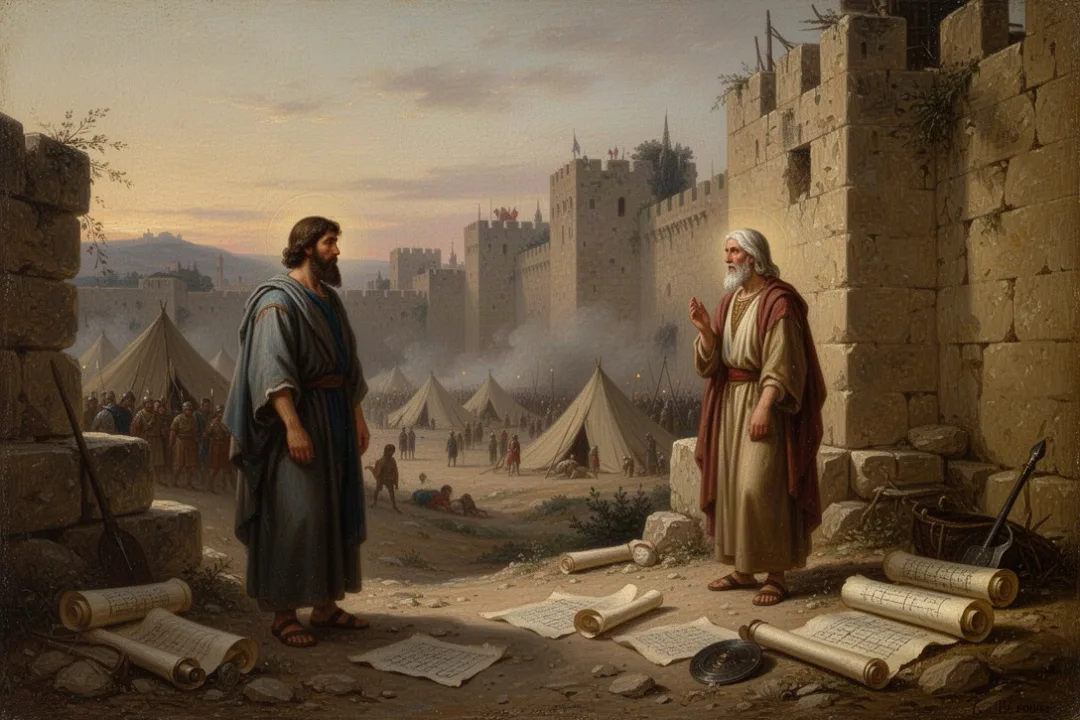
Judah stood between larger powers. Its leaders had to decide whether to resist Babylon, seek help from Egypt, or submit to Babylonian authority. Jeremiah consistently argued that Babylon’s rise was part of God’s judgment on Judah and that rebellion would bring greater disaster. That political message made him deeply unpopular, especially among officials and prophets who promised quick deliverance.
The book’s central setting is Jerusalem, including the temple, the royal court, city streets, and places of imprisonment. Later passages also refer to communities in exile and to the remnant of Judah that fled to Egypt. Jeremiah therefore moves from public preaching in Jerusalem to personal suffering, national catastrophe, and life among displaced survivors.
Who Jeremiah was and how the book was formed
Jeremiah came from Anathoth, a priestly town in the territory of Benjamin. The opening chapter presents his call from God while he was still young. Jeremiah initially objects that he lacks the authority and ability to speak, but God appoints him to confront nations and kingdoms, announcing both destruction and rebuilding.
The book identifies Baruch son of Neriah as Jeremiah’s scribe and associate. According to Jeremiah 36, Jeremiah dictated his prophetic words to Baruch, who wrote them on a scroll. After King Jehoiakim cut up and burned that scroll, Jeremiah dictated the words again, along with additional material. This account shows that the book grew through prophetic preaching, written collections, remembered events, and later arrangement.
Jeremiah is not arranged like a modern biography. It does not present every event in chronological order, and some sections shift suddenly from sermons to narratives or from Judah to foreign nations. The final form preserves theological meaning rather than a simple timeline: the reader sees why judgment came, how people responded, and what God promised beyond the catastrophe.
Reading clue: Jeremiah’s repeated warnings make more sense when you remember that the prophet spoke over many years. The same crisis appears from different angles because the people repeatedly refused to change.
How the book of Jeremiah is organized
The exact boundaries between sections can vary slightly in different outlines, but the book has several recognizable movements. A helpful reading plan follows its major voices and purposes rather than trying to treat every chapter as the same kind of writing.
Jeremiah 1: the prophet’s call and commission.
Jeremiah 2–25: accusations against Judah, calls to repentance, warnings of coming disaster, and accounts of opposition.
Jeremiah 26–29: conflicts with leaders and prophets, including Jeremiah’s message to the exiles in Babylon.
Jeremiah 30–33: promises of restoration, return, healing, and a new covenant.
Jeremiah 34–45: historical narratives covering the final years of Jerusalem and the aftermath of its fall.
Jeremiah 46–51: oracles concerning Egypt, Philistia, Moab, Ammon, Edom, Damascus, Elam, Babylon, and other nations.
Jeremiah 52: a historical account of Jerusalem’s fall, the temple’s destruction, the exile, and the release of King Jehoiachin.
Jeremiah 36 is particularly useful for understanding the relationship between spoken prophecy and written Scripture. Jeremiah speaks, Baruch writes, a king rejects the scroll, and the prophetic word is written again. The scene reinforces the idea that human attempts to silence God’s warning do not erase it.
Why Jeremiah condemns Judah’s worship and society
Jeremiah’s criticism is not directed at religious practice in the abstract. He confronts a people who maintain outward worship while violating the covenant in daily life. The leaders and people trust the presence of the temple as a guarantee of safety, but they exploit the vulnerable, pursue idols, and refuse to obey God.
The temple sermon in Jeremiah 7 attacks false confidence in sacred institutions. The people appear to believe that repeated religious actions can protect them while they continue stealing, murdering, committing adultery, oppressing foreigners, or mistreating orphans and widows. Jeremiah insists that worship cannot substitute for justice and faithfulness.
Idolatry is also described with vivid images. Judah abandons the living God for other sources of security and fertility, often represented through images of spiritual unfaithfulness. The problem is not merely that the people add other gods to their worship. They exchange their true source of life for what cannot sustain them.
This concern connects Jeremiah with earlier prophetic books. Like Amos, Isaiah, and Micah, Jeremiah joins right worship with right treatment of neighbors. A nation cannot claim covenant loyalty while its courts, leaders, families, and economic practices contradict that claim.
What Jeremiah teaches about judgment and Babylon
Babylon serves as the main instrument of judgment in the book. Jeremiah does not present Babylon as morally innocent; later chapters announce judgment against Babylon as well. But for Judah’s immediate situation, Babylon is the power God uses to expose the consequences of prolonged rebellion.
Many people in Jerusalem expect God to rescue the city because of the temple and the promises associated with David’s line. Jeremiah challenges that assumption. The city’s religious history does not make it immune to judgment when its people reject the covenant. Privilege increases responsibility; it does not cancel accountability.
The prophet also rejects the claim that the crisis will end quickly. Other prophets and officials announce peace, but Jeremiah says the people must face a long period under Babylonian rule. In his letter to the exiles in Jeremiah 29, he tells them to build homes, raise families, seek the welfare of the city where they live, and wait for God’s appointed restoration.
That message would have sounded disloyal or defeatist to many listeners. Jeremiah, however, distinguishes faithful hope from wishful optimism. Hope does not require pretending that disaster is near its end. It trusts God enough to live faithfully during a difficult and extended season.
How Jeremiah’s personal struggles shape the book
Jeremiah does not deliver his messages as a detached observer. He experiences rejection, threats, loneliness, imprisonment, physical abuse, and accusations of treason. His prayers reveal fear, anger, grief, and confusion as he tries to remain faithful while watching his nation move toward destruction.
These personal prayers are sometimes called Jeremiah’s confessions. They include passages in which he questions why the wicked prosper, complains about betrayal, and asks why his calling has brought him such pain. The book allows these emotions to remain visible rather than presenting the prophet as consistently calm or triumphant.
Jeremiah’s suffering does not mean that his faith is absent. His honest prayers show a relationship with God that can withstand difficult questions. He brings his distress to God instead of hiding it behind polished religious language. His example makes room for lament as an expression of faith, especially when obedience does not produce immediate success.
The prophet’s life also becomes a sign of the message he proclaims. God tells him not to marry or have children in the land because the coming judgment will disrupt ordinary family life. He later buys a field while Jerusalem is under siege, an action that dramatizes confidence in a future when homes, fields, and vineyards will again be possessed in Judah.
What the book says about false prophets and deceptive peace
Jeremiah repeatedly disputes prophets who promise that Jerusalem will soon be safe. Their messages are attractive because they offer reassurance without repentance. Jeremiah presents them as speaking from their own imagination rather than from God’s commission.
The conflict with Hananiah in Jeremiah 28 illustrates the problem. Hananiah announces a short period before Babylon’s power is broken, while Jeremiah warns that the yoke of Babylon will remain. The narrative does not define a true prophet simply as someone who makes religious claims. A true messenger must speak what God has actually given and must not use confidence as a substitute for truth.
Jeremiah’s warnings are not intended to glorify disaster. They are meant to expose denial. A comforting message can become destructive when it persuades people to ignore danger, reject correction, or treat peace as guaranteed regardless of their conduct.
What the new covenant promise means in Jeremiah
Jeremiah 30–33 is often called the Book of Consolation because it gathers some of the book’s strongest promises of restoration. God promises to bring the people back, rebuild what was destroyed, heal wounds, and restore joy. These promises do not erase the reality of judgment, but they show that judgment is not the end of God’s relationship with his people.
The best-known promise appears in Jeremiah 31, where God announces a new covenant. Unlike a covenant written only on external tablets or maintained through inherited identity, this covenant involves God’s instruction being written on the people’s hearts. The people will know God, and their sin will be forgiven.
The promise does not mean that God has abandoned all continuity with Israel’s earlier story. It uses covenant language, recalls the exodus, and points toward a renewed relationship between God and his people. Its emphasis falls on inner transformation, forgiveness, and lasting knowledge of God.
Jeremiah 32 adds a practical sign of hope. While the land is threatened and many people are being taken away, Jeremiah purchases property. The deed is preserved as evidence that houses, fields, and vineyards will once again be bought in the land. Biblical hope here is concrete: it concerns ordinary life restored after devastation.
How the major people in Jeremiah affect the story
Jeremiah’s message becomes clearer when the main figures are distinguished from one another. They represent different responses to warning, power, fear, and faithfulness.
Jeremiah: God’s appointed prophet, whose obedience brings personal cost and whose prayers reveal the emotional burden of his calling.
Baruch: Jeremiah’s scribe and companion, who records the prophet’s words and shares in the danger surrounding them.
Josiah: the king associated with religious reform, during whose reign Jeremiah begins his ministry. The later history shows that reform did not permanently change Judah’s direction.
Jehoiakim: a king who rejects Jeremiah’s warning and burns the scroll containing the prophet’s words.
Zedekiah: Judah’s final king before Jerusalem falls. He repeatedly seeks Jeremiah’s counsel but lacks the resolve to follow it.
Ebed-melech: a foreign official who rescues Jeremiah from a cistern, demonstrating courage and compassion amid widespread fear.
Hananiah: a prophet who contradicts Jeremiah by promising a rapid end to Babylonian domination.
Nebuchadnezzar: Babylon’s king, whose armies capture Jerusalem and carry out the judgment Jeremiah had announced.
These characters also show that faithfulness is not limited to people with official religious status. A foreigner may act with greater courage than Judah’s leaders, while a king who asks for spiritual advice may still refuse to obey it.
Common mistakes to avoid when reading Jeremiah
Jeremiah can be misunderstood if its poetry, history, and theology are flattened into a few familiar phrases. Keep the following cautions in mind as you read.
Do not treat every chapter as chronological. The book groups material by theme and purpose, so events may appear out of sequence.
Do not reduce Jeremiah to personal sadness. His grief matters, but the book also addresses worship, public justice, international politics, leadership, and communal responsibility.
Do not isolate promises from their setting. Passages about hope and restoration come after serious warnings and should not be used to deny the reality of judgment.
Do not assume Babylon is praised as morally good. God uses Babylon as an instrument, but the later oracles also announce Babylon’s downfall.
Do not read “new covenant” as a vague promise of personal improvement only. The passage concerns God’s restored relationship with his people, forgiveness, and a transformed community.
Do not confuse a confident religious message with a faithful one. Jeremiah shows that spiritual authority depends on truth and obedience, not popularity or optimism.
Do not overlook the historical narratives. The stories of prison, siege, exile, and political pressure demonstrate what Jeremiah’s sermons cost in real life.
How to read Jeremiah with greater understanding
A thoughtful reading benefits from moving between the book’s main types of material. Start with Jeremiah 1 to understand the prophet’s commission, then read selected sermons alongside the historical scenes that show how people responded to them.
Mark the audience. Ask whether Jeremiah is speaking to Judah, its kings, the exiles, foreign nations, or the prophet himself in prayer.
Identify the accusation. Look for the specific failure being confronted, such as idolatry, injustice, political arrogance, or refusal to listen.
Notice the proposed response. Some passages call for repentance, while others tell the people to accept exile, wait, or trust a future restoration.
Separate immediate and future horizons. A passage may address the coming fall of Jerusalem and also point toward later healing or return.
Read images in context. Broken jars, yokes, wells, vineyards, and scrolls communicate particular messages rather than functioning as random symbols.
Pay attention to repeated contrasts. Jeremiah often sets true and false worship, temporary and lasting security, or human plans and God’s word against each other.
It can also help to read Jeremiah with 2 Kings 22–25, which provides a related account of Judah’s final years. The two books are not identical in emphasis, but the historical material helps place Jeremiah’s warnings within the reigns, battles, deportations, and political decisions of the period.
Why Jeremiah still speaks to readers today
Jeremiah addresses questions that remain relevant: Can religious identity protect people from accountability? What happens when leaders prefer comforting messages to difficult truth? How should a community live when its familiar structures are collapsing? And how can someone remain faithful when obedience brings rejection rather than recognition?
The book warns against mistaking institutions for faithfulness. A temple, tradition, nation, church, or personal reputation cannot replace a life shaped by justice and loyalty to God. Jeremiah also challenges simplistic ideas of success. A faithful messenger may be opposed, misunderstood, or apparently defeated while still serving an essential purpose.
At the same time, Jeremiah refuses despair. Its promises of restoration insist that God can create a future after judgment, displacement, and loss. Hope is not based on denying what happened. It rests on God’s capacity to forgive, renew, gather, and transform a people whose failure has been fully exposed.
Central message: Jeremiah calls God’s people away from false security and empty worship, through honest repentance and faithful endurance, toward a restored relationship marked by forgiveness and changed hearts.
Read as a whole, Jeremiah is both a warning and a witness. It explains why Jerusalem fell, shows the human cost of resisting truth, gives dignity to lament, and preserves God’s promises beyond the ruins. Its most distinctive message is that judgment and hope belong together: God confronts evil seriously, yet he continues to call people toward renewal, covenant faithfulness, and life restored.
Frequently asked questions
Why is Jeremiah called the weeping prophet?
Jeremiah receives that description because the book repeatedly portrays his grief over Judah’s sin, coming destruction, and the suffering of his people. The title is useful but incomplete. Jeremiah also confronts kings, challenges false prophets, speaks about international powers, performs symbolic actions, and announces restoration. His tears show that his warnings come from sorrow and love, not personal pleasure in judgment.
What is the main message of Jeremiah?
The central message is that Judah’s persistent idolatry, injustice, and refusal to obey God will bring judgment through Babylon. Yet the book also promises that God will preserve a remnant, restore the land, forgive sin, and establish a new covenant. Jeremiah therefore holds together accountability and hope rather than presenting either one by itself.
Is Jeremiah arranged in chronological order?
No. Some sections follow the general movement toward Jerusalem’s fall, but many chapters are arranged thematically, and narratives may appear after the events they describe. Jeremiah 52, for example, gives a later account of Jerusalem’s destruction. Reading the book alongside the reigns of Judah’s kings and the historical material in 2 Kings can clarify its setting.
What does Jeremiah’s new covenant mean?
Jeremiah’s new covenant promise describes a renewed relationship between God and his people. God’s instruction will be internalized, people will know him personally and communally, and their wrongdoing will be forgiven. The promise grows out of Judah’s covenant failure, but it points beyond punishment toward transformed hearts, restored fellowship, and a faithful future for God’s people.







Leave a Reply