Ezekiel was a Jewish priest and prophet who lived among the exiles in Babylon during the sixth century BCE. His prophetic ministry addressed the destruction of Jerusalem, the reasons for Judah’s judgment, and the hope that God would restore his people.
The biblical Book of Ezekiel presents him as a highly visual prophet. He communicated through extraordinary visions, symbolic actions, vivid speeches, and carefully dated messages. His writing can seem difficult because it moves between courtroom-like accusations, strange heavenly imagery, funeral songs, practical warnings, and detailed visions of a renewed temple.
Ezekiel’s name comes from the Hebrew name Yehezqel, commonly understood to mean “God strengthens” or “God makes strong.” The book identifies him as the son of Buzi and describes him as a priest (Ezekiel 1:3). That priestly background helps explain his attention to holiness, impurity, sacred space, offerings, worship, and the presence of God.
Ezekiel lived during the period when the kingdom of Judah was being overtaken by the Babylonian Empire. Babylon captured Jerusalem in stages rather than in one single event. A first group of Judeans was taken into exile after Babylon defeated Jerusalem in the early sixth century BCE; Jerusalem was later destroyed, and another large group was deported.
The Book of Ezekiel dates his call to the fifth year of the exile of King Jehoiachin (Ezekiel 1:2-3). This is generally placed in the early 590s BCE. The final dated message in the book falls in the twenty-seventh year of that exile (Ezekiel 29:17), suggesting that Ezekiel’s recorded ministry extended across more than two decades.
He belonged to the community of Judean exiles in Babylon. Rather than addressing only people still living in Jerusalem, Ezekiel spoke to people who had been forcibly removed from their homeland and were trying to understand what their displacement meant. His setting matters because exile raised difficult questions: Had God abandoned Judah? Was Jerusalem still sacred? Could the people live faithfully outside the land? Would they ever return?
The central setting: Ezekiel prophesied from among the exiles, but much of his message concerned Jerusalem and the coming destruction of the city. His ministry connected the experience of people already deported with the catastrophe still approaching their homeland.
The biblical text does not provide a complete biography of Ezekiel. It gives his family connection, priestly identity, location among the exiles, prophetic call, selected experiences, and messages. It does not clearly describe his death, his later career, or the details of his life outside the events included in the book.
How Ezekiel received his prophetic call
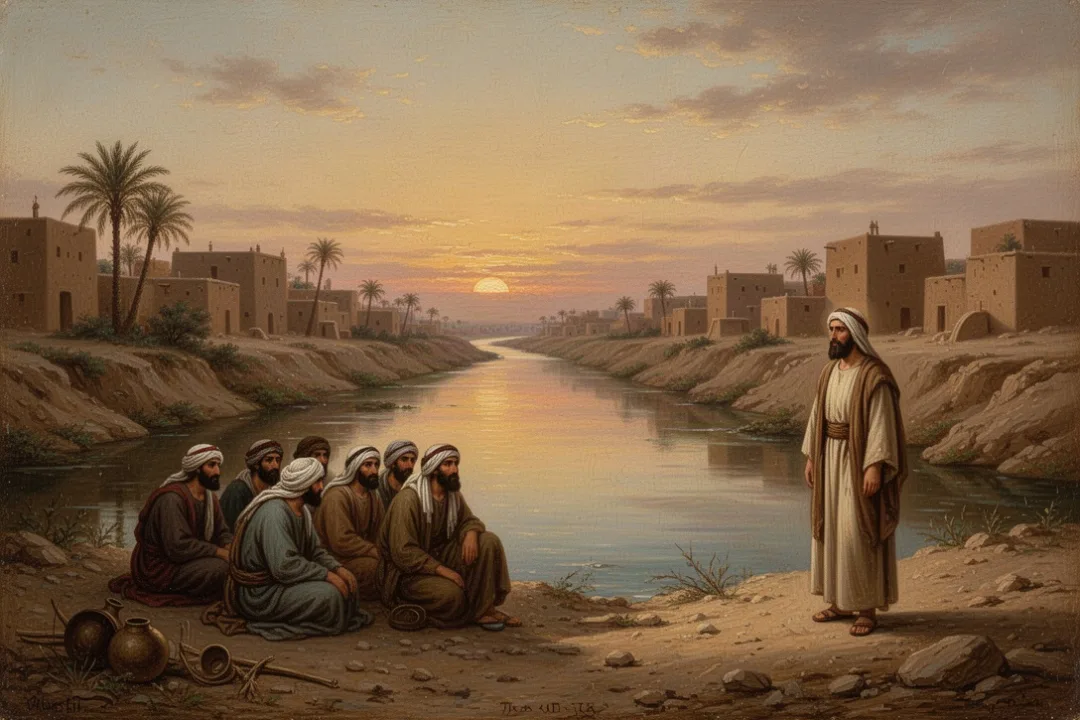
Ezekiel’s prophetic call begins with a vision beside the Chebar canal, in the land of Babylon (Ezekiel 1). The text describes a storm wind, a great cloud, flashing fire, four living creatures, and wheels associated with them. Above the creatures Ezekiel sees something resembling a throne, and above the throne a figure with a human-like appearance surrounded by radiant brightness.
The vision is not presented as a casual religious experience. Ezekiel falls facedown, and a divine voice addresses him as “son of man,” a phrase used repeatedly throughout the book for the prophet. He is sent to a rebellious people who have resisted God. His task is to speak whether the people listen or refuse to listen.
The living creatures and wheels are among the best-known images in Ezekiel. The creatures have multiple faces and wings, while the wheels are described as moving in different directions without turning in the ordinary way. Their appearance communicates order, mobility, and overwhelming power rather than providing a simple mechanical description.
The vision’s most significant message is theological: God’s glory is not trapped inside Jerusalem. A later vision shows the divine glory leaving the temple because of Judah’s unfaithfulness, while other passages show that God is still present with the exiles. This movement challenges the assumption that the destruction of Jerusalem would mean that God had ceased to rule.
Ezekiel’s call also includes a scroll containing words of lament, mourning, and grief. He is told to eat it, and it tastes sweet to him. The image represents his acceptance of the prophetic message, even though the message itself contains judgment and sorrow. Ezekiel must take the words into himself before he can deliver them to others.
His first assignment is to serve as a watchman for Israel (Ezekiel 3). A watchman was responsible for warning a community when danger approached. Ezekiel applies that image to moral responsibility: he must warn people about wrongdoing, while individuals remain accountable for how they respond.
This responsibility appears again in Ezekiel 18 and 33. Those chapters reject the idea that people can simply blame their ancestors for everything they do. Ezekiel emphasizes that each person is answerable for present conduct and that a wrongdoer who turns away from wrongdoing can live. The teaching does not deny communal history, but it places strong weight on personal response.
What Ezekiel did as a prophet
Ezekiel did more than deliver spoken sermons. He used symbolic actions to make his message visible. These actions were often severe, uncomfortable, or physically demanding, reflecting the seriousness of the crisis facing Judah.
He constructed a model of Jerusalem and represented a siege against it (Ezekiel 4).
He lay on his side for an assigned period as a sign bearing the guilt of Israel and Judah.
He measured restricted food and water to portray scarcity during the siege.
He shaved his head and beard, then used the hair in symbolic ways to represent the fate of Jerusalem’s inhabitants (Ezekiel 5).
He packed baggage and moved it through a wall to dramatize exile (Ezekiel 12).
He was told not to mourn publicly when his wife died, making his personal loss a sign of how Jerusalem’s coming disaster would leave the people stunned (Ezekiel 24:15-24).
These actions were not entertainment or theatrical decoration. They allowed Ezekiel to embody the message so that people could see the warning as well as hear it. Some signs represented siege conditions, forced departure, hunger, panic, or the emotional shock that would follow Jerusalem’s fall.
The death of Ezekiel’s wife is one of the most personal episodes in the book. God tells him that she will die, and when she does, he must not follow the expected public customs of mourning. The unusual instruction becomes a sign for the exiles, who will lose the temple and loved ones yet be overwhelmed by the scale of the disaster.
Ezekiel also performed a symbolic action with two sticks in Ezekiel 37. One stick represents Judah and the other represents Joseph, or the northern tribes associated with Israel. When the sticks are joined, the sign expresses a future reunification of the divided people under one rule.
His prophetic work included direct confrontation. Ezekiel criticized false prophets who offered reassurance without confronting the people’s wrongdoing. He also condemned leaders, priests, and officials who exploited the vulnerable. In Ezekiel 34, Israel’s leaders are portrayed as shepherds who fed themselves rather than caring for the flock; God promises to seek the sheep and provide a faithful shepherd.
Another important feature of Ezekiel’s ministry is its emphasis on God’s reputation among the nations. The prophet repeatedly explains that God will act so that Israel and other nations recognize who is sovereign. This does not make Israel’s sin less serious. Instead, it places Judah’s judgment and restoration within a larger understanding of God’s holiness and authority.
What the Book of Ezekiel says
The Book of Ezekiel is traditionally attributed to the prophet and is written largely in the first person. It contains dates, visions, speeches, poetic passages, symbolic actions, and messages concerning Judah, Jerusalem, surrounding nations, and the future restoration of Israel.
A helpful way to understand its broad movement is to follow the book’s major themes:
Ezekiel 1-3: The prophet’s vision and call among the exiles.
Ezekiel 4-24: Signs and messages announcing judgment on Jerusalem and Judah.
Ezekiel 25-32: Oracles against neighboring nations and the rulers of Egypt and other powers.
Ezekiel 33: A turning point after news of Jerusalem’s fall reaches the exiles.
Ezekiel 34-39: Promises of renewed leadership, reunification, land, protection, and restoration.
Ezekiel 40-48: A detailed vision of a restored temple, ordered land, and God’s renewed presence.
The first part of the book explains why Jerusalem will fall. Ezekiel condemns idolatry, injustice, violence, corruption among leaders, and the misuse of the temple. The people’s relationship with God has been damaged not merely by isolated mistakes but by a pattern of rebellion affecting public life, worship, and personal conduct.
Ezekiel 16 uses an extended metaphor of Jerusalem as an unfaithful woman. The language is deliberately shocking and has troubled many readers. It portrays the city’s political alliances and religious practices as betrayal, while also exposing how deeply the prophet understands Judah’s unfaithfulness. The passage should be read with care because it uses disturbing imagery and can be harmful when detached from its historical and literary setting.
Ezekiel 18 addresses a different concern: the proverb that children suffer because of their parents’ wrongdoing. The prophet challenges a fatalistic reading of inherited guilt. He insists that God judges justly, that each person’s conduct matters, and that turning from evil remains possible. The chapter ends with an appeal for a changed heart and a new way of life.
After the fall of Jerusalem, the tone changes. Judgment has not disappeared, but the book increasingly speaks about renewal, cleansing, new leadership, and restored identity. The exiles are not told simply to recover the past. They are promised a transformed relationship with God.
Ezekiel 36 contains the promise that God will gather Israel, cleanse the people, give them a new heart and a new spirit, and enable them to live faithfully. The restoration is described as God’s work rather than something Israel can claim as a reward for its own achievement.
Why Ezekiel’s visions are important
Ezekiel’s visions are central to his identity as a prophet. They are not random puzzles; they use symbolic language to answer questions about holiness, judgment, divine presence, human responsibility, and hope.
The valley of dry bones
The vision of the dry bones in Ezekiel 37 is probably his most famous passage. Ezekiel sees a valley filled with bones that are extremely dry, suggesting that the dead have been gone for a long time. God asks whether the bones can live, and the vision proceeds through stages: bones come together, tissue forms, bodies develop, and breath enters them.
The vision itself explains that the bones represent the whole house of Israel, whose people feel cut off and without hope. Its first meaning concerns the national restoration of a defeated and exiled people. The image of new life expresses God’s power to rebuild a community that appears politically and spiritually dead.
Many Jewish and Christian readers have also connected this vision with resurrection, especially because its imagery is so vivid. The immediate interpretation in Ezekiel, however, focuses on Israel’s restoration from despair and exile. Later interpretations can draw broader theological meaning without erasing the passage’s original setting.
The vision of the restored temple
In Ezekiel 40-48, the prophet sees a future temple and receives measurements for its courts, gates, chambers, and sacred spaces. The detail reflects his priestly concerns, but the vision is more than an architectural plan. It communicates a world in which worship, land, leadership, and communal life are ordered around God’s holiness.
The vision concludes with a powerful declaration about the city’s identity: “The Lord is there” is the meaning of its final name, often rendered in English as “The LORD is there.” The point is not simply that a building has been reconstructed. The defining feature of the restored community is the renewed presence of God among the people.
A river flows from the temple in Ezekiel 47 and becomes deeper and more life-giving as it moves outward. The waters transform the landscape, support living creatures, and make the Dead Sea region fruitful. The image represents life flowing from God’s presence into places associated with barrenness and death.
The wheels and later religious imagery
The opening vision of Ezekiel has influenced Jewish and Christian reflection about heavenly beings, divine chariots, and sacred vision. In Jewish tradition, the study of Ezekiel’s chariot vision became associated with merkavah mysticism. The text’s imagery has also influenced art, literature, preaching, and modern discussions about visions.
Readers should avoid treating the vision as a technical diagram or a prediction of modern machinery. Ezekiel’s language is symbolic, poetic, and shaped by ancient religious imagery. Its purpose is to communicate the majesty, mobility, and holiness of God’s presence.
What makes Ezekiel different from other biblical prophets
Ezekiel shares themes with Isaiah, Jeremiah, and other prophets, including condemnation of injustice, warnings of judgment, and promises of restoration. His distinctive contribution comes from the combination of priestly concerns, exile setting, visionary symbolism, and detailed attention to God’s glory.
Jeremiah prophesied primarily in and around Jerusalem during the crisis, while Ezekiel spoke from the exile community in Babylon. Their messages overlap, but their audiences and experiences differ. Ezekiel’s work helped exiles understand that their relationship with God had not ended simply because they were far from Jerusalem.
His writing is also unusually structured around dates. These time markers place visions and speeches within the unfolding political disaster. The dates create a record of a prophetic ministry that begins before Jerusalem’s fall and continues after the city has been destroyed.
Ezekiel’s language can be graphic. He describes violence, sexual betrayal, corpses, famine, fire, and destruction. Those passages should not be treated as simple moral tales or quoted without context. They belong to a prophetic tradition that uses deliberately forceful images to confront a society facing war, displacement, and the collapse of its institutions.
At the same time, Ezekiel’s message is not only about punishment. The latter part of the book insists that judgment is not the last word. God promises a new shepherd, a cleansed people, a renewed covenant relationship, secure land, a reunited nation, and a sanctuary marked by divine presence.
The main movement of Ezekiel’s message: Jerusalem’s destruction is explained as a consequence of persistent rebellion, but exile does not cancel God’s purposes. Judgment gives way to the promise of a transformed people and renewed presence.
How to read Ezekiel responsibly
Ezekiel becomes easier to understand when you read each passage in its historical and literary setting. A vision of dry bones, for example, should first be read as a message to exiles who believed their national future had ended. A passage about the temple should first be read in light of the destruction of the existing temple and the question of whether God would dwell with the people again.
Several practical habits can help:
Track the setting. Ask whether Ezekiel is addressing exiles, Jerusalem, foreign nations, leaders, or the restored community.
Notice the date. The book’s dates help show whether a message comes before or after Jerusalem’s fall.
Separate symbol from explanation. Ezekiel often follows a vision or action with an interpretation that identifies its main meaning.
Read judgment and hope together. The book’s restoration promises respond directly to the failures and losses described earlier.
Handle violent imagery carefully. Some passages use metaphor, personification, or ancient war language and should not be applied carelessly to modern groups.
The book also raises questions that remain significant for readers today: Can a community recover after catastrophe? What does responsibility look like when people inherit damaged institutions? Can religious identity survive displacement? How should leaders care for vulnerable people rather than exploit them?
Ezekiel’s answer is not that the people can repair everything through willpower. Restoration depends on God’s action, but it includes moral change: a new heart, a new spirit, just leadership, faithful worship, and a community ordered around God’s presence.
So, who was Ezekiel? He was a priest from Judah who became a prophet among the Babylonian exiles, probably beginning his ministry in the early sixth century BCE. Through visions, symbolic actions, warnings, and promises, he explained the fall of Jerusalem and proclaimed that God could bring life, unity, holiness, and hope out of national devastation.
Frequently asked questions
Was Ezekiel a priest before he became a prophet?
Yes. Ezekiel 1:3 identifies him as the son of Buzi and a priest. His priestly background appears throughout the book in his concern for the temple, holiness, sacred boundaries, worship, and the proper ordering of the restored community. The text does not describe a separate career change in modern terms; it presents his prophetic calling as the central work of his life among the exiles.
Where did Ezekiel live when he prophesied?
Ezekiel lived among Judean exiles in Babylon, beside or near the Chebar canal. The location was outside Jerusalem, which made his ministry distinctive. He addressed people who had already experienced deportation while also interpreting the disaster that would soon overtake Jerusalem. His setting shows that biblical prophecy did not depend on remaining in the homeland or temple city.
Did Ezekiel predict the end of the world?
Ezekiel’s visions concern several subjects, including Jerusalem’s fall, Israel’s restoration, foreign nations, a symbolic conflict involving Gog, and a renewed temple. Some later readers interpret these passages in an end-times framework, but the book’s immediate concerns are the judgment and restoration of ancient Israel. Specific predictions about modern events should not be presented as the only or certain meaning of Ezekiel’s visions.
Why is Ezekiel’s writing so difficult to understand?
Ezekiel combines ancient symbolism, priestly language, political history, poetry, visions, and dramatic actions. He often communicates through images rather than direct explanation, although he sometimes interprets those images within the text. Reading the dated sections in order, identifying the audience, and comparing each vision with its explanation can make the book more understandable without reducing its complex imagery to a single interpretation.







Leave a Reply