When a short story stays in your mind long after you hear it, you may be experiencing the same effect Jesus intended with his parables. A tale about a farmer, a lost sheep, a wedding feast, or a traveler on a dangerous road can make a spiritual truth easier to see—and harder to ignore.
Parables in the Bible are usually brief stories, comparisons, or images that communicate moral and spiritual truths. Jesus used them most often, but the Old Testament also contains parable-like stories and symbolic illustrations. Their meanings are not hidden puzzles with a single secret code; they invite you to consider God’s character, human choices, repentance, mercy, and the nature of God’s kingdom.
Central idea: A parable normally makes one main truth vivid through an ordinary situation. Read the story in its biblical setting before assigning a symbolic meaning to every detail.
The word parable refers to placing one thing beside another for comparison. A parable may be a story, an extended metaphor, or a striking picture drawn from familiar life. Biblical parables use things such as seeds, household work, money, meals, family conflict, farming, fishing, and travel to point toward realities that cannot always be seen directly.
Jesus taught in parables because stories could reach both the mind and the conscience. A listener might understand a farming image immediately, yet only later recognize that the story was confronting personal pride, indifference, or unwillingness to forgive. The story creates room for reflection while still making its central challenge clear.
Parables also suited Jesus’ message about the kingdom of God. God’s reign was arriving through Jesus, but it did not always look as people expected. Instead of beginning with political force, it could resemble a seed growing quietly, yeast working through dough, or a net gathering different kinds of fish. These images taught that God’s work may begin in an apparently small or hidden way while still carrying lasting significance.
Some parables reveal the generosity of God, while others warn about judgment. Some comfort people who feel overlooked; others unsettle religious people who assume they are already righteous. The same teacher who described a compassionate father welcoming a lost child also warned about servants who were unprepared and religious leaders who rejected God’s call.
Jesus sometimes explained a parable to his disciples, as with the parable of the sower in Matthew 13, Mark 4, and Luke 8. At other times, he left the audience to respond. This does not mean the stories were designed to make faith impossible. Rather, they exposed whether listeners were willing to hear, reflect, and act on what they had heard.
They clarify spiritual truth through ordinary experiences.
They challenge assumptions about status, goodness, success, and religious respectability.
They invite a response rather than simple agreement with an abstract principle.
They remain memorable because people can picture the characters and situations.
How to interpret parables in the Bible responsibly
A reliable reading begins with context. Ask who told the parable, who heard it, and what question or conflict surrounded it. The parable of the Good Samaritan, for example, appears after a question about the meaning of loving one’s neighbor in Luke 10. That setting matters because Jesus does not merely define a neighbor; he shows that neighborly love crosses social and religious boundaries.
Next, identify the main point suggested by the story and its surrounding explanation. Many parables contain several characters, actions, or objects, but not every feature carries an independent spiritual meaning. A farmer may represent one thing in one parable and serve simply as part of the scene in another.
Pay attention to repeated words, contrasts, surprises, and endings. Biblical storytellers often guide the reader through a clear contrast: wise and foolish builders, compassionate and unmerciful servants, prepared and unprepared attendants, or a self-righteous religious person and a repentant sinner. The unexpected element usually carries much of the force.
It also helps to distinguish between what the parable meant then and how its principle applies now. A first-century listener would have understood details about debt, vineyards, household servants, wedding customs, and village roads differently from a modern reader. The underlying lesson can still speak today, but application should grow from the original meaning rather than replace it.
Before interpreting a story, use these questions:
What prompted Jesus or the biblical speaker to tell it?
What would the original audience have found surprising or challenging?
What contrast, command, warning, or promise stands out?
Does the surrounding passage explain the story’s purpose?
How does the lesson fit with the wider biblical teaching about God and human life?
Parables should not be treated as direct descriptions of every historical or theological detail. For instance, the parable of the rich man and Lazarus in Luke 16 uses vivid imagery to warn against hardheartedness and neglect of the poor. It should be read carefully within its context rather than used alone to construct a complete account of the afterlife.
Helpful guardrail: Start with the story’s central contrast or command. Only after that should you consider secondary details, and only if the wider passage supports the interpretation.
Jesus’ parables about God’s kingdom and spiritual growth
A large group of Jesus’ parables explains the kingdom of God—God’s active rule and saving purpose. In Matthew, Mark, and Luke, these stories show that the kingdom is both present in Jesus’ ministry and moving toward a future completion. It may appear ordinary at first, but its value is greater than its initial appearance.
The sower and the different responses to God’s word
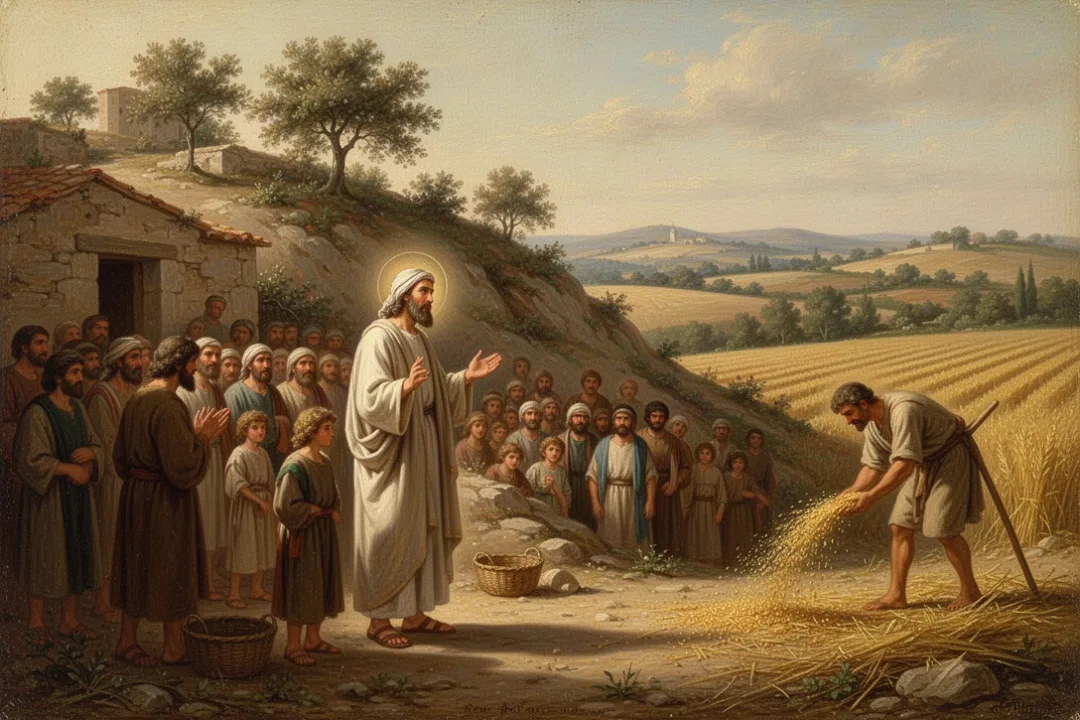
In the parable of the sower, found in Matthew 13, Mark 4, and Luke 8, a farmer scatters seed across several kinds of ground. Jesus explains that the seed represents the message of the kingdom, while the different soils represent different responses to it.
The hard path pictures a person who hears but does not understand, allowing the message to be taken away. Rocky ground represents a shallow response that fades under pressure. Thorny ground represents competing concerns, including anxiety and the attraction of wealth. Good soil represents those who hear, receive, and produce a fruitful life.
The parable does not teach that people are permanently trapped in one category. Its warning is about the conditions that prevent spiritual fruit, while its promise is that receptive hearing can produce an abundant result. The emphasis falls on listening, endurance, and the effect of God’s word on a person’s life.
The mustard seed and the yeast
The mustard seed and yeast parables in Matthew 13 and Luke 13 describe the kingdom’s unexpected growth. A mustard seed is presented as very small compared with the plant it becomes, while yeast works through a large amount of dough from within. Together, the images suggest that God’s reign may begin in an unimpressive form yet develop with powerful results.
These stories would have encouraged people who expected God’s kingdom to arrive with immediate public dominance. Jesus’ ministry could look modest beside the structures of political and religious power. The parables teach patience without suggesting passivity: the small beginning is not insignificant because God is at work through it.
The hidden treasure and the pearl of great value
In Matthew 13, a man discovers treasure hidden in a field and another merchant finds a pearl of extraordinary value. Each responds by selling what he has to obtain the greater treasure. The paired stories emphasize the supreme worth of God’s kingdom and the decisive response it deserves.
The two figures differ in how they find what they value. One appears to discover the treasure unexpectedly; the other is actively searching for fine pearls. The message applies to different spiritual experiences: some people encounter God’s truth suddenly, while others arrive after a long search. In both cases, recognizing its value leads to wholehearted commitment.
The wheat and the weeds
The parable of the wheat and the weeds in Matthew 13 addresses the coexistence of good and evil before final judgment. An enemy plants weeds among a farmer’s wheat, and the workers ask whether they should remove them immediately. The farmer refuses because premature removal could damage the wheat, allowing both to grow until harvest.
Jesus connects the harvest with a future separation, but the story also teaches restraint. Human beings are not given permission to carry out God’s final judgment according to their own limited knowledge. The parable offers patience without moral indifference: evil matters, yet final judgment belongs to God.
Parables about mercy, repentance, and loving your neighbor
Many of the best-known biblical parables answer a question about who deserves love, forgiveness, or welcome. They regularly challenge the assumption that moral worth can be measured by social status, religious reputation, or outward respectability. Their focus is often the mercy of God and the kind of mercy God expects people to show one another.
The Good Samaritan and active neighborly love
The Good Samaritan in Luke 10 begins with a legal question about inheriting eternal life and then a narrower question about who counts as a neighbor. Jesus tells of a wounded traveler ignored by a priest and a Levite but helped by a Samaritan, a person from a group viewed with suspicion by many Jewish listeners.
The Samaritan provides practical care, transports the injured man, pays for lodging, and promises to cover additional costs. Jesus shifts the question from “Which people must I love?” to “Will I become a neighbor to someone in need?” The parable defines neighborly love as compassion expressed through action, not merely warm feelings or correct beliefs.
Its application includes people outside your social circle, congregation, ethnicity, political group, or preferred community. It does not require ignoring healthy boundaries or placing yourself in unnecessary danger. It does require refusing to use another person’s difference as an excuse for indifference.
The lost sheep, the lost coin, and the lost son
Luke 15 brings together three parables about loss and recovery: a shepherd seeks one missing sheep, a woman searches for one lost coin, and a father receives a son who has left home. Each story ends with joy, highlighting heaven’s delight when a sinner turns back to God.
The parable commonly called the Prodigal Son is also a story about two lost sons. The younger son is visibly rebellious, while the older son remains outside the celebration because of resentment and self-righteousness. The father moves toward both: he welcomes the younger child home and pleads with the older child to enter the feast.
The father’s response portrays God as eager to forgive and restore those who repent. At the same time, the older brother warns religious people against treating grace as unfair when it reaches someone they believe is less deserving. The parable does not minimize the younger son’s wrongdoing; it emphasizes the father’s joy when relationship is restored.
The unforgiving servant and receiving mercy
In Matthew 18, Jesus tells of a servant whose enormous debt is canceled by his master. That same servant then refuses to show patience toward someone who owes him a much smaller amount. When the master learns what happened, he condemns the servant’s failure to extend the mercy he received.
The story teaches that people who have received God’s forgiveness must not cling to a spirit of revenge or refuse every opportunity for mercy. Forgiveness does not mean pretending that harm did not occur, removing all consequences, or abandoning wise boundaries. It means refusing to make personal retaliation the governing principle of your life.
Parables that challenge religious pride and reveal the heart
Some parables focus less on public wrongdoing than on hidden attitudes. They expose self-righteousness, hypocrisy, greed, and spiritual complacency. These stories can be uncomfortable because their most serious warnings are often addressed to people who appear religious, responsible, or successful.
The Pharisee and the tax collector
In Luke 18, two men pray in the temple. The Pharisee lists his religious practices and contrasts himself with other sinners, while the tax collector admits his need for God’s mercy. Jesus says the humble tax collector goes home justified rather than the self-confident Pharisee.
The story does not condemn prayer, fasting, generosity, or moral discipline. It condemns using religious behavior as a platform for looking down on others. The central issue is the posture of the heart: the person who knows he needs mercy is closer to God than the person who uses devotion to claim superiority.
The rich fool and the danger of storing wealth
In Luke 12, a prosperous man plans to build larger storage facilities so he can enjoy years of ease. He assumes that abundant possessions will secure his future, but God calls him a fool because his life is about to end. The story follows a warning against greed and the belief that life consists in the abundance of possessions.
The man’s problem is not simply that he owns property or plans ahead. His speech centers on “my” crops, “my” barns, and “my” goods, with no concern for God or other people. The parable asks whether your security, identity, and generosity are being shaped by possessions rather than by faithfulness.
The rich man and Lazarus
In Luke 16, a wealthy man lives in luxury while a poor, sick man named Lazarus lies at his gate. After both die, their conditions are reversed. The rich man’s suffering reveals the seriousness of his indifference, while Abraham points to the testimony already available through Moses and the prophets.
The story condemns comfortable neglect. Lazarus is not presented as earning salvation through poverty, and the rich man is not condemned merely for having money. His guilt lies in seeing desperate need at his own gate and refusing to respond. The closing exchange also warns that spectacular signs will not persuade people who reject the truth they already know.
Parables about readiness, stewardship, and final accountability
Several parables ask how people should live while waiting for God’s purposes to be fulfilled. Their themes include watchfulness, faithful responsibility, perseverance, and judgment. They are not invitations to calculate dates or satisfy curiosity about the future. They call for steady obedience in the present.
The wise and foolish builders
At the end of the Sermon on the Mount in Matthew 7, Jesus compares two builders. One builds on rock, and the other builds on sand. Storms strike both houses, but only one remains standing.
Jesus identifies the solid foundation with hearing his words and putting them into practice. The difference is not exposure to teaching; both builders hear. The difference is obedience. The image also suggests that testing reveals the quality of a foundation. A life built on practice rather than admiration can endure pressure more firmly.
The talents and faithful responsibility
In Matthew 25, a master entrusts different amounts of money to three servants before leaving on a journey. Two servants put what they receive to work, while the third hides his amount in the ground. When the master returns, the first two are commended for their faithfulness, while the third is judged for fear and inactivity.
The parable teaches that faithfulness is measured by responsible use of what has been entrusted, not by comparison with another person’s assignment. The servants receive different amounts, but each is accountable for his response. In application, this can include time, abilities, influence, opportunities, money, and responsibilities—not just public ministry.
The parable is sometimes confused with the similar story of the minas in Luke 19. Both involve servants and money, but they occur in different settings and make distinct narrative points. Treating them as identical can blur the emphasis of each passage.
The ten virgins and readiness for the bridegroom
Matthew 25 describes ten attendants waiting for a bridegroom. Five bring extra oil for their lamps, while five do not. When the bridegroom is delayed, all become sleepy, but only the prepared attendants are ready when he arrives.
The story emphasizes readiness that cannot be transferred at the last moment. Its warning is not about predicting the timing of Christ’s return. It is about refusing to assume that a last-minute response can replace a life of faithful preparation. The delay tests whether expectation is genuine or merely verbal.
The sheep and the goats
In Matthew 25, Jesus portrays a final separation between sheep and goats. The distinguishing evidence is how people treated those who were hungry, thirsty, sick, imprisoned, or in need. Jesus identifies acts of care toward “the least” with service rendered to him.
This passage presents compassionate action as evidence of allegiance to Christ. It should not be reduced to a message that charitable works earn salvation, nor should it be separated from the wider biblical call to faith. Instead, it shows that genuine devotion becomes visible in how people respond to vulnerable neighbors.
Readiness means faithful living, not date-setting.
Stewardship means using what you have received responsibly.
Perseverance matters when obedience feels ordinary or delayed.
Mercy becomes visible in concrete care for people in need.
Accountability reminds you that choices have lasting moral significance.
What the major parables mean for everyday life
Parables become useful when their central truth reaches ordinary decisions. The Good Samaritan can shape how you respond to a stranded neighbor. The unforgiving servant can expose a habit of replaying someone else’s offense. The sower can help you examine whether anxiety, wealth, distraction, or shallow enthusiasm is preventing spiritual growth.
Apply a parable by identifying both the comfort it offers and the correction it requires. The lost son comforts people who fear they are beyond forgiveness, while the older brother corrects people who resent grace given to others. The mustard seed encourages those who see little progress, while the rich fool challenges those who treat material security as permanent.
A practical reading process can look like this:
Read the entire passage, including the verses before and after the story.
Describe the plot plainly before assigning spiritual meanings.
Mark the surprise or conflict that makes the story memorable.
State the main lesson in one sentence.
Choose one concrete response, such as forgiving, giving, listening, repenting, or serving.
Revisit the passage later to see whether your response has changed.
Remember that a parable may address different listeners in different ways. The lost sheep comforts the person who feels forgotten, but it may challenge a community that overlooks one struggling member. The rich fool warns the affluent person about greed, but it can also comfort someone who feels pressured to measure life by possessions.
Parables are not meant to be admired only as ancient stories. They ask you to decide what kind of soil you are becoming, whether you will cross the road to help, how you respond when another person is restored, and whether your life is built on hearing or on obedience. Their enduring force comes from that personal demand: the meaning becomes clearest when the listener responds.
Frequently asked questions
How many parables are in the Bible?
There is no universally agreed number because scholars differ on what counts as a parable. Some count only Jesus’ extended stories, while others include brief comparisons, sayings, and Old Testament examples. The Gospels contain several dozen recognizable parables attributed to Jesus, with the largest collections appearing in Matthew and Luke.
Which Bible book contains the most parables?
The Gospel of Luke is commonly recognized for containing the largest number of distinctive parables, including the Good Samaritan, the Prodigal Son, the rich fool, and the Pharisee and tax collector. Matthew also contains many kingdom parables, especially in chapter 13, while Mark includes a smaller but significant collection.
Are parables always meant to be taken literally?
No. Parables are teaching stories and comparisons, so their characters and events generally communicate a central spiritual truth rather than a complete literal account. Some details establish the setting or advance the plot. Interpretation should focus first on the story’s main point and its context instead of treating every object as a separate symbol.
Why did Jesus sometimes explain parables only to his disciples?
Jesus’ explanations helped his disciples understand the kingdom message and prepared them to teach others. His use of parables also revealed how different listeners responded: receptive hearers sought understanding, while resistant hearers dismissed the message. The stories were not simply intellectual riddles; they called for humility, attention, and a willingness to act.











Leave a Reply