Revelation 18 explained: Babylon, judgment, and hope
Revelation 18 explained: Babylon, judgment, and hope
Revelation 18 announces the collapse of “Babylon,” a symbol of powerful human society organized around wealth, exploitation, idolatry, and opposition to God.
The chapter is not primarily a prediction about one commercial city or a timetable for the end times. It is a dramatic vision showing that systems that appear untouchable can fall suddenly when God judges them. Revelation presents Babylon as impressive, prosperous, and influential, yet morally rotten beneath its surface.
The chapter belongs to the final section of the book of Revelation. Chapter 17 introduces Babylon as a corrupt woman associated with the beast, while chapter 18 focuses more directly on Babylon’s economic power, luxurious lifestyle, political influence, and destruction. Chapter 19 then moves toward praise in heaven and the triumph of God’s judgment.
Babylon is both a historical reference and a symbolic name. In the Old Testament, ancient Babylon stood for pride, conquest, oppression, idolatry, and resistance to God. Revelation uses that familiar name to describe a broader reality: an organized culture of human power that seduces people through prosperity and demands loyalty that belongs to God.
Many first-century readers would also have recognized an allusion to Rome. Rome ruled a vast empire, controlled trade routes, displayed extraordinary wealth, and exercised military and political power over many peoples. Revelation’s language about Babylon may therefore have spoken directly to the pressures faced by Christians living under Roman rule.
Still, Babylon should not be reduced to Rome alone. The symbol can describe any society, institution, empire, or economic order that gains wealth through injustice and treats human beings as instruments. Some Christian traditions expect a future, identifiable world power called Babylon. Others emphasize Rome’s historical setting or see Babylon as a recurring pattern throughout history.
Reading principle: Revelation 18 gives a theological picture of corrupt power rather than enough information to identify every modern nation, city, company, or political event with certainty.
How Revelation 18 describes Babylon’s sudden fall
The chapter opens with an angel announcing that Babylon has fallen. The repeated declaration gives the scene the force of a verdict already settled in heaven, even though the city’s earthly collapse unfolds in the vision. Babylon’s apparent permanence is an illusion; its judgment can arrive quickly and decisively.
The fallen city becomes a dwelling place for demons and unclean creatures. This imagery draws on prophetic descriptions of ruined cities in the Old Testament, especially passages concerning Babylon and other nations under judgment. The point is not to provide a zoological description of a future ruin. It portrays complete desolation and the reversal of Babylon’s former glory.
Babylon had influenced nations through her immorality, often expressed through the biblical image of sexual unfaithfulness. That image refers to more than private sexual behavior. In prophetic literature, adultery and prostitution frequently represent idolatry, political compromise, and the betrayal of covenant faithfulness.
The rulers of the earth are pictured as having committed immorality with Babylon, and merchants become wealthy through her excessive luxury. Political leaders and commercial interests are connected to the city because they benefit from its system. Revelation therefore links political corruption and economic exploitation rather than treating them as unrelated problems.
Why God’s people are told to leave Babylon
A voice from heaven calls God’s people to come out of Babylon so that they will not share in her sins or receive her plagues. This command echoes Old Testament warnings to the exiles in Babylon and similar calls for God’s people to separate themselves from idolatrous practices.
“Come out” does not necessarily mean that every Christian must physically abandon a city, withdraw from society, or refuse all participation in ordinary economic life. The emphasis is on spiritual and moral separation from Babylon’s values. Believers are called to reject the worship of wealth, the normalization of injustice, and the pursuit of status at the expense of faithfulness.
Christians still live, work, shop, vote, and serve within societies that contain both good and evil. The challenge is to participate without allowing the surrounding culture to define what is admirable. Revelation 18 warns that distance from God’s people can be measured by desires and loyalties, not only by physical location.
The command also shows that judgment does not excuse passivity. God’s people are not told to admire Babylon until its collapse, imitate its methods, or assume that prosperity proves divine approval. They are called to recognize its sins and remain faithful before judgment comes.
Which sins bring Babylon under judgment
Revelation 18 names several interconnected forms of evil. Babylon is judged because her influence has spread corruption across nations, her rulers have benefited from her, and her wealth has been built through practices that disregard God and human dignity.
Idolatrous influence: Babylon persuades people to treat created things, political power, luxury, or cultural prestige as ultimate.
Sexual immorality: the imagery points to moral corruption and unfaithful alliances, including the seduction of rulers and societies.
Luxury without restraint: the city celebrates abundance while remaining indifferent to the suffering connected to its prosperity.
Economic exploitation: merchants profit from a system that treats people and resources as commodities.
Violence against God’s people: Babylon is associated with persecution and the blood of faithful witnesses.
Pride and self-sufficiency: the city assumes that its power, wealth, and security will continue indefinitely.
The problem is not that every form of trade, beauty, government, or material possession is inherently evil. Revelation 18 condemns wealth joined to arrogance, exploitation, and spiritual unfaithfulness. The chapter exposes the moral character of a system, not merely the existence of money or urban prosperity.
What the merchants’ grief reveals about Babylon’s economy
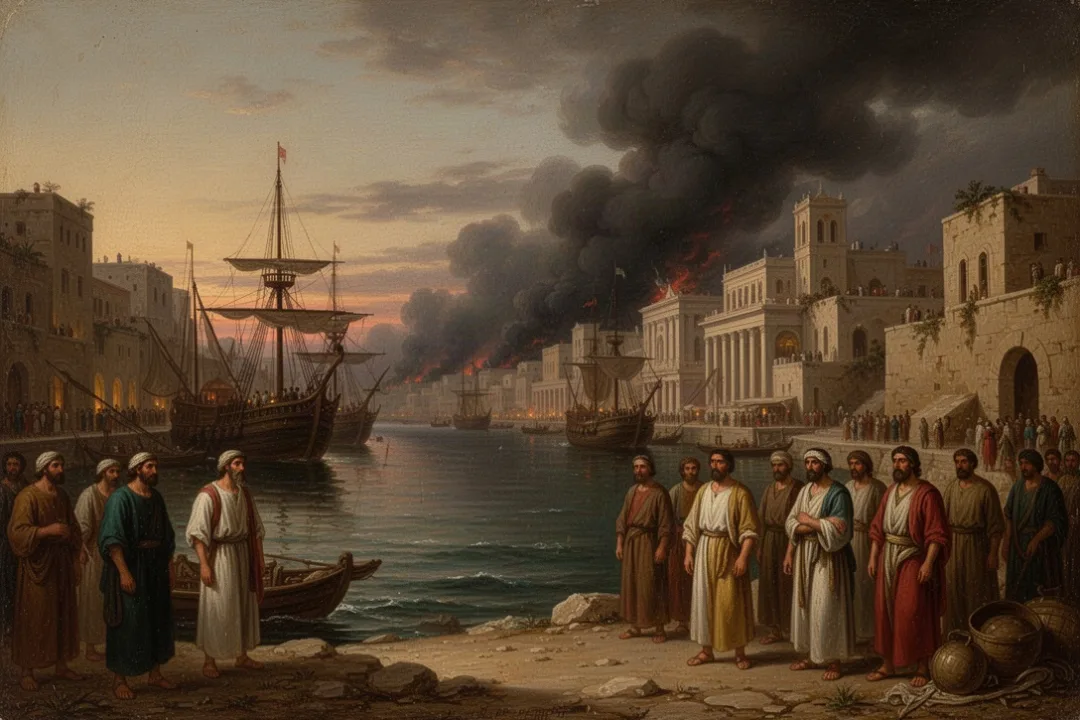
Three groups mourn Babylon’s fall: kings, merchants, and those who work at sea. Their grief is revealing because they do not first mourn the city’s sin or the people harmed by it. They mourn the loss of access to Babylon’s wealth and market.
The kings lament because their political relationships with Babylon have benefited them. They stand at a distance, afraid of the city’s suffering, which suggests that their attachment was based on advantage rather than love. Their reaction exposes how easily political leaders can cooperate with injustice while assuming that consequences will never reach them.
The merchants mourn because no one buys their cargo anymore. Revelation provides a long catalog of goods, including precious metals, stones, fine fabrics, spices, food, livestock, transportation equipment, and enslaved people. The list creates the impression of an entire luxury economy suddenly stopping.
The inclusion of human lives or human beings near the end of the cargo list is especially disturbing. It shows that Babylon’s commerce has crossed a moral boundary: people are treated like merchandise. The chapter refuses to separate elegant luxury from the suffering that may support it.
The seafaring workers also grieve. Those who transported goods and profited from the city’s trade see the smoke of its destruction and mourn the disappearance of their livelihood. Their reaction emphasizes how widely Babylon’s economic influence reaches. When the center collapses, many connected interests lose the benefits they assumed were permanent.
Central warning: Revelation 18 asks whether prosperity has made people love the benefits of an unjust system more than they love truth, mercy, and faithfulness to God.
Why Babylon’s luxury is a spiritual issue
Revelation does not condemn beauty, craftsmanship, celebration, or responsible prosperity by themselves. Scripture contains positive examples of skilled work, generous feasts, wise stewardship, and material blessing. The issue in chapter 18 is luxury detached from love of neighbor and submission to God.
Babylon’s wealth creates a world where almost everything can be purchased, including influence and human labor. Its abundance gives the impression that material success validates the system. Yet the chapter reveals that economic success cannot prove moral legitimacy.
This distinction matters for modern readers. A person may enjoy comfort without personally controlling an exploitative system, and no individual can trace every connection in a global economy. Revelation 18 does, however, challenge believers to examine habits, assumptions, and public choices rather than treating consumption as morally neutral in every circumstance.
The chapter also critiques the spiritual danger of luxury. Excess can make dependence on God seem unnecessary. When security comes from possessions, connections, and institutions, a person may begin to regard worship, repentance, justice, and generosity as optional.
How Revelation 18 portrays God’s justice
God’s judgment on Babylon is described as deserved, proportionate, and certain. The city’s sins have accumulated, and God remembers them. This does not mean that God has been unaware of evil until the final judgment. It means that the time for public accountability has arrived.
One difficult feature of the chapter is its call for heaven and God’s people to rejoice over Babylon’s judgment. Read carelessly, this can sound like a celebration of suffering. The context, however, presents rejoicing as the recognition that God has acted justly, vindicated those who were oppressed, and ended a violent system that appeared unstoppable.
Revelation contrasts Babylon’s loud commercial celebration with heaven’s worship. Babylon’s songs, feasts, and trade have been silenced. Heaven praises God because truth has defeated propaganda and justice has answered oppression.
That does not authorize personal revenge. The chapter does not instruct Christians to harm enemies or take judgment into their own hands. Elsewhere in the New Testament, believers are told to leave vengeance to God and to pursue peace where possible. Revelation 18 places final retribution in God’s hands precisely because human beings are not qualified to exercise perfect judgment.
What the repeated “in one hour” language means
Revelation repeatedly emphasizes that Babylon’s wealth and power disappear in a single hour. The phrase highlights speed, shock, and reversal. A city that had seemed secure can be ruined before its allies have time to respond.
The wording should not automatically be treated as a precise sixty-minute prediction. Apocalyptic literature often uses compressed, symbolic language to communicate theological certainty and suddenness. The central message is that God’s judgment will not be delayed forever, and human systems cannot guarantee their own survival.
The suddenness also exposes misplaced confidence. Babylon says, in effect, that she is secure and will never experience mourning or loss. Her confidence collapses because it is based on wealth rather than God. Revelation invites readers to ask what they have assumed will always protect them.
How Babylon’s destruction connects with the rest of Revelation
Revelation 18 should be read alongside the chapters around it. Chapter 17 emphasizes Babylon’s relationship with the beast and her influence over rulers. Chapter 18 expands the economic and cultural picture. Chapter 19 responds with worship, judgment, and the announcement of the Lamb’s victory.
This sequence moves from seduction to exposure, exposure to judgment, and judgment to worship. Babylon’s power appears attractive before it is revealed as corrupt. Once it falls, heaven does not mourn the loss of luxury; it rejoices that the system no longer persecutes the faithful or deceives the nations.
The chapter also prepares readers for the contrast between Babylon and the holy city in Revelation 21 and 22. Babylon is associated with impurity, exploitation, and death. The New Jerusalem is associated with God’s presence, healing, holiness, and life. These two cities represent competing visions of human existence.
Practical ways to read Revelation 18 faithfully
Revelation’s imagery can encourage speculation, especially when readers try to match every symbol with a headline or current institution. A careful reading keeps the chapter’s moral and theological message central.
Begin with the chapter’s first-century setting. Ask how imagery about Babylon, Rome, trade, rulers, and persecution would have challenged the original audience.
Separate clear themes from uncertain identifications. The chapter clearly condemns arrogant and exploitative power; it does not provide a universally agreed label for every modern society.
Read symbols through the Old Testament. The language of Babylon, merchants, plagues, judgment, and exile draws heavily on earlier biblical patterns.
Watch for the moral question behind the image. Instead of asking only, “Who is Babylon?” ask, “What kind of power does Babylon represent, and where do I see its values?”
Keep judgment and discipleship together. The chapter warns about God’s justice while also calling God’s people to leave sinful patterns.
Read Revelation as a book of hope. Babylon’s fall is not the last word. God’s justice clears the way for faithful worship and the renewal described later in the book.
Common mistakes when interpreting Revelation 18
Reducing Babylon to one modern city: The symbol may have historical connections to Rome, but its meaning is broader than a simple geographical prediction.
Setting an exact date for the fall: The chapter emphasizes certainty and suddenness, not a calendar calculation.
Calling all wealth sinful: The target is luxurious oppression, idolatrous dependence, and exploitation rather than every possession or business activity.
Ignoring the enslaved people in the cargo list: This detail is central to the chapter’s exposure of dehumanizing commerce.
Using the chapter for political revenge: God’s judgment is not permission for Christians to attack opponents or declare their own enemies damned.
Reading “come out” as total social withdrawal: The command concerns rejecting Babylon’s sins and loyalties, not necessarily abandoning ordinary life and public responsibility.
Focusing only on predictions: Revelation 18 also addresses everyday questions about worship, consumption, ambition, justice, and solidarity with the oppressed.
What Revelation 18 means for Christian life today
The chapter calls for moral alertness. You may live in a society that rewards speed, status, consumption, and competition, yet those values should not become your deepest measure of success. Faithfulness may require refusing opportunities that depend on deception, exploitation, or harm to vulnerable people.
It also calls for honest examination of comfort. You do not need to feel guilty for every ordinary purchase, nor can you personally solve every injustice in a complex economy. You can still ask practical questions: Who may be harmed by this choice? Does this company or institution treat people with dignity? Am I pursuing more simply because I need it, or because I want status and security?
Churches can apply the warning corporately. A congregation may resist Babylon by practicing financial transparency, caring for the poor, refusing favoritism, supporting victims of exploitation, and measuring ministry by faithfulness rather than prestige. Christian witness becomes distorted when churches imitate the advertising, celebrity, and power-seeking habits of the culture they are meant to challenge.
Revelation 18 also offers comfort to people who have seen injustice go unanswered. Exploitative systems may be protected by wealth, law, reputation, or political alliances for a time. The chapter insists that God sees what powerful institutions conceal and that no empire is beyond accountability.
Finally, the chapter teaches Christians not to confuse visibility with victory. Babylon is loud, wealthy, and influential, but it is temporary. God’s kingdom may appear less impressive by the standards of commerce and political power, yet it is the kingdom that endures.
Why Revelation 18 still gives hope
Although the chapter contains severe judgment, its purpose is not despair. Babylon’s fall means that oppression is not eternal, exploitation will not have the final word, and the suffering of faithful people is not forgotten. God’s justice creates the possibility of a world no longer organized around domination and greed.
The chapter therefore asks for both courage and humility. Courage is needed to resist systems that reward compromise. Humility is needed because no individual or church should assume immunity while benefiting from the same attitudes Revelation condemns.
Revelation 18’s lasting message is clear: human power built on pride and exploitation will collapse, but God’s purposes will stand. Believers are called to recognize Babylon, refuse its loyalties, care about those harmed by its practices, and trust God to judge with perfect justice.
Frequently asked questions
Is Babylon in Revelation 18 a real city?
Babylon may refer to historical Babylon as a biblical symbol and to Rome as a likely first-century reference. Many Christians also understand it as a broader or future system of political, economic, and religious corruption. The chapter’s message does not depend on identifying one modern location. It focuses on the downfall of proud, exploitative power that opposes God.
Does “come out of her” mean Christians must leave society?
Not necessarily. The command primarily calls believers to separate themselves from Babylon’s sins, values, and loyalties. Christians can participate in ordinary work and civic life while rejecting idolatry, exploitation, dishonesty, and materialistic pride. In some circumstances, physical separation from a harmful environment may be wise, but total withdrawal is not the only meaning.
Does Revelation 18 condemn all wealth and business?
No. The chapter condemns wealth connected with pride, luxury without mercy, exploitation, slavery, and corruption. Scripture can affirm honest work, generosity, responsible ownership, and trade. Revelation 18 challenges readers to examine how wealth is gained, whom an economic system harms, and whether prosperity has become an object of worship or a substitute for dependence on God.
Why do heaven and God’s people rejoice when Babylon falls?
Their rejoicing expresses relief that God has ended a system responsible for deception, oppression, and persecution. It is not a command for personal cruelty or revenge. The chapter places final judgment with God and celebrates the restoration of justice. Christians should respond to evil with faithfulness and compassion while trusting God to judge more perfectly than human beings can.







Leave a Reply