Isaiah speaks to a nation facing military danger, political confusion, religious failure, and the consequences of injustice. Its message is not limited to one crisis. The book moves from warnings about judgment to promises of restoration, from Jerusalem’s immediate troubles to a vision of renewed creation. That movement gives Isaiah unusual depth for both historical study and personal reflection.
The prophet repeatedly challenges misplaced trust. Judah looked to political alliances, military strength, religious rituals, and foreign powers for security. Isaiah insists that trust in God must shape public life, worship, leadership, and decisions about justice. At the same time, he offers genuine hope: God will preserve a remnant, establish righteous rule, gather scattered people, and bring light to the nations.
Central idea: Isaiah holds judgment and hope together. Human rebellion has serious consequences, but God’s purposes for holiness, mercy, restoration, and worldwide blessing will not fail.
Historical context for studying Isaiah
Isaiah ministered in the kingdom of Judah during the eighth century BCE, when Assyria was the dominant imperial power in the ancient Near East. The opening verse places his prophetic work during the reigns of Uzziah, Jotham, Ahaz, and Hezekiah. These kings ruled in a period marked by military expansion, international pressure, and spiritual compromise.
The northern kingdom of Israel and the kingdom of Syria threatened Judah, while Assyria posed an even greater danger. Later, Assyria destroyed the northern kingdom and attacked Judah. The crisis surrounding Jerusalem during the reign of Hezekiah forms an important setting for chapters 36–39. Isaiah’s messages address real political events, but he interprets those events through the character and purposes of God.
Judah’s problems were also internal. Isaiah condemns exploitation of the poor, dishonest courts, corrupt leadership, empty worship, and dependence on political schemes. His criticism is not aimed at religious practice itself. He objects to worship that remains outward while people ignore mercy, righteousness, humility, and obedience.
Chapters 40–55 speak to people living with the reality of exile or looking toward restoration after catastrophe. Chapters 56–66 address the life and hopes of a restored community. Because the book reflects several historical settings, readers should avoid treating every chapter as though it describes the same moment.
A step-by-step method for studying Isaiah
Isaiah contains poetry, sermons, symbolic actions, historical narrative, hymns, courtroom scenes, and visions of the future. A careful method helps you notice how each part works before you apply its message.
Read the passage several times. Mark repeated words, contrasts, commands, questions, images, and changes in speaker.
Identify the setting. Ask whether the passage addresses Judah, another nation, exiles, a future community, or an individual servant figure.
Locate the literary unit. Study a complete oracle, poem, narrative, or vision rather than isolating a single sentence.
Observe the problem. Look for idolatry, injustice, fear, pride, unbelief, political dependence, or the suffering caused by judgment.
Describe God’s action. Isaiah may portray God judging, warning, defending, forgiving, gathering, creating, or reigning.
Trace the movement. Many passages move from sin to judgment, from distress to trust, or from exile to restoration.
Compare related passages. Repeated images such as the vineyard, highway, remnant, servant, and mountain often develop across the book.
Apply the passage carefully. Ask what it reveals about God, human responsibility, community life, hope, and faithful response without skipping its original setting.
A notebook divided into four columns can make the process manageable. Record the historical setting, the literary observations, the theological message, and the questions that remain. This prevents a familiar verse from becoming detached from the larger argument.
How the book of Isaiah is organized
Isaiah has 66 chapters, but chapter numbers were added much later and do not always mark the boundaries of the prophet’s main arguments. The book can be studied in broad movements while still recognizing smaller sections within them.
Chapters 1–12: Judah’s sin, Jerusalem’s crisis, the coming judgment, and promises connected with David’s line.
Chapters 13–27: Oracles concerning nations, the downfall of human pride, and visions of God’s universal reign.
Chapters 28–35: Warnings against political alliances and promises of God’s protection, justice, and restoration.
Chapters 36–39: Historical narratives about Assyria, Hezekiah, Isaiah, and the announcement of future Babylonian exile.
Chapters 40–48: Comfort for exiles, God’s uniqueness, the weakness of idols, and the promise of return.
Chapters 49–55: The servant’s mission, suffering, redemption, restoration, and a renewed relationship with God.
Chapters 56–66: The restored community’s responsibilities, continuing sin, future glory, judgment, and new creation.
These divisions are useful guides, not rigid compartments. Themes cross the boundaries. For example, the contrast between trusting God and trusting human power appears in the early historical material and returns in later promises about liberation and restoration.
Isaiah’s vision of God’s holiness
Isaiah’s theology begins with God’s holiness. In the vision of Isaiah 6, heavenly beings proclaim God’s holiness, and the prophet becomes aware of his own uncleanness. The scene shows that Isaiah’s calling is not based on personal confidence or moral superiority. He is confronted by God’s majesty, receives cleansing, and is sent to speak.
Holiness in Isaiah means more than moral purity. It describes God’s absolute otherness, authority, reliability, and power. The “Holy One of Israel” is not a distant abstraction. This title connects God’s transcendent holiness with a particular covenant people, even when that people is rebellious.
God’s holiness explains both judgment and mercy. Evil cannot be treated as harmless, but God’s holiness also makes his promises dependable. Human leaders fail, empires rise and fall, and religious institutions become corrupt; the Holy One remains faithful to his purposes.
Isaiah’s vision turns fear of God’s presence into a call to faithful service.
Judgment, justice, and the remnant
Isaiah does not describe judgment as an arbitrary punishment. It exposes what injustice and idolatry produce. The wealthy take land, judges accept dishonest influence, rulers pursue self-interest, and people seek security from gods that cannot save. Isaiah therefore connects spiritual unfaithfulness with social injustice.
The prophet uses images such as a vineyard that produces bad fruit, a city filled with corruption, and a people who are spiritually blind or deaf. These images communicate that Judah’s problem is not a lack of information. The people have received warning, but they refuse to respond.
Yet judgment does not erase hope. Isaiah often speaks of a remnant—a surviving group through whom God will continue his purposes. The remnant is not presented as a self-congratulating elite. It is a community preserved and refined by God, called to live differently after judgment.
This pattern helps explain why Isaiah can move quickly between severe warnings and promises of restoration. The book is not contradicting itself. It distinguishes between the end of sinful systems and the preservation of God’s redemptive work.
Trusting God instead of political power
One of Isaiah’s clearest recurring conflicts concerns the source of security. Judah’s leaders considered alliances with Assyria, Egypt, and other powers. Isaiah warns that these arrangements cannot provide the safety they promise. Political decisions matter, but no government can replace dependence on God.
This teaching should not be reduced to a command to ignore practical action. Isaiah criticizes the assumption that strategy, wealth, or military force can guarantee the future. He calls the nation to quiet confidence, repentance, justice, and wise obedience rather than panic or manipulation.
The historical narrative in chapters 36–39 illustrates this theme. Assyria threatens Jerusalem, and the crisis forces the king and the people to decide where their confidence lies. The narrative also looks ahead to Babylon, showing that one deliverance does not mean every future danger has disappeared.
For modern readers, the principle applies beyond international politics. Careers, savings, institutions, public influence, and personal planning can all be useful, but Isaiah asks whether they have become substitutes for trust. The question is not whether preparation is wrong. It is whether fear has made human control the highest authority.
The promised king and righteous rule
Isaiah contains several passages about a coming ruler connected with David’s line. In chapters 7–11, the prophet addresses immediate political circumstances while also presenting a larger vision of leadership marked by justice, wisdom, and peace. The promised ruler differs from the kings who exploit power or fail to trust God.
Isaiah’s royal hope includes righteous judgment, protection for the vulnerable, and peace among creation. The imagery is poetic and expansive. It portrays a world in which violence is restrained, knowledge of God spreads, and the nations recognize the significance of God’s reign.
Jewish and Christian readers have interpreted these royal texts in different ways. In Jewish interpretation, they may be connected with hopes for an ideal Davidic king, national restoration, and the future age of redemption. Christian interpretation frequently reads them in relation to Jesus and the New Testament’s presentation of his identity and mission. A responsible study should acknowledge both the original setting in Isaiah and the later interpretive traditions.
The servant passages and their meaning
Several passages in Isaiah 40–55 describe a “servant.” The servant is sometimes clearly identified with Israel, while other passages portray the servant as an individual who represents Israel and has a mission to Israel and the nations. The servant’s role includes bringing justice, restoring the people, and serving as a light beyond Israel.
The servant songs are especially significant in chapters 42, 49, 50, and 52–53. The servant is called, opposed, obedient, and in the final song associated with suffering that somehow contributes to the good of others. Interpretation requires attention to the surrounding chapters rather than assuming every use of “servant” refers to the same figure in exactly the same way.
Christian readers commonly connect the suffering servant with Jesus, drawing on New Testament references and the themes of innocent suffering, sacrifice, and exaltation. Jewish readings may understand the servant in relation to Israel, a faithful remnant, or an individual righteous figure, depending on the passage and interpretive tradition. The text’s own questions about mission, suffering, faithfulness, and restoration remain central in every reading.
Reading tip: When studying Isaiah 52–53, read the entire servant song and ask who speaks, who suffers, who benefits, and how the servant’s suffering relates to restoration.
Comfort, new exodus, and return from exile
Isaiah 40 begins a major shift in tone. The people who have experienced judgment are addressed with words of comfort and hope. God is portrayed as a shepherd who gathers and carries his flock, while the landscape becomes a way through which the returning people can travel.
The return from Babylon is described with imagery that recalls the exodus from Egypt. This does not mean the two events are identical. Isaiah presents the later return as a new act of deliverance, showing that God’s power to save is not limited to the past.
Several themes appear together in these chapters: God’s uniqueness, the emptiness of idols, the certainty of his word, the restoration of Jerusalem, and the inclusion of the nations. The comfort Isaiah offers is not shallow reassurance. It is based on God’s sovereignty over history and his commitment to redeem.
The book also confronts fear. Exiles may feel forgotten, powerless, or permanently displaced. Isaiah answers by declaring that empires are temporary, while God’s purposes endure. Hope rests not in the strength of the displaced community but in the faithfulness of the One who calls it home.
Isaiah’s teaching about the nations
Isaiah speaks frequently about surrounding nations, including Assyria, Babylon, Egypt, Moab, and others. These oracles show that God is not merely a tribal deity concerned with Judah alone. He judges every nation, including those used as instruments of judgment against Judah.
The nations are accountable for violence, arrogance, and oppression. At the same time, Isaiah’s final vision is not simply Israel’s triumph over everyone else. Many passages look toward the nations coming to God’s light, learning peace, and participating in worship.
This universal horizon is one of the book’s most important features. Election does not mean favoritism without responsibility. Israel is called to become a channel through which God’s blessing and knowledge reach the wider world.
Worship, fasting, and practical righteousness
Isaiah challenges the idea that religious ceremony can compensate for injustice. In chapter 1, sacrifices and gatherings are rejected because the community’s conduct contradicts its worship. In chapter 58, fasting is criticized when people continue to exploit workers and neglect those in need.
The positive alternative is concrete. Isaiah calls people to release the oppressed, share food with the hungry, shelter the vulnerable, and care for those without protection. These instructions do not turn faith into mere social activism. They show that genuine worship changes how people treat neighbors and use power.
Examine whether worship is joined to truthful and compassionate conduct.
Look for people who carry the burden of a community’s economic or political decisions.
Test religious claims by their treatment of the vulnerable.
Practice repentance through repaired relationships and changed behavior.
Remember that justice in Isaiah includes both personal conduct and public structures.
This emphasis makes Isaiah especially relevant for congregations, families, leaders, and institutions. The prophet does not permit private devotion to become an excuse for public indifference.
How to study difficult poetry and prophecy
Isaiah uses symbols that can be misunderstood when read like straightforward news reporting. Mountains may represent obstacles or places of divine revelation. Wilderness can signal judgment, transformation, or the route of return. Light and darkness often describe revelation and distress, while blindness and deafness can describe spiritual resistance.
Start with the image’s function in its paragraph. Ask what changes before and after it appears. Then compare the image with other uses in Isaiah. A symbol should be interpreted by the book’s patterns, not by a private association formed from one verse.
Prophetic speech also shifts between near and distant horizons. A passage may address an immediate king, describe a coming judgment, and present a future vision in the same poetic movement. This is why rigid predictions about one modern event can miss the passage’s broader theological purpose.
Use several tools when possible: a Bible translation with notes, a historical background resource, a cross-reference system, and a commentary that explains literary structure. Read interpretations from more than one tradition when studying disputed passages, especially those involving the servant, the nations, or the end of the book.
A practical reading plan for Isaiah
A full reading can be completed in several stages rather than one uninterrupted sitting. The following plan gives each major movement enough space for reflection.
Read chapters 1–12 to identify Judah’s failures, Isaiah’s calling, the remnant, and the hopes surrounding Davidic leadership.
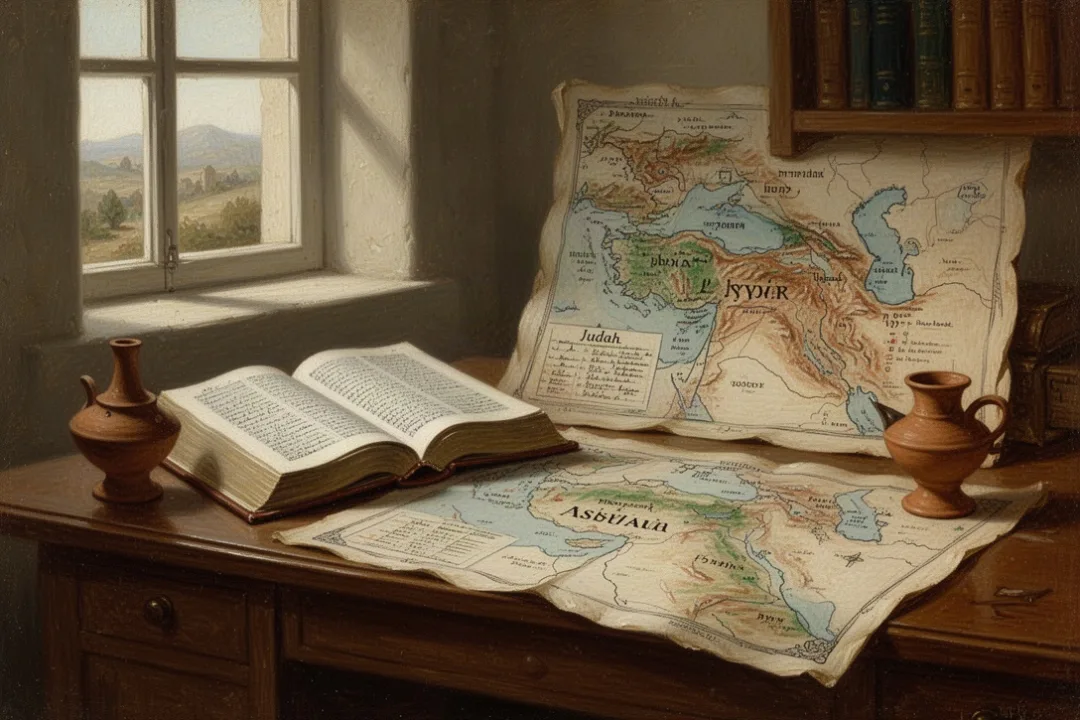
Read chapters 13–27 with a map of the ancient Near East, noting how judgment on nations connects with God’s universal rule.
Read chapters 28–35 while tracking every warning about alliances, fear, pride, and misplaced confidence.
Read chapters 36–39 as historical narrative and ask how the events interpret the earlier prophecies.
Read chapters 40–48 by marking every reason given for hope, comfort, return, and trust.
Read chapters 49–55 slowly, concentrating on the servant, redemption, covenant, and the invitation to receive God’s grace.
Read chapters 56–66 by comparing the community’s failures with the promised future of worship, justice, and renewed creation.
After each session, write one sentence describing the passage’s main claim about God and one sentence describing the response it calls for. That simple discipline keeps study grounded in the text rather than in isolated impressions.
Questions to ask while applying Isaiah
Isaiah should not be applied by transferring every historical detail directly into modern life. A more careful approach identifies the enduring principle and then considers how it works in a different setting.
Ask whether you are trusting a created thing as though it were ultimate. Ask how your worship relates to your treatment of people with less power. Ask what forms of pride, fear, or injustice Isaiah would expose in your community. Ask where the book’s promises invite patience, courage, repentance, or hope.
For group study, assign different readers to track different themes: one person can follow judgment, another can mark references to the remnant, another can observe servant language, and another can record images of Zion and the nations. Comparing those observations often reveals connections that are easy to miss when reading alone.
Isaiah rewards patient reading because its message is deliberately larger than one moment. It speaks to a threatened kingdom, a grieving exiled people, a restored but imperfect community, and anyone who must decide where to place trust. Its deepest promise is that God’s holiness does not cancel mercy; it purifies, judges, and ultimately directs history toward restoration.
Frequently asked questions
Who wrote the book of Isaiah?
The book is traditionally associated with Isaiah son of Amoz, a prophet active in Judah during the eighth century BCE. Many scholars also examine how later disciples, editors, or prophetic communities preserved and shaped material addressing exile and restoration. These views differ, but both recognize the book’s strong literary unity and its sustained focus on God’s holiness, judgment, redemption, and worldwide purposes.
Why does Isaiah seem to change subjects and historical periods?
Isaiah brings together material from different settings and uses prophetic poetry that can move between immediate events, future judgment, and restoration. The shift is part of the book’s design: Judah’s crisis becomes a lens for discussing exile, return, kingship, the nations, and renewed creation. Reading each unit in context helps distinguish its original setting while tracing its recurring themes.
What is the best way to study Isaiah in a group?
Read a manageable section aloud, identify its speaker and audience, and list repeated images before discussing interpretation. Give group members different themes to track, such as justice, holiness, trust, the servant, or the nations. Use a map and historical notes for context, and allow room for Jewish and Christian interpretations where the text has been read in significantly different ways.
How long does it take to study Isaiah?
Reading all 66 chapters may take a few weeks, but careful study usually takes longer. A useful plan is to read one literary unit at a time and revisit major passages after completing each larger section. Allow extra time for chapters 6, 36–39, 40–55, and 56–66 because their structure and themes are especially important for understanding the whole book.









Leave a Reply