When you read a difficult news story or face a season that has disrupted everything familiar, you may ask where God is and what comes next. The book of Ezekiel addresses that kind of crisis. It speaks to Judeans living through national defeat, forced exile, and the destruction of Jerusalem, explaining why judgment came while also promising that God had not abandoned his people.
Ezekiel is a book about God’s holiness, human responsibility, judgment, restoration, and renewed worship. Its visions can seem strange, but they serve a clear purpose: they show that God is not confined to one city or building, that wrongdoing has serious consequences, and that restoration must include changed hearts as well as rebuilt homes.
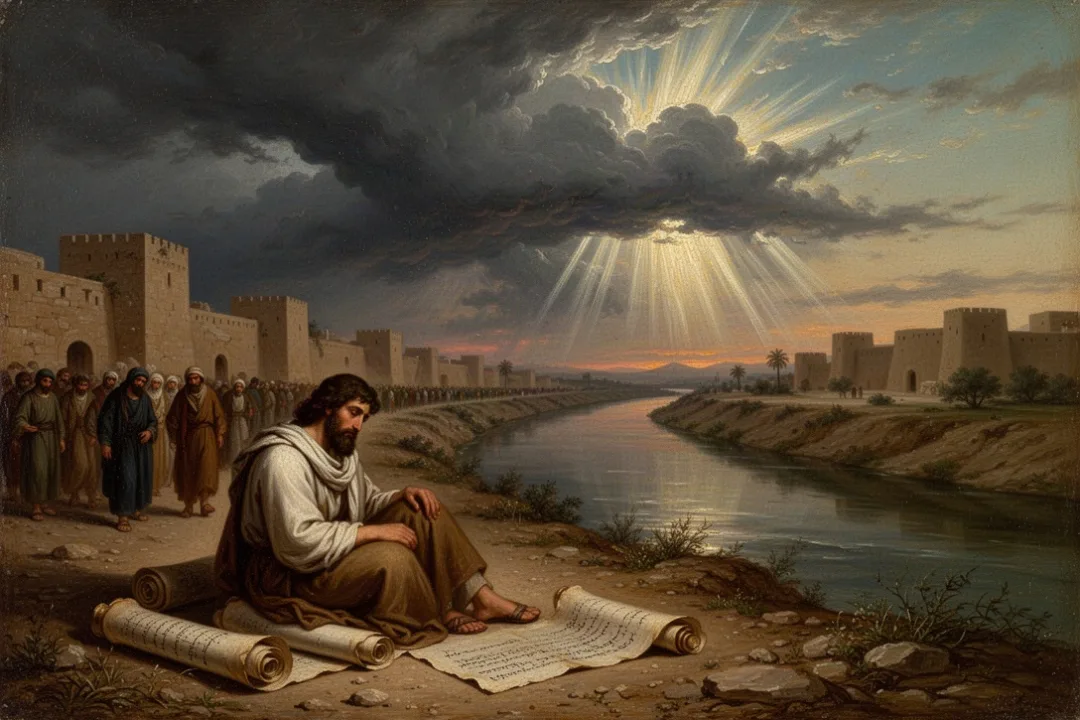
Ezekiel was a priest from Judah who lived among the exiles in Babylon. He received his prophetic calling during the sixth century B.C., after Babylon had conquered Jerusalem and deported groups of Judeans. His messages speak both to people already living in Babylon and to those still in Jerusalem who believed the city would somehow escape disaster.
The book begins with Ezekiel beside the Kebar River, a canal or waterway in Babylonian territory. That setting matters because the opening vision shows God’s glory appearing outside Jerusalem. The message is unsettling but essential: exile has not placed God beyond reach, and the Lord’s presence is not limited to the temple in Jerusalem.
Ezekiel’s audience was divided. Some exiles hoped to return quickly, while others may have assumed that life in Babylon meant their relationship with God was over. People in Jerusalem often trusted the temple, the city’s political status, or their ancestry to protect them. Ezekiel challenges each false source of security.
Central idea: Ezekiel explains the fall of Jerusalem as a consequence of persistent unfaithfulness, yet it also presents exile as a setting where God can purify, gather, and renew his people.
How the book of Ezekiel is organized
The book follows a broad movement from judgment to hope. Its arrangement helps readers see why the severe early messages are connected to the later promises of restoration.
Chapters 1–3: Ezekiel’s call and his first vision of God’s glory.
Chapters 4–24: Warnings against Jerusalem and explanations of its coming judgment.
Chapters 25–32: Oracles against neighboring nations that opposed Judah or took advantage of its collapse.
Chapters 33–39: A transition from Jerusalem’s fall to promises of renewed Israel, including the vision of dry bones.
Chapters 40–48: A detailed vision of a restored temple, an ordered land, and God’s enduring presence.
The turning point comes when news reaches Ezekiel that Jerusalem has fallen. Before that event, his task is mainly to warn people who refuse to listen. Afterward, his ministry emphasizes comfort, responsibility, reunification, and future restoration. The book does not treat hope as a denial of judgment; hope emerges after the truth about judgment has been faced.
What Ezekiel’s opening vision reveals about God
Ezekiel’s first vision is one of the Bible’s most memorable scenes. He sees a stormy cloud, fire, radiant light, living creatures, and remarkable wheels. Above them appears a throne-like form surrounded by brilliance. Ezekiel does not present the vision as a simple physical description. Its imagery communicates movement, power, awareness, and overwhelming holiness.
The living creatures and wheels suggest that God’s authority is not static or restricted to one place. The wheels can move in every direction, and the vision emphasizes their connection with the living creatures. For exiles who associated God’s presence with the Jerusalem temple, this was a major theological statement: God remains sovereign in Babylon.
The vision also creates distance between God and human beings. Ezekiel falls facedown when he sees the divine glory, and he must be addressed and empowered before carrying out his mission. The scene presents a God who is near enough to speak but so holy that people cannot approach casually or control him.
Many readers focus on identifying the wheels or creatures, but Ezekiel’s main concern is not mechanical detail. The vision establishes the authority of his message. His warnings and promises come from the God whose glory can appear amid exile, political collapse, and personal disorientation.
Why Ezekiel uses symbolic actions and startling images
Ezekiel often communicates through actions as well as speeches. He acts out a siege, lies on his side for an extended period, prepares limited food, shaves his hair, and uses other signs to dramatize what will happen to Jerusalem. These actions function like visible sermons for an audience that has grown resistant to ordinary preaching.
One sign depicts the city’s coming siege and the scarcity that will accompany it. Another uses Ezekiel’s hair to represent the fate of Jerusalem’s inhabitants. These images are severe because Ezekiel is describing war, famine, disease, killing, and exile. The prophet’s unusual behavior is intended to make the coming crisis impossible to ignore.
His symbolic actions also show that judgment is not random. The people’s corruption, violence, idolatry, and injustice have created consequences that affect the entire community. Ezekiel insists that religious rituals cannot protect a society that refuses to live faithfully.
The book includes other powerful images, including a cooking pot, an unfaithful spouse, a failed vine, and a great eagle. These metaphors address political alliances, spiritual betrayal, royal ambition, and misplaced trust. They are not always meant to be decoded into one neat answer. Their purpose is to expose attitudes that people have tried to hide from themselves.
How Ezekiel explains Jerusalem’s judgment
A central question in Ezekiel is why Jerusalem fell. The people had the temple, the traditions of Israel, and the promises associated with David’s line. Ezekiel answers that these privileges did not cancel the demands of covenant faithfulness. The city had become marked by idolatry, oppression, bloodshed, corruption among leaders, and contempt for God’s commands.
In the vision of the temple, Ezekiel is shown practices that defile the sanctuary. The point is not that the temple itself was worthless. Rather, the people had treated sacred space as a shield while bringing injustice and false worship into their communal life. The presence of a religious building could not compensate for persistent disobedience.
Ezekiel also describes God’s glory leaving the temple. This is one of the book’s most serious images. It shows that judgment includes the withdrawal of the divine presence from a city that has repeatedly profaned what is holy. Yet the wider book makes clear that God’s glory does not disappear; it moves beyond the destroyed center and later returns in the restoration vision.
The prophet’s explanation differs from the claim that Jerusalem fell because its God was defeated by Babylon’s gods. Ezekiel presents Babylon as an instrument permitted within God’s judgment, not as the ultimate ruler of history. Babylon itself will later be judged for pride, cruelty, and exploitation.
What Ezekiel teaches about personal responsibility
Ezekiel challenges the idea that people are trapped by the moral failures of previous generations. In chapter 18, he argues that each person is accountable for his or her own conduct. A righteous child is not condemned simply because a parent was wicked, and a wicked person is not excused by pointing to a parent’s faithfulness.
This teaching does not deny the effects of family history or social injustice. Elsewhere, Ezekiel describes communal consequences and national corruption. His emphasis is that individual choices still matter. People cannot use ancestry, reputation, or inherited religious identity as a substitute for obedience.
The chapter also leaves room for change. A person who turns from wrongdoing and begins to practice justice can live, while a person who abandons righteousness and embraces evil faces accountability. God is not portrayed as taking pleasure in destruction. Ezekiel presents God as calling people to turn and live.
For modern readers, this theme has two applications. You are not required to repeat the sins of a family, community, or nation, and you cannot assume that belonging to a respected group makes your own conduct irrelevant. Ezekiel holds together responsibility, repentance, and the possibility of transformation.
How Ezekiel describes false confidence and failed leadership
Several groups in Ezekiel place confidence in something other than God. Some trust Jerusalem’s defenses, some trust Egypt as a political ally, and some trust the temple as a guarantee of safety. Ezekiel exposes these forms of confidence as unstable because they depend on power, diplomacy, status, or religious appearance rather than faithful living.
The prophet also criticizes Judah’s leaders in chapter 34. He compares them to shepherds who feed themselves instead of caring for the flock. They have failed to strengthen the weak, heal the sick, search for the lost, or protect the vulnerable. As a result, the people are scattered and exposed.
This passage shows that Ezekiel’s concern is not limited to private morality. Leaders are judged by how they treat people who depend on them. Authority is a responsibility, not a privilege to exploit. The promise that God will seek the scattered sheep and provide a faithful shepherd points toward direct divine care and renewed leadership.
The imagery remains useful for evaluating public, religious, and organizational leadership. Ezekiel asks whether those with power protect people, tell the truth, and serve the common good—or whether they use responsibility for personal gain.
What the dry bones vision means
The valley of dry bones in chapter 37 is probably the best-known vision in Ezekiel. The prophet sees bones scattered across a valley, dried out and apparently beyond recovery. God asks whether they can live, then commands Ezekiel to speak. The bones come together, receive tendons and flesh, and are finally animated by breath.
The vision’s primary meaning is given in the passage itself: the bones represent the people of Israel, who feel cut off and without hope. The image addresses national restoration after exile. God promises to open their graves, bring them back, and place his spirit within them so they can live again in their own land.
The vision can also speak broadly about God’s power to bring life where human beings see only irreversible loss. Still, its first meaning should not be replaced by a purely individual interpretation. Ezekiel is talking about a scattered people, their return, and their renewed identity under God’s rule.
The second half of chapter 37 uses two pieces of wood to represent Judah and the northern tribes of Israel. They are joined into one in God’s hand. This adds another promise: restoration will include reunification, not merely the survival of separate groups.
What restoration means in Ezekiel
Ezekiel’s hope includes far more than returning from Babylon. God promises to gather the people, cleanse them from impurity, give them a new heart and spirit, establish peace, and dwell among them. Restoration therefore involves inner renewal, social stability, faithful worship, and God’s presence.
The promise of a new heart does not mean that God simply overlooks past wrongdoing. It means that the people must become capable of living differently. Ezekiel describes a transformation from stubbornness to responsiveness, from divided worship to loyalty, and from injustice to ordered communal life.
Another promise concerns the land. The restored land becomes productive, secure, and capable of supporting the people. Mountains, rivers, cities, and fields appear in the prophetic imagery as signs that devastation will not have the last word.
Ezekiel also speaks of a renewed covenant relationship. The people will belong to God, and God will be their God. This language connects the future to Israel’s earlier story while emphasizing that restoration must repair the broken relationship at the center of that story.
Read restoration as a whole: In Ezekiel, renewal is not merely a change of location. It includes changed desires, repaired community, responsible leadership, purified worship, and the return of God’s life-giving presence.
Why Ezekiel judges surrounding nations
Chapters 25–32 contain messages directed against neighboring nations, including Ammon, Moab, Edom, Philistia, Tyre, Sidon, and Egypt. These sections can feel like a pause in the story, but they answer an important question: if Judah is judged, does that mean other nations are free to celebrate, exploit, or escape accountability?
Ezekiel says no. Nations are held responsible for hostility, violence, arrogance, exploitation, and contempt for Judah’s suffering. Edom is condemned for rejoicing over Jerusalem’s destruction and taking advantage of the disaster. Tyre’s judgment addresses commercial pride and confidence in wealth and strategic power. Egypt’s downfall exposes the weakness of a nation that presents itself as an alternative source of security.
These oracles do not claim that Judah is innocent while its neighbors are guilty. Judah has already been judged for its own sins. Instead, the passages show that God’s moral authority extends beyond one nation. No empire, trading power, military alliance, or national identity places a people outside accountability.
What the new temple vision represents
The final chapters present Ezekiel with a detailed vision of a restored temple, its priests, its worship, the land, and a river flowing from the sanctuary. The measurements and arrangements have generated different interpretations among Jewish and Christian readers. Some view the vision as a future literal temple, while others emphasize its symbolic portrayal of holiness, order, and divine life.
The central message does not depend on resolving every architectural question. The vision presents a restored center of worship governed by God’s holiness. Boundaries matter, access is ordered, leaders are accountable, and what is sacred must not be treated as ordinary or exploited for personal advantage.
The river flowing from the temple brings life wherever it goes. It reaches the Dead Sea region, and the imagery portrays waters that were previously lifeless becoming productive. The picture connects God’s presence with healing, fruitfulness, and renewal beyond the sanctuary itself.
The closing statement gives the book its final emphasis: the city is named “The Lord Is There,” a reference that can be cited as Ezekiel 48:35 without reproducing the verse. After a book that began with God’s glory appearing among exiles and described that glory leaving Jerusalem, the final vision centers on God dwelling with a restored people.
Common mistakes when reading Ezekiel
Ezekiel rewards careful reading, but several habits can make the book more confusing than it needs to be. Keep these practical guidelines in mind:
Do not isolate the strange visions. Read each vision with its surrounding explanation. Ezekiel often gives the meaning of an image within the same passage.
Do not treat every detail as a coded prediction. Symbolic imagery communicates theological truth without requiring a modern event or person to match every feature.
Do not reduce the book to end-times speculation. Ezekiel addresses an actual exile, the fall of Jerusalem, national responsibility, and restoration before its imagery is applied to later questions.
Do not read judgment as God’s only message. The early warnings prepare for promises of healing, gathering, new hearts, and renewed worship.
Do not read restoration as permission to ignore justice. The restored community includes responsible leaders, cleansed worship, and a changed people.
Do not assume the temple is a magical guarantee. Ezekiel repeatedly shows that sacred places cannot protect people who persist in violence, idolatry, and oppression.
Do not overlook the historical setting. Babylonian exile, Jerusalem’s destruction, political alliances, and ancient forms of worship shape the book’s original force.
Practical ways to read Ezekiel with greater clarity
You do not need to solve every symbolic detail before gaining something valuable from the book. A steady reading method can keep the major themes in view.
Mark the speaker and audience. Ask whether Ezekiel is addressing exiles, Jerusalem’s residents, foreign nations, leaders, or the restored community.
Identify the form. Notice whether you are reading a vision, a symbolic action, a parable, a judgment speech, or a restoration promise.
Look for the stated reason. Ezekiel often connects judgment to idolatry, violence, injustice, pride, or misplaced trust.
Track movement and presence. Pay attention to where God’s glory appears, where it goes, and how the final chapters portray its return.
Compare judgment with hope. Ask what the book says must change before restoration can be meaningful.
Apply the leadership passages carefully. Consider how the treatment of vulnerable people reveals the character of those in authority.
A helpful reading plan is to pair the early warnings with the later promises. For example, read the temple vision in chapters 8–11 alongside the restoration vision in chapters 40–48. Read the criticism of shepherds in chapter 34 alongside the promises of gathering and care. These pairings show that Ezekiel is not a collection of disconnected nightmares; it is a coherent argument about holiness, accountability, and renewal.
What Ezekiel says to readers today
Ezekiel speaks to people living through displacement, institutional failure, public injustice, and the collapse of familiar assumptions. The book refuses easy comfort, but it also refuses despair. It says that wrongdoing should be named honestly, that leaders are accountable, and that inherited identity cannot replace faithful action.
It also offers a larger vision of hope. Restoration begins with God’s initiative, but it produces a people who are changed in practice. The new heart is not merely an improved feeling; it leads to renewed loyalty, justice, worship, and communal life.
For readers who feel far from home or uncertain about God’s presence, Ezekiel’s opening vision offers a significant assurance: exile does not limit God. For readers who trust institutions, traditions, or status too completely, the book offers a warning. For readers who believe their situation is beyond repair, the dry bones vision presents God as capable of bringing life to what appears finished.
The book of Ezekiel is therefore about more than mysterious creatures, dramatic visions, or predictions of the future. It explains why judgment came, insists that God remains holy and sovereign, and promises that exile, corruption, and death will not be the final word. Its ending places the deepest hope in a restored relationship: God present among a renewed people.
Frequently asked questions
Who wrote the book of Ezekiel?
The book presents its messages as coming through Ezekiel, a priest and prophet among the Judean exiles in Babylon. The text identifies him by name and records visions, symbolic actions, and speeches connected with his ministry. As with many biblical books, the final form may reflect the preservation and arrangement of prophetic material, but Ezekiel is the central prophetic figure associated with the book.
Is Ezekiel mainly about the end times?
Not primarily. Ezekiel first addresses the historical crisis of Judah’s exile, Jerusalem’s destruction, and the corruption of its leaders and worship. Some passages are later read in connection with future events, especially the restoration visions and the battle involving Gog. Those interpretations vary, so the book’s original setting should remain the foundation for reading its imagery.
What does Ezekiel’s wheel vision mean?
The wheel vision represents the mobility, power, and comprehensive awareness of God’s glory. Its purpose is not mainly to describe a machine or predict modern technology. By showing God’s presence beside an exile community in Babylon, the vision teaches that God is sovereign outside Jerusalem and is not confined to the temple or the land.
What is the main message of the valley of dry bones?
The dry bones symbolize the exiled people of Israel, who believe their national life and hope have ended. God promises to restore them, bring them back, and give them life through his spirit. The vision primarily concerns national restoration and reunification, although its picture of life arising from apparent death can also encourage readers facing seemingly hopeless circumstances.







Leave a Reply