The barren fig tree appears in two related but distinct Gospel passages. In Luke 13:6–9, Jesus tells a parable about a fig tree that produces no fruit, emphasizing repentance, patience, and accountability. In Matthew 21:18–22, and in a similar account in Mark 11, Jesus encounters a fruitless fig tree and uses it to teach about faith, judgment, and prayer.
The central message is not that God expects flawless performance. It is that receiving care, time, and opportunity should lead to a changed life. The tree’s leaves may create an appearance of vitality, but the absence of fruit reveals a deeper problem.
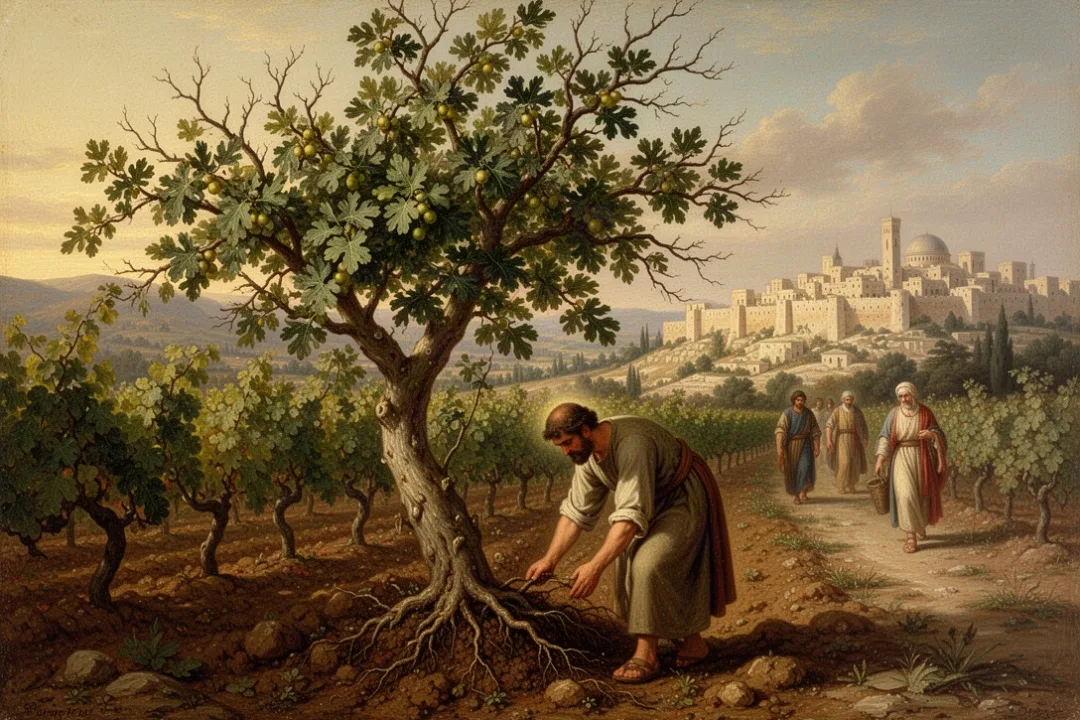
Luke 13:6–9 presents the barren fig tree as part of a parable. A landowner has a fig tree planted in his vineyard and comes looking for fruit, but the tree has produced none. He tells the gardener to remove it because it is using valuable ground without fulfilling its purpose.
The gardener asks for one more year. During that time, he will cultivate the soil and add manure around the tree. If it still produces no fruit afterward, the tree will be cut down. The parable ends without telling the reader what eventually happens, leaving the question open and personal.
The immediate setting matters. Before telling this parable, Jesus responds to reports of people who suffered violent deaths and to an accident that killed others. He rejects the assumption that those victims were necessarily worse sinners than everyone else. Instead, he calls his listeners to turn back to God rather than judging the victims.
That context connects the fig tree with a warning about spiritual urgency. Human beings do not control how much time they have, and religious identity alone does not substitute for repentance. The parable urges people to respond to God while the opportunity remains.
At the same time, the gardener’s request shows divine patience. The tree is not immediately destroyed. It receives additional care, attention, and time. Patience, however, is not the same as indifference. The delay has a purpose: the tree is expected to become fruitful.
Central point: In Luke, the barren fig tree is a warning against refusing repentance, but it also shows that judgment is preceded by mercy, cultivation, and a genuine opportunity to change.
How the fig tree represents spiritual fruit
Fruit in the parable represents the visible results of a life turned toward God. Jesus does not provide a single list of “figs,” but the wider New Testament connects spiritual fruit with repentance, justice, love, mercy, faithfulness, and obedience.
John the Baptist uses similar language in Matthew 3 and Luke 3. He calls people to produce fruit that demonstrates repentance, meaning that a changed confession should be accompanied by changed conduct. In Matthew 7, Jesus also teaches that a tree is recognized by the fruit it produces. These passages help clarify why the fig tree’s condition is serious: inner allegiance becomes visible through actions.
Spiritual fruit does not mean a person never fails. A fruitful life can include weakness, confusion, and repeated efforts to make things right. The difference is an ongoing willingness to receive correction and return to God. A barren life, by contrast, may preserve an outward appearance while resisting genuine change.
The image also challenges a narrow definition of religious success. Fruit is not simply public activity, religious vocabulary, or association with a respected community. A person may appear busy and knowledgeable while neglecting compassion, honesty, humility, and care for others.
Repentance: acknowledging wrongdoing and turning away from it.
Love: seeking another person’s good rather than using people for personal advantage.
Justice: treating people fairly, especially those with less power.
Faithfulness: continuing to do what is right when recognition is absent.
Mercy: responding to weakness with compassion rather than cruelty.
These qualities are not separate achievements that allow someone to earn God’s favor. They are signs of a life responding to God’s care. As a tree draws nourishment from the soil, a person shaped by God’s grace is expected to show that influence in ordinary decisions.
The parable therefore asks more than whether you identify as religious. It asks whether your beliefs are producing observable character. Are you becoming more truthful, patient, generous, teachable, and willing to repair harm? Those questions apply to private life, family relationships, work, church participation, and treatment of strangers.
Why the gardener’s patience matters
The gardener in Luke 13 is a significant part of the story. He does not deny the tree’s lack of fruit, and he does not claim that the landowner’s concern is unreasonable. Instead, he asks for time to provide focused care: digging around the tree and fertilizing the soil.
This picture keeps the parable from being reduced to a threat. God’s patience is active rather than passive. It involves teaching, conviction, correction, encouragement, and opportunities to practice a different way of living. The time given to the tree is meant to create conditions for fruitfulness.
That patience can be experienced through many ordinary means: a difficult truth spoken by a trusted person, a consequence that exposes destructive behavior, a passage of Scripture, a moment of loss, or a fresh chance to repair a broken relationship. None of these experiences automatically changes someone. They become fruitful when a person responds honestly.
The gardener’s work also suggests that barrenness may have contributing conditions. A tree may need its soil cultivated, its roots examined, or its surroundings improved. Applied to human life, this does not excuse sin, but it encourages wise diagnosis. A person who repeatedly fails may need accountability, counseling, practical boundaries, community support, or freedom from an unhealthy environment.
Patience should not be confused with enabling. Allowing someone more time to change does not require tolerating abuse, dishonesty, or ongoing harm. Biblical patience can exist alongside clear boundaries and appropriate consequences. The goal is restoration and truth, not the protection of appearances.
The unfinished ending also places responsibility on the reader. Jesus does not say whether the tree eventually bears fruit. The missing ending prevents detached observation. You are invited to ask what you are doing with the time, care, and warnings already given to you.
“By their fruits you will know them.” — Matthew 7:16, paraphrased
This teaching does not encourage people to inspect others harshly. Jesus directs the image toward honest discernment, not self-righteous condemnation. Before evaluating someone else’s fruit, a person should examine his or her own life with humility.
How Matthew’s barren fig tree differs from Luke’s parable
Matthew 21:18–22 describes a specific incident rather than the parable in Luke 13. Jesus is traveling toward Jerusalem when he becomes hungry and approaches a fig tree. The tree has leaves but no figs, and Jesus pronounces judgment on it. The disciples observe what happens and ask about it.
Mark 11:12–25 contains a related account with a distinctive sequence: Jesus sees the fig tree, later enters the temple, and then the disciples notice the tree’s condition. Many readers understand the tree and the temple action as connected symbolic signs. The leafy tree looks promising but lacks fruit, while the temple scene raises questions about whether worship is being practiced in a way that reflects God’s purposes.
Matthew emphasizes Jesus’ teaching about faith and prayer. The disciples are astonished by the tree’s rapid withering, and Jesus responds by describing the power of trusting prayer. This statement should not be treated as a guarantee that every desired outcome will occur if someone feels sufficiently confident.
In the surrounding teaching, faith is directed toward God, and prayer is connected with God’s will and the removal of obstacles to faithful obedience. The image of moving a mountain communicates that God can accomplish what appears impossible. It does not turn prayer into a technique for controlling events.
The Matthew account also carries a note of judgment on fruitless appearance. Leaves suggest life and promise, yet the tree supplies nothing when fruit is sought. In the broader Jerusalem narrative, outward religious status is exposed as inadequate when it is not accompanied by mercy, justice, and faithfulness.
Luke’s story and Matthew’s incident should therefore be read together carefully, not collapsed into one account. They share the image of a fruitless fig tree, but their emphases differ:
Luke 13:6–9: a parable about repentance, patience, opportunity, and eventual accountability.
Matthew 21:18–22: an acted sign connected with faith, prayer, and judgment on fruitless appearance.
Mark 11:12–25: a parallel account that places the fig tree alongside Jesus’ actions in the temple.
Some readers notice that Matthew and Mark mention the tree’s leaves, while Mark also says the usual season for figs had not arrived. Interpreters have offered different explanations, including the possibility that the leaves suggested early edible fruit or that the scene functions primarily as a symbolic sign. The main point is not to solve a botanical puzzle. The Gospel writers use the tree to expose a gap between appearance and reality.
What the barren fig tree teaches about judgment and mercy
The image of a tree being cut down can feel severe, especially when read apart from the surrounding context. Yet Luke places the warning beside the gardener’s appeal for more time. The message contains both mercy and accountability: God is patient, but patience does not erase responsibility forever.
Judgment in these passages is not presented as a random punishment for failing to meet an arbitrary standard. The tree occupies ground, receives cultivation, and is expected to produce fruit. In the same way, people who receive opportunities, instruction, relationships, and grace are called to respond to them responsibly.
This does not mean every hardship proves that God is punishing a person. Jesus explicitly resists that assumption in the setting of Luke 13. Suffering can result from many causes, and the presence of trouble is not a simple measure of someone’s moral condition.
Nor does the barren fig tree authorize Christians to declare which individuals are beyond mercy. The landowner’s decision belongs to the story’s divine authority, not to the reader’s personal judgment. The proper response is self-examination, prayer, and a willingness to encourage repentance without pretending to know another person’s entire spiritual condition.
Mercy appears in the time granted, the care offered, and the possibility of restored fruitfulness. Judgment appears in the recognition that continued refusal has consequences. Holding both truths together protects against two opposite errors: despair, which assumes change is impossible, and complacency, which assumes change is unnecessary.
Important distinction: God’s patience is an invitation to respond, not permission to postpone every change indefinitely. A delayed consequence should not be mistaken for approval.
The passage can also speak to communities and institutions, not only individuals. A church, ministry, family, or organization may have a healthy reputation and abundant activity while neglecting the people it is meant to serve. Fruitfulness requires more than preserving a name; it requires truthful evaluation and practical care.
How to apply the barren fig tree’s message today
Applying the parable begins with a question about your own response to God’s care. Instead of asking which other people seem barren, consider where you have received repeated opportunities to grow but have continued to resist them.
A useful examination should be specific. General feelings of guilt rarely produce lasting change. Name the attitudes, habits, or relationships that need attention, then identify one faithful action that can begin immediately.
Identify the missing fruit. Ask whether the problem involves honesty, forgiveness, self-control, generosity, justice, prayer, or another area of character.
Examine the conditions. Consider influences, habits, relationships, and environments that either nourish growth or reinforce the problem.
Confess without minimizing. Speak truthfully to God and, where appropriate, to someone you have harmed.
Choose a concrete response. Apologize, repay what you owe, set a boundary, seek counsel, or change a repeated practice.
Accept patient accountability. Invite a mature and trustworthy person to ask how the change is progressing.
Look for gradual evidence. Fruit often develops over time through repeated decisions rather than one dramatic moment.
This process should not become an attempt to earn salvation through moral improvement. Christian teaching presents salvation as grounded in God’s grace, while good works and transformed character are the response that grace produces. The tree does not create its own soil, rain, or sunlight, but it is still expected to bear fruit.
The parable is also relevant when you feel discouraged by slow growth. A barren season does not necessarily mean a permanently barren life. The gardener’s work suggests that growth may involve pruning, uncomfortable exposure, and patient cultivation. If you are turning toward truth, receiving help, and taking practical steps, the process itself may be evidence that God is working.
For teachers and church leaders, the passage calls for a balanced ministry. People need clear warnings about sin, but they also need patient instruction, meaningful support, and a believable path toward restoration. Correction without mercy can crush people; mercy without truth can leave destructive patterns untouched.
For anyone evaluating a religious community, the same standard offers a useful test. Look beyond impressive language or public success. Ask whether the community demonstrates care for vulnerable people, integrity in leadership, humility when corrected, and consistency between belief and conduct.
The barren fig tree ultimately asks whether the life you are living matches the identity you claim. Its warning is serious, but it is not merely destructive. The tree is given time, attention, and a chance to become fruitful. The appropriate response is neither panic nor complacency, but honest repentance and faithful action.
Frequently asked questions
Does the barren fig tree mean God rejects people who struggle with sin?
No. The passages distinguish between struggle and persistent refusal to respond to God. A person who confesses sin, seeks help, and keeps returning to what is right is not portrayed as hopeless. The warning concerns fruitlessness that remains unchallenged despite patience, care, and repeated opportunities to change. Growth may be gradual and imperfect while still being genuine.
Why did Jesus curse the fig tree if it was not the usual season for figs?
The Gospel accounts present the event as a symbolic sign, not merely an agricultural judgment. The leaves created an expectation of fruit, making the tree a picture of outward promise without inward reality. Interpretations differ about the botanical detail, but the surrounding context points toward lessons about faith, prayer, religious appearance, and accountability.
What does “fruit” mean for a Christian?
Fruit refers to the character and conduct that result from a life responding to God. It includes love, mercy, honesty, faithfulness, repentance, justice, and obedience. Fruit is not limited to public ministry or visible success. Quiet integrity, reconciliation, generosity, and care for people with little power can all show that spiritual growth is taking place.
Is the fig tree a symbol of Israel?
Fig trees sometimes symbolize Israel or the nation’s spiritual condition in the Hebrew Scriptures and the Gospels. In the passages about the barren fig tree, that background may inform the imagery, especially in Matthew and Mark. Still, the teaching also addresses individual disciples and religious communities. It should not be used to stereotype Jewish people or justify hostility toward them.






Leave a Reply