The Ten Commandments originate in the biblical story of Israel’s covenant with God at Mount Sinai, where Moses receives the laws after the Exodus from Egypt.
In the Hebrew Bible, they are not first presented as an isolated list of moral rules. They appear within a larger story about liberation, covenant, worship, and community life. God brings the Israelites out of Egypt, gathers them at Sinai, and establishes a relationship that includes obligations for both worship and conduct.
The familiar name “Ten Commandments” comes from the traditional English rendering of the Hebrew expression aseret haddevarim, meaning the “ten words” or “ten statements.” The Greek term Decalogue has the same basic meaning: ten words. The Bible itself does not number the commands in a way that settles every later disagreement about where one command ends and another begins.
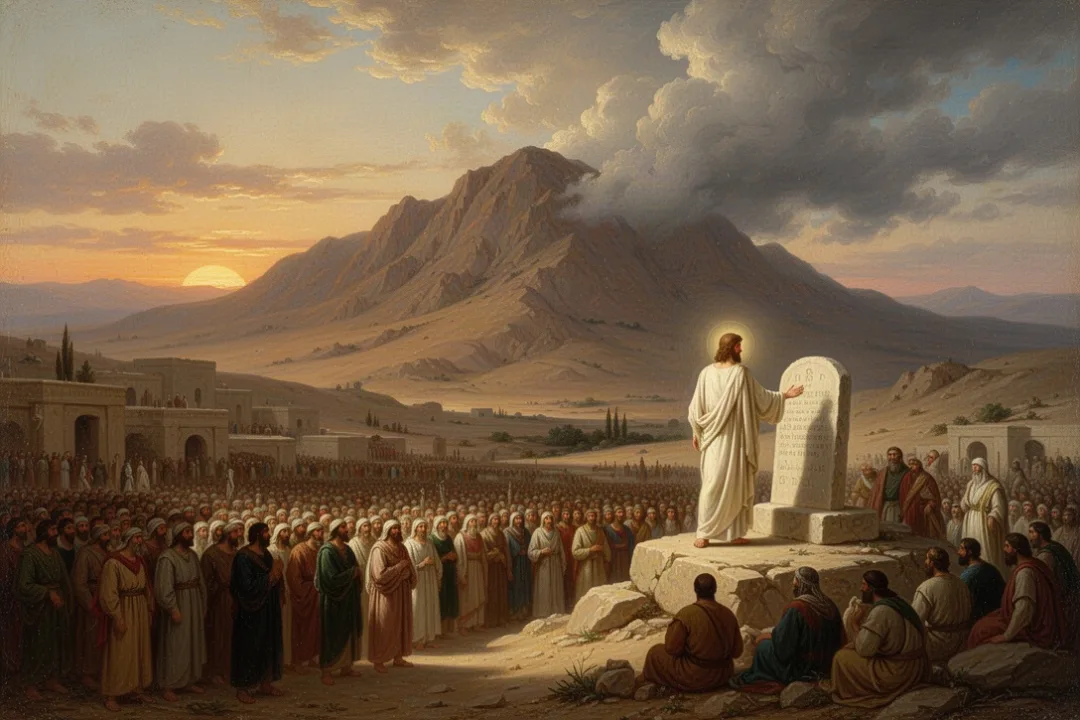
The primary biblical account is found in Exodus 19–24. After the Israelites leave Egypt, they arrive at Mount Sinai. The people prepare themselves, and God speaks the commandments from the mountain in a dramatic scene involving thunder, cloud, fire, and a trumpet-like sound. Moses then serves as the leader and mediator who receives further instructions for the covenant community.
The commandments themselves are recorded in Exodus 20:1–17. The passage begins by identifying the speaker as the God who brought Israel out of Egypt. That opening matters because the rules are presented as part of a relationship already established through rescue, not as conditions for earning freedom.
A second version appears in Deuteronomy 5:6–21. In that book, Moses reviews Israel’s history and repeats the commandments before the people enter the land of Canaan. The wording is very similar, but several details differ. The most noticeable difference concerns the reason for observing the Sabbath: Exodus connects it with God’s creation of the world, while Deuteronomy connects it with Israel’s release from slavery.
Other biblical passages refer to the commandments as a group without repeating all ten. Deuteronomy 4:13 says that God declared the covenant and wrote it on two stone tablets. Deuteronomy 10:4 again describes the words being written on tablets. These references reinforce the idea that the commandments form a defined covenant document, even though the biblical books also contain many additional laws.
The central setting: The Ten Commandments are part of the Sinai covenant, not a complete code containing every law in the Torah. They function as foundational statements within a much larger body of religious, civil, social, and ritual instructions.
The surrounding chapters help explain how the commandments operate. Exodus 20 continues with laws about altars and worship, and later chapters address servants, violence, property, justice, festivals, and treatment of vulnerable people. The Ten Commandments therefore serve as a compact beginning to a wider covenant collection.
What “ten words” means in the original tradition
The phrase “ten commandments” can give the impression of ten short imperatives arranged in a modern legal list. The biblical presentation is more varied. Some statements are prohibitions, such as commands against murder, adultery, theft, and false testimony. Others establish a required practice, such as honoring parents and keeping the Sabbath. The opening statements identify Israel’s exclusive loyalty to God.
The Hebrew phrase aseret haddevarim literally refers to ten words or sayings. It appears in Exodus 34:28, Deuteronomy 4:13, and Deuteronomy 10:4. “Commandments” became the conventional translation because these sayings carry divine authority and require obedience, but “ten words” also highlights their role as a concise covenant declaration.
The commandments include two broad areas of responsibility. The first concerns Israel’s relationship with God: exclusive worship, rejecting idols, honoring the divine name, and observing the Sabbath. The second concerns relationships among people: family respect, protection of life and marriage, property, truthful testimony, and control of wrongful desire.
That division is useful, but it should not be treated as a complete explanation of the list. Honoring parents, for example, affects family life and social stability. Sabbath observance has a religious meaning but also gives servants, resident foreigners, and working animals a recurring period of rest. The commandments connect worship with public ethics rather than separating them into unrelated categories.
The opening declaration also gives the commandments a distinctive shape. Before the first prohibition, God identifies himself as the one who brought Israel out of Egypt. This makes historical deliverance the foundation for the covenant. The people are commanded as a rescued community, and obedience is portrayed as a response to that relationship.
Why different traditions count the commandments differently
Jewish, Roman Catholic, Lutheran, Eastern Orthodox, and many Protestant traditions divide the statements into ten in different ways. The main differences involve the opening commands and the final prohibition concerning coveting. No tradition is necessarily adding or removing biblical material; the difference comes from how the material is grouped and numbered.
One common Jewish arrangement treats the opening declaration about God bringing Israel out of Egypt as the first “word,” followed by the prohibition of other gods and idols.
Many Protestant traditions combine the statements about having no other gods and making idols as the first command, then treat coveting a neighbor’s wife and coveting a neighbor’s property as the final two.
Roman Catholic and Lutheran traditions commonly combine the prohibitions concerning other gods and idols, while grouping the two forms of coveting together in the final command.
Eastern Christian traditions generally use a division that differs from both the common Protestant and Catholic patterns.
The numbering question does not change the underlying biblical content. It shows that the phrase “ten” describes an established structure whose individual boundaries were interpreted differently by later communities. When comparing religious materials, you should check the wording and tradition rather than assuming that every list numbers the commandments alike.
How the Sinai story explains their origin
According to Exodus, the commandments are given after the Israelites’ escape from Egypt and before their settlement in the land promised to them. This placement creates a sequence: deliverance, covenant, law, and communal life. The law is not presented as an abstract philosophy detached from history. It addresses how a formerly enslaved people should live together under a new identity.
Exodus 19 describes Israel as arriving at the mountain and being invited into a covenant relationship. The people agree to obey what God commands. The scene is public and communal, not merely a private experience given to one individual. Moses plays a central role, but the covenant concerns the whole people.
The narrative portrays the divine voice as coming from the mountain, while Moses later receives additional instructions. This combination explains why the commandments have a special status within the Torah. They are introduced as words spoken directly by God, then placed within a much broader set of laws communicated through Moses.
The tablets add a physical dimension to the covenant. In Exodus 31, the tablets are described as written by God. Moses breaks the first tablets after seeing the people worship a golden calf, and Exodus 34 describes replacement tablets. Deuteronomy retells this episode with its own emphasis on Moses’ actions and the renewed covenant.
These details are theological as well as narrative. Stone tablets suggest permanence, public authority, and a written relationship between God and Israel. The broken tablets represent the seriousness of the people’s betrayal, while the replacement tablets express renewal after covenant failure.
The ark later becomes associated with the tablets. Deuteronomy 10 describes Moses placing them in the ark, and the biblical account of Solomon’s temple refers to the tablets being kept there. The story thus connects the Ten Commandments with Israel’s central worship space, even though the commands themselves address everyday conduct as well as ritual loyalty.
Read the setting carefully: The Sinai account presents the commandments as the visible foundation of a covenant community. Their meaning comes from the relationship between God and Israel, the memory of slavery, and the practical need for justice and faithfulness.
The story also links the commandments with Israel’s memory of Egypt. The prohibition against coveting, the laws about servants, and the Sabbath command in Deuteronomy all gain additional force when read against the experience of oppression. A people who had lived under forced labor is called to build a society with limits on exploitation and with recognized rest.
What ancient Near Eastern culture contributes to their background
The Ten Commandments emerged in the cultural world of the ancient Near East, where societies used written laws, treaty documents, royal proclamations, and religious instructions. Israel was not developing ideas about authority, oath-taking, property, family, or punishment in complete isolation. Similar concerns appear across ancient legal and literary traditions.
Mesopotamian law collections, including those associated with rulers such as Hammurabi, show that ancient societies recorded rules about property, marriage, labor, injury, trade, and social status. These collections are useful comparisons because they reveal the kinds of disputes that concerned ancient communities. They do not, however, provide a simple source from which the Ten Commandments were copied.
Ancient Egyptian texts also contain moral and religious ideas that can be compared with parts of the Decalogue. The “Negative Confession” in the Book of the Dead lists actions a deceased person claims not to have committed, including forms of theft, murder, false dealing, and sexual wrongdoing. The resemblance is limited: the Egyptian text belongs to a funerary setting, while the biblical commandments establish a public covenant for a living people.
Scholars often compare the Sinai covenant with ancient suzerainty treaties. In these agreements, a powerful ruler establishes terms with a dependent king or people. Such treaties may include an identification of the great king, a reminder of past benefits, required loyalty, specific obligations, witnesses, and provisions for preserving or reading the agreement.
Some features of Exodus and Deuteronomy resemble this broader treaty pattern. The opening identifies the covenant lord, recalls the Exodus, demands exclusive loyalty, and places the commandments within a formal agreement. These parallels help explain the structure and political vocabulary of the biblical story, but they do not prove that a single treaty supplied the exact wording.
The commandments are also distinctive in their combination of religious and social claims. Exclusive worship stands beside rules about murder, adultery, theft, testimony, and desire. The list is concise, addressed to the community as a whole, and grounded in the identity of the God who rescued Israel. Its particular arrangement reflects Israel’s own theology and social concerns.
Ancient law collections provide comparisons for rules about property, injury, marriage, and social responsibility.
Egyptian moral texts show that concerns about theft, violence, and dishonest behavior were widespread in the region.
Treaty traditions help illuminate the pattern of a ruler’s identity, remembered favor, loyalty, and obligations.
The biblical covenant reshapes these familiar forms around Israel’s Exodus story and exclusive worship of its God.
It is more accurate to speak of a shared ancient setting than of a single proven source. The Ten Commandments participate in the legal and religious world of their time while giving that world a particular Israelite interpretation.
Why Exodus 20 and Deuteronomy 5 differ
The two main versions are close enough to be recognized as the same covenant tradition, but they are not identical. Exodus presents the commandments in the context of the original Sinai event. Deuteronomy presents them as Moses’ speech to a later generation preparing to enter the land. The difference in setting helps explain differences in emphasis.
The Sabbath command provides the clearest example. In Exodus 20, Sabbath observance is connected with God’s pattern of creating the heavens and the earth and resting on the seventh day. In Deuteronomy 5, the command emphasizes Israel’s former slavery and God’s act of bringing the people out of Egypt. One version stresses creation; the other stresses redemption and social rest.
The command about coveting also differs in sequence and wording. Exodus mentions a neighbor’s house before the neighbor’s wife, while Deuteronomy reverses that order. The two passages also use slightly different descriptions of possessions and household relationships. These variations do not eliminate the shared prohibition against grasping what belongs to another person.
The commands concerning parents, Sabbath, and coveting show that biblical tradition could preserve a teaching while adapting its presentation. Deuteronomy is not simply a word-for-word duplicate of Exodus. It reinterprets the covenant for a new moment in Israel’s story.
Scholars study these differences when examining how the Torah was composed, edited, transmitted, and understood. Some emphasize the growth of traditions over time; others focus on the literary design of each book. The biblical text itself presents both forms as authoritative, so the differences are part of the tradition rather than a reason to treat one account as irrelevant.
There is also a separate passage in Exodus 34 that refers to “ten words.” Its commands focus on matters such as worship, festivals, firstborn animals, and the prohibition against making molten gods. Because the passage appears near the story of the renewed tablets, some readers have called it a second or “ritual” Decalogue.
Most religious teaching identifies Exodus 20 and Deuteronomy 5 as the Ten Commandments familiar from Jewish and Christian practice. Exodus 34 remains significant because it shows that the expression “ten words” and the idea of a compact set of covenant statements could be associated with more than one group of instructions in the biblical material.
How the commandments became a lasting foundation for ethics
The Ten Commandments became central because they combine theological loyalty with basic protections for communal life. Their influence extends beyond the original narrative context into Jewish interpretation, Christian teaching, art, education, public debate, and legal history. Their role has never been limited to displaying a list on a wall.
In Judaism, the commandments belong to the Torah and are read within the larger framework of Jewish law, worship, interpretation, and communal practice. Rabbinic tradition discusses their meaning alongside the many other commandments of the Torah. The Ten Commandments are highly prominent, but they are not understood as replacing the rest of Jewish law.
Christian communities have often treated the commandments as a concise guide to love of God and neighbor. Christian writers have connected the first part with devotion to God and the latter part with moral obligations toward other people. Different churches vary in how they number and interpret the commands, yet the list remains a major element of Christian instruction.
The commandments also shaped the language of Western moral discussion. Prohibitions against murder, theft, adultery, false testimony, and coveting are often cited as examples of duties that protect personal dignity, family relationships, property, truth, and social trust. Their religious basis should not be confused with the details of modern law, but their influence on moral vocabulary is substantial.
Several commands are broader than a narrow legal reading suggests. “You shall not murder” addresses the wrongful taking of life rather than every form of killing in all possible circumstances. “You shall not bear false witness” specifically concerns false testimony against another person, especially in a judicial or community setting, while also supporting the wider value of truthful speech.
The command against coveting is especially distinctive because it addresses inward desire, not only outward action. A legal system can often identify theft or fraud, but the command reaches toward the attitudes that may lead someone to violate another person’s household, marriage, or property. It links public behavior with the formation of character.
The Sabbath command also extends beyond private devotion. In Deuteronomy, rest is tied to the memory of slavery, and the command includes servants and resident foreigners. That makes the Sabbath a social practice with implications for labor, power, and humane treatment.
When studying the origins of the Ten Commandments, it helps to keep several levels together:
The narrative level: Exodus and Deuteronomy place the commandments within Israel’s encounter with God at Sinai.
The historical level: The commands reflect the legal, political, and religious world of the ancient Near East.
The literary level: Exodus 20 and Deuteronomy 5 preserve related but differently framed versions.
The theological level: The commandments express covenant loyalty, remembrance of deliverance, and obligations toward other people.
The reception level: Jewish and Christian communities later interpreted, numbered, taught, and applied them in different ways.
These levels answer different questions. The biblical narrative asks where the commandments come from within Israel’s faith. Historical study asks what ancient cultural forms and social concerns shaped their expression. Literary study compares the versions. Religious interpretation asks how the commandments should guide a community’s life.
The most careful explanation therefore avoids two extremes. It is too simple to treat the Ten Commandments as a document with no connection to its ancient setting. It is also too simple to reduce them to a direct copy of an earlier law code. They are best understood as a distinctive covenant declaration formed within the ancient Near Eastern world and preserved through Israel’s biblical tradition.
Frequently asked questions
Were the Ten Commandments written by Moses or by God?
The biblical accounts present both elements. God speaks the commandments and is described as writing the words on stone tablets, while Moses acts as the mediator who receives, carries, teaches, and replaces the tablets after the golden calf episode. Jewish and Christian interpretations differ in how literally they understand these details, but the narrative clearly attributes the commandments’ ultimate authority to God.
Are the Ten Commandments the oldest laws in the Bible?
No. The Bible contains legal and covenant material before and after Exodus 20, including commands given to Noah, Abraham, and the patriarchal family, as well as laws in later chapters. The Ten Commandments are the best-known compact group, but they are not presented as the entire legal system of the Torah or as the first rules ever given in the biblical story.
Why are the Ten Commandments on two tablets?
The Bible mentions two stone tablets but does not explicitly explain how the statements were divided between them. Later traditions have proposed different arrangements, such as dividing duties toward God from duties toward other people. Those arrangements are interpretations rather than a detail specified by Exodus or Deuteronomy.
Did the Ten Commandments directly influence modern law?
They influenced moral and legal thought, especially in societies shaped by Jewish and Christian traditions, but modern laws come from many sources. Biblical commandments, Roman law, customary law, political philosophy, court decisions, and constitutional systems all contributed to modern legal frameworks. A commandment’s religious importance does not mean that its wording maps directly onto a current statute.











Leave a Reply