Are you reading The Book of Jubilees and wondering why chapter 1 begins with Moses, angels, exile, and a future restoration before retelling Genesis? The chapter functions as a preface and interpretive key for the whole work. It presents Moses on Mount Sinai receiving a revelation from an angel, explains why Israel will suffer judgment, and promises that the people will eventually return to God.
Chapter 1 also establishes a central idea: the history of Israel is already known in heaven and recorded on heavenly tablets. Jubilees therefore does more than repeat biblical stories. It presents those stories as part of a divinely ordered calendar, covenant, and account of obedience. The chapter prepares readers to see the rest of the book as an angelically revealed interpretation of Israel’s past and future.
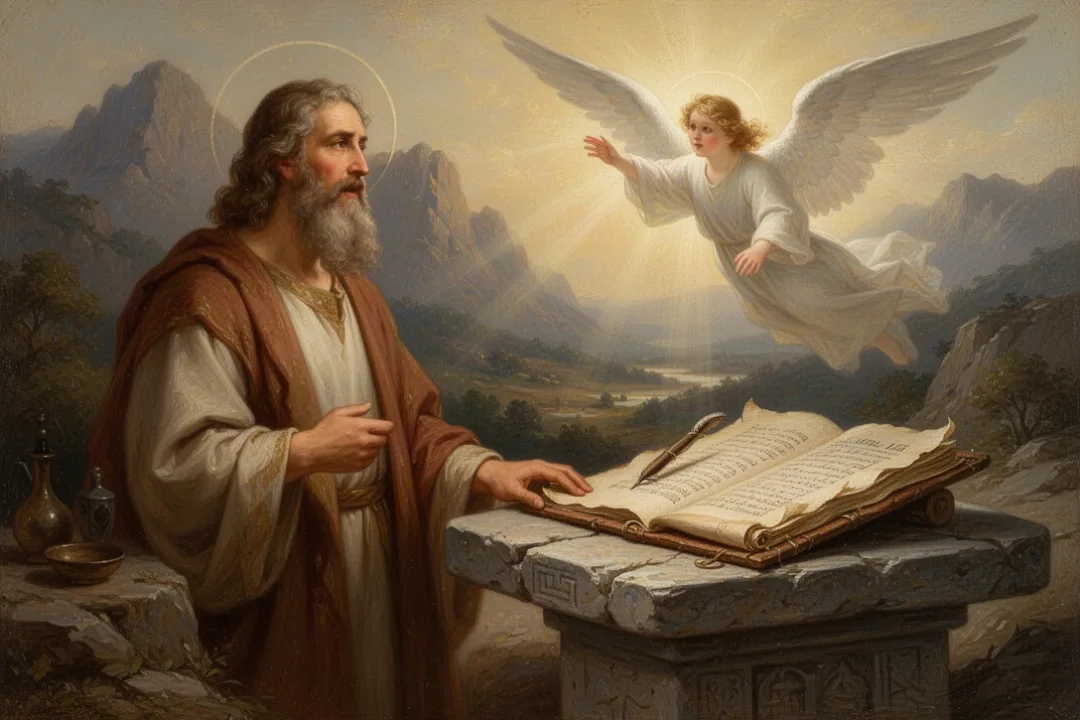
The first chapter does not begin with the creation of the world. Instead, it places the entire work inside a scene at Mount Sinai. Moses is called up the mountain, where an angel of the presence speaks to him and records a revelation concerning the divisions of the times, the years, and the jubilees of history.
This framing device gives the book authority. The stories that follow are presented as information revealed to Moses, not merely as a later writer’s retelling of Genesis and Exodus. The text claims that Moses receives the correct interpretation of events, including details about dates, festivals, covenant obligations, and the actions of the patriarchs.
Chapter 1 also looks beyond Moses’ own lifetime. It anticipates Israel’s disobedience, exile, repentance, and restoration. That future outlook matters because the book is concerned with a recurring pattern: God establishes a covenant, people violate it, judgment follows, and divine mercy opens a path back to faithfulness.
Central idea: Chapter 1 presents Jubilees as a revelation given to Moses on Sinai that interprets Israel’s history through covenant faithfulness, sacred time, and the certainty of God’s judgment and mercy.
Historical and literary context for the book of Jubilees
The book of Jubilees is an ancient Jewish work from the Second Temple period. Its precise date is debated in scholarship, but it was composed before the Common Era and reflects a community deeply concerned with the Torah, ritual purity, the calendar, circumcision, angels, and Israel’s separation from other peoples.
The work retells material from Genesis through part of Exodus. It divides history into periods of jubilees, traditionally groups of forty-nine years, with smaller divisions used to organize events. The retelling often supplies chronology and motives that are not stated in the biblical narrative. It also emphasizes that heavenly beings, patriarchs, and Israel’s ancestors observed practices that the author sees as essential to faithful Jewish life.
The complete text is preserved primarily in Ge’ez, or classical Ethiopic. Fragments and portions have also survived in other ancient languages, including Hebrew material discovered among the Dead Sea Scrolls. Because the work survives through a complex transmission history, wording and chapter divisions can vary among translations and editions.
Readers should therefore distinguish between the Bible’s account of Sinai and Jubilees’ expanded retelling. Chapter 1 uses the Sinai setting familiar from Exodus, but it develops that setting into a literary frame for a much longer revelation. The chapter’s message is best understood by asking what Jubilees adds: a heavenly source, a detailed timetable, an explanation of exile, and a strong emphasis on future restoration.
Chapter 1 broken down step by step
The chapter can be followed as a sequence of connected movements. Each one prepares for the next:
Moses ascends Mount Sinai and enters the setting of divine revelation.
An angel of the presence speaks and is associated with the heavenly record given to Moses.
The revelation concerns history’s divisions, including weeks, jubilees, and the order of time.
Israel’s future apostasy is announced, including the possibility of exile and scattering.
Moses intercedes and asks for mercy, showing his role as mediator for Israel.
God explains the consequences of disobedience while also promising eventual repentance.
Israel’s restoration is described as a return of the heart to God and a renewal of the covenant.
The revelation is connected with the rest of Jubilees, which will retell earlier history according to this heavenly pattern.
This sequence keeps judgment and mercy together. The chapter does not treat exile as the final word, but neither does it minimize Israel’s responsibility. The future depends on a genuine return to God, not merely on political recovery or physical relocation.
Moses and the angel of the presence at Sinai
At the opening of the book, Moses is portrayed as the recipient of a revelation delivered in the presence of an angel. The phrase angel of the presence identifies a heavenly messenger closely connected with God’s presence and authority. In Jubilees, this angel has a major role in communicating sacred knowledge to Moses.
The scene resembles the Sinai revelation known from Exodus, but the emphasis is different. Exodus focuses on the covenant, commandments, and Israel’s encounter with God at the mountain. Jubilees uses Sinai as the place where the entire interpretation of sacred history is disclosed. Moses becomes not only the receiver of law but also the recipient of a structured account of time.
The angelic setting also reinforces a distinction between earthly history and its heavenly interpretation. Human beings experience events in sequence and may forget, distort, or disobey. The heavenly record, by contrast, represents history as ordered and known. The angel’s role assures the reader that the chronology and meaning of the events have divine authorization.
Moses’ presence is equally significant. He is the trusted mediator who receives the revelation for Israel. The text thereby links its own authority to the most important prophetic and covenantal figure in the Torah. When Jubilees gives additional explanations about the patriarchs or the calendar, it presents those explanations as part of what Moses learned at Sinai.
The heavenly tablets and the meaning of revealed history
One of chapter 1’s most important images is the heavenly tablets. These tablets symbolize a divine record in which the structure of history, the appointed times, and the deeds of human beings are preserved. The image suggests that sacred time is not invented by later communities; it belongs to the order established in heaven.
The heavenly tablets also explain why Jubilees is so interested in exact chronology. Dates are not decorative details. They demonstrate that creation, the patriarchs, festivals, covenant events, and future judgments belong to a meaningful pattern. The book’s calculations seek to show that history follows a divinely established arrangement.
This idea has an ethical dimension. If deeds are recorded before God, then obedience and disobedience matter beyond the immediate moment. Human actions become part of a lasting account. The chapter connects Israel’s future suffering with the nation’s failure to honor the covenant, while also describing repentance as a change recognized within the divine plan.
The heavenly tablets should not be reduced to a simple prediction chart. They express a worldview in which time, worship, morality, and identity belong together. Keeping the correct calendar and observing the covenant are signs that Israel is living according to the order revealed by God.
Why chapter 1 focuses on Israel’s future exile
Although the book will retell events from the distant past, chapter 1 directs attention toward Israel’s future. God tells Moses that the people will turn away, worship other gods, abandon the covenant, and experience judgment. The exact presentation varies by translation, but the broad movement is clear: disobedience leads to scattering and distress.
Exile is presented as a covenant consequence rather than an unexplained disaster. Jubilees connects national suffering with the failure to observe God’s commands. This reflects the covenant theology found throughout the Hebrew Bible, especially the warnings associated with Moses. The chapter treats exile as morally intelligible, even though it remains painful.
At the same time, the prophecy has a pastoral purpose. It allows readers living after major national crises to understand their suffering as part of a larger story. If Israel’s troubles were already known in the revelation to Moses, then those troubles do not prove that God has abandoned the covenant. The prophecy makes room for judgment without eliminating hope.
The chapter’s future vision includes a process of return. Israel recognizes its wrongdoing, turns back to God, and seeks the covenant again. This repentance is not described as a superficial admission of error. It involves a reorientation of the people’s heart, worship, and conduct.
Repentance and restoration in chapter 1
The promise of restoration is one of the chapter’s strongest themes. God’s mercy appears alongside the warnings of exile, and the future return begins with repentance. The people are expected to acknowledge their failure, abandon false worship, and seek the God of their ancestors.
Jubilees presents restoration as both inward and communal. The heart must return to God, but the people also have to live again as a covenant community. This includes renewed commitment to the commandments, proper worship, and the practices that mark Israel’s identity.
The chapter also describes God as remembering the covenant with the patriarchs. That language places restoration within a long history of divine promises. Israel’s future does not depend only on its current strength or merit. It depends on God’s continuing faithfulness to the covenant made with Abraham, Isaac, and Jacob.
Still, divine faithfulness does not make obedience irrelevant. Jubilees holds the two ideas together: God remains committed to the covenant, and Israel must respond through faithful living. Restoration is therefore neither automatic nor purely political. It is a return to a relationship defined by worship and obedience.
Reading tip: When chapter 1 speaks about Israel’s return, read “restoration” as more than a change of location. The chapter emphasizes a restored heart, renewed covenant loyalty, and a return to the practices that define faithful Israel.
The covenant themes that chapter 1 establishes
Several covenant concerns introduced in chapter 1 shape the rest of the book. The first is exclusive loyalty to God. Israel’s central failure is not merely social disorder; it is the abandonment of the God who established the covenant.
The second is the relationship between covenant and memory. The people must remember what God has done and what the ancestors received. Forgetfulness becomes a spiritual danger because it leaves Israel vulnerable to adopting foreign worship and customs.
The third is the importance of embodied signs of belonging. Circumcision receives special attention in the larger work, and chapter 1 points toward the covenant obligations that distinguish Israel from the nations. Jubilees consistently treats identity as something practiced through the body, the calendar, family life, and communal worship.
The fourth is the role of the patriarchs as models. Abraham, Isaac, and Jacob are not simply characters from an ancient past. Their actions demonstrate the correct way to observe the covenant. The later retelling often portrays them as already practicing laws and festivals that the Sinai covenant will formally establish.
Worship: Israel must serve the one God rather than turn to idols.
Memory: The community must preserve the story and promises of its ancestors.
Practice: Covenant loyalty is shown through concrete commandments and rituals.
Time: Festivals and sacred seasons belong to a heavenly order.
Repentance: Restoration requires a genuine return of the heart.
How chapter 1 treats sacred time and the calendar
The reference to the divisions of time signals one of Jubilees’ most distinctive interests: the calendar. The book organizes history through weeks of years and jubilees, presenting time as measured and ordered by God. This framework helps the author locate biblical events within a comprehensive chronology.
Calendar disputes were significant in some Jewish communities of the Second Temple period. Jubilees reflects a strong concern that festivals should be observed on the correct days and according to a reliable pattern. Although chapter 1 does not provide every calendar detail, it announces that the revelation will explain the appointed times.
For Jubilees, the calendar is theological rather than merely practical. It determines when the community worships and how it participates in the rhythm of creation. A correct calendar therefore becomes a sign of correct covenant identity.
This concern also explains the book’s resistance to what it sees as confusion in ordinary human timekeeping. The heavenly tablets provide an unchanging standard. The community is called to align earthly observance with the order known in heaven.
How chapter 1 differs from the opening of Exodus
Readers familiar with Exodus may notice that Jubilees does not simply reproduce the biblical account of Moses at Sinai. Both works connect Moses with revelation, covenant, and the mountain, but their narrative goals differ.
Exodus gives the foundational story of Israel’s deliverance from Egypt, covenant formation, commandments, the tabernacle, and Israel’s failures in the wilderness. Jubilees places that material inside a larger chronological and angelic framework. It emphasizes what was revealed to Moses about the complete course of history.
Chapter 1 also makes the future exile and restoration central at the outset. Instead of allowing the reader to encounter Israel’s later failures as they emerge in the narrative, it announces the broad pattern in advance. This is a form of foreshadowing: the reader knows that the people will fail, suffer, repent, and receive mercy.
The differences do not mean that Jubilees rejects the Torah. The book presents itself as an explanation and expansion of the Torah’s history. Its distinctive claims concern how that history should be interpreted, dated, and applied to the author’s community.
What chapter 1 reveals about the purpose of Jubilees
Chapter 1 suggests that Jubilees was written to strengthen a community’s commitment to a particular vision of Jewish faithfulness. The work wants readers to trust the covenant, observe the appointed times, honor circumcision and purity, and maintain separation from practices viewed as foreign or corrupting.
Its retelling of biblical history is therefore selective and purposeful. The author highlights episodes that support a clear theology of obedience, chronology, ancestry, and separation. Additional details about angels, patriarchs, and heavenly records reinforce the authority of that theology.
The opening chapter also addresses people living amid uncertainty. Exile, foreign rule, cultural pressure, and religious disagreement form the background against which the book’s message would have mattered. By placing its teaching in the mouth of an angel speaking to Moses, Jubilees presents its instructions as ancient, authoritative, and relevant to present circumstances.
For modern readers, the chapter is useful as a guide to the book’s priorities. It explains why the later chapters pay such close attention to dates, festivals, genealogies, covenant signs, and the moral meaning of history.
Questions to ask when reading the rest of Jubilees
Chapter 1 provides a set of interpretive questions that can be applied to each later episode. These questions help you see why the author includes particular details and how those details connect to the opening revelation.
What does this episode say about covenant obedience?
How does the author place the event within sacred time?
Does the story explain the origins of a practice, festival, or boundary?
How are angels or heavenly records used to confirm the interpretation?
Does the episode warn against foreign worship or social compromise?
How do the patriarchs model the kind of faithfulness the book expects?
These questions prevent the retelling from seeming like a collection of random additions. The extra material serves the book’s larger argument: God’s covenant has a precise order, the ancestors knew that order, Israel’s history confirms it, and the community must live by it.
Why chapter 1 still matters to readers today
The chapter remains valuable for understanding how ancient Jewish interpreters read Scripture. It shows that biblical interpretation in antiquity could involve expansion, chronology, angelic revelation, legal reflection, and theological application at the same time. A work such as Jubilees does not merely repeat a biblical passage; it builds an interpretive world around it.
It also raises enduring questions about the relationship between judgment and hope. Chapter 1 does not ignore the consequences of disobedience, but it refuses to treat failure as the end of the story. The promise of return depends on repentance and covenant renewal, yet it is grounded in God’s continuing faithfulness.
Finally, the chapter invites readers to consider how communities use sacred history. Jubilees presents the past as a guide for present conduct. Creation, the patriarchs, Sinai, exile, and restoration all become part of an argument about how people should worship, remember, and live.
Read on its own, chapter 1 is a compact vision of the entire book: revelation at Sinai, history recorded in heaven, Israel’s failure, divine judgment, repentance, and restoration. Read as the opening of Jubilees, it tells you to pay close attention to the calendar, the covenant, the ancestors, and the claim that earthly history follows a pattern already known in heaven.
Frequently asked questions
Is the book of Jubilees part of the Bible?
The book of Jubilees is not included in most Jewish or Christian biblical canons. It is regarded as canonical in the Ethiopian Orthodox tradition. Other Jewish and Christian communities generally classify it as an ancient religious work outside their standard Scriptures, although it remains important for studying Second Temple Judaism and early biblical interpretation.
Who is the angel speaking to Moses in Jubilees chapter 1?
The chapter identifies Moses’ heavenly guide as an angel of the presence. The text does not depend on the angel having the same name or role in every later religious tradition. The angel functions as a messenger who communicates the revelation and connects Moses with the heavenly record of history.
What does “jubilee” mean in this book?
A jubilee is a period of forty-nine years, organized as seven groups of seven years. Jubilees uses these periods to structure sacred history and arrange major events. This chronological framework helps the author explain the timing of biblical episodes, festivals, covenant events, and future developments.
Does Jubilees chapter 1 predict a specific historical exile?
Chapter 1 describes Israel’s future disobedience, scattering, suffering, repentance, and restoration in broad covenantal terms. Readers may connect that pattern with known historical exiles, but the chapter is not simply a dated political forecast. Its main purpose is to explain how judgment and renewal fit within God’s larger plan for Israel.











Leave a Reply