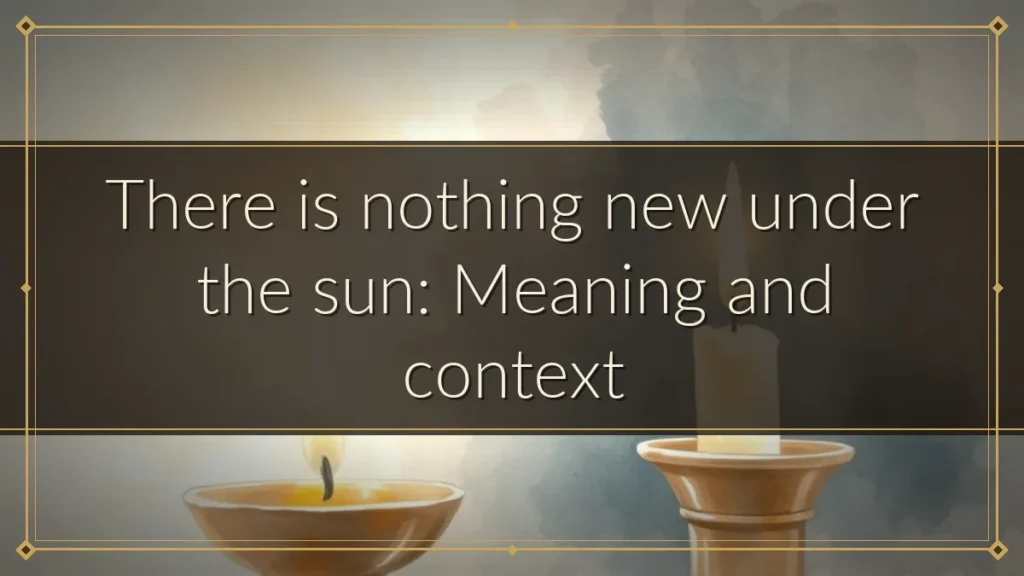
The phrase appears in Ecclesiastes 1:9, traditionally associated with the Teacher, or Qoheleth. Ecclesiastes opens by observing the repetition of nature, human labor, and generations: one generation passes, another arrives, and the world continues its familiar cycles.
The expression under the sun is one of the book’s central phrases. It refers to ordinary life as people experience it in this visible, earthly world. The writer is examining work, pleasure, wisdom, wealth, injustice, and mortality from the standpoint of life as it appears when human beings try to find lasting meaning in temporary things.
That context matters because the sentence is often used as a casual way to say that every idea has already been tried. Ecclesiastes is making a more careful observation. Human desires and behaviors repeat, and material achievements do not permanently solve the deepest problems of existence.
Central idea: The phrase does not deny creativity or historical progress. It points to the persistence of familiar human conditions—ambition, conflict, desire, disappointment, work, love, loss, and death.
What “there is nothing new under the sun” means step by step
The statement becomes clearer when you separate its main ideas rather than treating it as an absolute claim about every object or invention.
Human beings keep facing similar questions. People in every generation ask how to live well, deal with suffering, use power, pursue love, and face death.
Human motives often repeat. Pride, envy, greed, fear, generosity, loyalty, and the desire for recognition appear in changing circumstances.
Nature follows recurring patterns. Ecclesiastes draws attention to cycles such as rising and setting, flowing waters, and the succession of generations.
Achievements do not last forever. Buildings, reputations, fortunes, and institutions can be impressive, yet time eventually exposes their limits.
Novelty is often a change of form. A new device, platform, or cultural trend may express an old desire, such as communication, status, entertainment, or control.
The phrase raises a question about lasting meaning. If the same pursuits keep returning without satisfying the human heart, where should a person look for significance?
This reading allows the statement to be both realistic and nuanced. There can be genuine discoveries, new technologies, and unprecedented events. Yet the basic moral and spiritual condition of humanity may remain recognizable across centuries.
Why “under the sun” is the key phrase
Without the words under the sun, the sentence can sound like a universal denial that anything new has ever existed. Ecclesiastes uses the phrase to establish a viewpoint: the writer is considering life within the boundaries of human observation and earthly experience.
That viewpoint includes real beauty and real goodness, but it also includes frustration. People work hard and still lose what they gain. The wise and foolish both die. Justice is not always visible. A person may achieve success and yet wonder who will receive the results after that person is gone.
In this setting, “new” often means genuinely new in a way that breaks the old cycle. A new product is not necessarily a new answer to the human condition. A new political movement may use different language while repeating familiar struggles over power. A new form of entertainment may satisfy an old appetite for distraction.
The phrase therefore has a limited scope. It is not saying that every event is identical or that history never moves forward. It is asking whether earthly life, considered by itself, can produce an entirely new source of meaning that overcomes repetition, frustration, and death.
How Ecclesiastes uses repetition to make its point
Ecclesiastes begins with observations about the natural world. The sun rises and sets, the wind moves in recurring patterns, and streams flow toward the sea without filling it. These images create a sense of motion without final completion.
The world is active, but its activity does not automatically lead to lasting fulfillment. People labor, generations change, and familiar patterns continue. The writer’s concern is not that movement is unreal; it is that constant activity does not guarantee lasting purpose.
The book also emphasizes memory. A generation may accomplish remarkable things, yet later generations may not remember the people who came before them. This does not mean every achievement is worthless. It does mean that fame and human recognition are unstable foundations for identity.
Ecclesiastes directs attention from the excitement of novelty to the deeper question of whether human effort can endure.
Repetition functions almost like a mirror. It shows readers that the same desires can appear in different costumes. A person may pursue wealth rather than pleasure, knowledge rather than wealth, or influence rather than knowledge, but each pursuit can become empty when treated as an ultimate answer.
What the phrase says about human nature
The saying has an anthropological dimension: it describes recurring features of human behavior. People are inventive, but they are also vulnerable to the same temptations. They build systems to solve old problems and sometimes create new versions of the problems they hoped to remove.
Consider several patterns that appear across history:
The search for status: Titles, clothing, possessions, followers, and public recognition change, but the desire to be admired remains familiar.
The pursuit of security: People store money, build walls, form alliances, and seek authority because fear of loss is persistent.
The struggle for control: Individuals and institutions often try to manage other people, circumstances, or the future.
The experience of injustice: Corruption, favoritism, exploitation, and unequal treatment have appeared in many forms.
The need for belonging: Families, friendships, tribes, neighborhoods, and communities reflect a recurring human desire for connection.
The fear of mortality: Medical progress can extend life, but it does not remove the basic fact that human beings are mortal.
These patterns do not prove that people never improve. Individuals can become more compassionate, institutions can become fairer, and societies can reject harmful practices. The point is that improvement requires vigilance because old impulses can return under new conditions.
Does the phrase mean nothing is truly new?
No. Read as a statement about every possible fact, the phrase would be too broad. New inventions, scientific discoveries, artistic works, relationships, and historical events can be genuinely new in their immediate form.
A smartphone is not the same object as a handwritten letter. A vaccine is not the same as an herbal remedy. A modern city is not the same as an ancient village. The sentence from Ecclesiastes should not be used to erase these differences.
Instead, ask what kind of newness is being discussed. There is a difference between new form and new human reality. Communication methods change, but the desire to communicate is old. Economic systems develop, but the temptation to exploit others is old. New tools can transform daily life, but they do not automatically create wisdom or virtue.
This distinction prevents two opposite mistakes:
Cynicism: assuming that every improvement is meaningless because people remain imperfect.
Naivety: assuming that a new invention or movement has solved problems simply because it looks different from what came before.
Ecclesiastes encourages clear-eyed judgment. Appreciate genuine progress, but do not confuse novelty with redemption. A change in technology may be significant without being a change in the deepest structure of human life.
How the phrase relates to wisdom and human knowledge
Ecclesiastes presents wisdom as valuable, yet limited. Understanding can be better than ignorance, and careful judgment can protect a person from foolish decisions. Still, knowledge alone cannot make life permanent or fully predictable.
The more a person learns, the more clearly that person may see the world’s disorder. Knowledge can reveal injustice without giving immediate power to correct it. It can explain how something works without answering why a person should use that knowledge well.
This creates a tension at the center of the book. Wisdom is preferable to foolishness, but wisdom is not the same as ultimate control. A wise person remains subject to time, uncertainty, loss, and death.
The phrase about nothing new under the sun can therefore challenge intellectual pride. Human beings discover much, but each generation also inherits unresolved questions. The fact that a question has been asked before does not make it unimportant. It may show that the question reaches deeply into human nature.
How the phrase relates to work, success, and ambition
Ecclesiastes repeatedly examines labor. Work can provide skill, responsibility, service, and enjoyment. It can also become a source of anxiety when a person expects achievement to provide permanent security or an immortal reputation.
A career may bring real satisfaction, but it cannot guarantee that future generations will remember the worker. A business may create useful products, but it cannot control how those products will be used later. A person may leave an inheritance, yet have little control over the character or decisions of those who receive it.
The passage does not require passivity. It asks you to examine what your work is expected to accomplish. If work is meant to serve others and express responsible stewardship, it can be meaningful. If it is expected to prove your worth, defeat mortality, or guarantee complete control, it will eventually disappoint.
A practical reading may lead to questions such as:
Am I pursuing success because the work is worthwhile, or only because I need recognition?
What part of my effort benefits people beyond my own image?
What losses would expose the limits of my current definition of success?
Can I receive the good in work without demanding that work become my entire identity?
These questions preserve ambition while placing it in a healthier position. Ecclesiastes does not tell people to stop acting; it warns them not to treat temporary achievements as permanent answers.
How the phrase applies to modern technology
Modern life makes the saying especially easy to misunderstand. New technology changes the speed, scale, and convenience of human activity. It can alter how people work, communicate, learn, and spend leisure time.
At the same time, technology often magnifies familiar desires. Social platforms can offer new ways to seek approval. Automated systems can offer new ways to pursue efficiency and control. Online commerce can make buying easier, while the underlying desire for comfort, status, and acquisition remains recognizable.
That does not make technology unimportant. Tools can improve access, reduce suffering, connect people, and solve practical problems. The biblical observation is that better tools do not automatically produce better character.
Practical test: When something is marketed as completely new, ask which old human desire it serves, what new risks it creates, and whether it actually improves wisdom, justice, or love.
The question is not whether innovation should be rejected. It is whether innovation deserves the level of trust people sometimes give it. A device can increase connection while also increasing distraction. A system can improve efficiency while also making unfair decisions harder to see. A new opportunity can bring genuine good and still require moral boundaries.
What the phrase teaches about disappointment
Many people encounter this saying during disappointment. A repeated failure, a familiar conflict, or a broken promise can make life feel circular. The phrase gives language to that experience: despite effort and change, the same problems seem to return.
Ecclesiastes does not treat that perception as foolish. It recognizes that life contains unfairness and that human control is limited. Its honesty can be valuable because it refuses to promise that every problem will be solved quickly through optimism, productivity, or cleverness.
However, the phrase should not be used to justify hopelessness. Recognizing repetition can help you respond wisely. If a conflict keeps returning, you can examine the pattern rather than merely reacting to the latest incident. If a goal repeatedly fails to satisfy, you can question the goal rather than assuming you need more of it.
Repeated disappointment may reveal that you are asking a temporary thing to provide a permanent result. Money can meet material needs, but it cannot guarantee peace. Praise can encourage you, but it cannot establish your worth. Control can reduce some uncertainty, but it cannot eliminate vulnerability.
What Christians often see beyond “under the sun”
Within Christian interpretation, Ecclesiastes is not read as the whole of biblical teaching in isolation. The book exposes the limits of life viewed only from the earthly horizon. Other biblical themes point toward God, resurrection, judgment, redemption, and a renewed creation.
That broader context changes how the phrase is applied. If everything is considered only in terms of present achievement, then repetition, mortality, and loss appear to have the last word. Christian faith claims that God’s work introduces a kind of newness that human invention cannot produce by itself.
This does not make ordinary life irrelevant. Instead, it places ordinary work and pleasure within a larger framework. A meal, friendship, task, or act of generosity can be received as a gift rather than worshiped as an ultimate source of meaning.
The Christian response is therefore neither blind optimism nor total despair. It acknowledges the frustration of life under the sun while looking beyond it for a lasting foundation. The phrase exposes the limits of human striving; it does not have to be the final statement about reality.
How to use the phrase accurately in conversation
People often say “there is nothing new under the sun” when they notice that a current controversy resembles an older one. That usage can be appropriate, especially when it highlights repeated motives or predictable consequences.
Use the phrase carefully, though. It can sound dismissive when someone is sharing a genuinely new experience. The fact that many people have faced grief, anxiety, or betrayal does not make one person’s pain unimportant.
A thoughtful use of the expression might sound like this: “The technology is new, but the desire for status and approval is familiar.” That statement recognizes both historical change and human continuity.
A careless use would be: “Nothing ever changes, so there is no point trying.” That conclusion goes beyond Ecclesiastes. The text recognizes limits, but it does not erase responsibility, compassion, wisdom, or the possibility of receiving joy.
Questions for personal reflection
The phrase can become more than a slogan when it helps you identify repeated patterns in your own life. Reflection should be specific rather than abstract. Look at choices, habits, expectations, and reactions.
Which disappointment keeps appearing in a different form?
What desire seems to control my decisions most strongly?
Am I mistaking a new purchase, role, or achievement for a new identity?
What have earlier generations already learned about the path I am considering?
Where have I seen genuine progress, and where have old problems simply changed appearance?
What good can I do even though I cannot control the final outcome?
These questions encourage humility without requiring indifference. You can learn from history, pursue improvement, and make responsible choices while admitting that you are not the first person to face uncertainty.
Why the phrase remains relevant
“There is nothing new under the sun” remains relevant because it addresses a permanent tension: human beings live amid real change while carrying enduring needs and weaknesses. Every generation receives new tools, institutions, and possibilities, but no generation escapes mortality or the need for moral wisdom.
The phrase helps you distinguish novelty from significance. Something can be new without being good, useful without being ultimate, or powerful without being wise. That distinction is valuable in personal decisions, public debates, business, education, and faith.
It also encourages historical humility. The present is not as unprecedented as it may feel. Earlier people wrestled with ambition, loneliness, injustice, pleasure, fear, and the search for meaning. Their experiences cannot answer every modern question, but they can expose recurring patterns that a culture may otherwise overlook.
Read in context, the saying is neither a slogan for resignation nor a denial of progress. It is a sober invitation to see life clearly. Human beings can create new forms, but lasting meaning cannot be manufactured simply by making the next thing faster, larger, or more impressive.
Frequently asked questions
Is “there is nothing new under the sun” a Bible verse?
It is a phrase from Ecclesiastes 1:9, where the Teacher reflects on recurring patterns in nature and human life. The surrounding passage describes generations changing while familiar cycles continue. The statement is biblical language, but its meaning depends on its context: it addresses earthly human experience rather than denying every scientific discovery, invention, or historical event.
Does Ecclesiastes say that innovation is pointless?
No. Ecclesiastes recognizes the value and limits of human wisdom and labor. Innovation can improve lives and solve practical problems, but it cannot by itself cure selfishness, eliminate mortality, or guarantee lasting fulfillment. The phrase cautions against treating technological or material progress as a complete answer to humanity’s deepest spiritual and moral needs.
What does “under the sun” mean in Ecclesiastes?
“Under the sun” describes life as observed within the earthly world. It focuses on work, relationships, pleasure, injustice, time, and death as people experience them. The expression helps define the book’s viewpoint: when life is considered only through visible, temporary circumstances, human achievements appear limited and recurring patterns become especially clear.
How can this phrase help with modern problems?
It can help you recognize old motives behind new circumstances. A current dispute may involve unfamiliar technology while still reflecting familiar desires for power, recognition, security, or control. Seeing those patterns encourages humility and better judgment. It also reminds you to value genuine progress without assuming that new tools automatically make people wiser or more virtuous.









Leave a Reply