Timbrels: meaning, biblical use, and how they sound
Timbrels: meaning, biblical use, and how they sound
Have you encountered the word timbrels in a Bible passage, hymn, or historical description and wondered what kind of instrument it means? A timbrel is generally a small frame drum: a shallow circular drum with a stretched skin or other membrane over one side. In many modern contexts, it is closely related to a tambourine, although the ancient instrument may not have had the metal jingles associated with tambourines today.
Timbrels were played by striking the membrane with the hand. They could provide a steady pulse, emphasize dance movements, accompany singing, or add energy to a public celebration. In biblical passages, timbrels often appear alongside women’s singing, dancing, worship, victory, and communal joy.
Quick definition: A timbrel is an ancient hand-played frame drum, usually associated with celebration and rhythmic accompaniment. The plural form is timbrels; the singular is timbrel.
The basic timbrel consists of a round wooden frame and a stretched covering, traditionally made from animal skin. The frame is usually shallow compared with the body of a barrel drum. Because the player holds the instrument in one hand, the timbrel can be carried easily while walking, dancing, or singing.
Sound comes from the vibrating membrane. A player can strike the center for a fuller, deeper tone, tap closer to the edge for a sharper sound, or use the fingers and palm to create contrasting accents. Pressing lightly against the membrane can change its resonance, while moving the hand around the rim can produce softer rhythmic effects.
The instrument’s sound depends on several features:
Frame size: A larger frame can produce a lower, broader tone, while a smaller one often sounds brighter and more focused.
Membrane material: Natural skin and modern synthetic heads respond differently to temperature, humidity, and touch.
Frame depth: A shallow frame emphasizes a crisp hand-drum sound rather than the extended resonance of a deeper drum.
Playing technique: Open-hand strikes, fingertip taps, rim touches, and rolls create different textures.
Jingles or fittings: Some related frame drums include attached metal discs, but their presence should not automatically be assumed when an ancient text says “timbrel.”
Descriptions of ancient instruments are often less precise than modern musical classifications. A word translated as timbrel may identify a family of hand-played frame drums rather than one standardized model manufactured to a single design.
Is a timbrel the same as a tambourine?
In ordinary English, timbrel and tambourine overlap in meaning. Both can refer to a small frame drum played by hand. Many dictionaries treat “timbrel” as an old or biblical term for a tambourine-like instrument, and some modern readers use the words interchangeably.
The distinction becomes more useful when discussing historical instruments. A modern tambourine commonly has metal jingles set into its frame, while an ancient timbrel may have been a plain frame drum without them. The surviving evidence does not justify treating every timbrel mentioned in an ancient text as identical to the familiar modern tambourine.
The safest wording depends on the setting:
Use timbrel when discussing the biblical or older literary term.
Use tambourine when describing a modern instrument with jingles or a contemporary performance.
Say timbrel-like frame drum when you want to describe the likely instrument without claiming more certainty than the evidence allows.
Do not assume that an illustration of a modern tambourine precisely reconstructs an ancient timbrel.
Some Bible translations use “timbrel,” while others use “tambourine” for the same underlying Hebrew term. That variation reflects translation choices, changes in English vocabulary, and uncertainty about the exact construction of ancient musical instruments.
What the Bible says about timbrels
The biblical references to timbrels are usually connected with public celebration and musical response. The instrument is not normally presented as an isolated object. It appears as part of a larger scene involving singing, dancing, processions, victory, worship, or the expression of strong communal emotion.
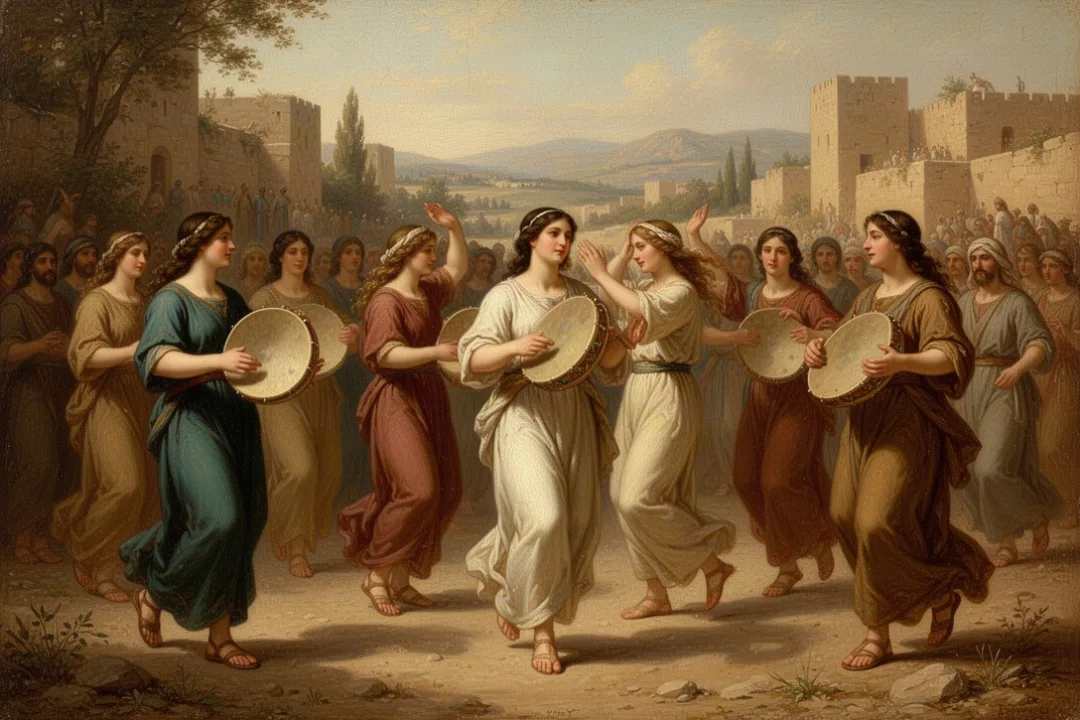
One of the best-known examples appears in Exodus 15. After the Israelites’ escape from Egypt and the crossing of the sea, Miriam is described as taking a timbrel, and other women follow her with timbrels and dancing. The scene presents hand drums as instruments of collective celebration and as a way for women to lead a musical response to a major event.
The passage is significant for more than its mention of an instrument. It places music, movement, leadership, and religious memory together. The timbrel helps turn a private feeling of relief into a shared public act. It marks the moment as one to be remembered through rhythm, voice, and bodily movement.
A second reference occurs in Judges 11:34, where Jephthah’s daughter comes out to meet him with timbrel and dancing after his return. This account is emotionally and morally complex, and the instrument should not be read as making the entire episode uncomplicatedly joyful. The timbrel reflects the normal cultural setting of a celebratory welcome, while the larger narrative quickly exposes the tragedy surrounding the vow.
The Psalms also mention timbrels. Psalm 81 associates the instrument with communal worship and a festival setting. Psalm 149 connects it with praise, dancing, and musical celebration. Psalm 150 includes the timbrel in a broad list of instruments used to praise God, alongside stringed instruments, wind instruments, and cymbals.
Other passages use the instrument in descriptions of celebration, processions, or social life. 1 Samuel 18:6 portrays women coming out with singing and instruments after David’s victory over Goliath. Isaiah 5:12 mentions the timbrel among instruments used at feasts, though the passage criticizes people who focus on entertainment while ignoring God’s work. This shows that the instrument itself is not automatically presented as spiritually good or bad; its meaning depends on the behavior and purpose surrounding it.
Why biblical writers associate timbrels with women and dancing
Several biblical scenes connect timbrels with women’s musical participation. That association probably reflects social and cultural patterns in which women performed music at celebrations, welcomed returning warriors, marked weddings, and led dancing or responsive singing. It does not mean that men never played frame drums, but it does show that women’s musical leadership was visible in particular public settings.
A hand drum is especially suitable for group movement. It is portable, loud enough for outdoor gatherings, and simple to coordinate with repeated vocal phrases. A player can maintain a beat while walking or dancing, unlike many larger instruments that require a fixed position or both hands.
The combination of timbrel and dance also communicates more than entertainment. In biblical storytelling, physical movement can express gratitude, relief, triumph, grief, or communal identity. The rhythm gives people a way to participate together rather than merely watch a performer.
When reading these passages, avoid reducing the timbrel to a decorative prop. It often signals that a group has responded actively to an event. The instrument helps establish the mood, but the surrounding actions—singing, dancing, welcoming, praising, or criticizing—give the scene its full meaning.
How timbrels were likely used in ancient settings
The ancient timbrel was probably valued because it was portable, expressive, and easy to combine with the human voice. A group could use several frame drums to reinforce a repeated rhythm during a procession or celebration. A single player could also accompany a singer or dancer without needing complex equipment.
Its role may have varied by setting. At a victory celebration, the timbrel could support a chant or song of praise. At a festival, it could help establish a dance rhythm. During a procession, repeated beats could keep people moving together. In worship, it could form one part of a larger ensemble that included strings, pipes, horns, or cymbals.
Frame drums are also practical instruments for outdoor use. Their relatively light construction makes them easier to carry than large drums. Their sound can cut through voices and movement, especially when several players strike coordinated patterns.
Ancient musical performance did not necessarily follow the model of a modern concert with a fixed score and a single person performing for a silent audience. Music was often participatory and communal. People sang, moved, clapped, responded, and joined the rhythm. The timbrel fits naturally into that kind of performance because it can be played by ear and adapted to the pace of a group.
What ancient timbrels may have looked like
Archaeological finds, artistic representations, and references in ancient literature help scholars understand frame drums, but they do not answer every question about the biblical timbrel. Materials decay, images may be stylized, and a word used for an instrument may cover more than one design.
A likely form had a circular wooden hoop with a skin head stretched across it. Some frame drums from the ancient Near East were played with the head facing outward while the player held the rim. Others may have had different proportions or construction details. The absence of a surviving example directly labeled “the timbrel of Miriam” means that reconstructions remain interpretive rather than certain.
Modern illustrations sometimes show a shallow drum with a row of jingles. That is a reasonable visual approximation for some traditions, but it should not be presented as a guaranteed picture of every ancient timbrel. The safest reconstruction emphasizes the instrument’s defining feature: a hand-held frame drum used for rhythm.
Climate and maintenance would have affected the instrument. Animal skin changes tension with moisture and temperature, so a player may have needed to adjust or replace the head. Wooden frames also required care. These practical details help explain why the timbrel was a useful but not mechanically uniform instrument.
How to hear the difference between a timbrel and other drums
The timbrel’s sound is generally more immediate and exposed than that of a deep, two-headed drum. Because the player strikes a single shallow membrane, the result can be a bright pulse with a clear hand attack. If jingles are present, they add a rattling layer that continues briefly after the strike.
Compared with a modern drum kit, a timbrel has a narrower range of tones but offers great rhythmic flexibility. The player shapes the sound through hand position and touch rather than foot pedals, multiple drums, or mechanical hardware. Compared with clapping, it provides more volume, more consistent timing, and greater tonal variety.
Compared with cymbals, the timbrel emphasizes a beat rather than a sustained metallic crash. Compared with a lyre or harp, it supplies rhythm rather than a sequence of pitched notes. It can work with melodic instruments, but it does not normally create a melody on its own.
If you hear a modern frame drum in a recording of biblical music, remember that the performance is an interpretation. The instrument may capture the rhythmic function of an ancient timbrel without reproducing its exact sound, size, materials, or playing style.
Practical tips for understanding timbrel references
Readers often make assumptions about timbrels because the word appears in poetic or religious passages. These steps can help you interpret each reference more carefully:
Read the surrounding verses. Identify whether the setting is a victory, festival, worship gathering, procession, feast, welcome, or criticism of excess.
Check the translation. Another Bible version may use “tambourine” or “hand drum,” showing that the English term is not identical in every translation.
Notice who is playing. The passage may highlight women, a worshiping community, celebrants, dancers, or a larger group of musicians.
Separate the instrument from the moral judgment. A text may criticize a person’s priorities at a feast without condemning the timbrel itself.
Compare related instruments. Mentions of lyres, harps, pipes, horns, and cymbals reveal that the timbrel served a distinct rhythmic role.
Avoid overconfident reconstruction. Describe the instrument as a frame drum unless the passage or historical evidence supports a more specific claim.
These habits are useful when studying a sermon, Bible commentary, worship practice, or museum display. They keep the word connected to its original setting instead of forcing it into a modern category too quickly.
Reading tip: When a translation says “timbrel” and another says “tambourine,” compare the passage’s setting and the translators’ notes before deciding that the instruments must be completely different.
Common mistakes people make about timbrels
Several misunderstandings recur in discussions of this instrument. Most come from treating a flexible ancient term as if it described one modern product with fixed specifications.
Assuming every timbrel had jingles: Some related frame drums may have had rattling attachments, but the word itself does not prove that jingles were present.
Assuming timbrel means a large drum: The term generally points to a small hand-played frame drum, not a deep bass drum or a large ceremonial drum.
Reading every reference as praise: Biblical writers can mention an instrument in a scene of celebration, ordinary feasting, or misplaced priorities.
Ignoring translation differences: “Timbrel,” “tambourine,” and “hand drum” may represent the same ancient term in different English versions.
Overlooking the social setting: The instrument frequently accompanies singing, dancing, procession, and group participation. Its cultural role matters as much as its shape.
Treating modern performances as exact reconstructions: A contemporary frame drum can suggest the sound and function without proving the precise ancient design.
Correcting these mistakes does not make the word less meaningful. It gives the term a more accurate range: a portable rhythmic instrument used in communal life, with details that may vary by time, region, and translation.
How to play a modern timbrel or frame drum
If you want to explore the instrument yourself, begin with a modern frame drum or tambourine. Hold the frame securely but lightly in your nondominant hand. Keep the wrist flexible so that the instrument can resonate instead of being squeezed tightly.
Start with a simple, even pulse using the fingers or the open hand. Strike near the center for a fuller tone, then experiment near the edge for a brighter attack. Practice alternating stronger and weaker beats, since much of the instrument’s character comes from accent and repetition rather than speed.
A basic practice sequence can look like this:
Play four evenly spaced center strikes.
Repeat the pattern with lighter fingertip taps.
Accent the first beat of each group of four.
Alternate a center strike with two edge taps.
Add a gentle roll only after the pulse feels steady.
Do not force a loud sound by striking as hard as possible. Good frame-drum technique uses relaxed movement, controlled contact, and consistent timing. If the instrument has jingles, remember that they continue sounding after the membrane is struck, so rapid movements can create more noise than intended.
For historical study, playing a modern instrument can help you understand the timbrel’s portability and rhythmic function. It cannot establish exactly how ancient performers played, but it can make the biblical descriptions of dancing, procession, and group singing easier to imagine.
Why timbrels still matter in biblical interpretation
The timbrel gives readers a glimpse of worship and celebration as something people did with their whole bodies. Biblical music was not limited to words or melodies. It could include rhythm, movement, procession, physical effort, and shared participation.
The instrument also draws attention to the role of women in public musical scenes. Miriam’s timbrel, for example, appears in a moment where women lead a visible response after a defining event. That detail can be overlooked when the passage is read only as a story about escape or military deliverance.
At the same time, the references resist a simplistic message that all music is automatically appropriate in every situation. The mention in Isaiah places musical enjoyment beside a rebuke about failing to recognize God’s activity. The instrument’s significance depends on what the people are celebrating, how they are behaving, and what the narrative asks the reader to notice.
Understanding timbrels therefore adds texture to biblical passages without requiring exaggerated claims about their construction. They were hand-played frame drums, but they also represented communal response: people marking an event, expressing emotion, and joining one another through rhythm.
Where the word timbrels appears today
You may still encounter timbrel in older Bible translations, hymn lyrics, religious poetry, historical writing, and descriptions of traditional music. Modern English more often uses “tambourine” or “frame drum,” so the older term can sound unfamiliar even when the object being described is recognizable.
Musicians may use “timbrel” loosely for a frame drum chosen to evoke biblical or Middle Eastern settings. In that context, the word can carry historical associations as well as an instrument name. A performer might be signaling a style of communal praise, a processional rhythm, or a connection with the imagery of Miriam and the Psalms.
When you see the plural timbrels, it usually suggests several players or a group performance. That plural helps convey the social character of many references: the sound is not coming from one isolated instrument but from people responding together through music and movement.
Frequently asked questions
What is the singular form of timbrels?
The singular form is timbrel. It refers to one small frame drum, while “timbrels” refers to two or more. In modern English, “timbrel” is less common than “tambourine” or “frame drum,” but it remains familiar in biblical translations and religious writing.
Did biblical timbrels have metal jingles?
The evidence does not allow a definite answer for every biblical timbrel. Some ancient frame drums may have included rattling attachments, while others were likely plain drums. Modern illustrations often show jingles because they resemble contemporary tambourines, but that detail should be treated as possible rather than certain.
Who played timbrels in the Bible?
Biblical passages especially associate timbrels with women, including Miriam and the women who celebrated after Israel’s escape from Egypt. Other references place the instrument among broader groups of singers, dancers, worshipers, or celebrants. These examples reflect particular social settings rather than proving that only women could play them.
Can a modern tambourine represent a biblical timbrel?
Yes, a modern tambourine can provide a useful practical approximation because both are hand-held frame drums. However, it may differ in size, materials, tuning, and jingles. For historically careful language, calling it a “modern frame drum” or “timbrel-like instrument” avoids claiming that it exactly reproduces the ancient object.









Leave a Reply