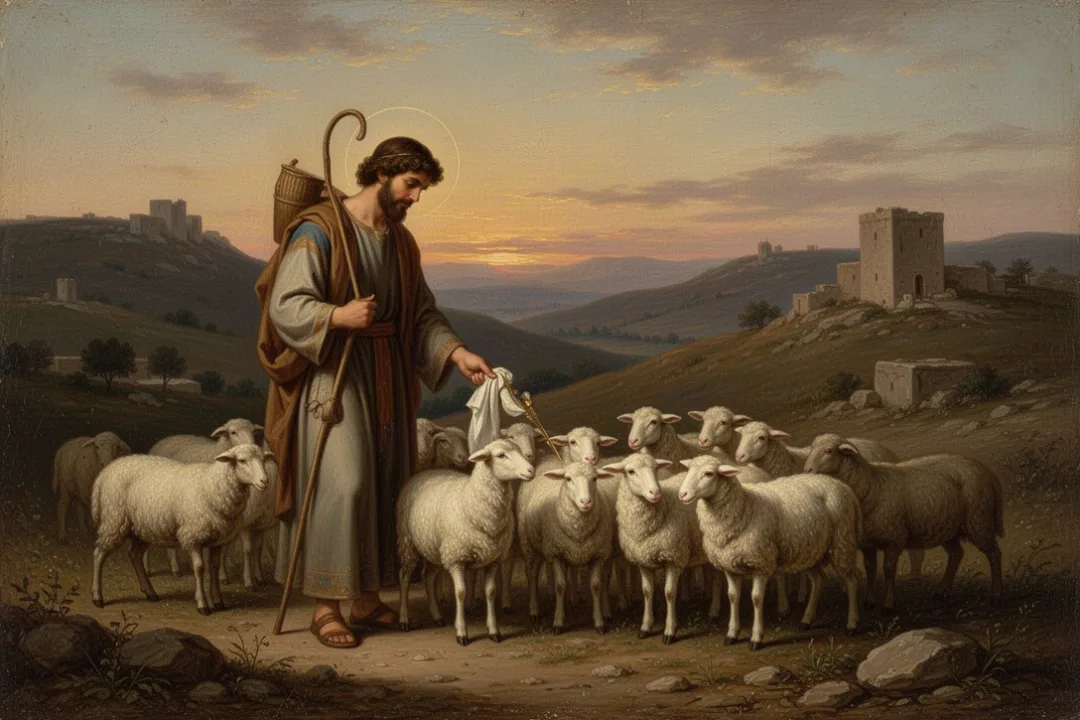
Abel offered God the firstborn animals from his flock, including their fat portions. Genesis presents this gift as an offering given in faith, and God regarded Abel and his offering favorably.
The account appears in Genesis 4:1–16, shortly after Adam and Eve leave the garden of Eden. Their sons, Cain and Abel, bring offerings to God from the work each man performs: Cain works the soil, while Abel keeps flocks.
Cain brings “some of the fruit of the ground,” while Abel brings the firstborn of his flock and their fat portions. The biblical account does not describe Abel bringing one particular species by name. The Hebrew word for flock can refer to small livestock, such as sheep or goats, so “animals from his flock” is the most careful description.
The central contrast is not simply plants versus animals. Genesis emphasizes what Abel selected: the firstborn and the fat portions. These details suggest that Abel did not give a random or leftover animal. He presented valuable parts of the flock as an act of honor toward God.
The direct answer: Abel offered the firstborn animals of his flock and their fat portions. Genesis does not specify the animal’s exact species or describe the physical procedure used to present the offering.
The short biblical context behind Abel’s offering
Cain and Abel are the first children named after Adam and Eve. Their occupations reflect two different forms of livelihood: Cain cultivates the ground, and Abel tends animals. Both bring something connected to their daily work, so the passage is not teaching that Abel earned God’s attention merely because he was a shepherd.
Genesis says that God regarded Abel and his offering, but did not regard Cain and his offering in the same way. The text places the person before the gift: God regards Abel and his offering, then Cain and his offering. That wording matters because it indicates that the offering cannot be separated from the worshiper’s heart and conduct.
God responds to Cain’s anger by warning him about sin and calling him to do what is right. Cain then kills Abel in the field. Abel’s offering therefore becomes part of a larger story about faith, human resentment, sin, and innocent blood, rather than a simple lesson about agricultural and animal sacrifices.
What exactly did Abel offer?
The description in Genesis gives several specific details. Abel did not merely bring an unspecified animal. He brought a selection that represented the value of his flock and the priority he gave to God.
The firstborn of his flock: These were the earliest offspring of the animals under his care.
The fat portions: The text identifies the rich or choice portions associated with the animal.
A gift from his own work: Abel gave from the flock he tended, just as Cain gave from the land he cultivated.
An offering presented in faith: Hebrews 11:4 interprets Abel’s act as an expression of faith and says that his offering was better than Cain’s.
The phrase “fat portions” does not mean Abel offered only animal fat in isolation. It refers to the prized portions connected with the offering. In later Israelite worship, fat was treated as a special part belonging to God, but Genesis occurs before the detailed sacrificial laws given through Moses.
For that reason, you should not assume that Abel followed the complete sacrificial system later described in Leviticus. Genesis gives the result and the meaning of the offering, but it does not explain every ritual detail, such as an altar, fire, priest, or method of slaughter.
Why the firstborn and fat portions matter
The firstborn represented the beginning and future strength of the flock. Giving the firstborn meant that Abel did not wait to see which animals were least useful before choosing a gift. He gave from the earliest and most valuable increase entrusted to him.
The fat portions likewise point to the best part rather than the surplus. In the Bible’s worship language, offering the choice portion expresses respect and devotion. Abel’s gift communicated that God deserved priority, not whatever remained after Abel had satisfied his own needs.
This does not mean every worshiper must own animals or reproduce Abel’s particular offering. The significance lies in the posture represented by the gift: Abel trusted God, honored him with the first and best, and approached him in the way God accepted.
Later passages use similar language when describing offerings made from the first produce, firstborn animals, or valuable possessions. These practices express a recurring biblical principle: the first and best belong to God because all provision ultimately comes from him.
How the Bible explains Abel’s offering step by step
Abel worked as a keeper of flocks. His offering came from the animals placed under his care.
He selected firstborn animals. The choice involved the earliest offspring, not an accidental or inferior selection.
He presented their fat portions. These were described as rich or choice parts of the animals.
God regarded Abel and his offering. The favorable response concerned both the giver and the gift.
Hebrews identifies faith as central. Hebrews 11:4 remembers Abel as a person who offered by faith.
Abel’s obedience became a lasting witness. The same passage in Hebrews says that his faith still speaks, even though Abel died.
This sequence prevents a common misunderstanding. Abel’s offering was not accepted simply because it involved blood, while Cain’s was rejected simply because it involved crops. The biblical explanation highlights Abel’s faith and the quality of his offering, while Genesis does not give one complete sentence explaining every reason Cain’s offering was not regarded.
Was Abel’s offering accepted because it was an animal sacrifice?
Many readers assume that God accepted Abel because animal offerings were automatically superior to produce offerings. That conclusion goes beyond what Genesis says. The passage specifically records that Cain brought fruit from the ground, but it does not say that crops were always unacceptable to God.
In later biblical worship, grain, flour, oil, wine, and other agricultural gifts could be offered to God. The laws in Leviticus include grain offerings alongside animal sacrifices. This shows that the Bible does not treat every non-animal offering as inherently wrong.
The sharper distinction in Genesis concerns the giver’s faith and the character of the gift. Abel brought the firstborn and fat portions, while Cain’s offering is described only as some of the produce. That wording may suggest a difference in generosity or care, although the text does not directly state that Cain chose leftovers.
Hebrews 11:4 provides the clearest interpretive comment: Abel offered by faith. It also connects the offering with righteousness, indicating that God’s acceptance involved Abel’s relationship with God, not merely the material used in the gift.
What was wrong with Cain’s offering?
Genesis does not give a single explicit explanation such as “Cain brought the wrong kind of food.” It says that Cain brought an offering from the ground, then says that God did not regard Cain and his offering. Readers therefore need to avoid claiming more certainty than the passage provides.
Several details help explain the contrast without turning speculation into fact:
Cain’s offering is described generally: He brought some produce, but the text does not call it the first or best harvest.
Abel’s offering is described carefully: Genesis names the firstborn and fat portions, giving his gift a marked quality.
Hebrews emphasizes faith: Abel’s offering is remembered as an act of trust in God.
Cain’s response reveals his heart: He becomes angry and eventually murders Abel after God addresses him.
God challenges Cain personally: Genesis 4 says Cain can do what is right and must resist sin’s desire to control him.
Cain’s later behavior does not prove every detail of his first offering, but it does show that the issue was not merely a technical mistake in selecting produce. The story exposes resentment, refusal to accept correction, and violence. The offering reveals a spiritual problem that Cain then allows to grow.
What Hebrews 11:4 adds to the story
Genesis gives the narrative, while Hebrews 11:4 gives a theological interpretation. It says that Abel offered a better sacrifice through faith and that God testified favorably about him and his gifts. The passage also presents Abel as righteous and says that his faith continues to speak after his death.
Faith here is not a vague feeling or a private opinion. It means trusting God and responding to him as God. Abel’s gift was an outward act that expressed an inward reliance on God’s character and promises.
Hebrews also helps explain why the person and the offering are connected. Abel did not use a valuable gift to manipulate God or purchase divine favor. His offering was a visible expression of faithful worship. The value of the offering and the faith of the giver belong together.
The passage does not erase the details in Genesis. Instead, it explains their significance. The firstborn and fat portions show the seriousness of Abel’s gift, while faith explains why the gift was accepted as righteous worship.
How Abel’s offering relates to the first offerings in Scripture
Abel’s offering takes place before the formal laws governing Israel’s sacrifices. The Bible later develops a broad system of offerings with different purposes, including thanksgiving, fellowship, cleansing from ritual impurity, and atonement. Abel’s gift should therefore be understood within the early Genesis story rather than automatically equated with one later category.
Still, several themes connect Abel’s offering with later worship:
God deserves honor: The offering acknowledges God as worthy of devotion.
The gift should represent value: Firstborn animals and choice portions communicate genuine sacrifice.
The worshiper matters: Biblical offerings are never presented as a substitute for integrity or faith.
God sets the terms of worship: Acceptance depends on responding to God rather than inventing worship on purely personal terms.
Later prophets make this last point strongly. They criticize people who perform religious actions while practicing injustice, hypocrisy, or disobedience. Those passages do not mention Abel’s offering directly in every case, but they reinforce the same principle: a religious gift cannot make an unfaithful life acceptable.
Does Abel’s offering point to Jesus?
Some Christian readers connect Abel’s death and offering with later teaching about Jesus. These connections can be meaningful, but they should be distinguished from what Genesis directly says. Genesis itself identifies Abel as the righteous brother who is killed by Cain and whose blood cries out from the ground.
The New Testament refers to Abel in several ways. Jesus mentions Abel when speaking about righteous people whose blood was shed. Hebrews compares the testimony of Abel’s blood with the better word associated with Jesus. These references place Abel within a larger biblical pattern involving righteous suffering, innocent blood, and God’s judgment.
Abel’s animal offering is not described in Genesis as a direct prediction of Jesus’ death. Christians may see a theological pattern in sacrifice and redemption, but the specific facts remain clear: Abel offered animals from his flock, God accepted him and his gift, and Cain killed him because of jealousy and anger.
What Abel’s offering teaches about giving to God
Abel’s example first teaches that worship should be offered with faith rather than mere outward performance. A gift can be religious in appearance while the giver remains unwilling to trust or obey God. Abel’s offering shows the relationship between what a person gives and the attitude with which it is given.
His offering also teaches intentional generosity. Abel did not appear to treat God as an afterthought. He selected the firstborn and choice portions, demonstrating that worship involved real value and deliberate attention.
For Christians and other readers who apply the story devotionally, the lesson is not to offer animals. The relevant question is how you honor God with your time, work, money, attention, and conduct. The story encourages gifts that are honest, purposeful, and consistent with faith.
Abel’s offering also warns against comparing yourself with another worshiper. Cain’s failure was not corrected by attacking Abel. When God confronted Cain, the proper response was to change course, not to destroy the person whose faith exposed his own resentment.
A careful application: Abel’s example is about faithful worship and giving God what is first and valuable. It should not be used to claim that God accepts only one type of material gift or that every hardship proves a person’s worship is rejected.
Common misunderstandings about what Abel offered
Abel did not offer all of his animals
Genesis says Abel brought the firstborn of his flock and their fat portions. It does not say that he surrendered the entire flock or every animal he owned. The offering was valuable, but the text gives no basis for imagining that Abel had nothing left afterward.
The Bible does not name a lamb with certainty
Many retellings describe Abel offering a lamb, and that may fit the ordinary meaning of a flock. However, the biblical wording does not identify the animal’s exact species. Sheep or goats are both possible within the broader category of small livestock.
Genesis does not describe a complete ritual
The passage does not say whether Abel used an altar, burned the offering, or followed a particular ceremony. Later Scripture describes such practices in detail, but those details should not be inserted into Genesis as though they were stated there.
Cain’s crops were not automatically sinful
The Bible later accepts agricultural offerings, so the material of Cain’s gift cannot by itself explain everything. The story emphasizes the difference between the two worshipers and the quality or faith associated with their gifts.
Abel’s offering did not earn God’s favor as a purchase
Faithful offering is not a transaction in which a person buys blessings from God. Abel’s gift expressed trust and honor. Its acceptance points to a right relationship with God rather than a commercial exchange.
How to answer the question in one sentence
If someone asks, “What did Abel offer to God?” the most accurate answer is: Abel offered the firstborn of his flock and their fat portions, and Hebrews explains that he did so by faith. Genesis does not identify the exact animal species or provide a full description of the ritual.
That answer includes both the physical gift and its biblical meaning. Abel brought animals from his flock, selected the firstborn and choice parts, and offered them as an act of faithful worship. The story’s lasting emphasis is not only what Abel placed before God, but the trust and devotion expressed through that offering.
Frequently asked questions
Did Abel offer a lamb or a sheep?
Genesis does not identify the exact species. It says Abel brought the firstborn of his flock, and the underlying term can refer to small livestock such as sheep or goats. Calling it a lamb is common in retellings, but “an animal from his flock” is the more precise wording based on the biblical text.
Why was Abel’s offering accepted while Cain’s was not?
Scripture connects Abel’s offering with faith, especially in Hebrews 11:4. Genesis also emphasizes that Abel brought firstborn animals and their fat portions, while Cain’s gift is described more generally. The text does not say that God rejected crops as a category or give one complete explanation of Cain’s offering.
Did Abel sacrifice an animal for forgiveness?
Genesis does not assign Abel’s offering a specific later sacrificial category or state that it was made for forgiveness. It simply describes an offering from his flock. The detailed sacrificial system appears later in Scripture, so it is best not to impose all of its purposes on Abel’s earlier act.
What does Abel’s offering mean for people today?
Abel’s offering is commonly understood as an example of worship given in faith and with genuine honor. Its application is not that people must bring animals, but that what they give should reflect trust, sincerity, and priority. The story also warns against envy when another person’s faithful worship exposes personal resentment.









Leave a Reply