Imagine hosting a wedding reception when the food is running low or the main drink has run out. For the couple and their families, the problem would be more than an inconvenience; it could become a public embarrassment. That is the tension behind the marriage of Cana, the wedding celebration where Jesus turned water into wine.
The event appears in John 2:1-12, where John calls the miracle Jesus’ first sign. The story is not simply about producing more wine for a party. It presents Jesus as the one who brings unexpected abundance, reveals God’s glory, and begins to show his identity through a visible act.
The wedding took place in Cana of Galilee, a village associated with the region where Jesus lived and began his public ministry. Jesus’ mother was there, and Jesus and his disciples had also been invited. During the celebration, the wine ran out.
Jesus’ mother told him about the shortage. He responded by referring to the timing of his public mission and the “hour” associated with his full revelation. She then told the servants to do whatever Jesus instructed them to do.
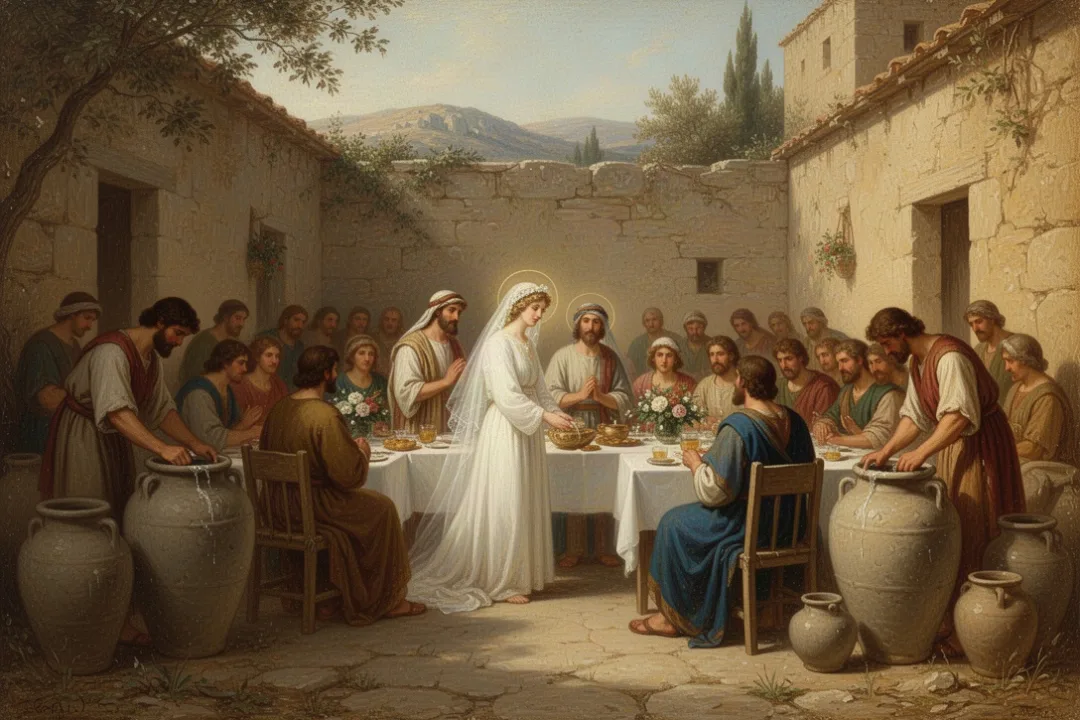
Nearby stood six stone water jars used for Jewish purification practices. Jesus directed the servants to fill them with water. When they drew some out and brought it to the master of the feast, it had become wine.
The master of the feast did not know where it had come from, although the servants did. He remarked that the hosts had saved the better wine until later, unlike the usual practice of serving the best wine first. John then explains that this was the first sign through which Jesus revealed his glory, and his disciples believed in him.
The central point: The miracle is called a “sign” because it points beyond the wine itself. It reveals something about Jesus’ identity, mission, and relationship to God.
The short biblical context behind the wedding
The account comes near the beginning of John’s Gospel. Before Cana, John presents John the Baptist’s testimony, the calling of several disciples, and the early signs that Jesus is gathering followers. The wedding therefore occurs at a significant moment: Jesus has begun to form a community, but he has not yet publicly displayed his power in John’s narrative.
John does not identify the bride and groom by name. He also does not explain how Jesus was related to the couple. The focus remains on the action of Jesus, his mother, the servants, the disciples, and the resulting sign. Details that might satisfy curiosity about the family are left aside so the spiritual meaning remains central.
Wedding celebrations in the ancient Jewish world could last for several days and involved extended families, neighbors, friends, food, music, and wine. Hospitality carried social importance. A host who failed to provide adequately could suffer lasting shame, especially in a close-knit village. The shortage at Cana was therefore a serious social crisis, even though it may seem minor compared with later miracles in the Gospels.
How the Cana miracle unfolds step by step
A wedding brings Jesus and his mother together. The setting is an ordinary family celebration rather than a temple, battlefield, or royal court. Jesus enters the story through a human need within a household.
The wine runs out. The problem is stated simply, but its consequences would have been humiliating for the hosts. The lack creates the situation in which Jesus’ sign will be revealed.
Jesus’ mother brings the need to him. She does not present a detailed argument or demand a particular method. She simply identifies the problem and leaves the response to Jesus.
Jesus speaks about his appointed hour. His words show that his actions are not controlled by social pressure or human expectations. His mission unfolds according to divine timing.
Mary directs the servants to obey. Her instruction is practical and deeply significant: they should follow whatever Jesus tells them. This prepares the way for the miracle.
Jesus uses ordinary containers. The stone jars are already present for a religious household practice. Their existing purpose becomes part of the setting for a new sign.
The servants fill the jars with water. Their work is concrete and obedient. They do not perform the transformation, but they participate in the event by carrying out Jesus’ instructions.
The water becomes wine. John does not describe the mechanics of the change. He emphasizes the result and the knowledge of the servants who had followed the command.
The feast master recognizes the quality. He tastes the wine without knowing its source and comments on the unusual generosity of serving the better wine later.
The disciples believe in Jesus. The sign accomplishes its deeper purpose by revealing Jesus’ glory and strengthening the disciples’ faith.
Why John calls the miracle a sign
John uses the idea of a sign to describe miracles that point to a deeper reality. The event matters not only because something impossible happened, but because the action reveals who Jesus is. The miracle at Cana opens a series of signs in John that progressively direct attention to Jesus’ authority and divine mission.
A miracle can answer an immediate need while also carrying symbolic meaning. At Cana, Jesus meets a practical problem, but John’s explanation moves beyond hospitality. The miracle displays glory, and the disciples respond with belief. The sign is therefore both an act of compassion and a revelation.
The Gospel does not say that every person at the wedding became a disciple. In fact, the master of the feast appears unaware of the miracle’s source. The servants know more than he does, and the disciples see the event as a revelation of Jesus. This contrast suggests that recognizing a sign requires more than witnessing an unusual result; it requires attention to what the act reveals.
What Mary’s role means in the story
John does not call her Mary in this passage. He refers to her as Jesus’ mother, which keeps the focus on her relationship to Jesus and on the role she plays in bringing the need to his attention. She notices the shortage and speaks to him before anyone else in the account takes action.
Jesus’ response can sound abrupt to modern readers, especially because English translations differ in how they render his form of address. The exchange should not automatically be read as disrespect. It highlights a boundary: Jesus is not acting merely because his mother has prompted him, and his public mission follows the timing given by God.
Mary’s next action is especially important. She tells the servants to follow Jesus’ instructions. She does not try to control the miracle, explain it, or claim credit for it. Her role is one of trusting attention: she recognizes the need, brings it to Jesus, and directs others toward obedience.
Many Christian traditions see this as a model of intercession. Catholics and Orthodox Christians often connect Cana with Mary’s continuing role in directing people toward Christ. Many Protestant readers emphasize the same passage as an example of faithful submission to Jesus without treating Mary as the source of his power. Across these traditions, the text itself keeps Jesus at the center.
Why the servants matter more than they first appear
The servants occupy a quiet but essential place in the account. They are the people who receive the instructions, fill the jars, draw out the transformed liquid, and carry it to the feast master. They may not understand the whole situation, but they obey the next command given to them.
John specifically shows that the servants know where the wine came from while the feast master does not. Their hidden service gives them knowledge that the public official lacks. This is a recurring biblical pattern: people who appear socially unimportant can become witnesses to God’s work because they are present and obedient.
The servants also show that obedience does not always begin with complete understanding. They are told to fill large jars with water when the immediate problem is a shortage of wine. The instruction may seem unrelated to the need, yet their willingness to act places them in the middle of the sign.
They listen carefully when Jesus gives instructions.
They act before seeing the outcome.
They carry out ordinary work that becomes part of an extraordinary event.
They know the hidden story even though the influential guest does not.
The meaning of the water jars
John identifies the jars as containers used for Jewish purification. This detail is not necessary to describe a wedding emergency, so it likely carries interpretive weight. Jesus uses vessels connected with ritual washing as the setting for an act that reveals a new abundance.
The story does not say that Jewish purification was worthless or sinful. Rather, the setting helps John show a movement from one stage of religious expectation toward what Jesus brings. The jars are still physically present, but their contents and purpose are transformed in the sign.
The water-to-wine change can therefore be read as a picture of transformation. Jesus does not merely repair what is missing by adding a small amount. He changes the situation completely and provides more than the guests expected. The sign suggests that Jesus brings a new quality and fullness rather than a minor adjustment to existing religious life.
Readers should avoid turning every object into a separate hidden code. John gives the clearest interpretation himself: Jesus reveals his glory, and the disciples believe. The jars support that message, but the passage does not require a speculative meaning for every detail.
What the abundant wine symbolizes
Wine in the Bible can be associated with celebration, blessing, harvest, fellowship, and the abundance of God’s provision. At Cana, the plentiful supply fits the atmosphere of a wedding feast. The miracle preserves joy and protects the hosts from shame.
The quantity implied by the six jars is substantial, although the exact capacity depends on how the ancient measurement is understood and how a translation renders it. The point is clearly not a barely adequate replacement. Jesus provides generously, and the quality is also praised.
This abundance is one reason many Christian interpreters connect Cana with biblical hopes for a coming time of blessing. Prophetic writings sometimes use feasting, rich food, and wine as images of restoration. John does not quote one particular prophecy in the passage, but the wedding setting and abundance naturally evoke those themes.
The sign also carries a future-facing dimension. A wedding feast can represent the joy of God’s restored relationship with his people, a theme developed elsewhere in the New Testament. Cana does not present the entire theology of the final wedding feast, but it offers an early glimpse of the kind of abundance associated with Jesus’ saving work.
A helpful balance: Cana should not be reduced to either a lesson about alcohol or a general promise that every material need will be met. John presents a specific sign whose main purpose is to reveal Jesus’ glory.
How the wedding setting shapes the message
Jesus’ first sign in John does not happen during a public debate or a dramatic confrontation. It happens at a wedding, where people are eating, drinking, talking, and celebrating. That setting shows that Christian faith is not limited to solemn religious spaces. God’s work can be revealed in ordinary human relationships and shared occasions.
The couple remains unnamed, yet their celebration becomes the setting for a revelation that affects the disciples. This detail can be reassuring for readers who feel that their own lives are unremarkable. The people at Cana are not seeking a miracle as part of a public demonstration. A private problem becomes the context for divine action.
The story also treats celebration as something worth preserving. Jesus does not criticize the wedding feast for being joyful. He responds to a need that could have brought shame and disruption. The miracle presents generosity, hospitality, and communal joy as meaningful aspects of human life.
What “my hour” means in John’s Gospel
Jesus’ reference to his hour introduces an important theme in John. The phrase points toward the appointed time of his suffering, death, resurrection, and glorification. Throughout the Gospel, Jesus’ public actions unfold in relation to that hour rather than according to pressure from crowds or even close associates.
At Cana, the hour has not yet fully arrived. Jesus still performs the sign, but the wording reminds readers that the miracle is part of a larger mission. The wedding is not the destination; it is the beginning of a chain of revelations that will lead toward the cross and resurrection.
This gives the miracle a deeper shape. The glory revealed at Cana is real, but it is not the complete revelation. John later shows that Jesus’ glory is most fully displayed through the entire movement of his saving work. The first sign offers a beginning glimpse of what will be made clearer later.
How different Christian traditions read Cana
Christians broadly agree that Cana reveals Jesus’ power and identity, but traditions often emphasize different aspects of the passage. These interpretations can complement one another when they remain grounded in the text.
Catholic interpretation often emphasizes Mary’s intercession, her trust in Jesus, and the way Cana supports reflection on her role in bringing human needs to Christ.
Eastern Orthodox interpretation commonly highlights the transformation of creation, the sanctification of marriage, and the revelation of Christ’s divine glory.
Many Protestant interpretations focus on Jesus as the source of the sign, Mary’s faithful obedience, and the disciples’ movement toward belief.
Marriage-focused readings point to Jesus’ presence at a wedding as evidence that marriage and family celebrations have dignity within Christian life.
Symbolic readings connect the water, wine, feast, and abundance with the transition from purification and expectation to fulfillment in Christ.
These perspectives should not obscure the passage’s basic order. Mary directs attention to Jesus, the servants obey Jesus, Jesus performs the sign, and the disciples respond to Jesus. The narrative’s center is not the hosts, the feast master, or even the miracle as an isolated wonder.
What Cana teaches about marriage and family life
The passage is sometimes used in Christian teaching about marriage because Jesus attends and supports a wedding celebration. John does not present a full doctrine of marriage here, and he does not describe the vows, the couple’s relationship, or their later life. Still, his presence at the feast communicates something significant about the value of human commitment and communal joy.
Jesus does not remain distant from the practical pressures surrounding the couple. He responds to a situation involving hospitality, reputation, family responsibility, and celebration. That does not mean every marriage will be free from shortage or crisis. It does suggest that ordinary household concerns are not beneath God’s attention.
The story also places the wider community around the couple. Weddings involve more than two individuals; they bring families and friends together. The Cana account therefore encourages a view of marriage that includes hospitality, mutual support, and shared responsibility rather than treating marriage as an isolated private arrangement.
Practical ways to read the Cana account today
A careful reading begins by respecting what the text says and what it does not say. The account is not a formula for forcing a miracle, and it does not promise that every shortage will be removed in the way you hope. It does offer several durable principles for faith and daily life.
Bring real needs to Jesus. Mary notices a practical problem and presents it without pretending that everything is fine.
Accept that timing matters. Jesus responds according to his mission rather than human pressure.
Follow the next faithful instruction. The servants do not need a complete explanation before they act.
Look for hidden witnesses. People working quietly may understand more than those holding public authority.
Receive abundance responsibly. God’s generosity is not a license for waste, pride, or careless excess.
Let signs lead to faith. The miracle is valuable because it directs attention to Jesus, not because it satisfies curiosity.
The account can also shape the way you respond to someone else’s crisis. A shortage at a celebration may appear small compared with war, illness, or poverty, but embarrassment and anxiety are still real. Cana encourages attentive care for needs that others might dismiss as unimportant.
Common misunderstandings about the marriage of Cana
The wedding couple is not identified
The Bible does not name the bride or groom, and it does not say that Jesus was the groom. Some later traditions and imaginative retellings have filled in details, but those additions should not be confused with John’s account. The text identifies the location, the guests, the shortage, the jars, and the sign without naming the couple.
The story is not mainly a lesson about drinking
Because wine is central to the event, readers sometimes approach the passage as a debate about alcohol. Yet John’s stated emphasis is the revelation of Jesus’ glory. Christian communities differ in their teaching about alcohol, but the narrative itself is primarily about the sign, obedience, abundance, and faith.
Mary does not perform the miracle
Mary recognizes the need and tells the servants to obey Jesus. The text gives the action and authority to Jesus. A reader may honor Mary’s faith without assigning her the power that John attributes to Christ.
The miracle is not a promise of luxury
The abundant wine points to generous provision and the joy of God’s kingdom, but it should not be turned into a guarantee of wealth. Cana is a sign within Jesus’ mission, not a promise that faithful people will always receive material abundance or escape every disappointment.
Why the first sign still matters
The marriage of Cana remains memorable because it joins the ordinary and the divine. A wedding celebration, a social embarrassment, large water jars, quiet servants, and a meal become the setting for Jesus’ first sign in John. Nothing about the location suggests a stage prepared for public spectacle.
Yet the event changes how the disciples see Jesus. The miracle is hidden from some guests and known to others, but its purpose is not hidden from the reader. Jesus brings transformation where there is lack, honors the joy of a wedding feast, and reveals his glory through generous action.
For readers of the Gospel, Cana is an invitation to look beyond the immediate gift to the giver. The water becoming wine is striking, but the deeper claim is that Jesus has begun to reveal who he is. His presence turns an impending humiliation into a celebration and points forward to the greater work still to come.
Frequently asked questions
Where is the marriage of Cana found in the Bible?
The marriage of Cana is recorded in John 2:1-12. It appears near the beginning of Jesus’ public ministry and is described as his first sign in John’s Gospel. The passage names Cana in Galilee as the location, mentions Jesus’ mother and disciples, and describes how Jesus turned water into wine during a wedding celebration.
Was Jesus the groom at the wedding in Cana?
No. The biblical account does not identify Jesus as the groom, and it does not name either member of the couple. Jesus attended the celebration with his mother and disciples. Later traditions may speculate about the couple, but those ideas are not stated in John’s Gospel and should be kept separate from the biblical text.
Why did Jesus turn water into wine at Cana?
The immediate reason was that the wedding celebration had run out of wine, creating shame for the hosts. John gives a deeper reason as well: the act was a sign that revealed Jesus’ glory and led his disciples toward belief. The miracle therefore combines compassion for a practical need with a revelation of Jesus’ identity.
What does Cana teach about Mary?
Mary notices the problem, brings it to Jesus, and tells the servants to follow his instructions. Her actions show trust without attempting to control the outcome. Christian traditions interpret her role differently, especially regarding intercession, but the passage consistently directs attention to Jesus as the one who performs the sign and determines its timing.




Leave a Reply