Noah was in the ark for about one year and ten days, according to the timeline in Genesis. The rain fell for 40 days and 40 nights, but Noah, his family, and the animals remained aboard while the waters rose, receded, and the ground dried.
Genesis gives the timeline using dates in Noah’s 600th and 601st years. He entered the ark on the 17th day of the second month and left on the 27th day of the second month the following year. Depending on how the ancient calendar and inclusive counting are calculated, this is commonly described as approximately 370 or 371 days—roughly one year and ten days.
The account in Genesis does not present the flood as a 40-day stay. Instead, it records a sequence of events that spans more than a year. The 40 days of rain were only one part of the larger flood period.
Genesis 7–8 names several dates that help establish the timeline. These dates cover Noah’s entrance into the ark, the beginning and end of the rain, the point when the waters reached their highest level, the appearance of mountain peaks, and Noah’s eventual departure.
The basic calculation looks like this:
Day 1 of the timeline: Noah enters the ark on the 17th day of the second month of his 600th year.
After seven days: The flood begins, and rain falls for 40 days and 40 nights.
For 150 days: The waters prevail or remain at their highest strength.
In the 601st year: The waters continue to recede, and the land gradually dries.
Final date: Noah leaves the ark on the 27th day of the second month of his 601st year.
Direct answer: Noah was in the ark for approximately one year and ten days. The 40 days refer to the period of rain, not the entire time spent inside the ark.
What happened during each stage of the flood timeline?
The dates in Genesis describe a gradual process rather than a single storm followed by an immediate return to dry land. Noah had to remain in the ark after the rainfall stopped because the floodwaters still covered the land and had not yet receded enough for safe travel.
Noah enters the ark before the flood begins
Genesis 7:11–16 places Noah’s entry on the 17th day of the second month of his 600th year. The animals enter with him, and the account says the flood begins after a seven-day interval.
This means the total time inside the ark includes more than the days of rainfall. The people and animals were already in the vessel before the waters began rising, and the ark remained their shelter after the rain had ended.
Rain falls for 40 days and 40 nights
Genesis 7:12 describes rain falling for 40 days and 40 nights. During this period, the floodwaters rise steadily. The text also describes water coming from below and above, presenting the flood as a vast, overwhelming event rather than ordinary seasonal rain.
The phrase “40 days and 40 nights” is one of the best-known details of the story, but it should not be confused with the total duration of the flood. When people ask how long Noah was in the ark, the answer must include the months after the rain stopped.
The waters prevail for 150 days
Genesis 7:24 says the waters prevail over the earth for 150 days. Genesis 8:3 then says the waters recede after that period. Readers sometimes treat the 150 days as a separate period that begins after the 40 days, but the wording can also be understood as describing the broader period during which the floodwaters remained dominant.
Either way, the passage makes the main point clear: the flood lasted far longer than the rainfall. The water did not disappear as soon as the clouds cleared. The ark continued to float while the flood reached its maximum extent and then slowly declined.
The ark comes to rest on the mountains of Ararat
On the 17th day of the seventh month, the ark comes to rest on the mountains of Ararat, according to Genesis 8:4. This occurs several months after Noah entered the ark.
The ark’s resting place did not mean that Noah could leave immediately. Mountains may have emerged or become visible while lower ground was still covered. Noah had to wait for the surrounding land to dry sufficiently before leaving the vessel.
The mountain tops become visible
Genesis 8:5 records that the tops of the mountains become visible on the first day of the tenth month. This is another sign that the water level is dropping, but it still does not mark the end of Noah’s stay.
The account emphasizes several stages of waiting. First, the ark floats. Then it rests on the mountains. Later, the mountain tops appear. Finally, the surface of the ground dries. These details explain why Noah remains inside for many months after the ark has stopped moving.
Noah sends out birds to test the land
After additional waiting, Noah sends out a raven. He later sends a dove, which initially finds no suitable place to land and returns to the ark. After another period, the dove returns with a fresh olive leaf, showing that vegetation is appearing above the water.
Noah sends the dove again, and it does not return. That suggests the land is becoming habitable, but Noah still does not leave immediately. The story presents him as waiting for God’s direction rather than treating the bird’s behavior as the final command to disembark.
The ground dries and Noah leaves the ark
Genesis 8:13 says that on the first day of the first month of Noah’s 601st year, the surface of the ground is dry. Even then, Noah remains inside until the 27th day of the second month. God tells him to leave in Genesis 8:15–19.
The final interval shows that “dry” and “ready for departure” are not necessarily the same moment. Noah leaves only after the divinely given instruction, bringing out his family and the animals so life can begin again on the land.
A step-by-step calculation of the time Noah stayed inside
The dates can be arranged as a simple sequence. Since the ancient calendar system does not map perfectly onto the modern calendar, the result is best expressed as an approximate number of days rather than as a claim about a precise modern date.
Entry: Noah enters the ark on the 17th day of the second month in his 600th year.
Waiting period: Seven days pass before the flood begins.
Rain: Rain falls for 40 days and 40 nights.
High water: The waters prevail for 150 days, covering the land and keeping the ark afloat.
Resting place: The ark comes to rest on the mountains of Ararat on the 17th day of the seventh month.
Visible mountains: Mountain tops are seen on the first day of the tenth month.
Testing the land: Noah sends out birds and waits for signs that the ground can support life.
Dry ground: The surface is dry on the first day of the first month of Noah’s 601st year.
Departure: Noah leaves on the 27th day of the second month, completing roughly one year and ten days inside the ark.
One common calculation treats the period from the 17th day of the second month in one year to the 27th day of the same month in the next year as 370 days, using 30-day months. Counting both the entry day and the exit day can produce a total of 371 days. That is why both figures appear in explanations of the flood timeline.
Why some explanations say 40 days and others say one year
The two answers refer to different parts of the story. Saying “40 days” answers the question, How long did the rain fall? Saying “about one year and ten days” answers the question, How long did Noah remain in the ark?
The distinction matters because the ark functioned as a place of protection throughout the entire flood cycle. Noah did not leave when the rain ended. The waters still covered the land, and the conditions outside were not yet safe for people or animals.
40 days and 40 nights: The period of rainfall described in Genesis 7.
150 days: The period associated with the waters prevailing and later beginning to recede.
About one year and ten days: The approximate time from Noah’s entry until his departure.
These numbers are not necessarily competing versions of the same duration. They describe different events within the larger account. Confusion usually arises when the duration of the rain is used as though it were the duration of Noah’s entire stay.
What the dates in Genesis 7 and 8 reveal
The date references give the flood story a chronological structure. Genesis does not merely say that Noah stayed in the ark “for a long time.” It identifies months, days, and Noah’s age to show the length and progression of the event.
The timeline begins in Noah’s 600th year and ends in his 601st year. That change of year alone indicates that the stay lasted more than twelve months in the narrative’s calendar system. The final departure occurs on the 27th day of the second month, while entry occurred on the 17th day of that month a year earlier.
The sequence also creates a pattern of waiting and observation. Noah receives instructions to enter, remains inside during the flood, watches for signs of receding water, and waits again before leaving. The story’s calendar details reinforce the idea that the process took place over an extended period.
How the ancient calendar affects the day count
Modern readers often want to convert the biblical dates into an exact number of 24-hour days. That calculation is not entirely straightforward because the text uses an ancient calendar, and the length of a month may vary depending on the chronological model being used.
Some interpreters work with a simplified system in which the months involved are treated as 30 days long. Under that approach, the date sequence can be counted as approximately 370 days. If both the opening and closing dates are counted, the total may be called 371 days.
This small difference does not change the practical answer. Noah stayed in the ark for about a year and ten days, not merely for the 40 days of rain. The safest wording is “approximately 370 days” or “roughly one year and ten days,” rather than claiming a precise modern-day total that the text itself does not require.
Calendar caution: The biblical dates support a stay of roughly one year and ten days, but inclusive counting and assumptions about month length can produce slightly different totals.
What Noah and the animals did during the long stay
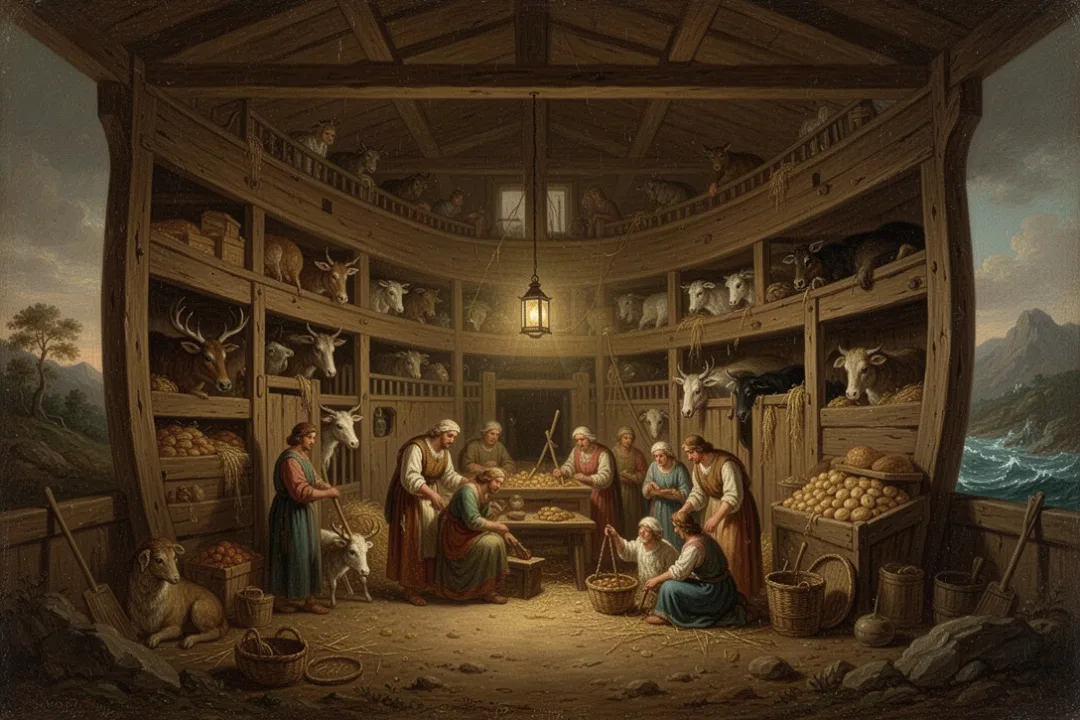
Genesis gives only limited information about daily life inside the ark. It does not provide a complete schedule, floor plan, or account of every task Noah’s family performed. Still, the narrative indicates that the ark had to sustain a large group of people and animals for an extended period.
Before the flood, Noah is instructed to bring food into the ark. Genesis 6:21 refers to gathering food for the people and the animals. That detail makes sense of the year-long duration: provisions were needed not only for a storm but also for months of confinement after the water rose.
The family likely had to manage practical responsibilities such as:
Distributing food and water to the animals.
Maintaining order in the enclosed spaces.
Removing waste and keeping living areas usable.
Monitoring the condition of the animals and family members.
Watching the changing position and movement of the ark.
Sending birds to assess whether the land was becoming accessible.
These tasks are reasonable implications of the account, but the biblical text does not describe each activity in detail. It is better to distinguish what Genesis explicitly says from what readers infer about the practical demands of life aboard the ark.
Did Noah leave the ark as soon as the ground was dry?
No. Genesis 8 gives two related but separate moments. On the first day of the first month in Noah’s 601st year, he observes that the surface of the ground is dry. He does not leave until the 27th day of the second month, after God tells him to go out.
This additional waiting period is one reason the timeline ends later than some quick calculations suggest. The ground’s condition is improving, but the narrative still places Noah inside the ark for several more weeks.
The delay also highlights the importance of the command to leave. Noah does not decide independently that the first visible dry ground is enough. He continues to wait until the instruction comes to bring out his family and the animals.
Does the Bible say the ark landed on one mountain?
Genesis 8:4 says that the ark came to rest on the mountains of Ararat. The wording refers to a mountainous region rather than necessarily identifying one modern peak. The biblical account does not name a specific mountain that can be confirmed as the ark’s location today.
This geographical detail does not affect the length of Noah’s stay. The ark’s resting on the mountains occurs well before Noah leaves. Even after it stops floating, the surrounding land must continue drying, and Noah remains inside while he waits for a safe and authorized departure.
How different traditions understand the flood timeline
Jewish, Christian, and other readers of Genesis have discussed the flood chronology in different ways. Some focus on the straightforward sequence of dates and calculate approximately one year and ten days. Others examine whether the 150 days overlap with the 40 days of rain or represent a distinct period.
These differences usually concern how the passages should be synchronized, not whether Noah stayed in the ark for only 40 days. The narrative’s dated events still show a prolonged stay that extends from one year into the next.
When reading explanations, look for the specific question being answered. A source may discuss:
The duration of the rain.
The duration of the rising or prevailing waters.
The time until the ark rested on the mountains.
The time until the mountain tops appeared.
The time until the ground became dry.
The total time from entry to departure.
Using precise terms prevents the numbers from appearing contradictory. “Forty days,” “150 days,” and “about 370 days” can all refer to real portions of the biblical timeline when they are attached to the correct events.
What the flood timeline means for reading Genesis
The extended duration changes the way the story is understood. Noah’s experience was not limited to surviving a short period of intense rain. He and his family faced a prolonged period of isolation, uncertainty, responsibility, and waiting.
The ark served as protection while the waters rose, but it also became a temporary home for many months. Even after the ark came to rest, Noah could not see the full condition of the land from inside. The birds, the visible vegetation, and the drying ground provided gradual evidence rather than an immediate answer.
The dates also show that the story values patience and careful observation. Noah responds to stages: he enters when instructed, waits through the flood, tests the conditions, and leaves when commanded. Whether a reader approaches Genesis as sacred history, religious literature, or a foundational biblical narrative, the timeline gives the account a strong sense of duration and sequence.
The clearest answer to remember
Noah was in the ark for approximately 370 days, or about one year and ten days. The rain lasted 40 days and 40 nights, but the waters continued to cover the land, and the ground required additional time to dry.
Genesis 7:11 through 8:19 supplies the relevant dates. Noah entered on the 17th day of the second month in his 600th year and left on the 27th day of the second month in his 601st year. Depending on the counting method, the total is described as 370 or 371 days, but the central answer remains the same: roughly one year and ten days inside the ark.
Frequently asked questions
Was Noah in the ark for 40 days or one year?
Both numbers describe different parts of the flood account. Rain fell for 40 days and 40 nights, but Noah remained in the ark while the waters continued to cover the land and then receded. From his entry until his departure, the period was approximately one year and ten days, or about 370 days.
When did Noah enter and leave the ark?
Genesis says Noah entered on the 17th day of the second month of his 600th year. He left on the 27th day of the second month of his 601st year, after the ground had dried and God instructed him to depart. These dates create the commonly cited total of roughly 370 days.
How long did the floodwaters remain on the earth?
Genesis describes the waters as prevailing for 150 days, while the complete process of flooding, receding, and drying lasted much longer. The 150-day figure should not automatically be added to the 40 days of rain, because interpreters debate how those periods overlap within the narrative.
Did Noah leave the ark immediately after the land dried?
No. Genesis says Noah observed that the surface of the ground was dry on the first day of the first month of his 601st year. He remained inside until the 27th day of the second month, when God told him to leave with his family and the animals.









Leave a Reply