The phrase the seven churches in Asia Minor refers to a group of early Christian communities addressed in the Book of Revelation. These communities were located in the western half of what is today Turkey, a region historically known as Asia Minor or Anatolia. Across the biblical letters written in the late first century, each church receives a distinct message that blends exhortation, warning, and promise. Taken together, the seven churches provide a unique snapshot of early Christian life under Roman rule: they reveal how communities organized worship, faced persecution, navigated doctrinal challenges, and sustained hope in the face of social and political pressures.
Together with the surrounding urban fabric—ports and inland trade routes, hillside sanctuaries, theaters, and markets—these congregations illustrate how early Christians engaged with city life, urban identity, and religious pluralism. Although the churches addressed in the Revelation of John are long gone as living congregations, they leave behind a layered history that spans apostolic memory, urban archaeology, and biblical interpretation. This article looks at the seven churches in Asia Minor not only as an antiquarian itinerary but as a doorway into the history, location, and significance of each site within both ancient and Christian heritage.
Overview of the seven ecclesial communities in Asia Minor
Ephesus — an old port city with a rich pagan and early Christian life, famed for its harbor and for hosting a vibrant church.
Smyrna — a prosperous port city that faced pressure and persecution, and which produced a historic martyr tradition.
Pergamon (Pergamum) — a political and cultural capital in the Attalid kingdom, home to a prominent Christian community and a city described as where Satan’s throne was located.
Thyatira — a commercial hub along inland routes, notable in Revelation for its strong-willed church and the warning about spiritual compromise.
Sardis — once a powerful capital with impressive fortifications, later admonished for spiritual complacency and lifelike appearances.
Philadelphia — a center of trade and minority communities that receives a steady commendation for perseverance and faithfulness.
Laodicea — a wealthy and thriving urban center whose lukewarm religious condition becomes a stark rebuke in the letters.
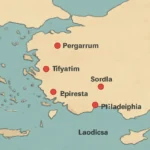
The localities share a geography that was crucial to their role in late antique life: coastal plains, river valleys, and highland routes that connected inland trade with Mediterranean commerce. The physical settings help explain why these seven churches were strategic centers for early Christian communities—places where evangelists preached, letters circulated, and doctrinal disputes shaped the trajectory of Christian tradition. In the rest of this article, we explore each site in turn under the headings of Historical background, Geographical location, and Biblical significance, followed by notes on archaeology and modern-day status that help visitors and scholars appreciate the enduring legacy of the seven churches in Asia Minor.
Ephesus
Historical background
Ephesus sits at the crossroads of commerce and culture on the western coast of Anatolia. The city had centuries of fame before the rise of Christian community life there, including the cult of Artemis, a major temple complex, and a long-standing role as a hub of Roman provincial administration. The epistles to the church in Ephesus in Revelation 2 begin with commendation for endurance and doctrinal fidelity, but they also carry a stern reminder that love—“the first love”—should not be abandoned. In other words, the seven churches in Asia Minor begin with a city that embodies both religious pluralism and urban vitality, reminding readers that early Christians inhabited spaces where many belief systems intersected.
Geographical location
Present-day Selçuk and the nearby town of Kuşadası sit on the Aegean coast, a few miles from the ancient harbor that once linked Ephesus to the broader Mediterranean world. Its location allowed for lively commerce, as ships brought goods and travelers into a city that could boast a large population, a sophisticated public space, and significant architectural grandeur. The proximity to the Ionian sea, the river basin, and fertile hinterland shaped a diverse urban environment where Judaism, Hellenistic culture, and the early Christian movement intersected.
Biblical significance
The message to Ephesus in Revelation 2 calls the community to return to their first love even as they maintain doctrinal integrity and faithful work. This balance—between zeal for correct teaching and sustained devotion—has resonated with readers across centuries. The letter also emphasizes endurance in the face of possible persecution and external pressure. For scholars, the Revelation to Ephesus offers an early model of how Christian communities navigated mixed religious economies and imperial authority while preserving a distinctive identity.
Archaeological and modern status
The ruins at Ephesus include the monumental Library of Celsus, a vast theater that could seat tens of thousands, and well-preserved street layouts and public buildings. The site remains a magnet for visitors who want to imagine the social life of a city that was once a major center of Asia Minor. In addition to the ancient remains, the area hosts the House of the Virgin Mary, a devotional site linked to later Christian tradition. The juxtaposition of ancient theater and sacred spaces makes Ephesus a powerful lens on how early Christians interacted with urban life, commerce, and religion.
Smyrna
Historical background
The city we now call Izmir sits on the western coast of modern Turkey and carries a memory of continuity from ancient times into the present. In late antiquity, Smyrna was renowned for its wealth, its education, and its struggles. The church in Smyrna is notable for enduring hardship and facing pressure under imperial authorities while maintaining a steadfast faith. The tradition surrounding the martyrdom of Polycarp, the bishop of Smyrna in the second century, is one of the enduring legacies of this urban church, illustrating how early Christians perceived faithful witness under dangerous circumstances.
Today’s Izmir sits on a deep natural harbor along the Aegean coast, a site that has hosted civilizations for millennia. The modern city reflects layers of people, languages, and religious practices that have shaped its character. The ancient port area, the surrounding fortifications, and the inland hinterland all contributed to Smyrna’s importance as a crossroads of commerce and culture—factors that similarly framed early Christian communities faced with competing claims on public life.
Biblical significance
In the Revelation letters, Smyrna is praised for endurance and faithfulness in the face of persecution. The text exhorts believers not to fear the coming trials and promises the crown of life to those who remain faithful unto death. This message has served as a source of resilience for generations of believers who found in the seven churches in Asia Minor a model of steadfastness under pressure. The Smyrna account underscores the theme that true perseverance, rather than sensational triumph, marks genuine discipleship.
Archaeological and modern status
The archaeological remains in Izmir and its surroundings are diverse, featuring ancient harbors, walls, and public buildings that reveal a long-standing urban identity. While fewer monumental ruins survive intact in Smyrna compared with Ephesus, the city’s historical memory as a center of Christian persecution, martyrdom, and steadfast faith remains a vital part of the story of the seven churches in Asia Minor.
Pergamon (Pergamum)
Historical background
Pergamon was the capital of the Attalid kingdom in the Hellenistic period and later became an important Roman provincial center. Its hilltop acropolis and impressive amphitheater symbolized a city of learning, culture, and power. The community that formed there in the first centuries of the Christian era faced a sophisticated urban environment where philosophy, medicine, and high politics coexisted with pagan worship and imperial cults. In Revelation, Pergamon is described as a place where Satan's throne was located, a formulation that signals the city’s prominence and the pressure Christians faced in a cosmopolitan setting.
Geographical location
Today, Bergama sits near the city of Izmir in western Anatolia. The landscape includes a dramatic citadel and the ruins of a large theater, along with the remains of the ancient library and other public buildings. Pergamon’s position on a raised site and its proximity to important trade routes helped it function as a judicial, religious, and cultural hub in antiquity.
Biblical significance
The letter to Pergamon in Revelation commends the church for holding firm to faith even in a context where Nicolaitans and other competing teachings circulated. The text also warns against embracing or tolerating practices associated with Balaam and false teaching, reminding readers that doctrinal fidelity and moral integrity must go hand in hand with perseverance.
Archaeological and modern status
The Pergamon Archaeological Site preserves a long sequence of structures, including the acropolis, the Altar of Zeus, a theater, and the Library of Pergamon. Visitors can trace the evolution of the city from a Hellenistic stronghold to a flourishing Roman center. The site is a powerful reminder of how a single urban space could house religious innovations, political power, and evolving Christian communities in close proximity.
Thyatira
Historical background
Thyatira sits along inland routes that connected coastal cities with inland towns, highlighting its role as a commercial and artisan center. The city’s history includes a diverse economy—craftspeople, merchants, and guilds—creating a social texture in which Christian communities navigated difference, ethics, and economic pressures. The Revelation letter to the Thyatira church is notable for its critique of compromise through the figure often referred to as Jezebel, a symbolic reference to spiritual seduction and tolerance of doctrinal error.
Geographical location
The site of Thyatira lies near modern Akhisar, in Manisa Province. Although not as prominently excavated as Ephesus or Pergamon, Thyatira’s location near trade arteries helps explain why a robust, diverse community could develop there, with a mixture of pagan temples, Christian households, and guilds shaping daily life.
Biblical significance
In the Thyatira portion of Revelation, the church is commended for its deeds, love, service, faith, and perseverance, yet it is admonished for tolerating false teaching. The figure of Jezebel represents a pattern of compromise—associating with practices that could threaten the integrity of the gospel message. This message has been widely discussed in generations of Christian teaching as a reminder that spiritual discernment must accompany social and economic participation in city life.
Although Thyatira’s ruins are less expansive than other sites, the area has yielded remains that illustrate a vibrant commercial and religious landscape. The modern village near Akhisar preserves the name of the ancient city, and scholars continue to study the site for insights into early Christian community life in interior Anatolia.
Sardis
Historical background
Sardis was once the capital of the Lydian kingdom and later grew into a major urban center under Persian and then Roman rule. Its wealth—fueled by gold and garments—made Sardis a symbolic target for conquest, pride, and cultural achievement. The city’s later decline in the Roman era created a tension between outward splendor and spiritual vitality, a tension echoed in Revelation’s warning to the church there.
Geographical location
The ruins of Sardis lie on a plateau above the Hermus (modern Karasubasi) valley in western Anatolia. The site features a well-preserved acropolis with a temple complex, a long basilica, and a grand theater. The strategic position of Sardis, controlling routes between inland Anatolia and coastal cities, helps explain why it was such an important link in the ancient world.
Biblical significance
In the Revelation letters, the Sardis church receives a rebuke for having a reputation of life yet being spiritually dead. The call to wake up and strengthen what remains invites readers to examine the risk of superficial religiosity—an issue that resonates beyond the first-century context and continues to speak to church communities today.
Archaeological and modern status
The Sardis site offers a fascinating look at a city whose visible grandeur now forms a rich urban ruin landscape. Visitors can explore the acropolis, the remains of a synagogue, early Christian churches, and traces of civic life that reveal the continuity and transformation of urban space in Asia Minor.
Philadelphia
Historical background
Philadelphia, not to be confused with its more famous American namesake, was a city whose name means “brotherly love.” In antiquity, it stood as a place of agricultural and commercial activity, located along important trade routes that connected inland Anatolian communities with the Aegean littoral. The church in Philadelphia becomes a counterpoint to the other letters by emphasizing endurance and faithfulness in the face of social and political pressure.
Geographical location
The ancient city sits near the modern town of Alasehir, in Manisa Province, Turkey. Its position along a corridor of movement between Smyrna and Sardis underscores why early Christians could form a resilient community within a network of towns and markets that shaped daily life and spiritual practice.
Biblical significance
The Philadelphia church receives a particularly encouraging message: do not fear; an “open door” will be kept open for your mission, and you will persevere. The emphasis on patience and steadfastness has made Philadelphia one of the enduring symbols of faithful witness in the seven churches in Asia Minor, offering a model of hope for Christians facing marginalization or external threats.
Archaeological and modern status
Though less famous for dramatic monuments than Ephesus or Pergamon, the Philadelphia area preserves urban and religious layers that reflect centuries of occupation and change. The region’s archaeological remains illuminate the everyday life of trade guilds, public life, and early Christian worship in a provincial setting, helping researchers understand how a non-metropolitan church navigated aging political structures and evolving religious landscapes.
Laodicea was one of the great commercial and financial centers of late antiquity, known for its wealth, banking, and textile production—especially the famous black wool. The city’s prosperity, however, created an interpretive challenge for Christian communities about how wealth should shape faith, ethics, and communal life. The Laodicean letter in Revelation uses the metaphor of lukewarm water to describe a church that is neither hot nor cold in its devotion, inviting readers to reexamine the relationship between abundance and spiritual vitality.
Geographical location
The ruins of Laodicea lie near Denizli, in the valley that links the Lycus river system with a wider network of routes in western Anatolia. The city’s water supply—flooding from the nearby cities of Hierapolis and Colossae—provides a vivid backdrop for the biblical image of lukewarm water, a practical reminder of how geography can become theological symbol.
Biblical significance
The Laodicea church receives perhaps the starkest indictment among the seven churches in Asia Minor: a condemnation of indifference and a call to genuine zeal. The message invites believers to cultivate a sincere, hot or cold devotion to Christ rather than a complacent, lukewarm posture. This admonition remains a familiar reference point in Christian ethics and spiritual formation, illustrating how the early Christian communities related to wealth, public life, and religious sincerity.
Archaeological and modern status
Laodicea’s ruins include a large theater, a well-preserved stadium, extensive baths, and an expansive agora. The site represents a high-water mark of late antique urban planning and social complexity in Asia Minor. It is an important location for scholars studying the late Roman world, Christian practice in prosperous cities, and the transition from pagan of the empire to Christian communities that continued to inhabit and rework these spaces after the third century.
Significance of the seven churches in Asia Minor
Historical and theological context
The story of the seven churches in Asia Minor is not a uniform tale of triumph or defeat; rather, it presents a spectrum of Christian experiences in a region that was culturally dynamic and politically contested. These letters reveal how early Christian communities:
Responded to persecution and social pressure while maintaining moral integrity.
Navigated economic life and guild membership within cities steeped in pagan practice.
Handled doctrinal challenges that required discernment and leadership—sometimes through reform or reproof.
Maintained hope and perseverance by trusting in divine promises offered through the Christ event and the call to faithful witness.
Literary and interpretive value
As a collection, these messages illuminate a pattern in which the author of Revelation addresses concrete churches with language that is both pastoral and prophetic. The rhetorical structure—commendation, rebuke, exhortation, and a promise of blessing—offers a model for contemporary ecclesial self-reflection: a recognition of what a church loves, what it risks losing, how it should repent, and what it may gain if it remains faithful. The phrase “the seven churches in Asia Minor” thus functions not only as a historical identifier but as a theological invitation to consider what it means to be a faithful Christian community in any era.
Archaeological and heritage implications
For travelers and scholars, the combination of biblical text with material remains at the sites of Ephesus, Smyrna, Pergamon, Thyatira, Sardis, Philadelphia, and Laodicea invites a multidimensional engagement: it connects sacred memory with urban history, shows how religious and civic life intersected, and helps explain why these seven urban centers became symbolic touchpoints in the broader story of early Christianity.
Conclusion
The study of the seven churches in Asia Minor is more than a tour of ancient ruins. It is a window into the way early Christian communities understood themselves, their mission, and their relationship to the larger imperial world. From the port cities that welcomed new ideas to the inland towns where merchants and artisans forged new forms of worship, the seven churches reflect a remarkable regional mosaic. The legacy of these churches continues to shape how scholars think about early Christian history, how visitors approach archaeology, and how churches today interpret messages about faithfulness, discernment, and hope under pressure.
If you are exploring these sites, consider not only what the cities were in antiquity, but what they can tell us about the enduring human questions: What does it mean to remain faithful in a complex urban society? How should communities balance tradition with reform? In the end, the seven churches in Asia Minor invite a conversation across time about resilience, integrity, and the ongoing call to a living faith.








Leave a Reply