Ancient Hebrew marriage customs centered on family agreements, a formal betrothal, the transfer of a bride price, and a public wedding celebration. Marriage was usually understood as a covenant joining households, not simply as a private relationship between two individuals. Families had a major role, although the surviving biblical accounts show that practices varied by time, place, wealth, and personal circumstance.
A typical marriage could involve negotiations between families, a period of legal betrothal, preparations for the bride to leave her father’s household, and a feast that marked the beginning of married life. The Hebrew Bible describes these customs through laws, stories, poetry, and short references, so no single ceremony or checklist represents every ancient Israelite marriage.
Historical caution: “Ancient Hebrew marriage” covers several centuries. Customs described in the patriarchal stories, the period of the Israelite kingdoms, the Second Temple period, and later rabbinic Judaism should not be treated as identical.
Marriage in ancient Israel generally connected two family households. A union affected inheritance, labor, social alliances, descendants, and the continuation of a family name. For that reason, parents and other male relatives often took an active role in arranging a marriage, especially when property or clan interests were involved.
The Hebrew Bible presents marriage arrangements in different ways. Abraham’s servant negotiates for Isaac’s marriage to Rebekah in Genesis 24, while Jacob works for Laban before marrying Leah and Rachel in Genesis 29. Samson’s parents object to his proposed marriage in Judges 14, showing that a man’s preference could conflict with family expectations.
These stories do not prove that every marriage followed the same procedure. They do show that kinship, household authority, and economic negotiation were central features of many unions. A marriage could strengthen ties between related groups or create an alliance beyond the immediate family.
The bride’s household also faced the loss of her labor and future children. A daughter who married normally moved into her husband’s household, although the Bible also records exceptions and more complicated arrangements. Marriages involving widows, childless couples, enslaved women, foreign wives, or royal families could follow different expectations.
Betrothal created a binding legal relationship
Ancient Hebrew betrothal was more serious than a modern engagement. In biblical law, a betrothed woman was treated as connected to a future husband in a legally meaningful way, even before the couple began living together. Deuteronomy 22 distinguishes between a married woman and a betrothed woman, but the penalties in that chapter show that betrothal was not considered a casual promise.
Later Jewish tradition used the term kiddushin for the first formal stage of marriage and distinguished it from the later step of bringing the bride into the groom’s home. That technical system developed over time, so it should not automatically be projected backward in its later form onto every biblical period.
The betrothal period allowed families to complete arrangements and prepare for the household change. It could also make a woman legally vulnerable. Matthew 1, written in a later Jewish setting, describes Mary as betrothed to Joseph and treats the relationship as binding enough to require a formal decision when pregnancy becomes known.
Joseph’s plan to end the relationship quietly reflects the seriousness of betrothal, although the passage belongs to the first-century context rather than the earlier world of the Hebrew Bible. Across these periods, the basic point remains clear: betrothal was a recognized legal commitment, not merely an informal intention to marry.
Families negotiated the bride price and marriage agreement
A major part of marriage negotiations was the bride price, often called the mohar in discussions of biblical Hebrew custom. This payment or transfer came from the groom or his family to the bride’s father or household. It recognized the economic consequences of the marriage and helped establish a formal agreement between the families.
The bride price should not be described simply as buying a woman. Ancient economies commonly expressed social obligations through property, livestock, labor, or precious objects. The payment acknowledged the bride’s value to her natal household and the responsibilities assumed by the groom’s household.
Exodus 22:16–17 discusses the payment required when a man seduces an unbetrothed virgin and her father refuses the marriage. Genesis 29 presents Jacob’s years of labor for Laban as part of the arrangements surrounding his marriages. In Genesis 24, Abraham’s servant gives Rebekah’s family valuable gifts during the negotiations for her marriage to Isaac.
The amount and form of the payment could differ according to wealth and circumstance. It might involve:
Money or silver, when a household had access to coin or precious metal.
Livestock and goods, which were practical forms of wealth in an agrarian society.
Labor, as in Jacob’s service to Laban.
Household gifts, including jewelry or clothing presented during negotiations.
Written or remembered agreements concerning property, obligations, or future support.
The bride’s family could also provide a dowry or household property, though biblical evidence is uneven and terms are not always used consistently. In Genesis 24, Rebekah receives attendants and goods, while in 1 Kings 9:16 Pharaoh’s daughter is associated with a city given as a wedding gift. These examples reflect elite or exceptional circumstances rather than a universal rule.
Consent existed, but family authority was powerful
Ancient Hebrew marriage customs did not fit neatly into either modern individual choice or a single model of forced marriage. Families clearly held substantial authority, particularly fathers and male household heads. At the same time, biblical narratives sometimes present a woman’s response or preference as significant.
In Genesis 24, Rebekah is asked whether she will go with Abraham’s servant, and she agrees to leave her household. Her answer does not erase the family negotiations already completed, but it indicates that the story recognizes her participation. In Genesis 29, Rachel’s marriage to Jacob is shaped by Laban’s authority and deception, illustrating how a bride’s wishes could be constrained.
Royal and wealthy families often used marriage for diplomacy, territorial relationships, or political advantage. Solomon’s marriages, described in 1 Kings 11, are connected with foreign alliances, while other biblical texts criticize marriages that bring foreign religious practices into Israelite royal life. These accounts reveal political concerns as much as domestic ones.
The social position of the bride mattered greatly. A free Israelite woman, a widow, a daughter of a priest, a foreign woman, and an enslaved woman did not necessarily face the same rules or protections. Biblical laws often address specific situations rather than presenting an abstract statement that applies equally to every woman.
The wedding marked a public change of household
After the agreement and betrothal, the marriage was commonly completed when the bride was brought into the groom’s household. The Bible often uses movement, procession, or arrival imagery to describe this transition. Psalm 45 portrays a royal bride being led into the king’s presence, while Genesis 24 describes Rebekah traveling to meet Isaac and entering the household of Sarah.
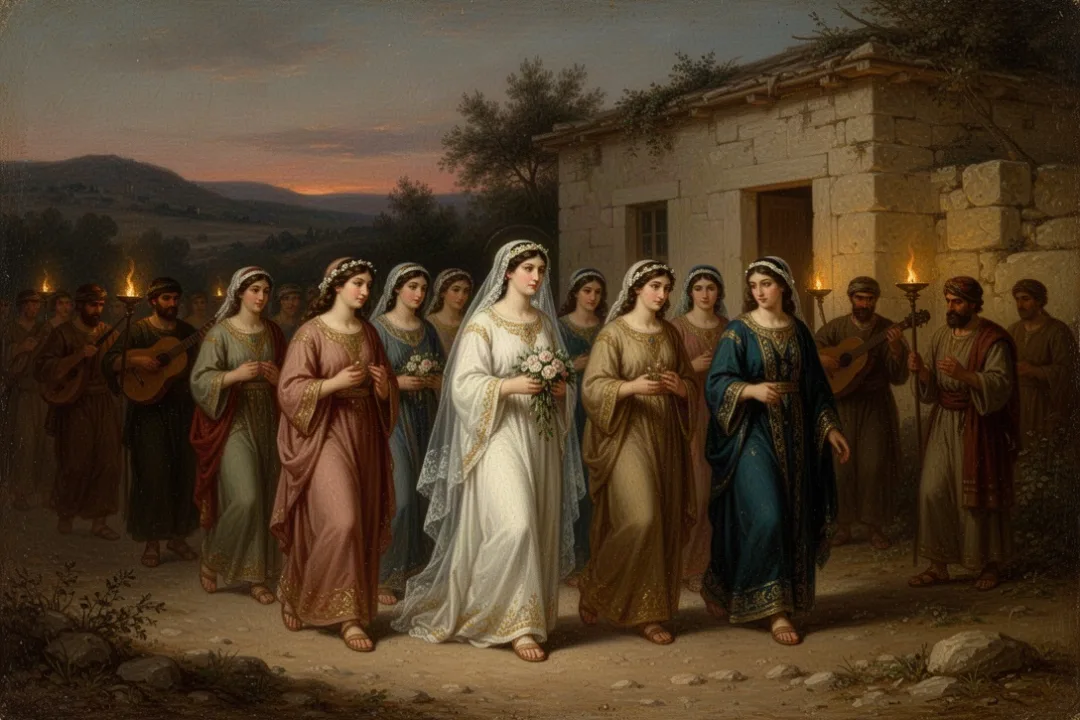
A wedding involved more than a private exchange of vows. The community and extended family helped recognize the new status of the couple. Guests, attendants, musicians, lamps, clothing, and food could all form part of the celebration, although the evidence does not establish one standard ceremony for every village or century.
Veiling appears in some biblical narratives. Rebekah covers herself when she sees Isaac in Genesis 24, and Tamar disguises herself with a veil in Genesis 38 for a very different purpose. These passages show that veils could carry social meaning, but they do not prove that every bride wore a particular style of veil throughout the wedding.
The groom’s arrival or procession also appears in later Jewish wedding imagery. The parable in Matthew 25 assumes a recognized social setting involving bridesmaids and a delayed bridegroom. Because the Gospel reflects first-century Jewish life, it can illuminate later practice but should not be used as direct evidence for every earlier Israelite wedding.
Wedding feasts could last several days
Food and hospitality were central to marriage celebrations. A wedding feast demonstrated the families’ ability to host guests and gave the wider community a chance to witness the union. Wealthy families could provide extensive meals, music, and entertainment, while poorer households would celebrate within their available means.
Genesis 29 describes a wedding feast held by Laban, and Judges 14 describes Samson’s marriage celebration lasting seven days. The wedding at Cana in John 2 also reflects a Jewish setting in which a celebration could extend over several days and depended on a large supply of wine and food.
A weeklong feast should not be treated as a universal requirement. The length of a celebration likely depended on the family’s resources, local custom, the status of the couple, and the period in which the marriage took place. The biblical stories tend to preserve memorable or unusual events, not a complete record of ordinary village practice.
Music, dancing, blessings, and joyful public gatherings were compatible with the biblical picture of marriage. The Song of Songs uses wedding and courtship imagery, while Jeremiah 16:9 refers to the sounds of bridegroom and bride as signs of ordinary communal life. These references suggest that weddings were visible social events whose presence or absence could symbolize peace, judgment, or restoration.
Sexual relations and household membership completed the union
Marriage involved the establishment of a recognized sexual relationship and the creation of a new household. Biblical law treats sexual relations with a betrothed woman differently from relations with an unbetrothed woman, indicating that sexual conduct affected family honor, legal status, and marriage obligations.
The wedding night could carry particular importance because consummation was connected with the couple’s transition into married life. Deuteronomy 22 includes a law about claims concerning a bride’s virginity, a troubling rule that exposes the power placed in male relatives and the danger faced by women whose sexual history was questioned.
The biblical account of Jacob, Leah, and Rachel shows that the bride’s entrance into the groom’s household did not always occur under conditions of equal knowledge or power. Laban gives Leah to Jacob instead of Rachel, and Jacob then marries Rachel as well. The story is not a simple guide to approved practice; it reveals the consequences of household authority and contested marriage arrangements.
Once married, the woman generally became part of her husband’s household and was expected to bear children, manage domestic work, and contribute to the economic life of the family. Men also carried obligations, including sexual fidelity in some circumstances, material support, and protection of the household, although the legal and social consequences were not always symmetrical for men and women.
Children, inheritance, and family continuity shaped marriage
Having children was a major purpose associated with marriage in ancient Hebrew society. Descendants carried a family name, inherited land, maintained ancestral claims, and supported older generations. Barrenness therefore brought social pain and could create conflict within a marriage, as seen in the stories of Sarah, Rachel, Hannah, and other women.
Genesis 16 describes Sarah giving Hagar to Abraham because Sarah had no child. Genesis 30 presents Rachel and Leah competing over children and household status. These narratives show that infertility could lead to additional unions, surrogate arrangements, or intense rivalry, although they do not mean every household handled infertility in the same way.
The levirate marriage law in Deuteronomy 25 addresses a special case: a man dies without a son, and his brother is expected to marry the widow so that the dead man’s name may continue. The practice is illustrated in the book of Ruth, though Ruth’s story involves a close relative and develops the custom in a distinctive way.
The levirate obligation was not an ordinary wedding custom for all couples. It was linked to inheritance, land, widowhood, and the continuation of a deceased man’s line. A widow could face serious economic insecurity, so preserving her connection to the husband’s family could have practical as well as genealogical consequences.
Marriage laws addressed divorce, adultery, and protection
Deuteronomy 24:1–4 refers to a man writing a certificate of divorce and sending his wife away. The passage regulates a particular situation involving a subsequent marriage; it does not present a complete description of every divorce procedure. It does show that divorce could involve a formal written document and that the husband held substantial power to initiate it in the legal framework being described.
Adultery was treated as a serious violation of marriage and family boundaries. Exodus 20:14 and Deuteronomy 5:18 prohibit adultery, while other laws address accusations, sexual assault, seduction, and relations with betrothed women. The penalties and procedures vary according to the circumstances, and modern readers should recognize that these laws reflect a patriarchal society rather than equal legal treatment by modern standards.
Marriage also created duties toward widows and vulnerable members of the household. Biblical prophets repeatedly condemn exploitation of widows, while laws in Deuteronomy connect widows with gleaning, communal generosity, and justice. These provisions did not eliminate vulnerability, but they show that the community regarded the treatment of widows and dependent women as a moral concern.
Do not combine unlike sources: A biblical story may describe what happened without approving it, while a legal passage may address an unusual case rather than an everyday ceremony. Read narratives, laws, poetry, and later Jewish customs in their own historical settings.
Foreign marriages and religious identity created tension
Marriage to foreigners was not viewed consistently across all biblical texts. The patriarchal stories include marriages and family connections involving people from outside Canaan, while later texts, especially Ezra and Nehemiah, strongly condemn certain marriages with foreign women. The reasons include concerns about idolatry, communal identity, land, and political survival.
Ruth, a Moabite widow, becomes part of the Israelite community through her loyalty to Naomi and marriage to Boaz. Her story complicates any simple claim that every foreign marriage was rejected. By contrast, Ezra 9–10 describes a postexilic crisis in which marriages with foreign women are treated as a threat to the restored community.
The distinction often involved religious allegiance and communal boundaries, not only ethnicity in a modern biological sense. Biblical writers from different periods emphasized different risks and ideals. A careful account of Hebrew marriage customs must therefore avoid presenting one universal rule about marriage to outsiders.
Common mistakes when interpreting ancient Hebrew marriage
Modern descriptions often turn a varied historical world into a single ceremony. These practical cautions help prevent the most common errors:
Do not call the bride price a purchase price. The payment expressed an economic and legal obligation between households, even though the system operated within a patriarchal society.
Do not treat betrothal as a modern engagement. In biblical settings, betrothal could create a binding legal status before the couple lived together.
Do not assume every wedding lasted seven days. Some stories describe weeklong celebrations, but duration depended on time, wealth, and local custom.
Do not project later rabbinic wedding structures onto every biblical period. Later Jewish law provides useful context but developed after many biblical texts were written.
Do not present arranged marriage and personal choice as complete opposites. Family negotiations were powerful, yet some narratives preserve evidence of a bride’s or groom’s preferences.
Do not use one biblical story as a universal rule. Jacob’s marriages, Ruth’s marriage, and the royal marriages of Solomon represent different settings and purposes.
Do not ignore class and legal status. Royal women, free Israelite women, widows, foreigners, and enslaved women could experience marriage very differently.
Do not confuse description with approval. A narrative may record deception, coercion, rivalry, or injustice without recommending that behavior.
What a historically careful reconstruction can include
A plausible reconstruction of an ancient Hebrew wedding begins with a family agreement rather than a standardized religious service. Relatives discuss the match, the groom’s household provides an agreed bride price or equivalent service, and the families settle practical matters concerning residence, property, and support.
The couple then enters a formal betrothal. During this period, the bride remains connected to her father’s household while preparations continue. The relationship is already socially and legally significant, even though the bride may not yet have moved to the groom’s home.
At the appointed time, the groom or his representatives bring the bride into the new household. Relatives and neighbors recognize the union through a procession, gathering, feast, blessing, music, or other local customs. The couple begins married life within the husband’s household, and the marriage becomes tied to questions of children, inheritance, labor, and family reputation.
This reconstruction is useful because it identifies recurring elements without pretending that every ancient Hebrew wedding looked alike. The most reliable general pattern is negotiation, betrothal, household transfer, public celebration, and new family obligations.
Why these customs matter for reading biblical marriage stories
Understanding marriage customs changes how several biblical narratives are read. Rebekah’s departure from her family is not merely a romantic scene; it is a major transfer between households. Jacob’s years of labor reveal that marriage could involve a substantial economic exchange. Ruth’s marriage to Boaz concerns widowhood, land, family lineage, and community recognition at the same time.
The customs also explain why marriage conflicts could threaten an entire household. Divorce, infertility, disputed paternity, an unpaid bride price, or a widow without protection could affect property and future descendants. Marriage was personal, but it was never only personal within the social structure of ancient Israel.
At the same time, the biblical texts preserve the voices of people who suffered under these structures. Leah is unwanted by Jacob, Tamar is denied the family protection promised to her, and many widows live at the edge of economic security. Reading the customs historically should not mean overlooking the unequal power built into them.
The clearest picture is therefore both social and human: ancient Hebrew marriage created alliances and households, but it also placed real obligations and risks on the people involved. Its customs can be understood only by considering family authority, economics, gender, religion, inheritance, and the changing history of Israelite and Jewish communities.
Frequently asked questions
Did ancient Hebrew couples choose their own spouses?
Families usually played a major role in selecting and negotiating marriages, particularly when property, lineage, or alliances were involved. However, biblical narratives sometimes show a bride or groom expressing a preference or giving an answer before the marriage proceeded. The balance between family authority and personal choice varied by period, household, social status, and the specific circumstances of the union.
Was an ancient Hebrew wedding a religious ceremony?
Marriage had religious and covenantal significance, but the surviving biblical evidence does not describe one universal wedding service comparable to a modern standardized ceremony. Family negotiations, betrothal, household transfer, public recognition, and a feast were more consistently important. Later Jewish traditions developed formal blessings and procedures that should not automatically be assigned to every earlier Israelite marriage.
How long did ancient Hebrew weddings last?
Some biblical celebrations lasted seven days, especially in stories involving wealthy or prominent families. A weeklong event was not necessarily required for every couple. The length likely depended on household resources, local traditions, the couple’s status, and the historical period. Ordinary families may have held shorter celebrations that left less of a record in surviving texts.
What happened if an ancient Hebrew marriage ended in divorce?
Deuteronomy 24 refers to a written certificate of divorce and regulates a situation involving a divorced woman’s later marriage. The law indicates that divorce could be formally documented, but it does not provide every procedural detail. In the patriarchal legal system described by the text, husbands generally held greater power to initiate divorce, leaving women economically and socially vulnerable.










Leave a Reply