The name Philip appears several times in the New Testament, but when people speak of Philip the Apostle, they usually mean one of the original Twelve chosen by Jesus. This figure has a distinctive place in early Christian narrative: he is present in the Gospel of John as one of the first followers called by Jesus, he embodies a practical and sincere curiosity about God, and he is listed among the Apostles in the Acts of the Apostles. In many church traditions, however, there is also a prominent figure known as Philip the Evangelist, a different leader who served as a deacon and spread the gospel in Samaria and beyond. To understand Philip in the Bible, it helps to distinguish these two men, while recognizing how their stories illuminate faith, mission, and Christian discipleship.
This article explores Philip the Apostle in depth: his identity, scriptural appearances, role among the Twelve, and the legacy he left in early Christian memory. We will also touch on common questions that arise when readers encounter two biblical figures named Philip, and we will consider what his brief, pointed interactions with Jesus reveal about belief, knowledge of God, and Christian leadership.
What Is in a Name? Philip the Apostle vs. Philip the Evangelist
Two different leaders in the New Testament era carry the name Philip, which can be a source of confusion for readers encountering biblical stories across different books. Here are the key distinctions:
Philip the Apostle — Also known as Philip the Apostle, he is one of the original Twelve disciples selected by Jesus. He is sometimes called Philip of Bethsaida in tradition, pointing to his likely geographic origin. He appears in the Gospel of John and is listed among the Twelve in the book of Acts.
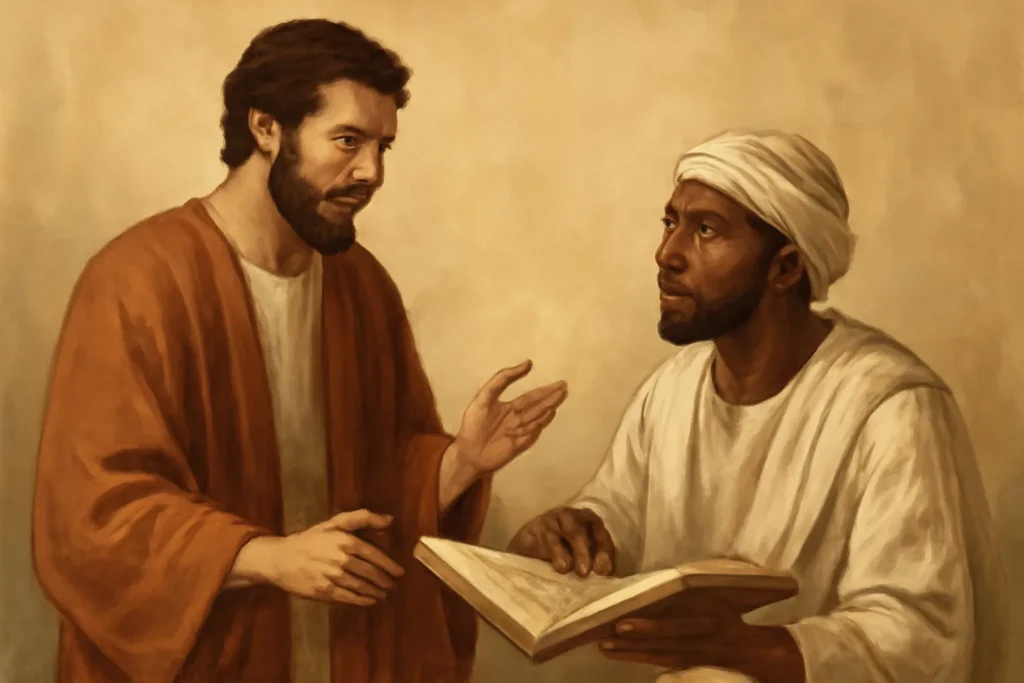
Philip the Evangelist — A different figure, sometimes called Philip the Deacon, who is described in the Book of Acts (Acts 6–8) as one of the seven chosen to serve tables and to disseminate the gospel, especially in Samaria and later to an Ethiopian official. He is not one of the Twelve, though he is a prominent early Christian missionary.
For readers seeking to understand Bible Philip in context, it is essential to note that the narratives about Philip the Apostle come largely from the Fourth Gospel, with brief confirmations in the Acts of the Apostles that place him within the broader circle of the Twelve. The separate figure of Philip the Evangelist offers a complementary portrait of early church expansion, but it is this Apostle who is most closely associated with the inner circle of Jesus’ first followers.
The Call and Early Ministries: Key Biblical Touchpoints
The Call: John 1 and the Beginning of a Ministry
The most foundational biblical moment for Philip the Apostle occurs in the Gospel of John, where Jesus calls Philip to follow him. In John 1:43, “Jesus found Philip and said to him, ‘Follow me.’” This brief encounter marks the start of a life devoted to learning from Jesus and introducing others to him.
Philip’s first recorded response to Jesus’ invitation is telling about his character and his role in the early church. In John 1:45, Philip informs his friend Nathanael about the Messiah he has discovered: “We have found him of whom Moses in the law and the prophets wrote, Jesus of Nazareth, the son of Joseph.” This moment highlights two themes that recur in Philip’s story: a sense of discovery and a readiness to bring others into the circle of Jesus' life and teaching.
The Nathanael Incident: A Testimony to Faith and Relational Witness
In the same chapter, the dynamic between Philip the Apostle and Nathanael shows how Philip functions as a bridge between Jesus’ early ministry and a broader audience. Philip’s invitation to Nathanael—“We have found him … Jesus of Nazareth”—is a model of relational evangelism: sharing personally about what one has encountered and then inviting others to see for themselves.
John 6:5–7: Practical Challenges and Faith Formation
One of the clearest windows into Philip the Apostle is the exchange in John 6:5–7, when Jesus asks, “Where should we buy bread, so that these people may eat?” The apostle Philip responds with a practical calculation: it would take “two hundred denarii” to provide a little bread for each person. This moment is often cited to illustrate Philip’s practical, down-to-earth temperament and his willingness to engage with real-world problems, which contrasts with Jesus’ expansive vision of abundance and discipleship. It also invites reflection on the way early Christians approached food, miracles, and mission in a world of limited resources.
John 12:21: Philip, the Greeks, and the Global Mission
In John 12:21, some Greeks come to Philip with a request: “Sir, we wish to see Jesus.” Philip’s task—bringing the Greeks to Jesus—offers a subtle but significant glimpse into how the Apostles continued to facilitate access to Christ for diverse audiences. Though the narrative does not record a long discourse with Philip, this moment places him at a crucial juncture in the gospel’s announcement to the broader world and foreshadows the evangelistic impulse that would characterize the early church’s mission.
John 14:8–9: Philip and the Father—A Teaching Moment
Another pivotal beat occurs in John 14:8–9, where Philip the Apostle asks Jesus, “Lord, show us the Father, and it is enough for us.” Jesus replies, in effect, that seeing him is seeing the Father: “Whoever has seen me has seen the Father.” This exchange unfolds a central theological motif: Jesus’ unity with the Father and the revelation of God through Jesus’ person and work. Philip’s question, while seemingly simple, pushes into essential Christian belief about revelation, incarnation, and the nature of divine presence among humanity. The exchange also marks Philip as a disciple who asks questions that advance understanding for a community of believers.
Philip in the Twelve: Identity, Lists, and Roles
In the canonical lists of the Twelve, Philip appears consistently, reinforcing his identity as an apostle with a specific role in the early church. The New Testament sources categorize him as part of the inner circle that was commissioned to preach, teach, and witness to the resurrection. Not every Gospel mentions Philip in the same way, but the pattern across the synoptic lists and the Gospel of John affirms that Philip the Apostle was one of the twelve chosen by Jesus.
Matthew 10:3 — Philip appears in the list of the Twelve apostles as part of the original group sent to preach the kingdom.
Mark 3:18 — Philip is named among the Twelve in the parallel list to Matthew.
Luke 6:14 — The Twelve, including Philip, are described in the feeding and commissioning narratives.
Acts 1:13 — After the Resurrection, Philip the Apostle is included in the company that returns to Jerusalem, awaiting the coming of the Holy Spirit and continuing the mission.
These scriptural markers help us anchor the identity of Philip the Apostle within the early Christian community. They show a trajectory from personal calling to communal mission, and they set the stage for how later Christian writers and communities remembered and engaged with him.
Traditions About Mission and Martyrdom: What Early Writers Say
Beyond the canonical pages, early Christian tradition offers varied accounts about where Philip the Apostle preached, how he lived, and how he died. It is important to distinguish these traditions from the biblical record, since they come from later writings, memories, and church commemorations. Still, they contribute to a fuller sense of Philip in Christian memory and highlight how the early church honored his example.
Geographic itineraries — Tradition often places Philip the Apostle in Asia Minor, Syria, and parts of Greece in the decades after the Resurrection. Some accounts tie him to Phrygia and the city of Hierapolis, while others place him in areas around the Aegean coast. These itineraries reflect a broader pattern of apostolic expansion in the early church, where each of the Twelve contributed to the spread of the gospel in distinctive regions.
Preaching and miracles — As with many early apostles, traditions recount that Philip the Apostle preached, performed acts through the Spirit, and taught communities to follow Jesus. These stories emphasize the continuity between Jesus’ ministry and the apostles’ witness in a world seeking truth.
Martyrdom — A common thread in traditional accounts is the martyrdom of Philip the Apostle in a city like Hierapolis (in Asia Minor). Some narratives describe crucifixion or other forms of martyrdom, while others emphasize a peaceful passing. Because these details appear in later hagiographic sources, they should be understood as tradition rather than a definitive scriptural statement.
Relics and veneration — In the history of Christian practice, saints’ relics and sites associated with the apostles became places of pilgrimage and focus for devotion. The memory of Philip the Apostle contributed to a broader culture of honoring the Twelve and learning from their example.
Theological and Practical Significance: What Philip Teaches Modern Readers
Even though the biblical material on Philip the Apostle is relatively concise, it yields several meaningful lessons for contemporary readers and communities of faith:
Discipleship and following Jesus — The instant call in John 1:43 shows the intensity and immediacy of true discipleship. Followers of Jesus are invited not simply to assent but to respond, to walk with him, and to bring others into that circle of life in Christ.
Opening doors to others — Philip’s role as a connector—inviting Nathanael to meet Jesus (and bringing Greeks to Jesus in John 12:21)—highlights the apostolic vocation to invite and guide others toward encounter with Christ. This relational witness remains a template for evangelism that respects personal journey while inviting a broader audience to know God.
Honest questions as catalysts for growth — The exchange in John 14:8–9 reveals that questions—like Philip’s request to see the Father—are not obstacles but opportunities for deeper revelation. The Christian life includes honest inquiry, and belief grows through answers that point beyond mere information to relationship with Christ.
The balance of faith and reason — The episode with the feeding of the 5,000 (John 6:5–7) shows that faith-facing practical realities requires both trust in God’s provision and thoughtful engagement with difficult situations. This balance encourages believers to steward resources, to plan wisely, and to trust divine abundance when human means fall short.
Unity of Jesus and the Father — The response in John 14:9—that seeing Jesus is seeing the Father—holds a cornerstone of Christology: revelation of God through Jesus. Philip’s interaction invites Christians to contemplate how God has chosen to reveal divine nature in the person and work of Christ.
The memory of Philip the Apostle in early Christian communities contributed to a culture of teaching and missionary ambition. The apostles’ willingness to travel, to engage diverse audiences, and to bear witness to the life, death, and resurrection of Jesus formed a blueprint for apostolic ministry. Even when the biblical text is sparse, the figure of Philip the Apostle stands for several enduring themes:
Active witness — Philip’s life illustrates a form of witness that integrates personal encounter with Jesus and shared testimony that brings others to faith.
Relational evangelism — He models the way faith moves through relationships: inviting, speaking truth in love, and bridging conversations to encounters with Christ.
Intellectual honesty in faith — His questions show that faith is not blind certainty but a journey in which questions can deepen understanding and strengthen conviction when answered well.
For readers who want to explore Bible Philip in a personal or group study, here are practical approaches that honor the biblical text while encouraging thoughtful reflection:
Study the gospel of John alongside Acts to observe how the identity of Philip the Apostle is introduced and how later Christian memory built on the Apostles’ witness.
Compare the Two Philips — When you read Acts 6–8, identify the figure of Philip the Evangelist, and distinguish his mission to Samaria and the Ethiopian eunuch from the twelve’s mission as described in the Gospels and Acts. This helps prevent conflating two distinct figures with the same name.
Reflect on key moments — The calls, the conversations about the Father, and the greeting of new seekers all offer prompts for personal prayer or group discussion about discipleship, faith, and how to accompany others on their spiritual journey.
Engage with traditional interpretations — If you’re curious about how early church writers remembered Philip, consult a few patristic or historical commentaries. They can illuminate the development of apostolic memory while clearly distinguishing biblical data from later legend.
Philip the Apostle
In the biblical record, Philip the Apostle emerges as a figure who embodies several enduring Christian virtues: follower-ness, openness to questions, a heart for bringing others to Jesus, and a practical sense of mission rooted in the miracle-working life of Christ. While early church tradition fills in many details about Philip’s travels and martyrdom, the core biblical portrait remains focused on his roles as a disciple, a witness, and a bridge-builder who points others to Jesus.
Ultimately, the name Philip in the Bible captures a dual sense: a personal call to respond to Jesus, and a communal call to invite others to encounter the same life-giving presence. For readers studying bible Philip, Philip the Apostle offers a compact but rich example of Christian discipleship—one that invites curiosity, invites companions, and dares to hope in the God revealed in Jesus Christ.
Philip and His World
To deepen your study beyond this article, consider consulting these categories of resources:
Primary biblical texts — The Gospels of John (with emphasis on the passages cited above) and the Acts, plus the lists of the Twelve in the synoptic Gospels.
Commentaries and introductions — Brief introductions to the life of the Twelve and to the two Philips can clarify how scholars differentiate biblical content from later traditions.
Historical and hagiographic sources — Early Christian writers (for example, in the patristic tradition) discuss the tradition around Philip the Apostle, his travels, and his martyrdom; these sources illuminate how church memory formed over centuries.
Whether you are studying for personal growth, teaching a class, or preparing a sermon, the figure of Philip the Apostle invites you to engage with faith in a way that blends personal encounter with a desire to introduce others to the God who reveals himself in Jesus. In this sense, Philip in the Bible continues to be a useful, approachable model for students of scripture who want to understand what it means to follow Jesus in a world that is constantly seeking to know the truth about God.







Leave a Reply