Philip the evangelist: His story and ministry in Acts
Philip the evangelist: His story and ministry in Acts
Have you ever wondered how a person with a practical role in a local church became part of a major turning point in Christian history? Philip the evangelist shows how faithful service, spiritual courage, and readiness to respond can place an ordinary believer in extraordinary situations. His story appears mainly in the Book of Acts, where he serves the church, preaches in Samaria, explains Scripture to an Ethiopian official, and welcomes traveling Christian leaders into his home.
Philip is not the same person as Philip the apostle, one of Jesus’ twelve apostles. The evangelist first appears among the seven men chosen by the Jerusalem church to oversee a practical ministry involving food distribution. Later, Acts identifies him as “Philip the evangelist” and as one of the seven. His ministry demonstrates that service and evangelism were not competing callings. In Philip’s life, careful administration created trust, and trusted service opened doors for the message about Jesus.
The short answer: Philip the evangelist was one of the seven appointed in Jerusalem in Acts 6. He later preached in Samaria, led an Ethiopian official to understand Isaiah, settled in Caesarea, and raised four daughters who prophesied.
Philip first appears in Acts 6:1-7, during a period of rapid growth in the Jerusalem church. The Greek-speaking Jewish believers complained that their widows were being overlooked in the daily distribution of food. The apostles asked the congregation to select seven men with a good reputation, spiritual wisdom, and evidence of God’s work in their lives.
The congregation chose Stephen, Philip, Prochorus, Nicanor, Timon, Parmenas, and Nicolas of Antioch. The apostles prayed for them and laid hands on them. Acts does not give each man’s complete job description, but the immediate need was practical and organizational: the community needed reliable leaders to ensure fair care for vulnerable members.
Philip’s inclusion in that group tells you something significant about Christian ministry in the early church. The man later known for public preaching began with responsible service behind the scenes. The apostles did not treat practical care as unspiritual work. They looked for people whose character could be trusted with both people and responsibility.
The name Philip was common in the first-century Greek-speaking world, so the account carefully distinguishes this Philip from the apostle. When Philip later appears in Acts 21:8, Luke calls him “Philip the evangelist” and identifies him as one of the seven. This description connects the preacher in Acts 8 with the servant chosen in Acts 6.
How to follow Philip’s story step by step
Philip’s ministry develops through several connected stages. Reading them in sequence helps show how his service, preaching, guidance, and hospitality formed one consistent pattern rather than a collection of unrelated events.
He accepted a practical responsibility. Philip joined the seven men appointed to address an urgent need among widows in Jerusalem, showing that ministry began with trustworthy care.
He preached when persecution scattered believers. After Stephen’s death, opposition drove many Christians away from Jerusalem. Philip went to Samaria and proclaimed Christ there.
He served a whole community. Philip’s preaching was accompanied by works of healing and deliverance, and the city responded with serious attention and joy.
He spoke personally with one seeker. An angel directed Philip toward the road from Jerusalem to Gaza, where he met an Ethiopian official reading Isaiah.
He explained Scripture and baptized a new believer. Philip began with the passage the official was reading and proclaimed Jesus, leading to baptism when the man responded in faith.
He continued preaching in new places. After the encounter, Philip traveled through the coastal region and announced the gospel in various towns.
He built a stable household ministry. Years later, he lived in Caesarea with his four unmarried daughters, who were known for prophesying.
This sequence shows a ministry that was both public and personal. Philip addressed crowds in Samaria, but he also walked alongside one individual who had a difficult passage of Scripture and honest questions. He served in an organized church setting, responded to direct guidance, and created a hospitable home where Christian ministry continued across generations.
Why Philip was chosen among the seven in Jerusalem
The situation in Acts 6 involved more than meal distribution. It exposed a risk of division between Hebrew-speaking and Greek-speaking Jewish believers. The overlooked widows belonged to the Greek-speaking group, and an unresolved complaint could have damaged the unity of a rapidly growing church.
The apostles responded by involving the entire congregation in selecting leaders. The chosen men needed a good reputation, spiritual maturity, and wisdom. Philip’s appointment therefore tells readers that Christian leadership is not based only on speaking ability. It also rests on fairness, reliability, and the ability to handle conflict without favoritism.
The seven men had Greek names, although names alone do not prove their ethnic backgrounds. Their selection fits the needs of a Greek-speaking part of the church and may have helped the community trust the process. What the text makes clear is that the church sought leaders capable of protecting vulnerable people and preserving fellowship.
Practical lesson: Philip did not have to choose between serving people and sharing the gospel. His first assignment involved daily care, and his later ministry involved preaching. Both were expressions of faithful leadership.
What Philip did in Samaria
Philip’s first major preaching scene appears in Acts 8:4-13. Following the persecution that began after Stephen’s death, believers scattered from Jerusalem. Instead of allowing fear to silence them, those who left announced the message about Christ wherever they went. Philip traveled to a city in Samaria and proclaimed Jesus there.
Samaria carried a complicated history for Jewish people. Jews and Samaritans shared parts of their religious heritage but had long-standing social, religious, and ethnic tensions. Jesus had already crossed some of those boundaries during his earthly ministry, including in his conversation with a Samaritan woman in John 4. Philip’s arrival showed that the message about Jesus was moving beyond its initial Jerusalem setting.
Acts describes Philip preaching, performing signs, and bringing relief to people troubled by unclean spirits and physical illness. The response was widespread: the people paid attention, and the city experienced great joy. The account presents proclamation and compassionate ministry together. Philip did not merely deliver information; his work brought visible help to people and affected the whole community.
One prominent figure in Samaria was Simon, who had previously practiced magic and impressed the people. Simon believed and was baptized, but his later attempt to buy the ability to confer the Holy Spirit exposed a serious misunderstanding of spiritual authority. Peter confronted him sharply in Acts 8:18-24.
Simon’s presence adds an important dimension to Philip’s success. A large public response does not mean every person understands the gospel with equal depth. Philip faithfully proclaimed Christ, while the apostles helped address confusion about power, money, and the Holy Spirit. Healthy ministry requires both clear proclamation and responsible spiritual discernment.
What the Samaritan response teaches about Christian mission
Geographic boundaries can change quickly. Persecution scattered believers, but God used the movement to carry the message into new regions.
Social barriers do not define the gospel’s reach. Philip preached to Samaritans despite historic hostility between the two communities.
Public ministry needs sound character. Visible signs and large crowds do not replace repentance, humility, and understanding.
Joy can accompany serious faith. The Samaritan response was not portrayed as shallow excitement but as a community receiving freedom and hope.
How Philip met the Ethiopian official on the Gaza road
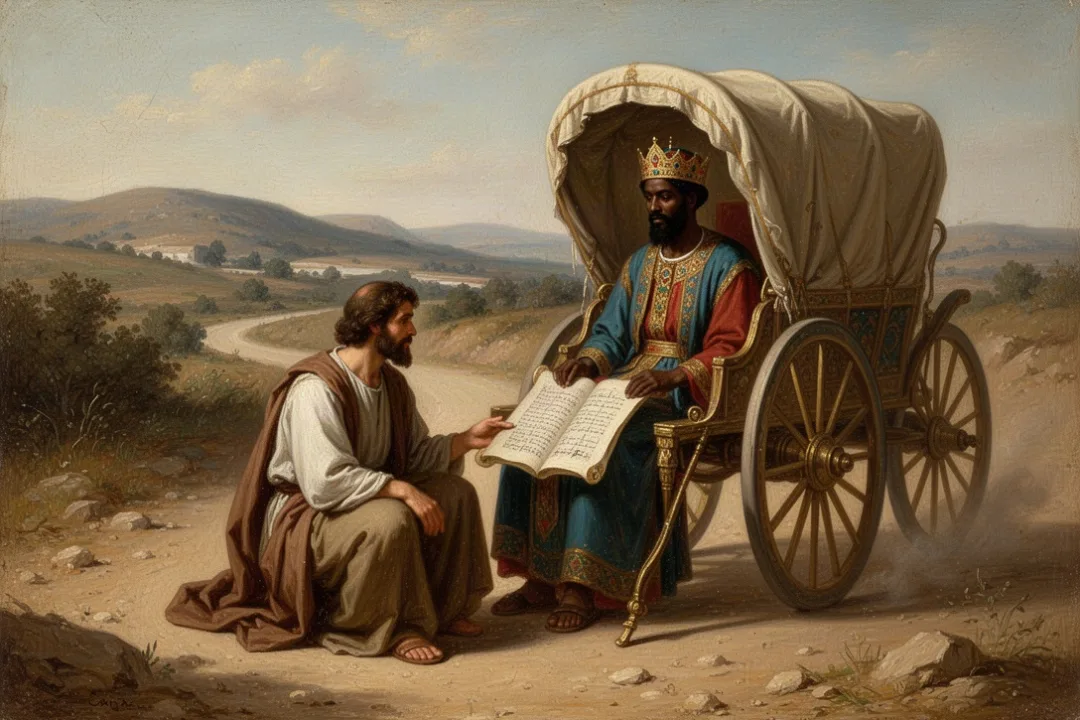
After the ministry in Samaria, an angel directed Philip to go south toward the road leading from Jerusalem to Gaza, according to Acts 8:26-40. The passage does not present Philip as planning this meeting himself. He was told to go, and he responded by setting out. On the road, he encountered an Ethiopian official returning from worship in Jerusalem.
The man was an important servant of Candace, a title used for the queen of the Ethiopians, and he was responsible for her treasury. Acts also says he was a eunuch, a term that may describe his physical condition and social status. He had traveled a considerable distance to worship and was reading from the prophet Isaiah while riding in his chariot.
Philip’s first action was not to launch into a prepared speech. The Spirit directed him to approach the chariot, and Philip asked whether the official understood what he was reading. The question opened a conversation. The official admitted that he needed someone to guide him and invited Philip to sit with him.
The passage was from Isaiah 53, which describes a suffering servant led like a sheep to slaughter and deprived of justice. The official asked whether Isaiah was speaking about himself or someone else. Beginning with that text, Philip explained the good news about Jesus. Acts does not record every detail of the conversation, but it clearly presents Philip as connecting the servant passage with Jesus’ death and saving work.
The encounter offers a useful picture of personal evangelism. Philip did several things well:
He went where he was directed. The meeting began with willingness to leave a successful public ministry for an uncertain assignment.
He started with the other person’s question. Philip did not ignore the official’s reading or force the conversation into an unrelated subject.
He explained Scripture in light of Jesus. He treated the biblical text as a doorway to the gospel rather than as an academic exercise.
He recognized a genuine response. When the official saw water and asked what prevented him from being baptized, Philip responded to his desire for faith and identification with Christ.
Many translations describe the official’s request for baptism and Philip’s response with a textual variation in the manuscript tradition. The longer wording found in some Bibles includes a statement about believing, while other modern translations place that wording in a footnote or omit it from the main text. Regardless of the translation, the narrative clearly depicts the official receiving Philip’s message, expressing faith, and being baptized.
After the baptism, the Spirit carried Philip away, and the official continued his journey with joy. Acts does not provide a later history of the man or establish a specific church tradition about his return to Ethiopia. The text simply emphasizes that one seeker heard the gospel, received baptism, and went on his way rejoicing.
Why the Ethiopian encounter matters for understanding evangelism
The Ethiopian official had several characteristics that made the meeting distinctive. He was a foreigner, a high-ranking government servant, a religious seeker, and a reader of Scripture. His questions were not presented as hostile challenges. He needed someone to help him understand a passage that raised a central question about suffering, identity, and God’s purpose.
Philip’s approach was neither passive nor aggressive. He took initiative by coming near the chariot, but he also listened. He gave the official room to explain what he was reading and allowed the biblical text to shape the discussion. This combination of courage and attentiveness makes the encounter especially useful for anyone learning how to speak about faith.
The story also highlights the gospel’s movement across cultural and geographic boundaries. Samaria represented one kind of barrier; the Ethiopian official represented another. The message about Jesus was not reserved for people who shared Philip’s hometown, language, ethnicity, or social position.
At the same time, the account should not be turned into a formula that promises every conversation will end immediately in baptism. Philip was prepared, but the official’s openness and circumstances were unique. The enduring principle is to remain ready to explain Scripture clearly when a person asks an honest question.
Where Philip lived after his major preaching journeys
After traveling through the coastal region and preaching in several towns, Philip settled in Caesarea. Acts 8:40 says that he reached Caesarea after the Ethiopian official continued on his way. The next direct reference comes many years later in Acts 21:8-9, when Paul and his companions stayed at Philip’s house.
By that time, Philip had four unmarried daughters who prophesied. Luke does not record their individual names or specific prophecies. Their mention is brief but meaningful: Philip’s household was known as a place connected with Christian service and prophetic ministry.
Caesarea was a major port city and an important administrative center on the Mediterranean coast. It became a strategic setting for the early church. Peter preached there to Cornelius and his household in Acts 10, and Paul later spent time there during legal proceedings described in Acts 23-26. Philip’s home stood within a city where travel, government, trade, and diverse populations brought many people into contact with the Christian message.
Luke’s description of Philip’s household adds balance to the earlier scenes. Philip was not only an itinerant preacher passing through towns. He was also a settled host, father, and established Christian leader. His ministry included long-term presence, not only dramatic moments of travel and public preaching.
How Philip the evangelist differs from Philip the apostle
The New Testament mentions more than one Philip, and confusing them can make the biblical accounts harder to follow. Philip the apostle was one of the twelve disciples chosen by Jesus. He appears in the Gospels, including the accounts of Jesus calling him, Philip bringing Nathanael to Jesus, and Philip participating in conversations before the feeding of the five thousand and before Jesus’ death.
Philip the evangelist appears most fully in Acts. He was one of the seven selected in Jerusalem, preached in Samaria, met the Ethiopian official, and later lived in Caesarea. Acts 21:8 explicitly gives him the title “evangelist” and connects him with the seven.
The two men may share a name, but Scripture gives no reason to identify them as the same person. Keeping them separate avoids combining details from different characters. It also allows Philip the evangelist’s own contribution to stand out: his ministry grew from church service into cross-cultural preaching and personal discipleship.
What Philip’s life reveals about effective Christian service
Philip’s story does not present one narrow model for ministry. He served in a food-distribution system, preached to a city, guided one reader through Isaiah, traveled between towns, and hosted Christian leaders. These responsibilities might seem unrelated at first, but they share several qualities.
Trustworthy service can prepare you for wider responsibility
Philip was first recognized as a dependable man in a local practical ministry. His public influence did not appear detached from his character. The church knew him as someone capable of serving people fairly before he became known as a preacher in Samaria.
Evangelism includes listening and explanation
Philip did not simply announce conclusions. With the Ethiopian official, he listened to a question and explained the relevant Scripture. Effective evangelism can involve a short answer, a patient conversation, or a longer process of helping someone see how biblical themes point to Jesus.
God can use both planned and unexpected settings
Philip’s ministry in Samaria was public and visible, while his meeting on the Gaza road was personal and apparently unplanned from his perspective. The contrast encourages flexibility. A person may serve through an organized church ministry one week and through a private conversation the next.
Ministry can include a household and a community
Philip’s four daughters show that spiritual influence was not limited to his preaching trips. His home became a place where Paul and his companions could stay, and his family was associated with prophetic ministry. Christian service may be seen in public work, family formation, hospitality, and the cultivation of other people’s gifts.
Practical ways to follow Philip’s example today
Philip’s circumstances belonged to the first-century church, so you should not assume every detail can be reproduced exactly. Still, his habits offer practical guidance for Christians who want to serve faithfully and speak about Jesus with wisdom.
Begin with responsibilities already in front of you. Caring for people, organizing help, and solving ordinary problems can reveal the character needed for broader ministry.
Learn enough Scripture to explain the central message clearly. Philip knew how to connect Isaiah’s suffering servant with Jesus, but he also began with the passage the official was reading.
Ask good questions. A question about what someone understands can create a better conversation than an immediate lecture.
Respect cultural and social differences. Philip did not treat Samaritans or the Ethiopian official as outsiders who had to become culturally similar before hearing the gospel.
Stay ready to change plans. The call to the Gaza road required Philip to leave a successful ministry setting and go somewhere less predictable.
Connect belief with a visible response. In the Ethiopian account, faith led to baptism, a public act of identification with Jesus.
Make your home available for Christian fellowship. Philip’s house in Caesarea became part of the support network for traveling church leaders.
Encourage the ministry of family members. His daughters are mentioned as active participants in prophetic ministry rather than merely as relatives of a famous father.
Philip’s example also cautions against measuring ministry only by size or visibility. The Samaritan crowds were important, but the conversation with one Ethiopian official was equally significant in the narrative. Faithful service can involve caring for a group, teaching a crowd, or sitting beside one person who needs help understanding Scripture.
What Acts does and does not tell us about Philip
Acts gives enough information to trace Philip’s main ministry, but it does not answer every question readers may have. We do not know the exact city in Samaria, the full content of his teaching to the Ethiopian official, the names of his daughters, or the details of his later years. Scripture also does not state that Philip personally founded a church in Ethiopia.
Later traditions may offer additional claims about Philip, but those traditions should not be presented as though they were recorded in Acts. The reliable biblical portrait is already substantial: Philip was one of the seven, a preacher in Samaria, an interpreter of Isaiah, a baptizer of the Ethiopian official, an evangelist in the coastal region, and a host in Caesarea.
That careful distinction protects the central message of his story. Philip does not need an embellished biography to appear significant. The recorded events show how God used a trusted servant to carry the gospel across social boundaries and to help both crowds and individuals respond to Jesus.
Why Philip remains a useful model for churches
Churches often need leaders who can connect practical care with spiritual vision. Philip’s life holds those responsibilities together. He helped address a fairness problem among widows, preached to people outside the Jerusalem community, interpreted Scripture for a seeker, and maintained a home where Christian leaders could receive hospitality.
His example encourages churches to recognize more than one kind of giftedness. Some people organize care systems; others explain Scripture; some move between communities; others provide a stable home and support traveling workers. Philip’s ministry suggests that these roles can strengthen one another rather than compete for importance.
It also reminds congregations to develop people before they need them for public tasks. The seven were chosen because of their existing reputation and spiritual maturity. Their appointment was not simply a response to a staffing shortage. It was a way to entrust vulnerable people and a potentially divisive issue to leaders whose character had already been tested.
Philip’s ministry ultimately points beyond Philip himself. In every scene, the focus is the message about Jesus: the Samaritans hear Christ proclaimed, the Ethiopian official receives an explanation of Isaiah centered on Jesus, and the scattered believers carry the gospel into new places. Philip’s usefulness came from directing attention to Christ while serving people with wisdom and compassion.
Frequently asked questions
Was Philip the evangelist one of Jesus’ twelve apostles?
No. Philip the evangelist was one of the seven men chosen in Jerusalem in Acts 6. Philip the apostle was one of Jesus’ twelve disciples. The New Testament treats them as different people, even though they shared the same name.
What Bible passage tells the story of Philip and the Ethiopian official?
The encounter is recorded in Acts 8:26-40. Philip meets the official on the road from Jerusalem to Gaza, explains Isaiah 53 in relation to Jesus, and baptizes him after the man responds to the message.
What does “evangelist” mean in Philip’s case?
An evangelist is someone who announces the good news about Jesus. Acts presents Philip as a public preacher, a personal Scripture guide, and a messenger who carried the gospel into Samaria and the coastal towns.
Did Philip have daughters who served in ministry?
Yes. Acts 21:8-9 says Philip lived in Caesarea and had four unmarried daughters who prophesied. The passage does not give their names or describe their individual messages, but it identifies them as active participants in the Christian community.








Leave a Reply