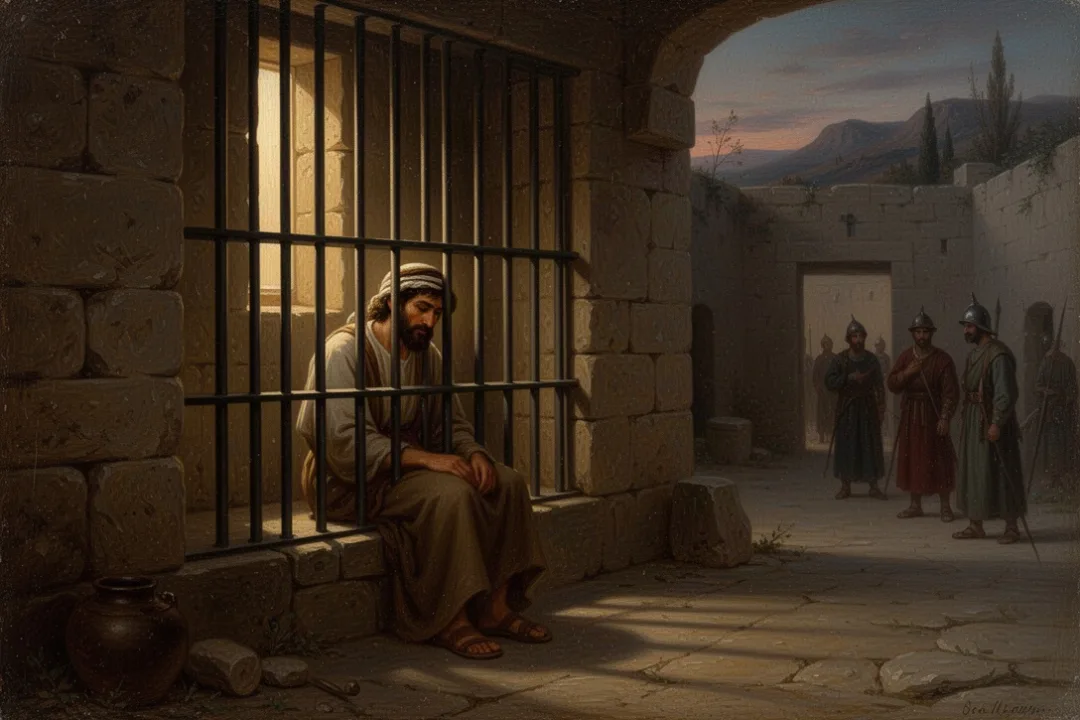
Biblical prison refers both to the real places of confinement described in Scripture and to prison as a powerful image of oppression, judgment, suffering, and spiritual bondage. The Bible tells of people imprisoned for crimes, political reasons, religious faith, or false accusations, while some passages use captivity to describe sin and separation from God.
Among the best-known prisoners are Joseph, who was confined after a false accusation; Jeremiah, who suffered imprisonment for delivering an unpopular message; John the Baptist, who was jailed by Herod; and Paul and Silas, who worshiped while chained in Philippi. Their stories do not suggest that every prisoner is guilty or that every hardship has an immediate explanation. They show how injustice, human choices, political power, faith, and divine providence can intersect.
Prison in the ancient biblical world was usually not a standardized correctional system like a modern jail or penitentiary. A person might be held in a guardhouse, a palace detention area, a military facility, a house under guard, or a pit or cistern adapted for confinement. The setting depended on the ruler, the city, the offense, and the prisoner’s social status.
Ancient imprisonment often aimed at temporary detention rather than rehabilitation. A king could hold someone while investigating an accusation, waiting for a decision, or using the prisoner as leverage. People were also imprisoned as political threats, military captives, debtors, or religious opponents. Conditions varied widely, but many prisoners depended on relatives or friends for food, clothing, and personal care.
Scripture uses several related ideas for confinement. A person may be described as being in a prison, dungeon, pit, stocks, chains, or under guard. These terms do not always identify the same type of facility. Reading the surrounding passage helps determine whether the writer means a literal prison, a place of detention, or a metaphor for a person’s helpless condition.
Key distinction: The Bible does not treat imprisonment as proof of guilt. Several important biblical prisoners were falsely accused, unjustly punished, or detained because their message challenged powerful people.
Joseph’s prison shows how false accusation can change a life
Joseph’s prison story appears in Genesis 39–41. After being sold by his brothers, Joseph served in the household of an Egyptian official. The official’s wife accused Joseph after he rejected her advances, and Joseph was sent to prison even though the account presents him as innocent of the charge.
Joseph’s confinement was a severe reversal. He had already lost his family, home, freedom, and status. Prison added another layer of uncertainty. Yet the narrative says that Joseph gained the trust of the prison keeper and was given responsibility over other prisoners. His ability to serve did not disappear simply because his circumstances had become humiliating.
While imprisoned, Joseph interpreted the dreams of two officials who had fallen out of favor with Pharaoh. Joseph correctly explained that one man would be restored and the other would be executed. Later, when Pharaoh was troubled by dreams, Joseph was brought from prison to interpret them. That moment led to his appointment as a leading administrator in Egypt.
The central lesson is not that every innocent prisoner will quickly receive promotion. Joseph spent a significant period waiting, and one official who promised to remember him failed to do so for a time. His story emphasizes faithfulness during delay, the possibility of useful work in a restricted place, and the way God’s purposes can continue through circumstances that appear to cancel a person’s future.
Jeremiah’s imprisonment reveals the cost of speaking an unpopular truth
The prophet Jeremiah was imprisoned because his message challenged the leaders of Judah during a national crisis. In Jeremiah 37–38, officials treated his warnings about Jerusalem’s coming defeat as disloyal or demoralizing. They accused him of weakening the people, even though he was presenting what he believed to be God’s message.
Jeremiah experienced more than one form of confinement. At one point he was placed in a guarded courtyard, where he had somewhat better conditions. Later, officials lowered him into a muddy cistern, intending to leave him there. An official named Ebed-melech intervened and helped rescue him from the pit.
This account shows how political fear can turn a messenger into a prisoner. Jeremiah was not jailed because he had committed an ordinary crime. His imprisonment came from a conflict between truth-telling and the demands of leaders who wanted reassurance. The story also highlights the moral importance of individual courage: one person acted to protect Jeremiah when others were willing to let him die.
Jeremiah’s experience also corrects a common assumption about faithful service. Obedience did not protect him from danger, misunderstanding, or public rejection. His calling required him to continue speaking even when the result was isolation. At the same time, the biblical account does not glorify cruelty; it condemns the abuse of power and records the rescue of a vulnerable person.
Samson’s prison illustrates captivity after destructive choices
Samson’s imprisonment in Judges 16 differs from Joseph’s and Jeremiah’s. After a long conflict with the Philistines, Samson was captured, blinded, and taken to Gaza. The Philistines put him in prison and forced him to perform labor. His captivity followed a pattern of reckless decisions, broken boundaries, and misplaced confidence.
Samson’s story should not be reduced to the idea that every prisoner simply receives the natural result of personal sin. The account includes oppression, political violence, and the Philistines’ desire to humiliate an enemy. Still, it clearly connects Samson’s downfall with his refusal to exercise wisdom and self-control.
At the end of his life, Samson prayed for strength and acted against the Philistine rulers gathered in their temple. His final act brought down the building and killed many of his enemies, as well as Samson himself. The account is tragic rather than simplistic. It presents both the consequences of destructive choices and the possibility that a person’s life is not beyond God’s reach even after profound failure.
John the Baptist’s prison raises questions about doubt and courage
John the Baptist was imprisoned by Herod Antipas after John publicly criticized Herod’s unlawful relationship with Herodias. The account appears in Matthew 14, Mark 6, and Luke 3. John’s confinement ended in execution when Herod, pressured by a public promise and the demands of his guests, ordered John’s death.
John had previously identified Jesus as the promised one, yet while in prison he sent messengers to ask whether Jesus was truly the one to come. The question is striking because John had spoken with great confidence earlier. His imprisonment, isolation, and awareness of danger may have created a moment of uncertainty.
Jesus did not treat John’s question as a reason to dismiss him. Instead, he pointed to the works taking place among the suffering and needy, directing John’s messengers toward observable evidence. The passage offers room for honest questions without presenting doubt as the same thing as rebellion.
John’s story also shows that faithfulness does not always lead to earthly rescue. Unlike Peter, who was released from prison, John was not delivered from execution. Biblical prison stories therefore resist a formula in which prayer always produces immediate escape. Sometimes the witness is found in endurance, truthfulness, and the refusal to flatter unjust authority.
Peter’s miraculous release demonstrates God’s power without creating a formula
In Acts 12, King Herod Agrippa I imprisoned Peter during a period of persecution against the church. Peter was guarded by soldiers and held under heavy security. The church prayed for him, and an angel awakened him, led him past the guards, and out of the prison.
Peter initially thought the experience might be a vision. After reaching safety, he went to the house where believers had gathered in prayer. The group was so surprised to see him that the servant who answered the door left him standing outside while she reported the news. The scene emphasizes both the community’s persistent prayer and its imperfect expectation of what God might do.
Acts 12 also includes a contrasting outcome: James, another apostle, had already been executed by Herod. The chapter therefore does not promise that every faithful prisoner will be released. Peter’s rescue was a particular act of divine intervention, not a guarantee that prayer will always produce the same result for every believer.
This distinction matters when people apply the story to modern imprisonment. The passage can encourage hope and prayer, but it should not be used to blame people who remain incarcerated or to imply that continued suffering proves weak faith. The Bible itself places deliverance and martyrdom side by side.
Paul and Silas show how worship can survive confinement
Paul and Silas were imprisoned in Philippi after Paul expelled a spirit from a slave girl whose owners had profited from her fortune-telling. Her owners stirred up opposition, and the magistrates ordered the two missionaries beaten and confined. Their imprisonment was connected to economic exploitation, public disorder, and the city’s failure to provide a fair hearing.
Acts 16 says that Paul and Silas prayed and sang hymns around midnight while their feet were secured in stocks. Their worship did not deny the pain of their wounds or the injustice of their arrest. It expressed trust while they were still inside the prison, before they knew whether they would be released.
An earthquake opened the doors and loosened the prisoners’ chains. The jailer, assuming the prisoners had escaped, was about to take his own life, but Paul stopped him. Paul and Silas remained present rather than using the opportunity to abandon him to shame or punishment. Their conduct led to a conversation about faith, followed by care for their wounds and food in the jailer’s home.
The next day, Paul challenged the authorities because the magistrates had publicly beaten Roman citizens without a proper hearing. This detail is significant: spiritual endurance did not require passive acceptance of every legal wrong. Paul could forgive personal mistreatment while still insisting that officials acknowledge the injustice.
Prison imagery describes spiritual and emotional captivity
In addition to literal imprisonment, the Bible uses captivity language to describe conditions that limit a person’s freedom. Sin can be pictured as a master that enslaves. Fear, oppression, exile, and judgment may also be portrayed through images of chains, darkness, pits, or closed doors.
Isaiah uses prison and release imagery when describing people living under oppression and awaiting God’s saving work. In Luke 4, Jesus applies a passage from Isaiah to his mission, including good news for the poor and release for captives. The language has spiritual meaning, but it also concerns people experiencing real poverty, exclusion, grief, and social harm.
The image of a spiritual prison can help explain how destructive patterns narrow a person’s choices. Addiction, resentment, deception, abusive control, and shame may feel like chains. However, the metaphor should be handled carefully. A person with depression, trauma, disability, or mental illness is not necessarily responsible for being “in bondage,” and spiritual language should never replace appropriate medical, psychological, legal, or social support.
Some biblical passages also use imprisonment in connection with judgment or hostile spiritual powers. These texts are difficult and interpreted in different ways by Christian traditions. A responsible reading avoids turning every hardship into evidence of demonic activity. The immediate context, literary form, and broader teaching of Scripture should guide interpretation.
How biblical prison stories differ from modern incarceration
Modern readers can misunderstand biblical prison narratives if they assume ancient detention worked like a contemporary prison system. Biblical accounts often focus on the prisoner’s relationship to a ruler, official, soldier, or household rather than describing an organized process of classification, sentencing, rehabilitation, and release.
Several differences are especially relevant:
Detention could come before judgment. People were sometimes held while rulers investigated accusations or decided what to do.
Political imprisonment was common. Kings could confine prophets, rivals, or officials who threatened their authority.
Conditions depended on status. A high-ranking prisoner might receive food, visitors, or limited freedom that others did not.
Family and friends often supplied necessities. Care for prisoners was not always provided by the state.
Release could depend on a ruler’s decision. Legal consistency was often weak, and royal favor could matter greatly.
Imprisonment was not always the sentence itself. A person could be held before execution, transfer, ransom, trial, or political negotiation.
These differences do not make the stories irrelevant. They help you read them accurately. When Scripture describes chains, guards, dungeons, or stocks, ask what kind of confinement the passage actually presents instead of treating every reference as a direct equivalent of a modern correctional facility.
Common mistakes when interpreting biblical prison passages
Prison stories invite strong emotional and theological reactions. A careful reader can avoid several common errors by paying attention to context, genre, and the full outcome of each account.
Assuming imprisonment proves guilt: Joseph, Jeremiah, John, Peter, Paul, and Silas show that faithful or innocent people can be confined.
Promising automatic escape: Peter and Paul were released in dramatic ways, but John the Baptist and James were not.
Blaming every prisoner: Some biblical prisoners made serious mistakes, while others were targeted by false accusations or corrupt authorities.
Spiritualizing every reference: A literal jail in Acts should not automatically be treated as a symbol of an inner emotional condition.
Ignoring social injustice: Several accounts involve abuse of power, economic exploitation, political retaliation, or unequal treatment.
Using the stories to silence questions: John the Baptist’s uncertainty shows that sincere faith can include difficult questions.
Separating faith from practical action: Paul prayed and worshiped, but he also appealed to legal rights and accepted help from others.
Reading one outcome as a universal promise: Biblical narratives describe particular events, not simple guarantees about every future situation.
Reading tip: Ask four questions: Who put the person in prison? Why was the person detained? How did other people respond? What does the passage actually say happened afterward?
What biblical prison teaches about justice and compassion
The Bible repeatedly exposes the danger of unchecked authority. Officials imprison people to protect reputations, preserve wealth, silence criticism, or satisfy public pressure. These accounts challenge readers to examine whether their own communities treat incarcerated people with fairness, dignity, and concern for truth.
Scripture also gives practical examples of caring for prisoners. Joseph’s fellow prisoners needed someone willing to listen to their distress. Jeremiah needed rescue from a lethal pit. Paul and Silas received care from the jailer after the earthquake. The New Testament later urges believers to remember prisoners as though they were suffering alongside them, a principle expressed in Hebrews 13:3.
Remembering prisoners does not require approving every crime or ignoring victims. It means recognizing the humanity of people in custody, supporting just legal processes, resisting abuse, and caring about rehabilitation and restoration. It also includes concern for families, who may experience financial strain, grief, stigma, and separation when a relative is incarcerated.
A biblical approach to justice holds several truths together: wrongdoing can cause real harm, authorities have responsibilities, accusations require careful examination, punishment must not become cruelty, and mercy is not the same as pretending that harm did not occur.
How to study a biblical prison passage carefully
Start with the immediate narrative. Identify the prisoner, the authority responsible for the confinement, the stated reason for imprisonment, and the people who benefit from or suffer because of the decision. These details often reveal whether the passage emphasizes false accusation, political control, personal failure, spiritual endurance, or divine rescue.
Then compare related passages when the same event appears in more than one Gospel or historical account. Matthew, Mark, Luke, and Acts may emphasize different details without requiring every account to use identical wording. Pay attention to what each writer highlights and avoid building a major doctrine on a detail that the text does not clearly establish.
A useful study process includes these steps:
Read the complete episode. Do not isolate a sentence about chains, release, or judgment from the surrounding events.
Identify the power structure. Notice the roles of rulers, soldiers, judges, accusers, witnesses, family members, and rescuers.
Separate description from command. A passage may report imprisonment without approving the actions that caused it.
Track the prisoner’s response. Look for prayer, protest, repentance, service, courage, silence, or questions.
Examine the outcome. Ask whether the person is released, transferred, executed, restored, vindicated, or left waiting.
Apply the lesson responsibly. Connect the passage to justice, endurance, repentance, compassion, or hope without making promises the text does not make.
Why biblical prison remains a significant image of hope
Prison stories remain powerful because they place faith in settings where freedom is restricted and outcomes are uncertain. Joseph serves while waiting. Jeremiah speaks while threatened. John asks questions while confined. Peter receives unexpected release. Paul and Silas worship before they know what will happen next.
Together, these accounts present a broad picture rather than one simple answer. God’s presence does not depend on comfortable circumstances, but divine presence does not erase the seriousness of injustice, trauma, or loss. The Bible permits lament, protest, fear, repentance, courage, and hope to exist in the same story.
For someone facing literal incarceration, the passages can offer dignity without denying responsibility. For someone experiencing emotional or spiritual bondage, they can name the longing for freedom while pointing toward truth, community, wise help, and restoration. For those outside prison, they provide a direct obligation to remember people who are confined and to resist the habit of treating them as invisible.
The biblical prison is therefore more than a location. It is a setting where human power is tested, where false judgments are exposed, where personal choices have consequences, and where faith is practiced under pressure. Its stories call for both hope in God and honest attention to justice.
Frequently asked questions
Does the Bible say that every prisoner is guilty?
No. Several biblical prisoners were innocent or unjustly accused, including Joseph, Jeremiah, Paul, and Silas. Other prisoners, such as Samson, were confined after serious personal failures. The Bible presents imprisonment as a condition that can result from wrongdoing, oppression, political retaliation, or false accusation, so guilt cannot be determined merely from a person’s incarceration.
What does being in a spiritual prison mean?
Spiritual prison is a metaphor for captivity to sin, fear, shame, destructive habits, oppression, or other forces that restrict a person’s freedom to live faithfully. It should not be used to dismiss mental illness, trauma, or practical danger. Professional care, legal protection, community support, and spiritual guidance may all be appropriate responses.
Which biblical prisoner was released by an angel?
Peter was released from prison by an angel in Acts 12. The event followed prayer by believers and involved Peter being led past guards and out of the prison. The same chapter records James’s execution, so Peter’s rescue is not presented as a promise that every faithful prisoner will experience miraculous release.
How should Christians respond to people in prison?
Biblical teaching encourages Christians to remember prisoners, treat them with dignity, and care about justice without denying the harm caused by crime. Appropriate responses may include visiting through approved programs, supporting families, offering practical assistance, encouraging rehabilitation, and advocating for fair treatment. Compassion and accountability can be held together rather than treated as opposites.











Leave a Reply