Christ Rose: The Resurrection of Jesus Explained is an invitation to explore one of the most central events in Christian faith. Throughout history, believers have spoken of the Risen Christ, Jesus who rose from the dead, and the Resurrection of Jesus as foundational to understanding who Jesus is, what God has done for humanity, and how Christians live in the present world. This article offers a broad, informative overview of what it means to say that Christ rose, how the Resurrection has been understood across biblical texts, church teaching, and personal faith, and why the event continues to shape culture, ethics, and worship today.
What does it mean that Christ rose?
To say that the Resurrection of Jesus occurred is to affirm that Jesus was raised from death to life and that this event inaugurated a new creation. The phrase Christ rose carries both historical and theological meanings: historically, it asserts that Jesus was not merely revived or resuscitated in the same mortal body, but transformed into a new, eternal life. Theologically, it proclaims that God vindicated Jesus’ ministry, fulfilled His promises, and opened the way for humanity to be reconciled to God. When Christians proclaim that the Risen Lord lives, they are also affirming that faith, hope, and God’s presence are not bound to a tomb but are available in a living relationship with Christ.
Key terms used in study and worship include anastasis (the Greek for “resurrection”) and egerthe (the Greek verb “has been raised”). In many traditions, the Resurrection is not only an event in history but also a continuing reality that informs moral formation, ecclesial life, and worship. In this sense, the risen Jesus appears as present and active—speaking, inviting, commissioning, and healing—through the Spirit and the church.
Understanding the Resurrection requires situating it within first-century Jewish and Greco-Roman contexts. The idea of life after death was present in various forms, but the claim that Jesus rose from the dead offered a distinctive claim: God’s power over death, demonstrated publicly, and a salvific invitation extended to all who would believe. Early Christians interpreted events surrounding Jesus’ death and the discovery of the empty tomb as decisive signs that God’s promises—especially those concerning new creation and the kingdom—were being fulfilled in a new and surprising way.
Former expectations: Many in the ancient world anticipated final bodily resurrection at the end of time, not a current event tied to a particular person and moment in history. Early Christians reframed this expectation around Jesus, saying that the risen Christ is the firstfruits of a future inheritance.
Witness as a hallmark: The earliest Christian claim rested on eyewitnesses and transformative experiences reported by followers who encountered Jesus after the crucifixion. This emphasis on appearance and proclamation is a hallmark of how the Resurrection was understood and transmitted.
Jewish and Greco-Roman dialogue: The Resurrection was wrestled with in the language of both Jewish monotheism and Greco-Roman philosophy. Some skeptics asked for signs, others interpreted the empty tomb in various ways. The Christian response consistently anchored the claim in the power and fidelity of God.
Gospel narratives: the Resurrection in Matthew, Mark, Luke, and John
The four canonical Gospels offer complementary, sometimes overlapping portraits of the Resurrection. Each account emphasizes different details while sharing core convictions: that the empty tomb and appearances of the Risen Jesus confirm that Christ rose and that faith in the resurrection calls for a transformed life. The following subsections outline the distinctive features and common threads of each Gospel.
Matthew’s account
In Matthew, the tomb is found empty on the first day of the week, and an angel announces that Jesus has risen. The narrative highlights the encounter with the women, the command to tell the disciples, and Jesus’ later appearance to his followers. A distinctive element is the emphasis on the fulfillment of prophecy and the commissioning of the disciples to go and make disciples of all nations. The phrase “Jesus has risen” is joined with a call to witness and to continue Jesus’ mission.
Mark presents the oldest Gospel fragmentary in its earliest form, with an abrupt ending in some manuscripts and a more developed conclusion in others. The core message centers on the discovery of the empty tomb by a group of women and on the appearance of the risen Jesus to certain followers. The “shorter ending” leaves readers with a sense of amazement and invitation to faith, while the “longer ending” expands with appearances and exhortations to go and tell. The emphasis is on faith in the face of questions and on the commissioning of the church to proclaim the message of life arising from death.
Luke’s account
Luke emphasizes the orderly nature of the Resurrection witnesses and the fulfillment of Scripture. The women, the disciples on the road to Emmaus, and later the appearance to the Eleven highlight a pattern of revelation through Scripture, fellowship, and shared meals. Luke’s narrative underlines the continuity between Jesus’ earthly ministry and the post-resurrection mission entrusted to the church, particularly in the empowerment of witnesses to testify about the resurrection of Jesus.
John’s account
John offers a more intimate and theologically dense portrayal. Mary Magdalene’s encounter, the initial appearance to the disciples, and the encounter with Thomas emphasize personal recognition, trust, and doubt transformed into confession. John foregrounds the resurrection as a moment of renewed relationship with the risen Lord, highlighting themes of recognition, identity, and renewed vocation to love and serve in Jesus’ name.
Across the Gospel narratives, the discovery of the empty tomb functions as a shared starting point for belief in the Resurrection. Whether the tomb is found empty by women, men, or a mixed group, the absence of Jesus’ body becomes the sign that something decisive has occurred. The appearances of the Risen Christ following the empty tomb—whether through direct encounter, a mysterious journey on a road, or a peaceful supper—function as personal and communal confirmation that death has been overcome.
Women at the tomb are consistently presented as the first witnesses in the early chapters of the Gospels, underscoring themes of faithfulness, humility, and trust.
Appearances to individuals and groups convey different dimensions of the Resurrection—comfort, challenge, commissioning, and teaching about the kingdom of God.
The resurrected body in these accounts is future-oriented: it is still Jesus yet transformed enough to be recognized and to invite participation in his mission.
The earliest believers began to articulate the core conviction that Jesus rose from the dead in concise summaries known as creeds. These confessions helped unify diverse communities around a shared proclamation and provided a durable memory for future generations. One of the most cited early statements appears in 1 Corinthians 15, where the apostle Paul summarizes the gospel: Christ died for sins, was buried, and was raised on the third day, appearing to Peter, then to the Twelve, and to many witnesses. This concise formula became a cornerstone of Christian identity and a standard against which later explanations and interpretations were measured.
Over time, the tradition expanded to include additional titles for Jesus and for his resurrection, helping Christians articulate how the event relates to creation, redemption, and eschatology. The phrase “the Resurrection of Jesus” thus functions not only as a historic claim but also as a theological claim about God’s power, justice, and faithfulness to promises made to Israel and extended to all nations.
Different Christian traditions emphasize particular aspects of the Resurrection while affirming core beliefs about Christ rose. Here is a broad overview of how three major family lines of Christianity understand the event.
The Catholic tradition speaks of the Paschal Mystery, in which Christ’s Passion, Death, and Resurrection constitute one single saving work. The Resurrection is not only a past event but also a present reality that informs the Mass, sacraments, and moral life. The Eucharist is understood as a participation in the Paschal Mystery, making the risen Jesus present to believers in a continual cause for thanksgiving and transformation. The doctrine of the Incarnation and the Resurrection together affirm God’s solidarity with humanity and the promise of new life that endures beyond death.
In the Orthodox tradition, the Resurrection is celebrated as an event that defeats death and transfigures creation. The language of triumph over Hades, the restoration of innocence, and the opening of the doors to the Kingdom characterize much of the patristic teaching. The Resurrection is experienced liturgically and liturgically re-membered in hymn, icon, and sacrament, with a strong emphasis on the mystery of God stepping into creation to heal and renew all things.
Protestant traditions typically emphasize the historical and doctrinal claims surrounding the Resurrection, focusing on justification by faith and the transformative power of the risen Christ in the life of a believer. The Resurrection is often tied to personal conversion, the empowerment of the Spirit, and the hope of eternal life. While there is variety in how the risen Christ is described in sermons and creeds, the core conviction that Jesus rose remains central for most Protestants and informs worship, preaching, and mission.
The topic of the Resurrection raises questions that have engaged theologians, historians, and lay readers for centuries. Here are some common inquiries and succinct responses to help clarify the landscape.
Was Jesus’ resurrection a literal, bodily event? Many traditions affirm a bodily resurrection, where Jesus’ physical body was transformed yet continues as a real presence. Others emphasize a spiritual or visionary encounter that communicates divine validation and eternal life. Within mainstream Christianity, the connection between the body and the new creation remains a central point of discussion, with the majority tradition affirming some form of continuity between Jesus’ body and the risen life he shares with believers.
Could the resurrection be explained as a myth or metaphor? Most scholarly and faith communities view the Resurrection as a historical claim rooted in first-century experience, while recognizing that it is also true in a theological sense—namely, that God’s power over death is demonstrated and that God’s new creation has begun. The metaphorical reading tends to arise in attempts to interpret the Resurrection in ways that resonate with modern scientific or rational inquiry; however, the witness of the early church consistently presents it as a real event with tangible implications.
What about rival theories, like the swoon theory or stolen body? Swoon theory (Jesus didn’t actually die) and theft explanations were proposed in ancient times and persist in some circles today. Mainstream scholarship and faith communities generally critique these explanations as insufficient to account for the rapid proclamation of the Resurrection, the transformation in the apostles, and the emergence of a global Christian movement.
How does the Resurrection relate to ethics and daily life? The Resurrection is often linked to a call to live in a way that reflects new life. This includes acts of love, justice, mercy, forgiveness, and witness. Christians believe that the risen Christ enables a reorientation of desires and priorities, shaping how people relate to God, themselves, others, and creation.
The claim that Christ rose has shaped Christian worship, ethics, and community across time. It is not only a theological proposition but also a practical impetus for mission, service, and spiritual growth. Some of the most enduring effects include:
Worship and liturgy: Easter and the season of Resurrection season—often called Eastertide—provide a framework for celebrating the risen Christ through hymns, readings, prayers, and sacraments. The rhythms of fasting, feasting, and vigil prayers reflect a faith oriented toward life and hope.
Forgiveness and reconciliation: The Resurrection is a source of confidence that God’s power can reconcile estranged relationships, heal wounds, and restore communities broken by violence or injustice.
Hope amid suffering: Belief in the risen Lord offers a horizon beyond death and a confidence that suffering is not the final word. This hope often sustains individuals and communities in times of trial.
Mission and proclamation: The Resurrection motivates Christians to bear witness to the good news, to engage in acts of mercy, and to pursue justice. The risen Christ sends believers into the world with a message of transformative life.
Religious language around the Resurrection employs rich imagery and theological vocabulary. For scholars and lay readers alike, understanding these terms helps clarify how believers describe and inhabit the reality of Christ rising. Some notable terms include:
Anastasis (resurrection) and anastatein (to resurrect) in Greek theological writings.
Paschal Mystery (the saving work of Christ manifested in Passion, Death, and Resurrection).
Empty tomb as a symbol of new creation and divine initiative.
Appearances as the primary means by which the risen Jesus is revealed to the disciples and others, confirming faith and forming the church’s mission.
Evidence and faith in balance: many traditions emphasize a combination of historical memory, eyewitness testimony, and spiritual experience as the proper framework for trust in the Resurrection.
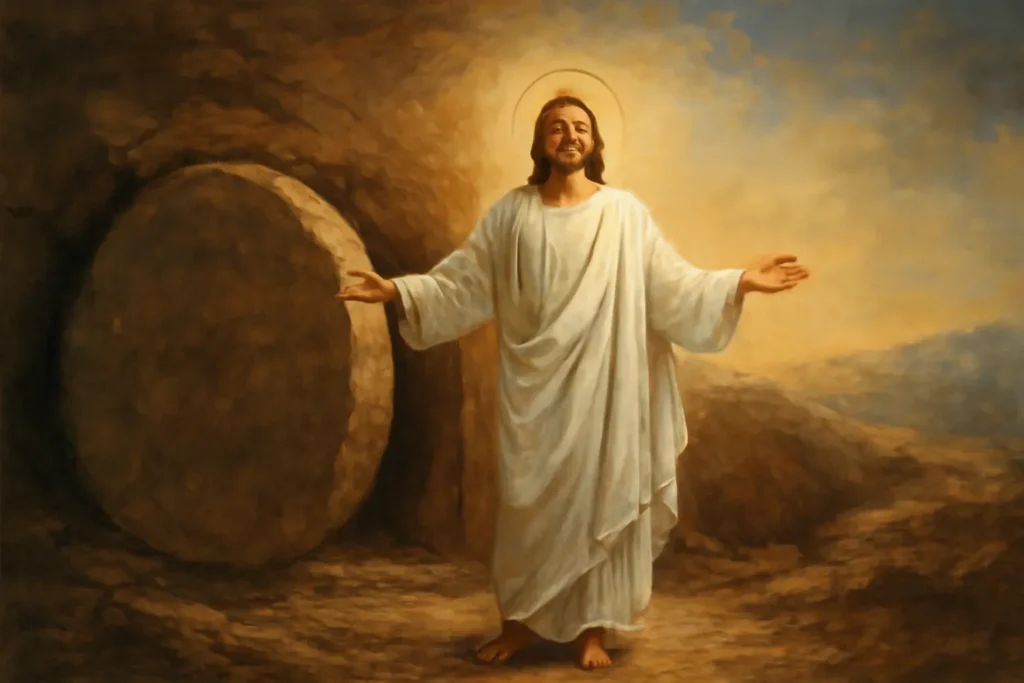
In art, hymnody, and iconography, the theme of Christ rising has inspired images of light, victory over death, and the reversal of sorrow. The language of being “raised” is often paired with imagery of dawn, new seeds, and abundant life—metaphors that echo the biblical claim that the risen Christ inaugurates a new era for creation.
A helpful way to understand the Resurrection is to see it within the broader scriptural arc: the suffering and death of Jesus as a sacrifice, the Resurrection as victory over death, and the coming of new creation in the Spirit. This triad is often framed as the Paschal mystery, through which God’s redemptive work culminates in Christ’s rising body transformed into the life-giving Spirit. Christians see in this sequence a proclamation that death does not have the final word and that God’s justice, mercy, and faithfulness are manifested in a restored relationship between God and humanity.
In contemporary discussions, believers often navigate questions about how the Resurrection relates to history, evidence, and scientific understanding. The Resurrection is typically treated as a matter of historical claim grounded in eyewitness testimony and interpreted through faith. Some readers approach it as a mystery that transcends purely natural explanations, while others seek to understand it as a historical event compatible with a modern historical method. Across traditions, a common thread is the conviction that the Resurrection reveals God’s power to redeem, renew, and sustain life beyond the limits of mortal existence.
Across the spectrum of Christian denominations and communities, certain emphases tend to recur, shaping how believers experience and teach about the Resurrection.
Liberation and justice: Some communities highlight the Resurrection as a call to address oppression, inequality, and injustice in the present world, arguing that new life in Christ compels believers toward compassionate action.
Personal transformation: Others stress the inner renewal that comes from encounter with the risen Lord, emphasizing disciplines such as prayer, baptism, and Holy Communion as means of receiving and sharing new life.
Church as Easter people: A common motif is the church’s identity as a community that has already experienced the Resurrection and is therefore called to bear witness to hope in every age.
While the Resurrection centers on the person of Jesus, it also reverberates through the church’s calendar, sacraments, and mission. The Easter celebration, for many Christian communities, marks the high peak of the liturgical year. The themes of redemption, reconciliation, and renewal flow from the event of Christ rising and inform liturgical prayers, Bible readings, and acts of service. The mission of the church—proclaiming good news, tending the vulnerable, and building communities of peace—appears as a direct outgrowth of the belief that Christ rose and that God’s life is breaking into the world now.
In sum, Christ rose is both a historical claim about what appears to have happened in the first century and a living conviction that continues to shape faith, worship, and daily life. The Resurrection of Jesus is widely understood as the moment when God’s Kingdom began to break into creation in a new and transformative way. It is a source of hope for individuals facing death, a motive for moral action, and a basis for confident worship. Across traditions and generations, the risen Jesus has remained present to communities through scripture, sacrament, and Spirit, inviting people to participate in the ongoing work of God’s renewal of all things.
For readers who wish to dive deeper into the topic of the Resurrection and the figure of Christ, here are some directions to explore. This list includes both historical-critical literature and devotional reflections that are accessible to a broad audience.
Introductory overviews of the Resurrection in biblical studies and dogmatics
Commentaries on the Gospel narratives that emphasize the Resurrection accounts
Early Christian creeds and their implications for faith
Patristic writings that explore the meaning of the Resurrection
Contemporary theological essays on the Paschal Mystery and the liturgical life of the church
Readers are invited to consider how Christ rose resonates in their own spiritual journeys, how it shapes their understanding of justice and mercy, and how it informs their participation in communities that seek to embody the values of the risen life in everyday action.










Leave a Reply