The ideas of resurrection and ascension sit at the center of Christian faith
because they are rooted in a sequence of events and claims about Jesus of Nazareth that shape how
Christians understand God’s plan for creation. The scriptural witness presents two interlinked
but distinct occurrences: the return to life after death of Jesus himself, and the exaltation of
Jesus to the heavenly throne after the Paschal events. Across four Gospels, the letters of the
apostolic era, and the early church’s creed-like statements, these realities are treated as
foundational for understanding who Jesus is, what God is doing in history, and what awaits all
those who follow him.
The most frequently cited sources include, but are not limited to:
Paul’s discussion of the resurrection of the dead in 1 Corinthians 15, which argues that the
resurrection is both a present hope and a future, bodily reality
The resurrection accounts in the Gospels (notably Luke 24, John 20–21), which interpret
the risen Jesus appearing to followers and sending them with a mission
The Ascension narrative in Luke 24:50–53 and Acts 1, which describes Jesus’ departure
from earth and his entry into heaven
Creedal affirmations that summarize these events as central to Christian faith
The Event of Resurrection: Meaning and Implications
The refrain of resurrection in Christian theology is not simply a return to earthly life; it is a
redefinition of life itself, a victory over death, and a demonstration of divine power over the
limits of mortality. The earliest Christians saw this event as the culmination of Jesus’
incarnate life, his faithfulness unto death, and his ultimate triumph. The implications are
multifaceted:
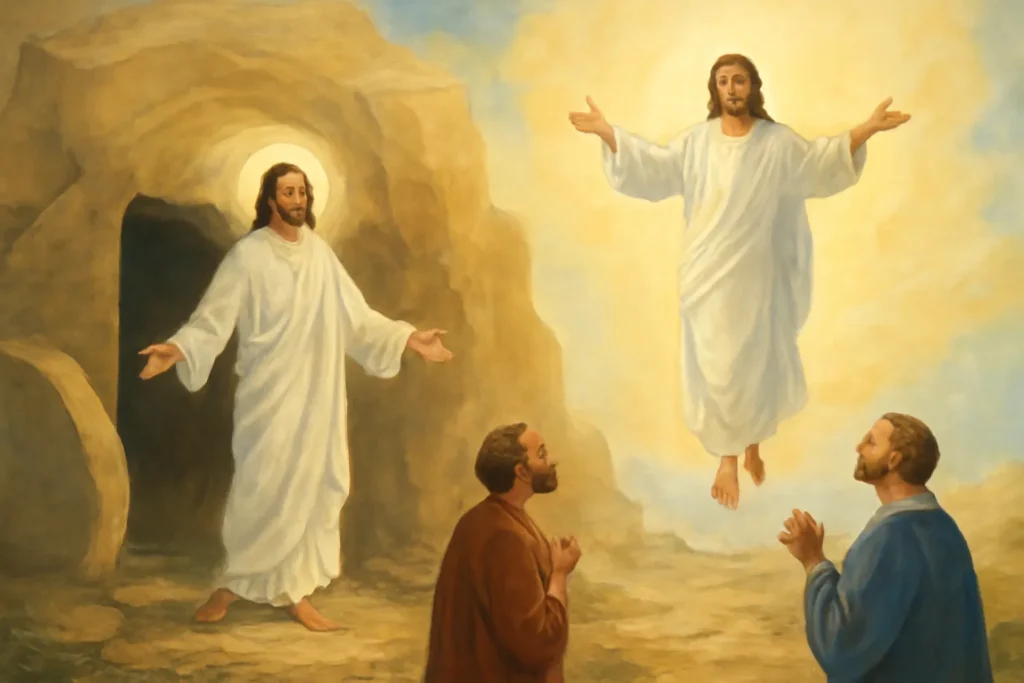
Bodily resurrection versus mere spiritual survival. The apostolic witness insists that Jesus
rose with a real, embodied presence—though transformed in a way that transcends ordinary
experience. This has shaped long-standing Christian doctrine about the glorified body and the continuity between the earthly Jesus and the risen Christ.
Vindication of Jesus’ claims. The resurrection is read as God’s public emblem of Jesus’
authority and the truth of his message—an, as Paul calls it, “firstfruits” of what God will do for
all creation.
Hope for humanity. If Jesus can be raised, then death is demystified as the final word, and
believers are invited into a future with God in which evil and decay are overcome.
Continuity and novelty. The risen Christ bears the marks of his crucifixion (in many gospel
accounts), yet his presence is transformed. This signals that God can redeem weakness and
suffering into a new form of life that confirms ethical and relational integrity.
Key theological themes associated with the resurrection
Resurrection as a historical claim. The early church proclaimed that Jesus truly rose, not as a
symbolic metaphor, but as a concrete event witnessed by many.
Resurrection as eschatological first fruits. Paul’s language of the “first fruits” ties the
risen Jesus to the future resurrection of all who belong to him (1 Corinthians 15).
Resurrection as the doorway to new creation. The resurrection inaugurates the in-breaking of God’s
reign and the renewal of all things, not merely the restoration of a single life.
The Significance of the Resurrection for Christian Life
Beyond the historical and soteriological claims, the resurrection has practical consequences for
how Christians live today. It shapes ethics, worship, mission, and community life, offering a
pattern of reality in which suffering is not the final word and where transformative power is
available through grace.
Hope and courage. The conviction of life beyond death fuels perseverance in the face
of adversity and injustice.
Witness and mission. The risen Christ sends the church into the world with a message of
reconciliation, justice, and mercy.
Unity and solidarity. The resurrection underlines the shared fate of believers as members of
one body—Christ’s body—united by the Spirit.
The Ascension: Event and Significance
The ascension refers to Jesus’ exaltation in which he is taken up to heaven and seated at the
right hand of the Father. This event is commonly understood as the culmination of Jesus’
earthly ministry, following his death and resurrection. The ascension has multiple layers of
meaning:
Exaltation and enthronement. Jesus is crowned as Lord over creation, possessing universal
authority. The language of sitting at the right hand signals a ruling, intercessory
function and a place of honor within the divine royal scheme.
Mediation. The ascended Christ acts as mediator between God and humanity, sustaining the
church through the Spirit and interceding for believers.
Pentecost and mission. The ascension creates the condition for the Spirit to be poured out
on the church at Pentecost, enabling mission, revelation, and fellowship.
Cosmic dimension. The return to heaven is not withdrawal but consolidation of Christ’s reign
over heaven and earth, so that creation looks toward its promised renewal.
Ascension in early Christian memory
Early Christians read the ascension as a keystone in the story of Jesus: a definite departure
from the visible scene on earth, followed by an unseen, but real, presence with and through the
Holy Spirit. This framework allowed the church to interpret Jesus’ ongoing work in the world as
both present and future—present through the Spirit and future through the coming Kingdom.
Christology and the Ascension
The two movements—resurrection and ascension—are not independent theological ideas but parts of
a single, coherent account of who Jesus is. In classic Christology, they contribute to a robust
understanding of the person of Christ as both fully divine and fully human, living a complete
human life in solidarity with creation and then being exalted in glory.
The two natures in one person. The resurrection confirms the divine authority of Jesus, while the
ascension confirms his humanity in glory.
Christ the Mediator. Through the ascension, Jesus remains the trustworthy mediator who
intercedes on behalf of the church and governs from the right hand of God.
Continuity with the Incarnation. The exalted Christ continues to bear the scars of the
crucifixion, symbolizing a united story of self-giving love and universal redemption.
In Christian teaching, the events of resurrection and ascension are not isolated to matters of
personal salvation; they also inform how Christians understand the present age and the future
hope of all creation. The New Testament frequently links these events with the anticipation of
the coming Kingdom, the final judgment, and the renewal of heaven and earth.
Cosmic scope. The risen and exalted Christ is described as Lord over all powers, including visible
and invisible realms. This has implications for spiritual warfare, divine providence, and
the ordering of creation.
Eschatological hope. The ascended Jesus acts as the precursor of a future reality where God
makes all things new, and where the body and spirit of believers are conformed to his
likeness.
Transformation of existence. The life of the world is expected to be reshaped by God’s
redemptive presence, so that mortality gives way to immortality, hardship to peace, and
violence to reconciliation.
Relation to the Incarnation and Salvation History
The arc from the Incarnation to the Resurrection and then to the Ascension constitutes a
unified storyline in Christian theology. The Incarnation—the Word becoming flesh—sets
in motion a plan to heal a broken creation. The resurrection demonstrates the victory of divine
life over death, and the ascension confirms Jesus’ ongoing authority and presence in the world
through the Spirit.
From a historical-theological point of view, these events function as milestones in salvation history (a term that captures how God acts across time). They indicate that God’s
action is not confined to one moment, but unfolds through Jesus and, by the Spirit, continues in
the life of the church. The church reads these milestones as not only past events but also
present realities that shape worship, ethics, and community life.
The meaning of resurrection and ascension is enshrined in Christian worship and
proclamation. The traditional creeds summarize these key moments in concise, enduring form:
Apostles’ Creed includes the lines: “He was crucified under Pontius Pilate; He
rose again on the third day; He ascended into heaven and sits at the right hand of God the
Father Almighty.”
Nicene Creed expands on the same core truths, locating Jesus’ exalted status within the
larger framework of the Trinity and the life of the church.
In liturgical settings, the resurrection is celebrated as the public triumph of life over death,
often with readings that recount Peter’s preaching and the eyewitness accounts of the risen Jesus.
The ascension is remembered as the moment when the risen Christ is taken up and given a place of
honor, a scene that motivates prayers, intercession, and a confident expectancy of the Spirit’s
coming.
Ecumenical Perspectives
Across Christian traditions, there is broad consensus on the essential importance of the
resurrection and ascension, though the emphasis and language can differ. Some broad tendencies include:
Roman Catholic and Eastern Orthodox. A strong emphasis on the physical
dimension of the risen body and the ongoing reality of Christ’s presence through the sacraments
and the liturgical life of the church. The ascension is often celebrated with high ecclesial
symbolism about the church’s mission to the nations.
Protestant traditions. A wide diversity exists here, from a robust focus on the
historical-resurrection claim to nuanced discussions about how to interpret the glorified body and the nature of post-resurrection existence. The ascension is frequently
linked to the Spirit’s sending at Pentecost and the church’s mission.
Anglican and Protestant-Ceced. A balance between Christological emphasis (who Jesus is)
and pneumatological emphasis (the Spirit’s activity in believers and in the world) in both
resurrection and ascension narratives.
Common Questions and Clarifications
The topics of resurrection and ascension invite careful distinctions and careful nuance. Here are
some common questions and concise responses that reflect mainstream Christian discourse.
What does it mean to talk about a bodily resurrection?
Most Christian traditions affirm that Jesus rose in a real, concrete body, though that body
was transformed in a way that transcended ordinary physical experience. The emphasis is not an
ethereal return to life but a transformed
embodiment that preserves continuity with the earthly life of Jesus while inaugurating a
new mode of existence in the fullness of the Kingdom.
Is the ascension the same as Jesus leaving the world?
The ascension is not a loss but a transition: Jesus departs from the visible scene to be exalted
at God’s right hand, where he continues to govern, plead, and send the Spirit. The ascension
redefines proximity to God—from geographical presence to a new form of relational and
intercessory presence through the Spirit.
How do resurrection and ascension relate to Christian hope?
Together they anchor a twofold hope: a present experience of God's life and power in the Spirit,
and a future expectation of a renewed creation where death, sorrow, and injustice are no more.
This eschatological hope shapes prayer, ethics, and prophetic witness in communities of faith.
Resurrection, Ascension, and the Life of Faith
The meanings of these events extend beyond doctrinal statements. They form a living
memory that shapes worship, preaching, and daily life. The risen Christ is a source of strength, guidance, and comfort for believers, while the ascended Christ
equips the church with authority and mission through the Spirit.
Practical reflections for Christian believers
Prayer. The ascended Christ intercedes, and believers invoke the Spirit to guide their lives in truth and love.
Worship. Eastertide and the feast of the Ascension are moments to celebrate Christ’s victory and to confess that his reign shapes how we live in time.
Ethics. The resurrection invites a life shaped by mercy, justice, and solidarity with the vulnerable, while the ascension calls Christians to pursue mission with humility and perseverance.
Hope in suffering. The belief in life after death offers a horizon that reframes present pain as part of a larger drama of redemption.
In summary, resurrection and ascension are not merely past events remembered in faith; they are
ongoing invitations to participate in the divine life. They tell a story about God’s power to
redeem all things, about the person of Christ who remains present to his people, and about a
future that God is bringing into the present through the Spirit.
Varieties of Language: Alternative Phrasings and Interpretive Angles
To deepen understanding, it helps to use a range of expressions that convey the same core ideas.
Here are some common variations you might encounter in theological literature or preaching while
keeping the essential meanings intact:
Rising from the dead, resurrection life, and the life-giving power of God
Resurrection of Jesus, the risen Christ, the empty tomb as emblem of victory
Ascension to the heavenly throne, enthronement, right-hand of God, heavenly session
Glorified body, transformed humanity, and the continuity of memory with transformation
Public vindication, divine sovereignty, and the Spirit-filled church’s mission
Closing Observations on Meaning
The doctrinal statements about the rising from the dead and the ascent into heaven are not merely
abstractions but are meant to cultivate a lived faith. They invite believers to trust in God’s
character, to embody hope in suffering, and to participate in God’s work of renewing the world. The
dual act of resurrection and ascension thus functions as a framework for understanding who Jesus is,
who Christians are in relation to him, and how the church carries forward a mission that is both
spiritual and tangible.







Leave a Reply