If you have heard the phrase “Flight into Egypt” and wondered what actually happened, the answer comes from the opening chapters of Matthew’s Gospel. After Jesus was born, Joseph was warned in a dream that King Herod intended to harm the child. Joseph took Mary and Jesus to Egypt, where they remained until Herod died.
The account appears only in Matthew 2:13–15. It is brief, but it has shaped Christian theology, preaching, prayer, and art for centuries. The story is not simply about a family traveling to another country. It presents Jesus as a vulnerable child, Mary and Joseph as refugees, Egypt as a place of safety, and God’s guidance as something received through responsible action.
The central point: The family’s escape protected Jesus from Herod’s violence and connected his life with Israel’s earlier story of rescue, oppression, and deliverance.
According to Matthew, wise men from the East had visited Jesus in Bethlehem after following a sign associated with his birth. They had first spoken with Herod the Great, the ruler of Judea, who asked them to report the child’s location. Herod claimed that he also wanted to honor Jesus, but Matthew portrays that request as deceptive.
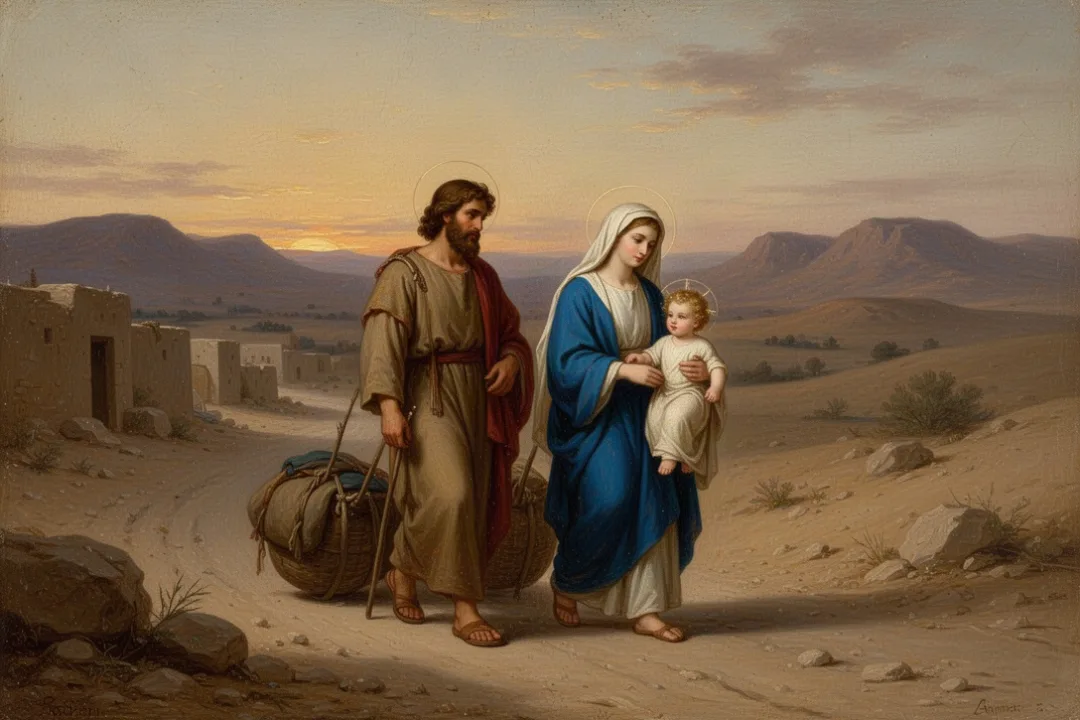
After the visitors left without returning to Herod, Joseph received a dream-warning from an angel. The message told him to get up, take the child and his mother, and flee to Egypt because Herod was searching for Jesus in order to destroy him. Joseph responded immediately, taking his family away during the night.
Matthew does not describe the journey in detail. The Gospel does not state exactly which route the family used, how long the trip took, where they lived in Egypt, or how they supported themselves. Those details appear in later traditions, but they should not be confused with the limited information found in the biblical text.
The family stayed in Egypt until Herod’s death. Joseph then received another dream instructing him to return to the land of Israel. Because Herod’s son Archelaus was ruling Judea, Joseph was afraid to settle there. After another warning, he went to Galilee and made his home in Nazareth. Matthew connects that move with the later identification of Jesus as a Nazarene.
The basic sequence is therefore straightforward:
Jesus is born in the region of Bethlehem during Herod’s reign.
Wise men visit and refuse to help Herod locate the child.
Joseph receives a warning through a dream.
The family escapes to Egypt and remains there until Herod dies.
Joseph returns with Mary and Jesus, eventually settling in Nazareth.
Matthew’s account follows the pattern of a dangerous ruler, a threatened child, and a family forced to leave home. The story also makes clear that Jesus’ safety did not come through political power. It came through Joseph’s attentiveness, courage, and willingness to act on a difficult warning.
Why did Joseph and Mary flee to Egypt?
The immediate reason was Herod’s plan to kill Jesus. Matthew presents Herod as a ruler deeply threatened by the idea that another king had been born. The wise men’s question about the newborn “king of the Jews” challenged Herod’s authority, even though Jesus was still an infant and had no political army or public following.
Matthew later describes Herod’s order to kill young boys in and around Bethlehem. That event is commonly called the Massacre of the Innocents. The Gospel portrays it as an act of state violence against children, carried out because Herod wanted to eliminate a perceived rival.
Historical sources outside the New Testament also portray Herod as a ruler capable of ruthless actions against suspected threats. Ancient accounts describe executions within his own family and harsh measures against political opponents. These sources do not provide an independent account of the family’s escape, but they help explain why Matthew’s depiction of Herod’s fear and cruelty fits the political world of the time.
Egypt was a practical place of refuge. It was outside Herod’s immediate kingdom, yet close enough to reach by established travel routes. Jewish communities already lived in Egypt, especially in and around Alexandria, so the family would not necessarily have entered an entirely unfamiliar religious and cultural environment.
The text does not say that Joseph and Mary were wealthy travelers. In fact, the family’s circumstances suggest limited means. Later in Matthew’s Gospel, Joseph’s occupation is associated with manual work, and Luke’s account of the family’s offering at the Jerusalem Temple is consistent with modest economic circumstances. A journey to Egypt would still have required planning, food, transportation, shelter, and work.
Calling the family refugees can be helpful, as long as the term is used carefully. They were displaced because of a ruler’s threat, crossed a border to seek safety, and remained away from home until the danger passed. The Gospel does not provide modern legal categories or describe a formal asylum process, but the human reality of forced flight is clearly present.
A careful distinction: Matthew tells readers why the family left and when they returned, but it does not provide enough information to reconstruct every detail of their migration. Later stories should be treated as tradition, not as additional biblical facts.
The story also shows that faith does not always mean staying in place and enduring danger. Joseph’s obedience involved movement, protection, and practical judgment. He did not interpret courage as refusing to leave. He protected the child entrusted to him by taking the threat seriously and finding a safer place.
How Matthew connects Egypt with Israel’s Scriptures
Matthew explains the family’s stay in Egypt by citing the prophet Hosea. The reference is Hosea 11:1, where the prophet recalls that God called Israel, described collectively as a son, out of Egypt. Matthew applies that scriptural pattern to Jesus, presenting him as the one who relives and fulfills Israel’s story.
Matthew’s use of Hosea is not merely a prediction-and-fulfillment formula in the modern sense. In Hosea, the “son” refers to Israel as a people who were brought out of Egypt. Matthew sees a meaningful correspondence between Israel’s history and Jesus’ life. Jesus goes down into Egypt and later comes out, echoing the nation’s earlier deliverance.
This way of reading Scripture is common in Matthew. The Gospel repeatedly presents events in Jesus’ life as connected with Israel’s Scriptures and identity. Jesus is shown not as someone detached from Israel’s history, but as one who embodies and completes important patterns within it.
The connection creates an interesting reversal. In the book of Exodus, Egypt is the place from which Israel must be rescued. In Matthew, Egypt becomes a temporary shelter that protects Jesus from a violent ruler. The same location can therefore carry different meanings: oppression in one part of the story, refuge in another.
The Flight into Egypt also echoes the life of Moses. Moses was threatened by a ruler who ordered the killing of Hebrew male infants. He was preserved as a child and later became the leader through whom Israel was brought out of slavery. Matthew’s account presents Jesus as another endangered child whose life is tied to the liberation story of Moses and Israel.
There are several overlapping patterns in Matthew’s opening chapters:
A threatened child: A ruler tries to destroy a child who represents a challenge to established power.
Divine preservation: The child survives through protection and guidance rather than military strength.
Exile and return: The family leaves home, lives in a foreign land, and later comes back.
Scriptural fulfillment: Jesus’ story is interpreted through Israel’s earlier experiences.
A new beginning: The return from Egypt leads toward Jesus’ life in Nazareth and his future public ministry.
These connections do not mean Matthew is claiming that every event happened in exactly the same way as an earlier biblical event. Instead, he uses familiar scriptural patterns to help readers understand Jesus’ identity. The child in the story is part of Israel’s history, yet the Gospel also presents him as the person through whom that history reaches its intended purpose.
What the story reveals about Herod, Jesus, and God’s guidance
The Flight into Egypt places political power and vulnerable life side by side. Herod has a palace, officials, information, and the authority to command violence. Jesus has none of those advantages. He is an infant dependent on his parents, and his survival begins with the decision of one ordinary family to leave quickly.
Herod’s behavior is driven by fear. He understands kingship as something that must be protected through control and elimination. Matthew contrasts that model with Jesus, whose kingship is announced while he is powerless and whose protection depends on people willing to respond faithfully.
The story also gives Joseph an unusually active role. In Matthew’s account of Jesus’ early life, Joseph receives several messages in dreams. He is told to take Mary as his wife, to flee to Egypt, and later to return. The narrative does not portray him as passive. He listens, evaluates the danger, and acts.
Joseph’s example includes both spiritual openness and practical responsibility. The dream provides direction, but Joseph still has to wake up, gather his family, arrange transportation, choose a destination, and live in an unfamiliar place. Biblical guidance does not remove the need for human decisions or effort.
Mary is not quoted in Matthew’s account of the escape, but she shares the danger and the displacement. As the mother of a young child, she would have faced the physical and emotional demands of sudden travel. The Gospel’s concise style leaves much unsaid, but the family’s vulnerability remains central to the scene.
Jesus is portrayed as the focus of Herod’s fear before he speaks publicly or performs any miracle. His identity is established through the narrative’s larger claims: he is connected with Israel’s hopes, associated with kingship, and protected as part of God’s purpose. The danger surrounding him points to the significance Matthew assigns to his life.
At the same time, the story should not be read as saying that every threatened family will be rescued in the same visible way. Matthew’s account is a specific claim about Jesus’ life, not a promise that violence will always be prevented through a dream or miraculous warning. Its moral force includes grief for those who are not spared and condemnation of the ruler who causes that grief.
The account can speak to people who have experienced migration, persecution, family separation, or fear of political violence. It does not erase the differences between the ancient world and the present day. It does, however, place a displaced child and his parents within the Christian story of salvation rather than treating refugees as outsiders to God’s concern.
What the Bible says and what later tradition adds
Only Matthew records the Flight into Egypt. Luke tells about Jesus’ birth, the shepherds, the Temple presentation, and the family’s life in Nazareth, but it does not mention a journey to Egypt. Mark begins Jesus’ story with his adult ministry, and John begins with theological reflections on the Word becoming flesh. The Gospels therefore emphasize different parts of Jesus’ early life.
The absence of the story from the other Gospels does not by itself prove or disprove the event. Ancient biographies often selected material according to their purposes, audiences, and theological interests. Matthew may have included the episode because it strongly supports his presentation of Jesus as the fulfillment of Israel’s story.
Later Christian tradition developed many accounts of the family’s time in Egypt. These stories often name villages, describe encounters with people and animals, or attribute miracles to the presence of Jesus. Some churches preserve local places connected with the family’s route, and Christian art frequently depicts the journey with Mary riding a donkey while Joseph walks beside her.
Those images can express the tenderness and hardship of the journey, but the donkey is not specifically mentioned in Matthew’s account of the escape. Matthew does mention a donkey in the story of Jesus’ later entry into Jerusalem, while the Flight into Egypt itself is described without transportation details.
Traditions about the family’s route also vary. Egypt has a long history of Christian devotion connected with the journey, and some locations are honored as places where the family may have stayed. Such traditions can be meaningful expressions of faith and memory, but their historical certainty differs from the clear biblical claim that Joseph took Mary and Jesus to Egypt.
A useful way to read the material is to keep three levels separate:
Biblical account: Matthew says Joseph was warned, fled with Mary and Jesus, stayed in Egypt, and returned after Herod’s death.
Historical setting: Egypt was a nearby region with established Jewish communities and could serve as a place of refuge from Herod’s control.
Later tradition: Christian communities added specific routes, locations, encounters, and visual details over time.
Keeping these levels distinct does not make the tradition less meaningful. It simply allows readers to appreciate religious art, pilgrimage, and devotional stories without attributing every later detail to the Gospel itself. Careful reading can honor both the biblical text and the communities that have reflected on it.
How Christians understand the Flight into Egypt today
For many Christians, the story carries a message about God’s care for the vulnerable. Jesus begins life not in security but under threat. Mary and Joseph are not protected from every hardship; instead, they are guided through danger by means that require trust, alertness, and action.
The account can also shape Christian attitudes toward displaced people. The Holy Family’s experience does not provide a direct policy statement about immigration, borders, or asylum. It does offer a powerful moral image: a child and his parents need safety, and refusing to see their vulnerability would contradict the compassion many Christians find at the heart of the Gospel.
Churches often reflect on the Flight into Egypt during Christmas seasons, services focused on refugees, and observances connected with the life of Jesus. The passage can prompt prayer for families who have fled war, persecution, trafficking, political repression, or other forms of violence.
The story also encourages a more mature understanding of faith. Joseph does not receive a complete map of the future. He receives enough direction for the next necessary step. He leaves when danger is present, waits in an unfamiliar place, and returns only when circumstances change and further guidance is given.
That pattern can be relevant in ordinary decisions as well. A person may need to recognize a harmful situation, seek protection, accept help, or change plans rather than treating endurance as the only faithful response. The passage does not turn every personal decision into a divine message, but it does affirm the wisdom of paying attention to danger and protecting those entrusted to your care.
At its deepest level, the Flight into Egypt joins incarnation and vulnerability. Christian belief says that God entered human life in Jesus, and Matthew immediately shows that human life exposed him to political violence, displacement, and uncertainty. The child is preserved not by escaping human weakness but by passing through the ordinary realities of a threatened family.
The family eventually returns, but the return is not a simple restoration of everything that came before. Herod is dead, yet another ruler creates concern, so Joseph settles in Galilee rather than Judea. Safety requires discernment even after the first danger has passed. The family’s future is shaped by both divine direction and careful attention to political circumstances.
For that reason, the story remains more than a travel detail in Jesus’ childhood. It is a compact account of danger, refuge, Scripture, and responsibility. It asks readers to see the child Jesus within Israel’s story, to recognize the cost of Herod’s violence, and to value the protective choices made by people who act before harm reaches the vulnerable.
Frequently asked questions
Where in the Bible is the Flight into Egypt described?
The account appears in Matthew 2:13–15. Matthew says an angel warned Joseph in a dream to take Mary and Jesus to Egypt because Herod wanted to destroy the child. The family remained there until Herod died, then returned and settled in Nazareth after Joseph received further guidance.
How long did Jesus stay in Egypt?
The Bible does not give a precise length of time. Matthew only says that the family remained there until Herod died. Since neither the exact date of Herod’s death nor the family’s arrival and departure dates are provided in the passage, estimates about the duration remain uncertain.
Did the Flight into Egypt really happen?
Christians accept Matthew’s account as part of the Gospel testimony, while historians assess it alongside the limited evidence available about Jesus’ early life. The Bible gives no independent travel records or detailed itinerary. Later traditions identify specific Egyptian locations, but those claims are less certain than Matthew’s basic account.
Why is Egypt significant in the story of Jesus?
Egypt connects Jesus with major themes in Israel’s history. It is the place from which Israel was eventually brought out, and Matthew uses Hosea 11:1 to connect Jesus’ return from Egypt with that earlier story. Egypt also functions practically as a refuge from Herod’s violence and symbolically as part of Jesus’ identification with Israel.











Leave a Reply