The Bible does not describe Christmas as a holiday, but it does tell the story of Jesus’ birth and explains why Christians celebrate it. The clearest accounts appear in Matthew 1–2 and Luke 1–2, while other New Testament passages interpret Jesus’ coming and its significance.
These accounts focus less on a calendar date and more on who Jesus is: the promised Messiah, the Son of God, and the Savior. They also show how his birth affected Mary, Joseph, shepherds, rulers, visitors from the East, and people waiting for God’s redemption.
Only two Gospel writers give a narrative of Jesus’ birth. Matthew emphasizes Jesus as Israel’s promised king, while Luke highlights God’s care for ordinary and overlooked people. Their accounts complement each other, but they do not tell the story in exactly the same way or include the same events.
Matthew’s account centers on Joseph, prophecy, and the visiting Magi
Matthew begins with a genealogy connecting Jesus with Abraham and David (Matthew 1:1–17). This opening places Jesus within Israel’s story and points to his royal and covenant significance. The genealogy is followed by an account of Mary’s pregnancy and Joseph’s response.
Joseph learns that Mary’s child has been conceived through the Holy Spirit. He plans to end their engagement quietly, but an angel tells him in a dream to take Mary as his wife. The child’s name is to be Jesus, because he will save his people from their sins (Matthew 1:18–25). Matthew presents this as fulfillment of prophecy and identifies Jesus as “God with us” by explaining the meaning of the name Immanuel.
After Jesus is born in Bethlehem, Magi from the East arrive in Jerusalem looking for the child born king of the Jews (Matthew 2:1–12). The text does not say how many Magi came, does not call them kings, and does not name them. The number three comes from the three gifts—gold, frankincense, and myrrh—rather than from an explicit count of visitors.
King Herod sees the child as a threat. After the Magi leave, Joseph is warned in a dream to take Mary and Jesus to Egypt. Herod orders the killing of young boys in and around Bethlehem, and Matthew connects this tragedy with prophetic Scripture (Matthew 2:13–18). After Herod dies, Joseph returns with his family and settles in Nazareth (Matthew 2:19–23).
Luke’s account centers on Mary, shepherds, and the temple
Luke sets Jesus’ birth within a broader story that begins with the announcement of John the Baptist’s birth. The angel Gabriel tells Mary that she will bear a son who will be called the Son of the Most High and receive David’s throne (Luke 1:26–38). Mary responds with trust and later praises God for showing mercy to the humble and needy (Luke 1:39–56).
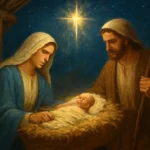
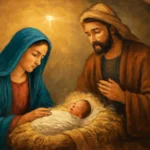
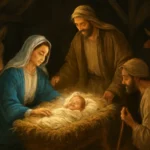
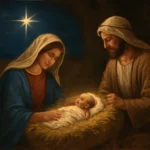
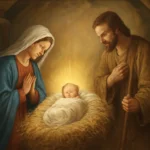
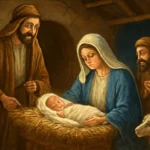
Luke says that Joseph and Mary travel to Bethlehem because of a registration connected with the Roman government. While they are there, Mary gives birth to Jesus, wraps him, and lays him in a manger because there is no suitable guest room available to them (Luke 2:1–7).
Shepherds in the surrounding countryside receive the announcement from an angel. They are told that a Savior, Christ, and Lord has been born in David’s town. A heavenly host praises God, and the shepherds go to see the child. Afterward, they tell others what they have heard and seen (Luke 2:8–20).
Luke also records Jesus’ circumcision and naming, his presentation at the temple, and the words of Simeon and Anna. Simeon recognizes the child as God’s salvation and says that Jesus will bring light to the nations while also revealing people’s responses to him. Anna, an elderly prophet, speaks about the child to those waiting for Jerusalem’s redemption (Luke 2:21–38).
A useful distinction: The Bible gives two birth narratives, not one complete scene containing every familiar Christmas detail. The manger belongs to Luke’s account; the Magi and the flight to Egypt belong to Matthew’s account.
What the Christmas story means in the Bible
The birth narratives are not merely accounts of an unusual delivery. They make theological claims about Jesus’ identity, God’s promises, and the purpose of salvation. Several themes appear across the opening chapters of Matthew and Luke and throughout the rest of the New Testament.
Jesus is presented as the promised Messiah
Messiah means God’s anointed king. In the Old Testament, Israel’s hopes include a future ruler from David’s family who would govern with justice and bring restoration. Matthew connects Jesus with David through the genealogy and the Bethlehem setting. Luke’s angelic announcement also refers to David’s throne (Matthew 1:1; Luke 1:32–33).
The title Christ is not Jesus’ last name. It is the Greek form of “Messiah,” a title describing his appointed role. When the angels call the newborn child “Christ” and “Lord” in Luke 2:11, the announcement gives his birth extraordinary importance. The child is not simply another member of David’s line; he is the one through whom God’s saving work is unfolding.
Jesus’ birth is linked to God’s presence
Matthew explains the name Immanuel as “God with us” (Matthew 1:23). John’s Gospel does not describe the manger, shepherds, or Magi, but it gives a theological explanation of Jesus’ coming: the eternal Word enters human life and lives among people (John 1:1–18).
Because Bible translations differ and some passages are copyrighted, it is best to read the exact wording in the translation you use. The central idea is clear: God does not remain distant from human suffering. In Jesus, God’s self-revelation takes place through a human life, beginning with birth in humble circumstances.
The birth points toward salvation
Joseph is told to name the child Jesus because he will save his people from their sins (Matthew 1:21). This explains why the Christmas story cannot be separated from the rest of the Gospel. Jesus’ birth is the beginning of a mission that includes his teaching, healing, death, resurrection, and exaltation.
Luke uses salvation language from the beginning. Simeon describes Jesus as God’s salvation, prepared before the nations, and calls him a light for Gentiles as well as glory for Israel (Luke 2:29–32). The angels’ announcement also calls him Savior (Luke 2:11). These descriptions show that the Bible treats Jesus’ birth as part of God’s rescue for both Israel and the nations.
God’s work appears through humble people and places
Mary is a young woman from Nazareth, a town that later prompts skepticism about whether anything significant can come from there (John 1:46). Joseph is a working man who must make difficult decisions with limited information. Shepherds receive the first public announcement in Luke, even though they hold no royal or priestly position.
The setting also matters. Bethlehem is associated with David, yet Jesus is laid in a feeding trough. This contrast between royal promise and humble surroundings appears throughout the New Testament. Jesus is identified with greatness, but he does not arrive through the visible power, wealth, or status people might expect from a king.
Which Old Testament prophecies the Christmas accounts connect to Jesus
Matthew repeatedly says that events in Jesus’ early life fulfill Scripture. Luke also places the birth within Israel’s promises, especially those concerning David’s family and God’s salvation. These connections are part of the Gospel writers’ argument that Jesus’ life is not an isolated event.
Isaiah 7:14: Matthew connects the birth of Jesus with a prophecy about a child and the name Immanuel (Matthew 1:22–23).
Micah 5:2: Matthew identifies Bethlehem as the place associated with the ruler who will shepherd God’s people (Matthew 2:5–6).
Hosea 11:1: Matthew applies the words about Israel’s son being called out of Egypt to Jesus’ return from Egypt (Matthew 2:13–15).
Jeremiah 31:15: Matthew connects Rachel’s mourning with the grief caused by Herod’s violence near Bethlehem (Matthew 2:16–18).
Isaiah 9:1–7 and related passages: Luke’s themes of light, salvation, and a Davidic ruler echo hopes found in Israel’s Scriptures, even when Luke does not present each connection as a direct quotation.
Reading these passages requires care. A prophecy’s original setting matters, and Christians interpret the relationship between the Old and New Testaments in different ways. Matthew is showing how he understands Jesus within Israel’s story; he is not presenting the birth narratives as disconnected proof texts.
The quotation from Isaiah in Matthew also raises a translation question. The Gospel uses the Greek Old Testament wording, while English Bibles may translate Isaiah differently. The safest approach is to compare the passages in a trusted Bible and pay attention to the surrounding chapters rather than relying on one isolated sentence.
The larger point is that Jesus’ birth fulfills a pattern of promise. God’s work involves David’s line, Bethlehem, deliverance from Egypt, sorrow, and hope for the nations. The Gospel writers want readers to see continuity between God’s earlier promises and the person of Jesus.
What the Bible does and does not say about the date of Christmas
The Bible does not give a calendar date for Jesus’ birth. It does not say that he was born on December 25, and it does not command Christians to observe an annual celebration of his birth on that date.
December 25 became associated with Christmas through later Christian practice, not through an explicit biblical statement. The date has been observed in different ways across Christian traditions, and historical explanations for its development are complex. It is more accurate to say that December 25 is a traditional date for celebrating Jesus’ birth than to claim that Scripture establishes it.
The biblical accounts also do not identify the exact year of Jesus’ birth. Matthew places the birth during the reign of Herod the Great, while Luke connects it with a registration. Scholars have discussed how these chronological details fit together, but the Gospel narratives do not provide enough information to settle every dating question with certainty.
Luke mentions shepherds staying outdoors with their flocks at night (Luke 2:8). Some readers use this detail to argue for or against particular seasons. It may offer background for thinking about the setting, but it does not establish a precise date. The text does not tell us when Christmas should be placed on a calendar.
That absence does not make Christian celebration wrong. The New Testament gives believers freedom in how they regard particular days, while also warning against judging one another over such practices (Romans 14:5–6). Paul’s point in that passage concerns conscience and devotion to the Lord; it should not be used to force either celebration or noncelebration on every Christian.
Keep the evidence clear: December 25 is a church tradition, not a date stated in the Bible. Christians may celebrate the birth of Jesus on that day while recognizing that Scripture does not identify his exact birthday.
How common Christmas traditions compare with the biblical accounts
Many customs help people remember the birth of Jesus, but they do not all come directly from Scripture. Separating biblical details from later traditions can make your reading more accurate without requiring you to reject every custom.
The manger: This is biblical. Luke says Mary placed Jesus in a manger because suitable lodging was unavailable (Luke 2:7).
Shepherds: This is biblical. Luke describes shepherds receiving the angelic announcement and visiting Jesus (Luke 2:8–20).
Magi: This is biblical. Matthew describes visitors from the East, but he does not say there were three, name them, or call them kings (Matthew 2:1–12).
Three gifts: This is biblical. Matthew lists gold, frankincense, and myrrh, but the gifts do not prove that exactly three people brought them.
Animals at the manger: The birth accounts do not explicitly say that animals were present. Their presence in nativity scenes is a reasonable artistic inference from the setting, not a direct statement of the text.
An innkeeper: The Bible does not introduce an innkeeper who turns Mary and Joseph away. Luke says there was no suitable guest room or lodging available, depending on the translation.
Santa Claus and gift giving: These are cultural and historical traditions, not characters or practices described in the Christmas narratives.
Christmas trees and decorations: The Bible does not connect these customs with Jesus’ birth. Their use is a matter of culture, family practice, and personal conviction.
The Magi are often placed beside the manger in nativity scenes, but Matthew may describe a later visit. He refers to Jesus as a child and says the family is in a house, not necessarily at the place where Jesus was born. Herod’s order to kill boys up to a certain age also suggests that some time may have passed, although the passage does not allow us to calculate the child’s exact age.
Nativity scenes combine details from Matthew and Luke into one visual presentation. That is understandable and often meaningful, but reading the two chapters separately helps you notice each writer’s emphasis. Luke gives you the shepherds; Matthew gives you the Magi, Herod, Egypt, and Joseph’s dreams.
How to read the Christmas passages with greater care
A thoughtful reading does more than collect familiar lines for a holiday service. It considers the whole passage, the writer’s purpose, and the way each event contributes to the Gospel’s message.
Read Matthew 1–2 and Luke 1–2 separately. Notice which people, events, and themes appear in each account.
Mark what the text actually says. Distinguish direct statements from details supplied by artwork, songs, movies, or tradition.
Read the surrounding context. Matthew’s birth story follows the genealogy and leads into Jesus’ public ministry. Luke’s account belongs to a larger story about John, Jesus, Israel, and the nations.
Compare repeated titles. Pay attention to names such as Jesus, Savior, Christ, Lord, Son of God, and Immanuel.
Trace the Old Testament references. Read the cited passages in context instead of treating each quotation as an isolated prediction.
Ask what the passage reveals about God. Look for God’s faithfulness, mercy, holiness, concern for the humble, and purpose to save.
Consider the response of the people in the story. Mary trusts and praises God, Joseph obeys difficult instructions, the shepherds share what they have seen, and Herod reacts with fear and violence.
Luke’s opening chapters also show that people respond to Jesus in different ways. Mary accepts a costly calling. Simeon waits with hope. Anna speaks openly about redemption. Herod treats the child as a political threat. These responses invite readers to ask not only what Christmas means historically, but also how they respond to the claims made about Jesus.
Jesus’ birth is presented as good news, but the story is not sentimental. It includes social vulnerability, political danger, displacement, grief, and uncertainty. Joseph and Mary face circumstances they did not control, and Matthew’s account includes the suffering caused by Herod’s fear. The Bible’s Christmas story holds joy and sorrow together.
For Christians, that combination points beyond the birth itself. The child in Bethlehem becomes the teacher, healer, crucified Messiah, and risen Lord described throughout the New Testament. The meaning of Christmas therefore depends on the complete Christian claim about Jesus: God has acted through him to bring salvation.
For readers who are exploring Christianity, Matthew 1–2 and Luke 1–2 provide a natural place to begin, but John 1 and Galatians 4:4–5 add important perspective. John explains Jesus’ eternal identity, while Paul describes God sending his Son in the fullness of time to bring people into the family of God. Together, these passages show why Christians celebrate more than the birth of a remarkable child.
The Bible leaves room for different customs and does not require one universal way to mark the season. What it does emphasize is the person of Jesus and the purpose of his coming. Any Christmas practice that helps you remember God’s promise, Christ’s identity, and the call to respond with faith should be measured against that central message.
Frequently asked questions
Does the Bible say Jesus was born on December 25?
No. Matthew and Luke describe the circumstances and meaning of Jesus’ birth but do not give a date. December 25 is a traditional Christian date for celebrating the event. The Bible does not require that particular date, and it does not identify the season or year with enough precision to establish his exact birthday.
Were there really three wise men at Jesus’ birth?
Matthew mentions Magi from the East who brought three gifts: gold, frankincense, and myrrh. The passage does not state how many Magi came, give their names, or call them kings. The familiar idea of three wise men developed from the number of gifts and later Christian tradition.
Does the Bible say animals were present when Jesus was born?
The birth account in Luke says Jesus was placed in a manger, a feeding trough, because suitable lodging was unavailable. That detail may suggest an animal setting, but Luke does not explicitly say animals stood around the child. Their appearance in nativity scenes comes from artistic tradition and reasonable inference rather than a direct biblical statement.
Why do Matthew and Luke tell different details about Jesus’ birth?
Each Gospel writer selects details that support his presentation of Jesus. Matthew emphasizes Jesus as the promised Jewish king, Joseph’s role, the Magi, Herod, and the flight to Egypt. Luke emphasizes Mary, the shepherds, the temple, and salvation reaching the nations. Their accounts overlap while giving distinct perspectives.





Leave a Reply