If you have encountered Agag in the Bible, you may be wondering whether he was a single historical king, a title used for Amalekite rulers, or the ancestor of Haman in the book of Esther. The clearest answer is that Agag was an Amalekite king whom Saul captured but refused to destroy completely, contrary to the command he had received through Samuel.
Samuel later killed Agag at Gilgal, but the name continues to matter because the Bible connects Agag with the larger story of Amalek’s hostility toward Israel. The book of Esther calls Haman an “Agagite,” creating a literary and theological link between Israel’s ancient enemy and the threat facing the Jewish people in Persia.
Agag appears most clearly in 1 Samuel 15. At that point, Saul was king of Israel, and Samuel delivered a message telling him to attack Amalek. The command was connected to Amalek’s earlier attack on Israel after the exodus from Egypt. The biblical account presents this judgment as delayed rather than arbitrary: generations earlier, Amalek had attacked Israel when the people were vulnerable in the wilderness.
Agag is identified as the king of the Amalekites. He was therefore not an ordinary soldier or local official. He represented the nation Saul had been ordered to defeat, and his survival carried political as well as religious significance. By keeping Agag alive, Saul preserved the most visible symbol of the enemy he had supposedly been sent to eliminate.
Saul and his army defeated Amalek, but Saul did not carry out the command fully. He spared Agag and kept the best animals and valuable possessions. The biblical narrative says the soldiers wanted to preserve some of the livestock for sacrifice, although the account also makes clear that Saul accepted responsibility for the decision.
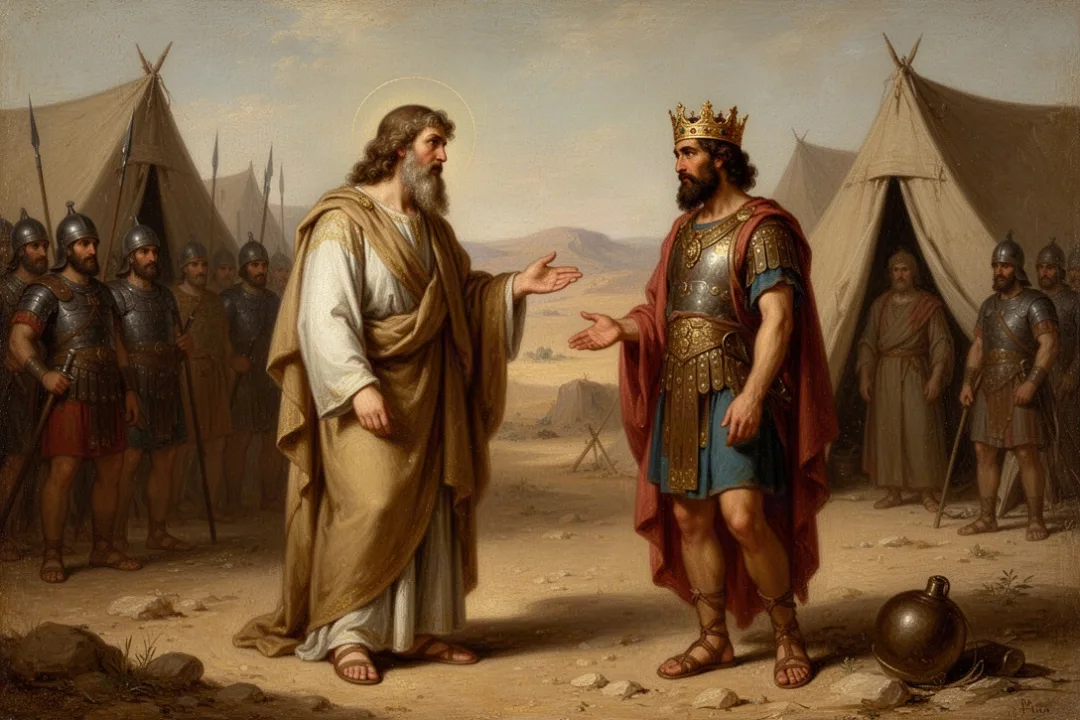
When Samuel confronted Saul, Saul first claimed that he had obeyed. As Samuel pressed him, Saul admitted that the people had spared the animals and that he had brought Agag back. The exchange exposes a central issue in the story: partial obedience is still disobedience when a person knowingly replaces a clear command with a preferred alternative.
The central point: Agag’s importance is not based on how much the Bible tells us about his personal life. He matters because his survival revealed Saul’s refusal to submit fully to God’s command and became part of the explanation for Saul’s rejection as king.
Samuel’s response is one of the best-known teachings in 1 Samuel. He explains that obedience is more valuable than ritual sacrifice and that rebellion is not a minor mistake. The passage does not reject worship or sacrifice in general. Instead, it rejects religious activity used to excuse a deliberate failure to obey.
Why Saul spared Agag and what happened next
The text gives more than one reason for Saul’s failure. Saul appears concerned with public approval, the wishes of his soldiers, and the appearance of religious devotion. He also seems to believe that keeping the best animals could be presented as an act of worship. These motives overlap, but the result is the same: Saul placed human preference above the instruction he had received.
Saul’s defense is especially revealing because he describes himself as obedient before acknowledging what he has done. This suggests that he measured obedience by the outcome he considered acceptable rather than by the command itself. He had won a military victory, captured the enemy king, and preserved animals for sacrifice. Yet the biblical account treats those achievements as insufficient because the defining command had not been followed.
Samuel told Saul that the kingdom would be taken from him and given to someone better suited to lead Israel. The passage does not say that Saul lost his throne immediately. He continued to rule for a time, but his relationship with God and his future as king had changed decisively.
After Samuel spoke with Saul, Agag was brought before him. Agag’s words indicate that he expected the danger to have passed, perhaps because his life had been spared. The Bible does not give a full account of his earlier actions or personal character, but it presents him as the ruler of the nation under judgment.
Samuel then killed Agag before the Lord at Gilgal. This action can be difficult for modern readers because it involves the death of a captive king. The narrative is not offering a general permission for private violence or revenge. It is describing an act of judgment within a specific ancient war account, carried out by Samuel as the prophet who had delivered God’s command and confronted Saul’s disobedience.
Several details sharpen the meaning of the scene:
Agag’s survival showed that Saul had not completed the assignment given to him.
Samuel’s action exposed Saul’s failure rather than allowing Saul to claim a complete victory.
The king’s death did not restore Saul’s position; judgment had already fallen on Saul’s kingship.
The episode closes with mourning and separation, as Samuel and Saul go their separate ways.
The story therefore focuses less on Agag’s personality than on the contrast between Saul’s selective obedience and Samuel’s determination to carry out the command. Agag is the person at the center of that conflict, but the passage is primarily about Saul’s character and the consequences of his choices.
How Agag connects to Amalek’s history in Scripture
To understand why Agag appears in such a severe story, you need to understand the Bible’s earlier references to Amalek. Amalek was a people associated with hostility toward Israel. The first major account appears in Exodus 17, where Amalek attacks the Israelites after they leave Egypt. The account emphasizes that Amalek struck a vulnerable community in the wilderness.
Later, Moses reminds Israel of the attack in Deuteronomy 25. The memory is connected to a command that Israel should not forget what Amalek did. The text describes Amalek as attacking those who were tired and lagging behind, and it presents the eventual judgment against Amalek as part of Israel’s national memory.
Amalek also appears in the period of the judges. Amalekites join with other enemies in attacking Israel, and later biblical passages continue to describe conflict between the two peoples. These references create a long-running pattern: Amalek is not simply an isolated opponent in Saul’s reign but a recurring national enemy in Israel’s story.
The book of Genesis traces Amalek’s ancestry to Amalek, a descendant of Esau. This genealogical connection places Amalek within the wider family history of Edom and Israel. It does not mean that every descendant of Esau was an enemy of Israel. Rather, the Bible uses the ancestry to identify Amalek’s place among the peoples surrounding Israel.
Because the biblical account describes conflict across multiple generations, the command in 1 Samuel 15 can sound broader than a normal military campaign. The story presents it as a specific act of divine judgment against Amalek, rooted in the people’s earlier conduct. Readers should resist turning this ancient narrative into a general principle for harming later groups. The text concerns a particular people, a particular historical setting, and a particular command addressed to Israel’s king.
The Bible also shows that Amalek was not necessarily an unlimited or permanent power. In 1 Chronicles 4, members of the tribe of Simeon are described as defeating a remnant of Amalek in the region of Seir. This later notice suggests that remnants of Amalek survived after the events of Saul’s reign, even though the biblical narrative had presented Saul’s campaign as a decisive judgment.
That detail helps explain why the word “Amalek” can function both historically and symbolically in later Jewish interpretation. In the biblical books themselves, it refers to an ancient people and their descendants. In later tradition, Amalek becomes a broader symbol of persistent opposition to God’s people. The symbolic use should not erase the original historical references, but it does help explain the continuing importance of Agag’s name.
What the Bible means when it mentions Agag elsewhere
Agag is mentioned in a second important setting in Numbers 24:7. Balaam, speaking about Israel’s future, refers to a king named Agag while describing Israel’s strength. The passage occurs before Saul’s reign, which raises a question: how can it mention Agag if the Agag of 1 Samuel lived later?
There are several ways readers and scholars have understood this reference. Some view Agag as a royal name or title used by Amalekite kings, much as certain royal names recur in different periods. On this reading, Numbers does not necessarily refer to the same individual encountered by Saul. It may use “Agag” as a representative name for an Amalekite ruler.
Others understand the reference more generally as a poetic or prophetic description of a future enemy. Ancient biblical poetry can use the name of a prominent ruler to represent the power of an entire nation. In that case, “Agag” functions as a symbol of Amalekite kingship rather than as a precise personal identification.
The passage in Numbers should therefore not be used to prove that the Agag in Numbers and the Agag in 1 Samuel were definitely the same person. The chronological setting makes that unlikely if Agag is treated as one ordinary personal name. The possibility that it was a dynastic title or representative royal name provides a more coherent explanation.
Agag’s name also appears indirectly in Esther 3:1, where Haman is called an Agagite. Haman is the official who plots to destroy the Jews living under Persian rule. The book of Esther does not provide a family tree proving that Haman was the direct descendant of the specific Agag killed by Samuel.
Still, the designation “Agagite” is almost certainly meaningful. It connects Haman with the old enemy of Israel and places the conflict in Esther within the Bible’s larger memory of Amalek. Haman is not merely a dangerous government official; he is presented as belonging to the tradition of an enemy whose hostility toward Israel reaches back generations.
That connection becomes clearer when Haman is compared with Mordecai. Mordecai is introduced as a Jew from the tribe of Benjamin, the same tribe associated with King Saul. This creates a striking narrative pattern: an Agagite threatens the Jewish people, while a Benjaminite stands against him. The book of Esther does not retell 1 Samuel 15, but the names and identities invite readers to remember Saul and Agag.
The contrast is especially significant because Saul failed to deal fully with Agag, while Mordecai and Esther help bring about the defeat of Haman. The comparison should be understood as a literary and theological echo, not as a simple claim that Haman’s genealogy has been documented back to Agag. The text uses identity and memory to frame the conflict.
Agagite does not automatically mean direct grandson of Agag. In Esther, the title most likely identifies Haman with the tradition or people associated with Agag and Amalek. The Bible does not give enough information to establish a complete biological genealogy.
What Agag teaches about obedience and religious excuses
The story of Agag is often remembered for the violent ending, but its main theological lesson begins earlier with Saul’s explanation. Saul did not openly reject God. Instead, he claimed that the animals preserved from Amalek were intended for sacrifice. His failure came through a religious justification for doing what he had been told not to do.
This makes the passage relevant to questions about obedience, leadership, and self-deception. A person may complete many good or impressive actions while still avoiding the specific responsibility that matters most. Saul defeated Amalek’s army, but he preserved the king. He carried out much of the assignment, but not the part that challenged his preferences.
Samuel’s teaching about obedience and sacrifice has a precise meaning. Worship cannot be used as a substitute for faithfulness. A good religious purpose does not transform disobedience into obedience. The biblical writer is not saying that sacrifice has no value; the point is that ritual cannot cover a deliberate refusal to do what God has commanded.
The narrative also examines the pressure of other people. Saul says the soldiers spared the best animals, but he was the king. Leadership meant accepting responsibility instead of blaming those under his authority. Even if the soldiers proposed the action, Saul had the power and duty to stop it.
For readers today, the story should be applied carefully. It does not authorize people to decide that they are carrying out divine judgment against individuals or communities. The New Testament and later Christian teaching place strong emphasis on love of neighbor, forgiveness, repentance, and leaving judgment to God. The events involving Agag belong to Israel’s ancient covenant history and should not be treated as a model for personal retaliation.
Several questions can help when reflecting on the passage:
Am I calling something obedience because it produces a result I like?
Have I replaced a clear responsibility with a religious-sounding excuse?
Am I blaming other people for a decision I accepted or enabled?
Do I care more about appearing faithful than about being truthful?
Have I assumed that partial success makes an unfinished duty unimportant?
These questions preserve the passage’s moral force without copying its ancient warfare into a modern setting. Agag’s story is not mainly a lesson about identifying enemies. It is a warning about the danger of selective obedience and divided motives, especially in people who hold responsibility over others.
Common questions about Agag’s identity and legacy
Was Agag an Amalekite king or a title?
In 1 Samuel 15, Agag is clearly presented as the king of the Amalekites whom Saul captured. In Numbers 24, however, the name may refer to a royal title or representative Amalekite ruler rather than the same individual. The Bible does not explain whether “Agag” was a recurring dynastic title, so it is safest to distinguish the two passages instead of assuming they identify one man.
Why did Samuel kill Agag?
Samuel killed Agag after confronting Saul for sparing him during the campaign against Amalek. The action is presented as the completion of a specific judgment God had commanded Israel’s king to carry out. It belongs to the narrative’s ancient covenant and warfare setting; it should not be interpreted as permission for individuals today to harm people they consider enemies.
Was Haman in Esther a direct descendant of Agag?
The Bible calls Haman an “Agagite,” linking him with Agag and the tradition of Amalek’s opposition to Israel. However, Esther does not provide a detailed genealogy proving that Haman was the biological descendant of the particular Agag in 1 Samuel. The designation is best understood as a meaningful ethnic, political, or literary connection rather than a fully documented family line.
What is the main lesson of Saul and Agag?
The central lesson concerns the difference between complete obedience and selective obedience. Saul achieved a military victory but kept what God had commanded him to destroy, then tried to justify the decision through sacrifice and public pressure. The account warns that religious language, impressive results, or other people’s influence cannot turn a knowingly incomplete response into faithful obedience.
Frequently asked questions
Where is Agag mentioned in the Bible?
Agag appears most prominently in 1 Samuel 15 as the king of the Amalekites captured by Saul and killed by Samuel. The name also occurs in Numbers 24:7 in a prophecy about Israel’s future strength. Esther 3:1 uses the related term “Agagite” for Haman, linking him with the memory of Agag and Amalek.
Did Saul kill all the Amalekites?
No. The account in 1 Samuel 15 says Saul defeated Amalek but spared Agag and preserved valuable livestock. Later Scripture refers to a remnant of Amalek, showing that the people were not entirely gone. The passage focuses on Saul’s failure to carry out the command completely, not on a claim that every Amalekite had been eliminated.
Why is Haman called an Agagite?
The title connects Haman with Agag and the ancient Amalekite enemy of Israel. It helps frame the conflict in Esther as part of a much older struggle. The text does not provide enough genealogy to prove that Haman was directly descended from the specific Agag in Samuel, so “Agagite” should not be treated as a documented family tree.
Is Agag the same person in Numbers and 1 Samuel?
The Bible does not establish that they are the same person. Numbers refers to Agag before the time of Saul, while 1 Samuel describes Agag as the king captured by Saul. Many readers understand the earlier reference as a royal title, a representative name, or poetic language for an Amalekite ruler rather than one individual living across both periods.












Leave a Reply