How Many Prophecies Did Jesus Fulfill from the Old Testament? A Comprehensive Guide
How Many Prophecies Did Jesus Fulfill from the Old Testament? A Comprehensive Guide
How many prophecies did Jesus fulfill from the Old Testament? This question has energized debates among scholars, theologians, pastors, and lay readers for generations. The way the question is answered depends on the criteria used to count, the interpretive lens applied, and how one understands the relationship between prophecy and fulfillment. In this comprehensive guide, we will explore the question with care, presenting the major ways people count, the kinds of prophecies involved, representative examples, and the critical perspectives that accompany the discussion. The goal is to offer a well-rounded, educational overview that helps readers understand both the breadth and the limits of claims about fulfilled prophecies in the life, ministry, death, and resurrection of Jesus as presented in the New Testament and its links to the Old Testament.
For many readers, the question “how many prophecies did Jesus fulfill from the Old Testament?” is not merely a statistic. It touches on issues of biblical interpretation, messianic expectation, and the way the New Testament authors read their sacred scriptures. Some readers approach the topic with a view to defense of faith, while others approach it from a critical or historical perspective. Still others explore it as a case study in how prophecy functions in the biblical narrative—what it means for a text to “foretell” something, and how later authors read earlier texts in light of Jesus’s life and work.
What counts as a prophecy?
To discuss how many prophecies Jesus fulfilled, we must first clarify what counts as a prophecy in the Old Testament and how those prophecies are understood in the New Testament. There are several relevant distinctions:
Direct prophecies versus typology
Direct prophecies: Clear statements in the Old Testament that explicitly predict events, characteristics, or roles associated with the Messiah. Examples include explicit birthplace, lineage, or suffering experiences that are later linked to Jesus in the New Testament.
Typological fulfillment: A broader, often thematic connection where events, persons, or institutions in the Old Testament shadow or prefigure New Testament realities. In this sense, the prophecy is “fulfilled” by a pattern or type that Jesus embodies or completes.
Prophetic symbolism: Poetry, symbolic language, or prophetic imagery that is interpreted in light of Jesus’s life. A symbol (e.g., the suffering servant) becomes a lens through which Jesus’s passion is understood.
Direct quotations and explicit citations
Some authors tally the number of explicit prophetic statements that are quoted or clearly referenced in the New Testament as they relate to Jesus. Other scholars include explicit fulfillments that are named by the New Testament authors (for example, “this was to fulfill what was spoken by the prophet …”). Still others include the broader category of fulfillment through type and pattern.
What counts as a messianic prophecy versus a prophecy with a more general theological purpose?
Do we count prophecies that were conditional or that describe a future generation beyond Jesus as fulfilled in him? And do we count prophecies that scholars now interpret as typological rather than literal predictions?
How many prophecies are claimed? The spectrum of numbers
Different sources give different totals, reflecting the varying methods and criteria used. Here are the main strands you will encounter in scholarship and popular apologetics:
Approximately 300+messianic prophecies often cited in popular apologetics or survey-type summaries. This large number includes many prophecies that are imagined to relate to Jesus through broad themes and patterns, and it sometimes blends direct prophecies with typological expectations.
60–80 or 80–100 major or explicit prophecies: Some scholars and popular writers highlight a more conservative suite of prophecies that are widely agreed to have a clear and specific messianic focus (birth, lineage, place of birth, sin-bearing, suffering, etc.).
48 or 50 specific items: A number of scholars propose a smaller, tightly defined list of prophecies that are seen as directly fulfilled in Jesus, often emphasizing clarity of text and a straightforward fulfillment in the Gospel accounts.
Eight prophecies (in a classic probability exercise): In some apologetic literature, notably the book Science Speaks by Peter W. Stoner and coauthors, a concise set such as eight prophecies is used to illustrate probability arguments about fulfillment. It is important to note that this is a methodological illustration rather than a comprehensive catalog of all messianic prophecies.
Why do these counts differ so much? The answer lies in definition, scope, and method. If you count every possible hint of messianic expectation found in the Hebrew Bible and treat it as a prophecy about Jesus, you will reach a far larger number. If you restrict yourself to explicit, clearly stated predictions that the New Testament explicitly identifies as fulfilled in Jesus, the number will be smaller. If you include only validly historical predictions tied to concrete events (birthplace, genealogical details, specific sufferings), the tally shrinks further. And if you emphasize typology (patterns that anticipate Jesus) rather than direct prediction, the universe of fulfilled content expands once more.
Key categories of fulfilled prophecies: a structured map
Although the lists vary, several recurring categories emerge as central to the conversation about fulfilled prophecy. These categories help readers understand how the New Testament authors connect Jesus to the Old Testament and how readers might evaluate those connections:
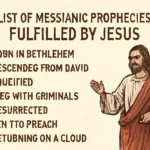
Birth and lineage: Prophecies about the Messiah’s origin, such as being born in Bethlehem or belonging to the lineage of David. Examples connected in the Gospels include Matthew 2:1 (birth in Bethlehem) and Luke 1–2 (ancestry and divine preparation).
Place of birth and childhood experiences: Specific locations described in prophetic texts and fulfilled in Jesus’s life, such as Bethlehem as the birthplace (Micah 5:2; Matthew 2:4–6).
Virgin birth and divine origin: The sign of a virgin conceiving (Isaiah 7:14) which is cited in Matthew 1:23 as fulfilled in Jesus’s birth.
Suffering and atonement: Passages that describe a suffering servant or the redemptive bearing of sins. Isaiah 53 is frequently cited here, along with Psalm 22 and other psalms that commentators connect to the passion narratives (e.g., Jesus’s cry of dereliction in Matthew 27:46 and Mark 15:34).
Crucifixion-related details: Elements such as pierced hands and feet, casting lots for garments, or the timing of crucifixion-like events. Some of these are read in the light of Psalm 22 or Psalm 69, and are related to Gospel accounts of Jesus’s crucifixion.
Resurrection and vindication: Texts that imply or predict a resurrection or a divine vindication, as interpreted in Acts 2:25–32 (Peter’s sermon about Psalm 16:8–11) and other New Testament uses of the Psalms.
Raising up a representative figure: Images of a messianic figure who represents God’s people, who leads, judges, and saves, often read through prophetic literature like Isaiah and Micah in light of Jesus’s ministry and claims.
Examples of core prophecies and their New Testament fulfillments
To illustrate how the connections are made, here are representative examples that are frequently discussed in both scholarly and devotional contexts. The purpose here is descriptive and educational, not to exhaustively prove or to settle every interpretive question.
Birth and origin
Micah 5:2 — The Messiah would be born in Bethlehem. Fulfilled in Matthew 2:1 and Luke 2:4–7, where Jesus’s birth occurs in Bethlehem and is tied to his Davidic heritage.
Isaiah 7:14 — The sign of a virgin conceiving a child. Cited in Matthew 1:23 as fulfilled in Jesus’s virgin birth.
Suffering and atonement
Isaiah 53 — The Servant bears the sins of many and suffers on behalf of others. The Gospel accounts describe Jesus’s suffering and death in ways readers often say align with the suffering described in Isaiah 53.
Psalm 22 — A cry of abandonment and experiences during crucifixion, including elements such as the words “My God, my God, why have you forsaken me?” (Psalm 22:1). Jesus’s crucifixion narrative in the Gospels is seen by many readers as echoing or fulfilling these lines (e.g., Matthew 27:46; Mark 15:34).
Resurrection and life after death
Psalm 16:10 — “You will not abandon me to the realm of the dead, nor will you let your faithful one see decay.” Peter cites this psalm in Acts 2:25–31 as evidence of Jesus’s resurrection and vindication by God.
Multiple psalm-based patterns — The New Testament occasionally uses psalms to interpret Jesus’s resurrection and exaltation, situating his experience within a broader scriptural framework that readers recognize as fulfillment.
Out of Egypt motif and mission patterns
Hosea 11:1 — “Out of Egypt I called my son.” Matthew 2:14–15 presents the flight to Egypt and the return as a fulfillment of this text, interpreted in light of Jesus’s early life.
How to interpret the claims: critical perspectives
Scholars approach the topic from different angles. Here are some common perspectives that influence how people read the question of fulfillment:
Historico-critical approach: Emphasizes historical context, literary forms, and the possibility of later authors shaping interpretation. Critics may ask whether an Old Testament text was intended as a prophecy about Jesus or whether the gospel authors read Jesus into texts through a post hoc interpretive lens.
Canonical hermeneutics: Views the Bible as a unified story in which the life of Jesus is read as the climax or culmination of the biblical narrative. Fulfillment language is part of the theological claims about the canonical order rather than a straightforward predictive forecast.
Prophecy-and-fulfillment theory: In traditional Christian scholarship, the New Testament writers present Jesus’s life as a fulfillment of God’s promises and of the prophetic witness across the Hebrew Scriptures. Proponents stress internal coherence and the intention of the divine author.
Prophecy as pattern: Some readers stress typology and pattern rather than a simple cause-and-effect fulfillment. Jesus is seen as the fulfillment of a pattern of salvation history rather than a cataloged set of independent predictions.
Limitations and cautions: Critics warn against conflating metaphor, typology, and predictive prophecy. They caution against reading modern expectations into ancient texts and remind readers that prophetic language often operates in multi-layered ways.
How to evaluate claims responsibly: a practical guide
Given the variety of counts and interpretive approaches, readers can adopt a careful, evidence-based stance. Here are practical steps for evaluating claims about fulfilled prophecies:
Clarify definitions: Ask which prophecies are included, whether a prophecy is considered explicit or typological, and what counts as fulfillment in the New Testament context.
Check sources: Look at where the list of prophecies comes from, whether from scholarly works, popular apologetics, or theological journals. Note any potential biases or methodological assumptions.
Distinguish prophecy from interpretation: Differentiate between a text that makes a concrete prediction and a later interpretation that reads the text as fulfilled in Jesus’s life.
Consider literary context: Explore how the New Testament writers cite or allude to the Old Testament, and how they frame fulfillment in light of Jesus’s activities and message.
Assess historical plausibility: Some prophecies describe events with precise timing and details; others are more general. Evaluate how precisely the text maps onto Jesus’s life in the Gospel narratives.
Be transparent about uncertainty: Acknowledge where the evidence is strong and where it is interpretive or debated. The goal is understanding, not simply proving a predetermined conclusion.
The educational value of studying fulfilled prophecies
Beyond the question of numbers, studying how Jesus is connected to Old Testament prophecies offers rich educational opportunities. It invites readers to explore:
The nature of biblical prophecy in ancient Near Eastern literature and how it was understood by its original audience.
The ways in which the New Testament authors use prophecy to present Jesus as the Messiah and the center of salvation history.
How theology and interpretation shape textual reading, as well as how different Christian traditions emphasize different aspects of these connections.
Variations in how readers frame the question: semantic breadth and depth
Because the phrase “how many prophecies did Jesus fulfill from the Old Testament?” can be understood in multiple ways, readers sometimes rephrase the question to capture different semantic breadths. Here are some variations you may encounter in discussions and literature:
How many explicit predictions? A count focusing on texts that directly predict events or conditions that appear in Jesus’s life, without reading typology.
How many fulfilled types? A count that includes typological foreshadowings—events or figures in the Old Testament interpreted as prefiguring Jesus.
How many key prophecies? A selective list of the most well-attested, specific, and widely recognized predictions linked to Jesus, often debated among scholars.
How many prophecies in the broader scriptural arc? A broader approach that includes thematic expectations (e.g., Davidic king, suffering servant, messianic deliverer) and examines how Jesus embodies or fulfills those themes.
Conclusion: embracing a thoughtful, balanced perspective
The question of how many prophecies did Jesus fulfill from the Old Testament does not yield a single, universally accepted number. Instead, it yields a spectrum of counts that reflect different definitions, interpretive traditions, and scholarly methods. What remains consistently important across approaches is the recognition that the New Testament authors view Jesus as intimately tied to the biblical narrative they inherited. They present his life, death, and resurrection as a culmination of God’s promises expressed across the Old Testament, understood within the framework of faith and interpretation.
For readers seeking a deeper understanding, a fruitful path is to study the individual prophecies, the New Testament passages that refer to them, and the historical-literary context in which these connections are made. This approach encourages careful reading, critical thinking, and a nuanced appreciation for how an ancient collection of texts continues to speak to readers today. Whether one emphasizes a large, comprehensive tally or a smaller, tightly defined set of explicit fulfillments, the broader takeaway remains clear: the life and mission of Jesus are commonly understood within the Christian tradition as deeply anchored in the Old Testament prophecy and promises, interpreted and celebrated in light of the events recounted in the New Testament.
As you continue your study, you might consider exploring:
How different Christian traditions name and prioritize the most significant prophecies.
How Jewish perspectives interpret the relevant texts in light of (or in opposition to) Christian claims of fulfillment.
How modern biblical scholarship approaches prophecy—what counts as a prophecy in the ancient world and how contemporary readers understand prophecy today.
In sum, the question “How many prophecies did Jesus fulfill from the Old Testament?” invites a careful, nuanced journey through biblical texts, interpretive history, and theological reflection. Whether you arrive at a broad estimate or a narrow catalog, the conversation illuminates how Scripture speaks across centuries about the figure of Jesus and his central role in the story of faith.









Leave a Reply