The Old Testament timeline is not a single, simple chronology but a tapestry of dates, eras, and centuries that scholars assemble from biblical narratives, archaeological findings, ancient Near Eastern records, and textual clues within the Hebrew Bible. This comprehensive guide presents a structured path through the major eras, highlighting the most significant events, approximate dates, and the shifting scholarly understandings that shape our sense of biblical chronology. From the creation of the world as narrated in primeval stories to the late exilic or early post-exilic period, the Old Testament timeline covers a span of many centuries and reflects a diversity of genres, from genealogies and covenants to laws, poems, and prophetic writings.
Methods for Reading the Timeline: How Modern Readers Approach the OT Chronology
Chronology in the Hebrew Bible (often called the Tanakh in Jewish tradition) blends narrative with religious memory, and ancient readers often understood time through covenants, generations, and periods rather than strict, linear dating. In modern scholarship, scholars use several tools to construct an Old Testament chronology:
Textual analysis: Reconstructing dates from internal clues (age of patriarchs at key events, reigns of kings, durations of kingdoms).
Archaeology and material culture to anchor or challenge biblical timelines (cities, fortifications, and artefacts).
Comparative Near Eastern chronologies: Noting overlaps with Egyptian, Assyrian, and Babylonian timelines.
Scholarly ranges: Recognizing that many dates are approximate and debated; there is no single universally accepted “definitive” timetable for early periods.
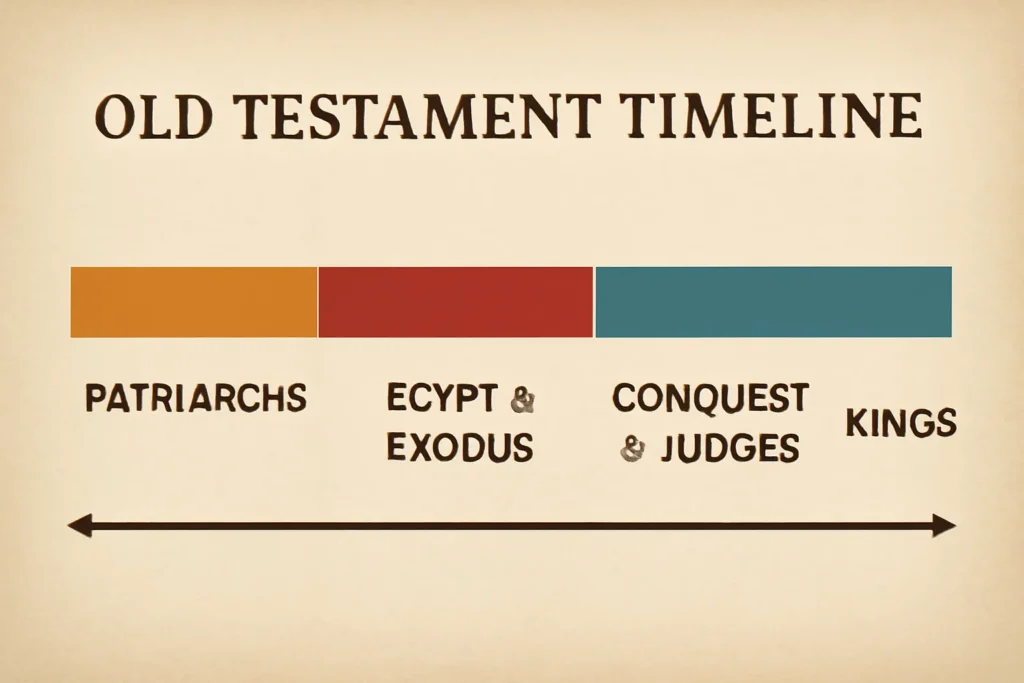
Literary structure: Understanding how the Bible itself organizes time—patriarchal histories, the exodus narrative, era of the Judges, united monarchy, divided kingdoms, exile, and return—as a framework that helps readers grasp long chronological arcs.
The Primeval and Patriarchal Narratives: Foundations before Israel as a Nation
Creation and Early World: Thematic Origins and Dating Considerations
In the opening books of the Bible, the creation narratives (Genesis 1–2) present a theological foundation rather than a tightly historical timeline. Traditional readings often place Creation in a prehistory that is not directly aligned with archaeological dates. When readers encounter figures such as Adam and Eve, Noah, and the Flood, they encounter a narrative frame that sets up later relationships, covenants, and moral themes rather than a precise, empirical chronology. Nevertheless, many modern timelines treat the Creation to Patriarchs period as spanning several millennia of mythic memory and ancient memory that eventually leads to the emergence of a people identified with Abraham, Isaac, and Jacob.
Important ideas to keep in view include:
Patriarchal era as a formative period: The stories of Abraham, Isaac, and Jacob function as the founding moments of an ancestral family that becomes a nation through covenantal promises.
Generational timekeeping: The biblical record often notes generations, ages at key events, and the transmission of blessings, which modern readers translate into broader historical periods.
Theological geography: The land and the people are defined by covenant promises rather than by a precise map alone, which colors how we date events tied to divine interaction.
Patriarchs: Abraham, Isaac, and Jacob
The patriarchal era typically spans several centuries and is dated by many scholars to roughly the middle to late 2nd millennium BCE. The following markers summarize the core arc:
Abraham: Often placed roughly in the 20th to 18th centuries BCE, depending on the dating approach. The call of Abraham and the formation of a covenant with God establish a lineage that becomes central to the rest of the biblical narrative.
Isaac and Jacob: The next generation in the family line continues to shape the covenantal promises and the formation of the twelve tribes of Israel through Jacob (who is renamed Israel).
Jacob’s family in Egypt: The later episodes describe Jacob’s sons migrating and the formation of a large family within Egypt, setting the stage for the exodus narrative years later.
Within this era, readers should note the recurrence of key themes: divine promises reasserted, interactions with neighboring cultures, and the development of a distinctive religious identity that centers on covenant faithfulness and trust in one God.
Egypt and the Exodus: Liberation, Law, and Wilderness Formation
Sojourn in Egypt
The narrative of the Israelites living in Egypt often serves as a transition from familial covenant to a national story. The dates proposed range broadly across scholarly work, but a common frame places the Israelites in Egypt for several centuries, culminating in a dramatic departure under divine guidance.
Population growth and oppression: The biblical text emphasizes a rising population and oppression under a regime that fears an uprising, setting the stage for a mass deliverance.
Haran to Egypt and the eventual enslavement provide a backdrop that explains dramatic deliverance as God’s saving act.
Recognition of a national identity through liberation and the establishment of a people who will receive a formal law and a homeland.
Exodus and Sinai: The Covenant and the Law
The exodus narrative and the Sinai revelation form a cornerstone of the Israelite identity in the OT timeline. Although dating is debated, many scholars place the exodus in the Late Bronze Age, with the Sinai event culminating in a formal covenant and the giving of the Law.
Exodus from Egypt: A defining act of divine intervention and national founding.
Sinai covenant: The reception of the Law, including the Ten Commandments and the broader Sinai instructions for worship and community life.
Wilderness formation: The years spent wandering in the wilderness as the new generation learns obedience and faithfulness.
From Conquest to Settlement: The Entry into the Land and the Era of Judges
Conquest and Settlement of Canaan
The entry into the land of Canaan marks a transition from wandering to settled life, though the biblical accounts differ in tone and detail. The historical dating for the conquest is hotly debated, with some proposing a rapid conquest, others a gradual settling, and some suggesting later literary shaping of the memory of conquest.
Conquest narratives: The accounts in books like Joshua describe military campaigns and the allocation of land among the tribes.
Settlement patterns: After the conquests, the tribes begin to inhabit different regions, with the tribal system gradually giving shape to a loose confederation.
Cultural memory: The period saw the integration of Canaanite and Israelite practices, sometimes leading to tensions that appear in prophetic critiques later on.
Judges: The Era of Local Leadership and Cycles of Faithfulness
Between the conquest and the establishment of a centralized monarchy, the Judges provide a model of leadership, crisis management, and repeated cycles of sin, oppression, repentance, and deliverance. This era emphasizes how fragile political unity can be and how charismatic leaders rise in response to urgent threats.
Localized leadership: Various judges rise to guide different tribes or regions in response to external threats or internal crises.
Cycle of apostasy and renewal: The pattern of turning away from God, facing oppression, and then being delivered by a judge who acts in response to prayer and repentance.
Preparation for a united monarchy: These years set the stage for a more centralized form of governance in later centuries.
The United Monarchy: Saul, David, and Solomon
Saul: The First King and the Search for Unity
The emergence of a centralized monarchy marks a turning point in the history of Israel. Saul, anointed by the prophet Samuel, becomes the first king who attempts to unify the tribes under a single rule.
Saul’s reign: Often dated to the late 11th or early 10th century BCE, depending on the chronology used.
Military campaigns: Saul fights external enemies and consolidates territory, though his reign experiences internal discord and divine disfavor in some biblical accounts.
David: Expansion, Covenant, and Administrative Reforms
David’s reign is central to the OT timeline because it anchors the idea of a dynastic covenant and the cultural flourishing of a national center in Jerusalem. His leadership expands the territory and consolidates national identity around a single throne and a shared religious center.
United monarchy: David unites the tribes after Saul and establishes a capital in Jerusalem.
Military and territorial expansion: The kingdom extends its influence, attaining a level of geopolitical prominence in the region.
Covenantal theology: The Davidic covenant, promising an enduring dynasty, becomes a theological and political touchstone for later generations.
Solomon’s reign is often viewed as the peak of the united kingdom and a time of architectural achievement, including the construction of the first temple. The era is characterized by relative prosperity as well as growing internal complexities that foreshadow future divisions.
Temple in Jerusalem: A central sanctuary that becomes a focal point of religious life for the nation.
Administrative sophistication: Solomon’s kingdom builds a robust bureaucracy, roads, and trade networks that connect with neighboring powers.
Divine judgment narratives: Biblical texts sometimes present a sense that wealth and power come with responsibilities and potential spiritual risks.
The Divided Kingdom: Israel in the North and Judah in the South
Split and Territorial Realities
After Solomon’s reign, the kingdom splits into the Northern Kingdom of Israel and the Southern Kingdom of Judah. This division becomes a defining feature of the OT timeline, shaping the political, religious, and prophetic landscape for centuries.
Isreal (the north) and Judah (the south) pursue separate kings, alliances, and religious reforms, often under pressure from powerful empires to the east and north.
Prophetic voices: The prophets arise in response to corruption, injustice, and idolatry perceived in the courts and among the people, offering calls to repentance and faithfulness to the covenant.
Assyrian and Babylonian pressures: External threats intensify as empires seek control over the Levant, accelerating the political fragility of both kingdoms.
Fall of the Northern Kingdom and the Southern Crisis
Two major turning points occur during this period: the fall of the Northern Kingdom to the Assyrians and the later fall of the Southern Kingdom to the Babylonians. These events mark the end of a long era of independent political sovereignty for almost all of Israel and Judah.
Fall of Israel (Northern Kingdom): Around 722 BCE, the capital Samaria falls to Assyria, leading to the dispersion of many Israelites and the emergence of the so-called “Lost Ten Tribes” in historical memory.
Destruction of Jerusalem and exile: In 586 BCE, Jerusalem is destroyed by Babylon, the temple is burned, and a significant portion of the population is exiled to Babylon.
Exile, Return, and the Persian Period
Babylonian Exile: Crisis and Covenant Memory
The exile represents a formative moment for Jewish identity, theology, and scripture. Exiled communities in Babylon preserve their distinct religious and cultural practices, which later inform the post-exilic period and the shaping of the Hebrew Bible.
Displacement and reflection: The destruction of Jerusalem and the temple reshapes religious life and expectations for a future restoration.
Prophetic reinterpretation: Prophets like Ezekiel and others respond to exile with visions of renewal, restoration, and a renewed covenant faithfulness.
Return under Cyrus: Rebuilding the Temple and the Community
The decree of Cyrus the Great (often dated to around 539–538 BCE) enables the return of a remnant to Jerusalem and the rebuilding of the temple. This marks the beginning of the Persian period in the OT timeline.
Decree of Cyrus: A pivotal moment that signals foreign policy openness and religious restoration for the returning exiles.
Temple reconstruction: The second temple is completed after a period of rebuilding efforts under leaders such as Zerubbabel and later Ezra.
Return to covenant life: Post-exilic communities reconstitute religious worship and social structures within a new political reality under Persian governance.
Ezra, Nehemiah, and the Reconstitution of Worship and Law
The post-exilic period features significant leadership that focuses on rebuilding the walls of Jerusalem, renewing the law, and reconstituting the community around the covenant. This era further develops the religious identity that will characterize much of the later Hebrew Bible.
Ezra’s reform: Emphasizes adherence to the Torah, the reorganization of religious practices, and the integration of the priestly leadership with the lay community.
Nehemiah’s leadership: Focuses on reconstructing the city walls, ensuring security, and reestablishing civic identity and religious practices.
Canon formation considerations: As the community returns and stabilizes, scribes and leaders begin to reflect on the authority and scope of the sacred writings that will later be recognized as part of the legal and prophetic corpus.
Post-Exilic Developments: The Formation of the Hebrew Bible and Long-Term Memory
Continuity and Reform: The Shaping of Sacred Texts
During and after the exile, the texts that would become the canonical sections of the Hebrew Bible accumulate, edit, and resonate with the experience of exile, return, and renewal. The OT timeline in this period includes not only historical dates but also the evolution of religious memory and doctrinal emphasis.
Prophetic voices in the late exile: Books like Haggai, Zechariah, and Malachi contribute to the shaping of a post-exilic religious consciousness and the expectation of future restoration.
Wisdom and psalter formation: The wisdom literature and the psalms reflect a community grappling with life under foreign rule, fidelity to covenant, and the hope of a renewed temple and sovereign rule.
Reclaiming land and covenant hopes: The memory of land, blessing, and the covenant continues to guide the community as it navigates Persian, then Hellenistic influences in later centuries.
Key Patterns in the Old Testament Timeline
Across the span from creation narratives to the post-exilic period, several enduring patterns emerge that help readers understand the OT chronology as a whole:
Covenant theology: Time is often measured in terms of covenantal moments—promises made, promises kept or renegotiated, and faithfulness or disobedience leading to consequences.
Faithfulness and failure: Repeated cycles of trust, rebellion, repentance, and restoration recur across generations, shaping the memory and prophetic critique.
Temple and worship: The center of worship shifts across periods—tabernacle, Solomonic temple, and the post-exilic temple—reflecting political changes and religious reforms.
Prophetic voices: Prophets address kings, judges, priests, and ordinary people, guiding ethical conduct and the call to righteousness in the light of covenant promises.
Common Chronological Debates and How to Understand Them
Because the biblical text does not always present precise, universally agreed-upon dates, several debates persist among scholars. Navigating these debates can help readers use the Old Testament timeline more effectively:
Dating the patriarchs: There is no consensus on exact dates for Abraham or Jacob; estimates range across several centuries depending on whether one emphasizes genealogical clues, external historical synchronisms, or literary composition.
Date of the Exodus: Some scholars place the exodus in the 15th century BCE, others in the 13th century BCE, and still others interpret it as a composite memory rather than a single historical event.
Conquest vs. Settlement: The degree to which the land was conquered by force versus gradually settled by Israelite groups is debated and may reflect different strands of tradition within the biblical text.
Dates of kings and empires: Reigning years of Saul, David, Solomon, and their successors are often cross-referenced with Assyrian and Babylonian chronologies, producing a range of possible dates for key events.
Practical Tips for Reading the Old Testament Timeline
When you read a biblical timeline, keep these practical strategies in mind to make sense of dates, events, and historical context:
Use ranges, not fixed dates: Accept that many dates are approximate and expressed as ranges (e.g., 1200–1000 BCE) rather than single numbers.
Differentiate main eras: Distinguish the major blocks—patriarchal era, exodus and wilderness, settlement and judges, united monarchy, divided monarchy, exile, return, and post-exilic period.
Recognize literary aims: Some chapters emphasize moral or theological lessons through narrative rather than aiming to record a precise historical chronology.
Cross-reference sources: Look for how biblical descriptions align—or contrast—with Egyptian, Mesopotamian, and other ancient records to obtain a fuller historical sense.
Appreciate the purpose of memory: The timeline often serves a purpose of remembering how God has acted in the life of the people, rather than simply documenting events in a strictly secular sense.
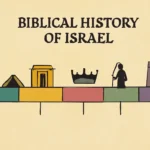
Creation narratives to Patriarchal period — symbolic beginning and the formation of a covenantal people.
Abraham’s call, covenant with God, and the birth of Isaac and Jacob — sources for the foundational tribes.
Jacob’s family in Egypt and the rise of the Israelite nation in Egypt.
Exodus from Egypt and Sinai covenant — core moments that establish law and worship.
Wilderness years and the formation of the priesthood and tabernacle system.
Conquest and settlement of Canaan and the era of the Judges.
United Monarchy under Saul, David, and Solomon.
Division into Israel and Judah and the prophetic critique that accompanies political decline.
Fall of Israel (Assyrian conquest, 722 BCE) and Fall of Judah (Babylonian exile, 586 BCE).
Babylonian exile and experiences of displacement, followed by the Cyrus decree allowing return.
Return to Jerusalem and temple rebuilding, with leadership by figures like Ezra and Nehemiah in the Persian period.
Post-exilic period and the gradual shaping of the Hebrew Bible as a sacred collection and memory bank for the people of Israel.
Readers seeking a comprehensive view of the old testament timeline will find that the most helpful approach blends careful attention to textual cues with an awareness of the broader historical context. While precise dates may vary across scholarly traditions, the core episodes—creation or origin stories, the patriarchs, the exodus, the wilderness experience, the conquest and settlement, the era of judges, the united monarchy, the divided kingdoms, the exile, and the post-exilic return—form a coherent arc. By recognizing the different ways these eras are dated, and by embracing the qualitative purposes behind biblical narratives, students can appreciate the depth and complexity of Old Testament chronology as a living guide to faith, history, and culture.
Glossary of Key Terms and Phrases
Old Testament timeline — the chronological framework used to trace events from creation narratives through the post-exilic period in the Hebrew Bible.
Biblical chronology — the study of the dating and order of events within the biblical text, often cross-referenced with archaeological data.
Patearchal era — the period of the patriarchs (Abraham, Isaac, and Jacob) and their families.
Exodus — the departure of the Israelites from Egypt and the start of their journey to the Promised Land.
Sinai covenant — the covenantal agreement established at Mount Sinai, including the giving of the Law.
United Monarchy — the period when Israel had a single king under Saul, David, and Solomon.
Divided Kingdoms — the era after Solomon when Israel split into Israel (north) and Judah (south).
Babylonian exile — the period when the elite were displaced to Babylon following the destruction of Jerusalem in 586 BCE.
Persian period — the era after exile when Persian rulers allowed the Jews to return to their land and rebuild the temple.
Ezra and Nehemiah — leaders associated with the post-exilic restoration and reform of religious life and the city of Jerusalem.







Leave a Reply