Jesus on the cross: Scripture passages and meaning
Jesus on the cross: Scripture passages and meaning
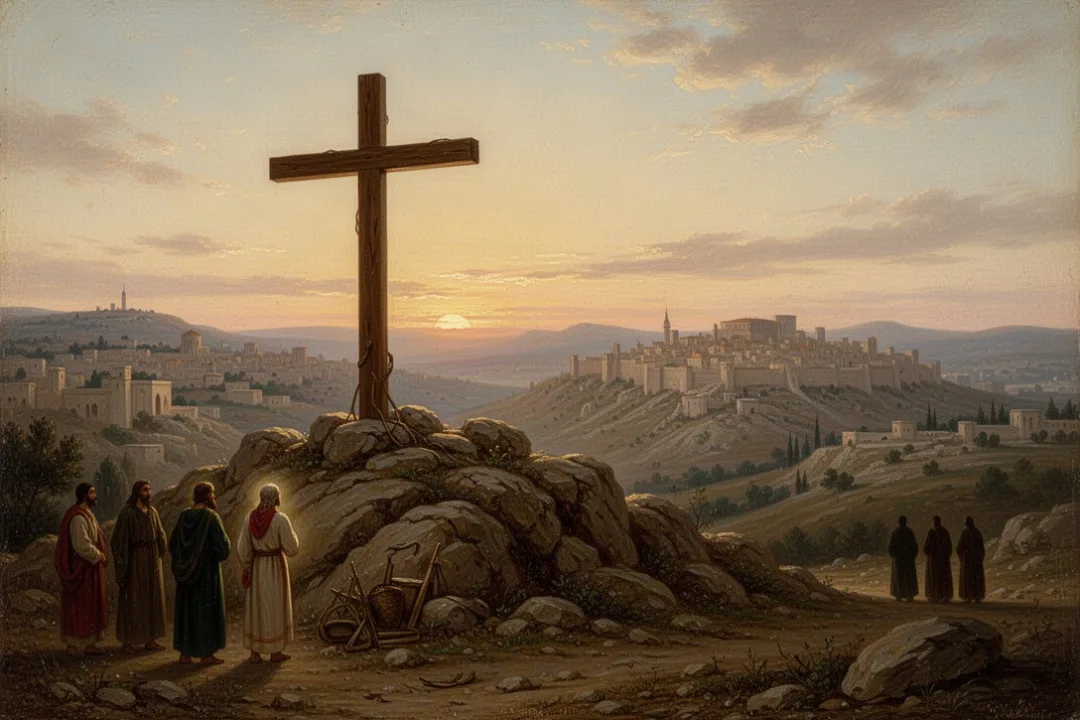
The clearest Scripture passages about Jesus on the cross are Matthew 27, Mark 15, Luke 23, and John 19. Together, these Gospel accounts describe his crucifixion, the words attributed to him, the people who watched, the darkness, his death, and the events that followed.
Other important passages interpret the cross as the means of atonement, reconciliation, and victory over sin. Romans 5, 1 Corinthians 1 and 15, Galatians 2, Colossians 2, 1 Peter 2, and Hebrews 9–10 help explain why Jesus’s death matters in Christian faith.
Each Gospel presents the crucifixion with a distinct emphasis. Reading them together gives you the fullest biblical picture, while reading one account slowly can show what its author wants you to notice.
Matthew 27 shows the suffering and royal identity of Jesus
Matthew 27:27–56 describes Jesus being mocked, beaten, and led to Golgotha. Roman soldiers place a robe on him, put a crown of thorns on his head, and mock him as a king. The sign above the cross identifies him as Jesus, the King of the Jews, even though the soldiers intend it as an accusation.
Matthew records darkness over the land from midday until the middle of the afternoon. When Jesus dies, the temple curtain is torn from top to bottom, an earthquake occurs, and tombs are opened. These signs connect his death with God’s judgment, the temple, and a new access to God.
Matthew also records Jesus crying out with words from Psalm 22. The reference does not mean that Jesus is merely reciting a psalm; it places his suffering within Israel’s Scriptures. Psalm 22 begins with abandonment and distress but moves toward trust and public praise, giving readers a biblical framework for understanding the cross.
Mark 15 emphasizes abandonment and the cost of the crucifixion
Mark 15 presents a stark account of the execution. Jesus is handed over to the soldiers, mocked by the crowd, and crucified between two others. Mark’s narrative gives particular weight to Jesus’s cry of abandonment before he dies, echoing Psalm 22.
Mark says the temple curtain is torn when Jesus dies. The event occurs without a long explanation, but its placement is significant: the barrier associated with the temple is removed at the moment of Jesus’s death. Many Christians understand this as a sign that Jesus’s sacrifice opens the way into God’s presence.
The Roman centurion watching Jesus says that he truly was God’s Son. In Mark, this recognition comes from a Gentile soldier at the cross, where Jesus appears weak and defeated. The scene challenges the assumption that power is always displayed through triumph; the Gospel presents Jesus’s identity through his faithful suffering and death.
Luke 23 highlights mercy, innocence, and hope
Luke 23 records several details that emphasize Jesus’s compassion. Jesus responds to those crucifying him with a prayer for forgiveness, though some early manuscript traditions differ over the placement or inclusion of that saying. Luke also records his assurance to one of the criminals beside him, promising that the man will share in paradise.
Luke repeatedly presents Jesus as innocent. Pilate finds no adequate basis for execution, one criminal recognizes that Jesus has done nothing wrong, and the centurion declares that Jesus was righteous. The contrast is deliberate: the one who suffers is not being punished for his own wrongdoing.
At the end of Luke 23, Jesus entrusts himself to the Father and dies. The centurion praises God, and the crowd leaves grieving. Joseph of Arimathea then places Jesus’s body in a tomb. Luke’s account connects the crucifixion with prayer, forgiveness, faithful trust, and the promise of life beyond death.
John 19 presents Jesus as the willing and victorious King
John 19 includes the trial, scourging, mockery, crucifixion, death, and burial. John gives special attention to the inscription identifying Jesus as King of the Jews, written in multiple languages. The authorities ask for a different wording, but Pilate refuses to change it.
In John’s account, Jesus remains composed and purposeful even during intense suffering. He entrusts his mother to the beloved disciple, receives sour wine, and declares that his work has been completed before giving up his spirit. These details support John’s presentation of the cross as a deliberate act of obedience, not an accidental defeat.
John also connects the crucifixion with Passover imagery. Jesus’s bones are not broken, and a soldier pierces his side after death. The Gospel says these details fulfill Scripture, linking the cross with the biblical themes of sacrifice, deliverance, and the Passover lamb.
Best starting point: Read John 19 for a focused account of the crucifixion, then compare it with Matthew 27, Mark 15, and Luke 23. The differences add perspective rather than requiring you to choose only one account.
What Jesus said from the cross in Scripture
Christian tradition commonly groups several sayings of Jesus from the cross, though no single Gospel records all of them. The wording and sequence vary among the accounts. It is better to treat the sayings as a combined picture from the four Gospels than to assume every Gospel intended to provide a complete list.
A prayer for forgiveness: Luke 23:34 presents Jesus asking the Father to forgive those responsible for his execution. Some ancient manuscripts do not include this sentence, but it remains part of the traditional reading of Luke.
A promise to the criminal: Luke 23:39–43 records Jesus assuring the repentant criminal beside him of welcome into paradise.
Care for his mother: John 19:25–27 describes Jesus entrusting his mother to the beloved disciple.
A cry of abandonment: Matthew 27:46 and Mark 15:34 preserve Jesus’s anguished appeal using the opening words of Psalm 22.
A statement of thirst: John 19:28 records Jesus acknowledging his physical thirst and connecting the moment with Scripture.
Completion: John 19:30 presents Jesus declaring that his assigned work has reached its goal.
Trust in the Father: Luke 23:46 describes Jesus committing his spirit to the Father before dying.
These sayings show several dimensions of the crucifixion at once. Jesus experiences real physical pain and emotional anguish, yet he continues to show mercy, responsibility, trust, and obedience. The cross is not portrayed as detached from human suffering; it is where Jesus enters suffering fully while remaining oriented toward God and others.
Why Psalm 22 matters when reading the cross
Matthew 27:46 and Mark 15:34 refer to Psalm 22, a passage that begins with a cry of abandonment. The reference gives voice to Jesus’s anguish and also points readers toward the whole psalm, not just its opening line.
Psalm 22 describes ridicule, physical distress, hostile observers, and the feeling that God is far away. It later turns toward confidence that God hears and toward worship among the nations. The Gospel writers use this scriptural connection to show both the depth of Jesus’s suffering and the larger purpose Christians see in it.
Reading the cross through Psalm 22 does not remove the darkness from the scene. Instead, it gives the darkness a place within the biblical story of honest lament, persistent faith, and eventual vindication. You can read Psalm 22 alongside Matthew 27 or Mark 15 to see these connections more clearly.
Old Testament passages connected with Jesus on the cross
The New Testament writers interpret Jesus’s death through Israel’s Scriptures. They do not present the crucifixion as an isolated tragedy. Instead, they connect it with patterns of sacrifice, innocent suffering, covenant, kingship, and deliverance.
Isaiah 52:13–53:12 and the suffering servant
Isaiah 53 describes a servant who is rejected, suffers, bears the consequences of others’ wrongdoing, and is later vindicated by God. The passage does not use the New Testament name Jesus, but Christians have long read it as a major prophetic framework for understanding his death.
Acts 8:26–35 shows an early Christian explanation of Isaiah 53 in relation to Jesus. First Peter 2:21–25 also draws on the passage when describing Jesus’s suffering and his faithful response to injustice. These texts emphasize that Jesus suffers innocently and that his wounds are understood as bringing healing and restoration.
Psalm 22 and the suffering righteous person
Psalm 22 is one of the most direct scriptural connections to the crucifixion because Jesus’s cry from the cross echoes its opening. The psalm describes a righteous sufferer surrounded by mockers and apparently abandoned, yet it ultimately moves toward confidence in God’s deliverance.
The Gospel accounts use this psalm to help readers recognize the crucifixion as both genuine agony and part of a larger biblical pattern. The psalm also prevents a shallow reading of the cross: faith does not require pretending that suffering feels easy or that abandonment is merely an illusion.
Passover and sacrifice in Exodus and the Gospels
Exodus 12 describes the Passover, when Israel remembers deliverance from slavery through a sacrificial meal and the protection of God. John’s Gospel places Jesus’s death in a Passover setting and includes details that connect him with the Passover lamb.
Paul calls Christ the Passover sacrifice in 1 Corinthians 5:7. This does not mean every New Testament writer explains the cross in exactly the same terms, but it shows how early Christians understood Jesus’s death as connected with deliverance from sin and bondage.
Psalm 69 and the rejected righteous sufferer
Psalm 69 is another lament associated with rejection, reproach, and suffering. John 2:17, John 19:28–29, and other New Testament passages draw on language or themes from this psalm. The Gospel writers use Israel’s songs of lament to interpret Jesus’s experience rather than treating his suffering as beyond the reach of Scripture.
What the New Testament says the cross accomplished
The cross is explained in several complementary ways across the New Testament. No single image exhausts its meaning. The writers speak of forgiveness, sacrifice, reconciliation, victory, redemption, covenant, example, and the revelation of God’s love.
Forgiveness and reconciliation with God
Romans 5:6–11 says that Christ died for the ungodly and describes the result as reconciliation with God. Second Corinthians 5:18–21 also presents God as reconciling people to himself through Christ. These passages focus on a restored relationship rather than only a legal transaction.
Ephesians 1:7 connects redemption and forgiveness with Christ. Colossians 1:19–22 speaks of peace and reconciliation through his death. In this language, the cross addresses the separation caused by sin and brings people into renewed fellowship with God.
Jesus’s death as a sacrifice for sin
Romans 3:21–26 describes God’s righteousness being revealed through Jesus and connects his death with atonement. Hebrews 9–10 compares Jesus’s offering with the repeated sacrifices of the old covenant and argues that his self-offering is decisive and sufficient.
First Peter 1:18–19 uses the image of a valuable lamb without defect to describe redemption. These passages do not suggest that Jesus’s death was meaningless violence. They present it as a self-giving offering through which God deals with sin and makes cleansing and access possible.
The cross as victory over hostile powers
Colossians 2:13–15 describes God forgiving sins and disarming hostile powers through the cross. The exact interpretation of the imagery is debated, but the central message is clear: the cross is not only an apparent defeat. Through it, God exposes and overcomes the forces that hold people captive.
First Corinthians 1:18–25 contrasts human expectations of power and wisdom with the message of the cross. To many observers, crucifixion looked like weakness and failure. Paul argues that God’s wisdom is revealed precisely through this event, overturning ordinary measures of status and strength.
The cross as the supreme expression of love
John 3:16 connects God’s giving of his Son with divine love for the world. Romans 5:8 says God demonstrates love through Christ’s death for sinners. First John 4:9–10 also describes God’s love as sending the Son to deal with sin.
These passages do not reduce the cross to a general example of kindness. They present love as costly, purposeful, and directed toward people who cannot claim that they have earned it. The cross reveals God’s character and God’s action together.
The cross as a pattern for Christian discipleship
Jesus speaks about taking up the cross before his own crucifixion in passages such as Mark 8:34–38. In that setting, the cross represents self-denial, loyalty, and willingness to follow Jesus even when discipleship is costly. It does not mean seeking suffering for its own sake.
Philippians 2:5–11 describes Jesus humbling himself and becoming obedient to death on a cross before speaking of his exaltation. First Peter 2:18–25 points to Jesus’s response to unjust suffering as an example for believers. These texts call Christians to faithful love and endurance, not to tolerate abuse or excuse wrongdoing.
Keep the meanings together: The cross is not only a symbol of suffering, and it is not only a formula for forgiveness. Scripture presents it as the place where Jesus suffers, obeys, gives himself, reveals God’s love, defeats evil, and brings reconciliation.
Practical ways to study the Jesus on cross scripture passages
A careful reading benefits from comparing accounts and asking what each passage actually says. The Gospels are short enough to read in one sitting, but their details become clearer when you slow down and observe the setting, speakers, repeated themes, and references to earlier Scripture.
Read one complete Gospel account first. Start with John 18–19, Luke 22–23, Mark 14–15, or Matthew 26–27 rather than collecting isolated verses.
Write down who speaks. Note the words of Jesus, Pilate, the soldiers, the criminals, the centurion, the crowd, and the women who remain nearby.
Mark physical and emotional details. Observe the scourging, mockery, thirst, darkness, fear, grief, abandonment, and care shown in the scene.
Check the Old Testament references. Read Psalm 22, Psalm 69, Isaiah 52–53, and Exodus 12 beside the Gospel passage.
Ask what the author emphasizes. Luke highlights innocence and mercy; John stresses fulfillment and purposeful completion; Matthew and Mark emphasize suffering and abandonment in distinctive ways.
Read an interpretation passage afterward. Compare the Gospel with Romans 5, 1 Corinthians 1, Galatians 2, Colossians 1–2, Hebrews 9–10, or 1 Peter 2.
Separate observation from application. First identify what the text says about Jesus. Then consider what it means for forgiveness, worship, hope, and discipleship.
Common mistakes when reading crucifixion passages
Using only one Gospel: One account may omit a saying or event included elsewhere. Comparing all four prevents an incomplete picture.
Combining every detail without checking the source: A statement found in Luke should not automatically be attributed to John. Keep track of each Gospel’s wording and emphasis.
Quoting one verse without its setting: Jesus’s cry from Psalm 22 should be read with the full psalm and the surrounding crucifixion narrative.
Assuming the cross was accidental: The Gospels include political pressure and human wrongdoing, but they also present Jesus as knowingly accepting his mission.
Reducing the cross to physical pain: The texts include bodily suffering, but they also address sin, covenant, judgment, mercy, kingship, prayer, and reconciliation.
Using “carrying your cross” to justify abuse: Christian discipleship involves faithful obedience and sacrificial love; it does not require remaining in danger or accepting another person’s violence.
How to pray and reflect on Jesus on the cross
The crucifixion passages can be read devotionally without ignoring their historical and literary details. Begin with a short section, such as Luke 23:32–49 or John 19:16–37, and sit with the actions and words in the passage before moving quickly to personal application.
You might reflect on the different people at the cross. The soldiers treat Jesus as an object of punishment, the religious leaders mock him, the criminals respond differently, the women remain present, and the centurion begins to recognize who Jesus is. Their reactions invite questions about faith, fear, power, guilt, and compassion.
You can also pray through Jesus’s sayings. Consider what his prayer for forgiveness reveals about mercy, what his promise to the repentant criminal shows about grace, what his care for his mother reveals about responsibility, and what his final trust in the Father teaches about faithful surrender.
Reflection should not turn the cross into a vague symbol detached from Jesus. The central Christian claim is that Jesus himself was crucified—a real person who suffered, died, and was buried—and that God raised him from the dead, as the resurrection accounts proclaim in Matthew 28, Mark 16, Luke 24, and John 20.
Related Bible passages to read with the crucifixion
Several sections make especially useful companions to the Gospel narratives. Reading them in groups can help you connect the event itself with its theological meaning and its place in the wider biblical story.
Jesus’s predictions: Matthew 16:21, Mark 8:31, Luke 9:22, and John 12:23–33.
The Last Supper and the new covenant: Matthew 26:26–30, Mark 14:22–26, Luke 22:14–20, and 1 Corinthians 11:23–26.
Salvation and reconciliation: Romans 3:21–26, Romans 5:6–11, 2 Corinthians 5:14–21, and Colossians 1:15–23.
Christ’s humility and obedience: Philippians 2:5–11 and Hebrews 5:7–9.
The suffering servant and faithful endurance: Isaiah 52:13–53:12 and 1 Peter 2:18–25.
The cross and Christian freedom: Galatians 2:15–21, Galatians 6:12–15, and Colossians 2:6–15.
The once-for-all offering: Hebrews 9:11–28 and Hebrews 10:1–18.
The risen Christ: Matthew 28, Mark 16, Luke 24, John 20, and 1 Corinthians 15:1–28.
Read the crucifixion and resurrection together. The New Testament does not treat Jesus’s death as the end of his story. The cross is central, but it is proclaimed alongside resurrection, exaltation, forgiveness, and the hope of new life.
Frequently asked questions
Which Bible verse best describes Jesus dying on the cross?
No single verse gives the full account. John 19:16–37 is a detailed passage focused on the crucifixion, while Luke 23:32–49 includes Jesus’s interactions with the criminals and his final prayer. For the main narrative, read Matthew 27, Mark 15, Luke 23, and John 19 together.
Where are the seven sayings of Jesus on the cross found?
The traditional seven sayings are compiled from all four Gospels, not found together in one chapter. Matthew and Mark record the cry of abandonment; Luke records forgiveness, paradise, and Jesus’s final prayer; John records care for his mother, thirst, and completion. Some wording and manuscript details vary.
What does the cross symbolize in Christianity?
The cross represents Jesus’s crucifixion and is associated with forgiveness, reconciliation with God, sacrificial love, victory over sin and death, and faithful obedience. Christians interpret its meaning through the resurrection as well, so the cross is a sign of suffering that leads to God’s saving action and hope.
Why do Christians read Old Testament passages alongside the crucifixion?
The Gospel writers and later New Testament authors interpret Jesus’s death through Israel’s Scriptures. Psalms 22 and 69 express the suffering of a righteous person, Isaiah 53 describes a suffering servant, and Exodus 12 provides Passover imagery. These passages help explain how early Christians understood the cross.







Leave a Reply