Matthew 22 explained: Jesus on love, loyalty, and resurrection
Matthew 22 explained: Jesus on love, loyalty, and resurrection
Have you ever wondered how to respond when a question sounds simple but is designed to trap you? Matthew 22 presents several moments like that. Religious leaders challenge Jesus publicly, asking about a royal banquet, taxes, resurrection, and the greatest commandment. His answers expose shallow religion while pointing toward faithful love, moral responsibility, and trust in God’s power.
The chapter belongs to the final period of Jesus’ public ministry in Jerusalem. The tension is rising, and Jesus speaks with unusual directness. Matthew 22 is not a collection of unrelated sayings; its scenes repeatedly ask who recognizes God’s authority and how that recognition should shape a person’s life.
Central idea: Matthew 22 challenges you to receive God’s invitation with a changed life, serve faithfully in the world, and place love for God and other people at the center of obedience.
Matthew 22 in its setting near the end of Jesus’ ministry
Matthew places this chapter after Jesus enters Jerusalem and after growing conflict with the city’s religious authorities. The preceding chapters describe disputes over authority and the meaning of faithful leadership. Matthew 22 continues those confrontations, but the subject changes from one challenge to another while the underlying issue remains the same: Who truly understands God’s purposes?
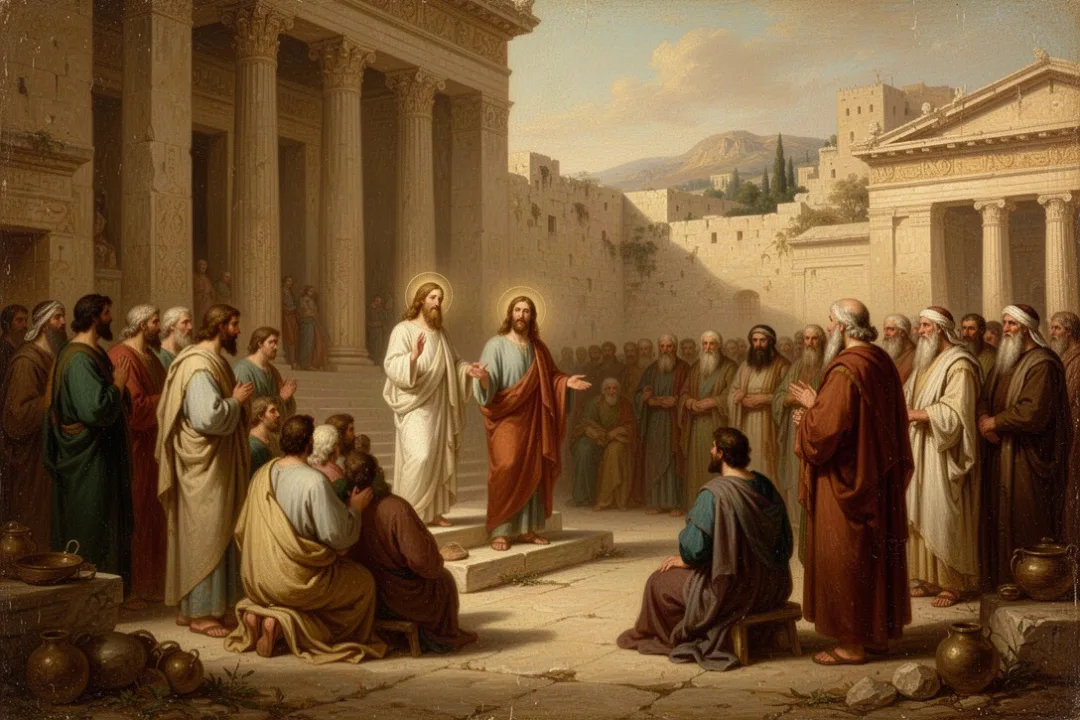
Jesus teaches in the temple area, a public setting where his words can be heard by crowds and scrutinized by opponents. The Pharisees, Herodians, and Sadducees do not all agree with one another, yet several groups approach Jesus with questions intended to discredit him. Their questions concern both religious interpretation and political danger.
The chapter’s arrangement creates a progression. The wedding banquet shows that receiving an invitation is not the same as honoring it. The question about taxes tests Jesus’ relationship to Roman authority. The Sadducees’ question tests his understanding of resurrection. The question about the greatest commandment moves to the heart of faithful living, and the final exchange asks how the Messiah can be both David’s descendant and David’s Lord.
What the wedding banquet means in Matthew 22:1-14
Jesus begins with a parable about a king who prepares a wedding feast for his son. The king sends servants to summon the invited guests, but they refuse to come. A second invitation gives more details about the prepared meal, yet the guests still ignore it. Some become violent toward the messengers.
The first group’s response is striking because the invitation is generous and the event is ready. Some guests treat it as an inconvenience, returning to ordinary business and property concerns. Others respond with hostility. The story portrays rejection not as a lack of information but as a refusal to recognize the king’s authority and the significance of the occasion.
The king then sends servants to invite people from the roads, including those who had not belonged to the original circle of guests. The banquet hall fills with people described as both good and bad. This turn emphasizes the wide reach of the invitation. Participation is no longer limited to those who assumed they had a privileged place.
Jesus then adds a difficult scene. The king notices a guest who is not wearing suitable wedding clothing. When the guest cannot explain his presence, he is removed from the celebration. The parable ends with a statement contrasting many who are invited with fewer who are chosen.
Why the wedding garment matters
Readers often ask why an improperly dressed guest is blamed when people were gathered from the roads with little warning. The story’s force does not depend on a detailed explanation of local clothing customs. The garment represents the guest’s failure to respond appropriately to the king’s invitation. Being present is not enough; the guest must honor the occasion.
Matthew’s version holds together two truths that should not be separated. God’s invitation is expansive, reaching people outside the expected circle. At the same time, accepting the invitation involves repentance, loyalty, and a transformed way of life. Grace is not presented as permission to remain indifferent to the king.
The parable should not be used as a simplistic claim that one ethnic or religious group was rejected while another group automatically replaced it. Matthew is addressing a conflict over responses to Jesus and God’s kingdom. The story warns every hearer, including religious insiders, against assuming that familiarity, status, or association guarantees faithful participation.
Reading tip: Keep both parts of the parable in view: the invitation reaches beyond expected boundaries, and those who accept it are expected to live in a way that reflects the invitation.
What Jesus teaches about taxes in Matthew 22:15-22
After the banquet parable, Pharisees and Herodians join forces to question Jesus about paying the imperial tax. This is a carefully chosen trap. If Jesus rejects the tax, he could be reported as a political agitator. If he openly supports it, opponents could portray him as compromising religious loyalty to God.
The question concerns a tax connected with Roman rule, making it both a financial and symbolic issue. The coin itself carries the emperor’s image and inscription. For some Jews, using such a coin could raise concerns about idolatry, foreign domination, and the emperor’s claims. The question is therefore more complicated than asking whether taxes are generally acceptable.
Jesus asks to see the coin and identifies the emperor’s image on it. He then gives an answer that distinguishes civil obligation from ultimate allegiance to God. His response does not reduce faith to political rebellion, but it also does not place the state above God. Anything owed to human authority may be given, while what belongs to God must be given to God.
How to apply the tax question without oversimplifying it
This passage is often quoted as though Jesus were offering a complete theory of government. He is not giving a detailed political constitution. He is answering a hostile question in a way that refuses the false choice between careless rebellion and total submission to imperial power.
The emperor may claim a coin, but human beings bear the image of God. That broader biblical idea helps explain why the answer reaches beyond money. Public responsibilities matter, but God’s claim on your life is deeper and more comprehensive than any government’s claim.
Paying taxes does not make political authority morally absolute.
Respecting civil order does not excuse injustice, corruption, or cruelty.
Religious commitment does not automatically require political revolt.
God’s authority remains the highest standard for judging every human institution.
Matthew 22 therefore encourages careful discernment. A Christian may participate responsibly in civic life while still evaluating laws, leaders, and public policies by moral principles. The passage does not give permission for governments to demand whatever they want, nor does it encourage treating every civic duty as an enemy of faith.
How Matthew 22 answers the Sadducees about resurrection
The Sadducees approach Jesus next with a question about resurrection. They did not accept the resurrection belief held by other Jewish groups, and they construct a hypothetical case based on a family law concerning a widow and her husband’s brother. In their scenario, one woman is successively married to seven brothers who die without producing children. They ask whose wife she will be after the resurrection.
The question is meant to make resurrection sound absurd. It assumes that life after resurrection must simply reproduce earthly arrangements. Jesus identifies two errors: the questioners misunderstand both the Scriptures and God’s power.
Jesus explains that resurrected life is not merely a continuation of present social structures. Marriage as known in this age does not define the age to come in the same way. He compares resurrected people to angels in heaven, not to suggest that humans become angels, but to indicate a radically different order of existence.
He then turns to the Torah, using the passage about God as the God of Abraham, Isaac, and Jacob. Jesus’ argument rests on God’s continuing relationship with these patriarchs. God is not associated with the dead as though they have been erased; he is the God of the living.
What this says about life after death
Matthew 22 does not answer every question about heaven or resurrection. It does not describe the daily activities of resurrected people, provide a timeline for end-time events, or settle every debate about the state of the dead. Its emphasis is that resurrection depends on God’s faithfulness and power, not on our ability to imagine the mechanics.
The passage also warns against using a clever hypothetical to avoid the central truth. The Sadducees’ scenario treats the future as a puzzle built from present categories. Jesus redirects attention to God’s ability to bring about a form of life that exceeds those categories.
For readers facing grief, this teaching offers hope without pretending that loss is easy. Christian resurrection hope is not the claim that nothing changes. It is the claim that God can preserve and renew life beyond the limits that now appear final.
Why loving God and your neighbor is the greatest commandment
A Pharisee who is described as a legal expert asks Jesus which commandment is greatest. The question may have been a serious attempt to test his interpretation, or it may have continued the public examination by religious leaders. Jesus answers by joining two commands from Israel’s Scriptures.
The first command calls for wholehearted love of God with one’s heart, soul, and mind. The language points to the whole person: affections, will, understanding, and devotion. Love of God is not limited to private feeling or religious identity. It involves the direction of your entire life.
The second command requires love for your neighbor as for yourself. Jesus says that all the Law and the Prophets depend on these two commands. He does not treat love as a vague substitute for obedience. Instead, love provides the organizing center for understanding what obedience is meant to accomplish.
How the two commands belong together
Matthew 22 does not present love for God and love for neighbor as competing priorities. Love for God gives the first command its focus, while love for neighbor shows how devotion becomes visible. A person who claims deep devotion to God but consistently harms, exploits, or despises other people has not fulfilled the pattern Jesus describes.
Likewise, neighbor-love is more than general kindness. It includes fairness, compassion, truthfulness, protection of the vulnerable, and a willingness to seek another person’s good. It may require boundaries and difficult correction rather than constant agreement or emotional closeness.
The phrase “as yourself” assumes that a proper concern for your own life is not automatically wrong. Jesus uses ordinary self-regard as a measure: the care, dignity, patience, and protection you naturally want for yourself should shape how you treat others.
Love God through worship, trust, gratitude, obedience, and a teachable mind.
Love your neighbor through practical care, honesty, patience, justice, and mercy.
Test religious behavior by asking whether it produces faithful love rather than pride.
Refuse false divisions between spiritual devotion and everyday treatment of people.
This teaching also clarifies why the earlier scenes matter. The banquet guests fail to honor the king’s invitation. The tax question raises the issue of divided loyalty. The Sadducees limit God’s power to their own assumptions. The greatest commandment gives a positive center: faithful life is ordered toward God and expressed through love.
What Jesus means by “David’s son” in Matthew 22:41-46
Jesus now asks the Pharisees a question about the Messiah. They answer that the Messiah is David’s son, meaning a promised ruler descended from King David. This expectation is grounded in Israel’s hope for a royal deliverer connected with David’s line.
Jesus then refers to a psalm in which David speaks of a figure whom he calls “Lord.” Because the psalm presents David addressing a descendant or successor with a title of superior authority, Jesus asks how the Messiah can be David’s son if David also calls him Lord. The opponents cannot answer, and Matthew says that no one continues questioning him.
The point is not that the Messiah cannot be David’s descendant. Matthew has already presented Jesus as connected with David’s family line. Instead, Jesus challenges a narrow expectation that reduces the Messiah to a merely political heir. The Messiah is greater than a conventional royal successor.
This final exchange has a christological purpose: it presents Jesus as both connected to Israel’s promises and possessing authority that exceeds ordinary human categories. Matthew is not asking readers to solve a grammar puzzle. He is showing that Jesus cannot be understood adequately if he is treated only as a teacher, reformer, or claimant to David’s throne.
Practical ways to read Matthew 22 without missing its message
Several misunderstandings can make the chapter seem harsher or more fragmented than it is. Reading each scene in isolation may lead you to miss the repeated question of how people respond to divine authority.
Do not reduce the banquet to inclusion alone. The invitation is broad, but the garment shows that acceptance has ethical consequences.
Do not use the tax passage to endorse every government action. Jesus distinguishes civic responsibility from the higher authority owed to God.
Do not treat resurrection as a simple continuation of present life. Jesus points to transformed existence rather than merely restored circumstances.
Do not separate love of God from love of neighbor. Matthew 22 presents them as inseparable expressions of faithful obedience.
Do not reduce the Messiah to a political label. Jesus’ question about David’s Lord presses readers toward a larger understanding of his identity.
A useful way to study the chapter is to ask the same questions of each scene. Who is speaking? What assumption is being challenged? What kind of response does Jesus commend or expose? These questions help you see that the chapter is not simply a list of moral sayings.
You can also compare the audience’s reactions. Some people refuse the invitation, some attack the messengers, some marvel at Jesus’ answers, and some stop asking questions because they cannot answer him. Matthew shows that intellectual recognition alone is not the same as discipleship. A person may be impressed by Jesus and still resist his authority.
Questions Matthew 22 raises for everyday discipleship
The chapter asks whether your relationship with God is based on entitlement or response. The first guests assume that the king’s invitation can be ignored, while the later guest assumes that attendance requires no change. Both attitudes miss the seriousness of the invitation.
It also asks how you balance public duties with spiritual loyalty. You may have responsibilities to family, employers, communities, and government. Matthew 22 does not tell you to abandon those responsibilities, but it does require you to remember that none of them deserves the place that belongs to God.
The resurrection debate asks whether your picture of God has become too small. Human experience gives you useful categories, but it cannot set limits on what God can do. Hope depends not on having every detail mapped out, but on trusting the God who gives life.
Finally, the greatest commandment gives you a way to evaluate religious seriousness. Public knowledge, moral arguments, political opinions, and doctrinal confidence can all become distractions if they do not lead to love for God and neighbor. Matthew 22 directs attention back to humble allegiance expressed in concrete relationships.
Read as a whole, the chapter presents Jesus as the one who exposes shallow answers and redirects people toward the reality of God’s kingdom. The invitation is generous, the demands are serious, the future rests in God’s power, and the proper response is wholehearted love.
Frequently asked questions
Is Matthew 22 mainly about the end times?
No. Although the wedding banquet uses imagery associated with God’s future kingdom, the chapter addresses several present responsibilities as well. It asks how people respond to God’s invitation, how they handle civic obligations, whether they trust God’s power over death, and whether love shapes their obedience. Its future hope supports faithful living now rather than replacing it.
Does “render to Caesar” mean Christians should never challenge government?
No. Jesus recognizes a legitimate sphere of civic responsibility without making political authority absolute. The passage leaves room for moral evaluation, conscientious resistance, and concern for justice when authorities act wrongly. Its central boundary is that government must never receive the loyalty, worship, or obedience that belongs uniquely to God.
Who is the guest without a wedding garment?
The guest represents someone who responds outwardly to the invitation but does not honor what the invitation requires. The detail cautions against presuming that proximity to religious community equals genuine faithfulness. It should not be used to claim that people must earn God’s welcome; rather, it shows that receiving grace produces a fitting response.
How does Matthew 22 connect with the teaching to love enemies?
The greatest commandment gives the broad principle of love for neighbor, while other teachings of Jesus clarify how that love should operate, including toward enemies. Love does not mean approving wrongdoing or removing wise boundaries. It means seeking another person’s good, refusing personal vengeance, and treating people as accountable human beings made under God’s authority.




Leave a Reply