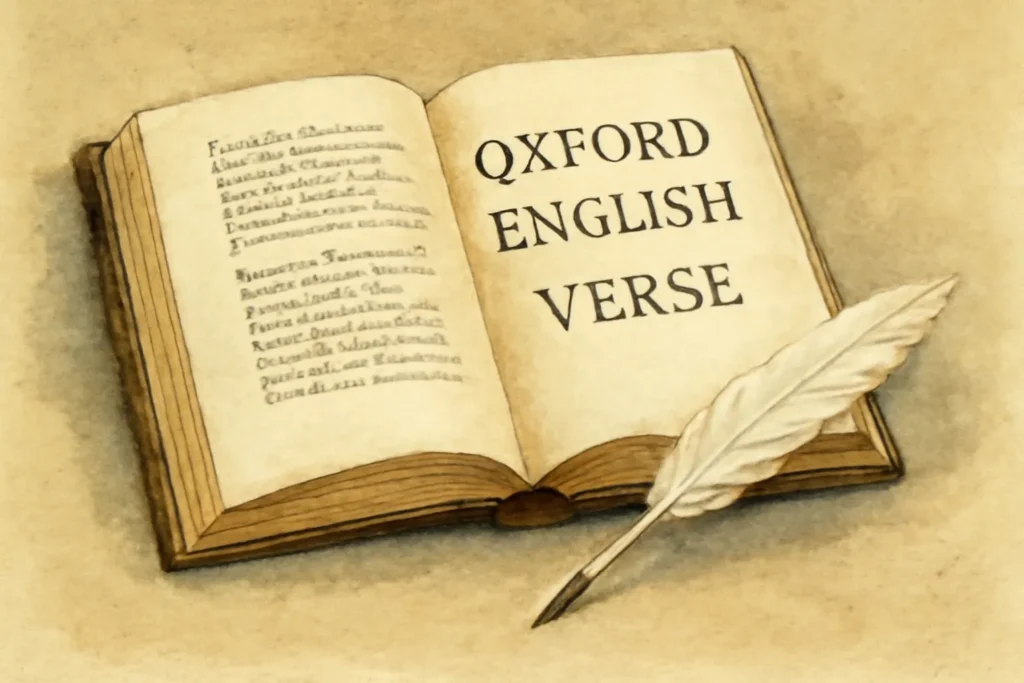
The phrase Oxford English Verse invites a broad conversation about poetry associated with Oxford scholars, teachers, editors, and readers across centuries. It is not a single
school or a single style, but a continuum of practice that has touched medieval manuscript culture,
the scholarly ecosystems of the university, the publishing houses connected to the
University of Oxford, and the classrooms where verse is read, argued over, annotated, and
celebrated. In this article, we survey the history of this evolving tradition, its
distinctive features, and a sample of key works that are often treated
as landmarks within the Oxford tradition of English verse.
History of Oxford English Verse
Medieval and early modern foundations
The roots of poetry in and around Oxford stretch back to the city’s role as a seat of
learning in the Middle Ages. While Oxford would become famous for colleges, scholars,
and manuscript culture, verse flourished as part of the broader culture of discipline, ritual, and
classical education. At its best, Oxford English Verse in this era combined
mnemonic power with formal craft: chant-like refrains, alliterative lines, and early uses of
rhyme that bring memory to the fore. In this sense, the early forms of the tradition set a tone for
later seriousness about literary craft, even when the subject matter ranged from devotion to social
satire.
18th and 19th centuries: the shaping of a canon in university culture
As the university’s colleges expanded their libraries and teaching became more specialized, Oxford
began to play a pivotal role in the formation of the English verse canon. The 18th and 19th centuries
witnessed a growth in textbooks, anthologies, and editions that treated English verse as a
serious field of study. The university press and associated editors helped stabilize a sense of
tradition—often privileging formal verse, classical allusion, and a certain moral or civic seriousness—
while also allowing for experimentation within bounded parameters.
The 20th century: modernism, pedagogy, and the rise of the Oxford editorial voice
The 20th century brought upheaval and renewal. In the wake of modernism, Oxford readers and
scholars engaged with new forms and new voices, while still anchoring their study in careful
textual editing, historical context, and a sustained attention to the language of poetry. University
curricula, seminars, and reading circles at Oxford colleges helped to disseminate both traditional
canons and newer experimental writings. The Oxford tradition thus became a venue for
close reading, critical debate, and cross-cultural comparison—an environment that valued both
inherited masterpieces and challenging innovations.
Contemporary directions
In recent decades, the Oxford milieu has continued to support a diverse array of voices,
from sharply formal verses to essays in verse, to performed poetry and digital editions. The role of
the Oxford University Press and other academic presses has kept the study of English
verse deeply connected to philology, commentary, and archival care, even as poets themselves cross
genres and pursue interdisciplinary projects. The modern Oxford English Verse scene is
thus characterized by interdisciplinary collaboration, digital scholarship, and an ongoing
conversation about how poetry of the past speaks to the present.
Features of Oxford English Verse
Form, meter, and craft
A central feature of Oxford English Verse is its respect for formal craft,
whether in traditional meters such as iambic pentameter or in refined rhymed couplets, sonnets, and
blank verse. The tradition often rewards precision of lineation, careful scansion, and a readiness
to harness classical forms for contemporary concerns. In many Oxford-influenced circles, the poem
is treated as an object of study—an arrangement of sound and sense that can be analyzed for its
meter, its rhythm, and its formal architecture. This is not to say that innovation is shut out;
rather, innovation tends to be discussed in relation to inherited forms, with the aim of testing how
new ideas can live within or push against tradition.
Oxford English Verse has often prized exactness of diction, learned allusion, and a lucid
syntax that invites intellectual engagement. Poets in this tradition may reference classical
authors, biblical texts, or historical events, inviting readers to join in a conversation across
time. The language can be deliberately precise, with a cultivated register that blends the everyday
with the elevated. Allusion is not mere ornament but a strategy for building resonance, echo, and
dialogue with earlier poets.
Ethics, religion, and social reflection
A recurring theme in many strands of Oxford English Verse is moral reflection:
questions of duty, faith, virtue, and social responsibility appear in ways that connect private lyric
insight to shared civic concerns. The religious and ethical orientation of some Oxford-linked verse
reflects the long association between the university and lifelong questions about meaning, conduct,
and public life. Yet the tradition is not monolithic: it accommodates skepticism, irony, and critique
of institutions as well as reverence for tradition.
Editors, editors, editors: the apparatus of the verse editor
An often underappreciated feature of the Oxford ecosystem is the culture of textual
editing. Scholarly editions, annotation, and apparatus criticize and annotate poems for readers who
want to know about manuscript variants, metrical choices, and historical context. In this sense,
the Oxford approach to verse is as much about scholarly engagement as it is about
the lines themselves. The editor’s voice—careful, patient, and historically aware—frequently shapes
how a poem is received by generations of readers and students.
Key Works and Figures Often Discussed in the Oxford Context
Beowulf: a translation and the medieval-modern bridge
One of the strongest anchors in any discussion of Oxford English Verse with a medieval
spine is J. R. R. Tolkien’s Beowulf translation and commentary. Tolkien’s
work as a professor and translator at Oxford helped bring a living, vibrant sense of
an ancient English verse tradition into modern classrooms and scholarly editions. The poem
Beowulf, in its original Old English, is a pinnacle of Germanic verse, with kennings and
alliteration that reward careful listening. Tolkien’s Beowulf translation—paired with his
scholarly notes—exemplifies how the Oxford environment sustains deep engagement
with form and meaning. The project demonstrates how a venerable verse tradition can converse with the
present through translation, commentary, and pedagogy.
Jabberwocky: wordplay in the English lyric tradition
Lewis Carroll’s Jabberwocky (from Through the Looking-Glass, 1871) is a classic specimen of the Oxford English Verse impulse to fuse playful invention with formal craft. Written by a
mathematician and logician who spent his academic life at Christ Church, Oxford, the
poem is famous for its portmanteau words and for the way nonsense coexists with recognizable
syntax. The poem’s famous opening, “’Twas brillig, and the slithy toves,” showcases how sound and
rhythm can carry meaning even when new words are introduced. It stands as an enduring example of how
formal technique can accommodate whimsy while still delivering a structured, memorable experience
for readers of all ages.
East Coker and The Waste Land: modernist milestones in Oxford classrooms
The modernist poets are prominent in many discussions of Oxford English Verse, not least
because their works are central in university courses and literary criticism. T. S. Eliot’s East Coker (the second of the Four Quartets, 1940) and The Waste Land (1922)
are frequently studied for their intricate allusions, their handling of time, memory, and cultural
crisis, and their mastery of many voices within a single poem. These works encourage readers to listen
for intertextual echoes—mythic, religious, literary—that resonate across centuries. In an Oxford
context, such modernist poems invite discussion about how verse can function as a map of modern
consciousness, while still being anchored in precise form and craft.
Representative modern and postwar voices connected to Oxford’s culture
Beyond these towering works, the Oxford environment nurtures writers who contribute to the living
conversation about verse. While not every writer is tied to Oxford in every respect, the
university’s departments, presses, and teaching culture frequently foreground poets who practice
formal technique with contemporary sensibility. Readers in Oxford often encounter a spectrum—from
lyric experimentation to classic forms reimagined for today’s audiences. This combination of
adherence to craft and willingness to test boundaries characterizes much of the Oxford
English Verse canon as it exists in modern literary education.
Representative forms and works commonly included in Oxford teaching and anthologies
Beowulf (translation and study) — J. R. R. Tolkien’s edition at Oxford, bridging ancient
verse with modern philology.
Jabberwocky — Lewis Carroll, a cornerstone in discussions of form, lexicon, and the playful
potential of English verse.
Selected Quartets and modernist poems (e.g., East Coker and The Waste Land) used to teach
intertextuality, allusion, and historical context within a formal framework.
Important canonical poems from the broader English canon that Oxford courses frequently reference when
tracing the evolution of form, metre, and diction across centuries.
How Oxford English Verse is taught and studied
Classroom practice and close reading
In the Oxford tradition, poetry is often taught through close reading, where students
examine how a poem’s sound-work—rhythm, alliteration, assonance—works in service of meaning.
Annotated editions and scholarly commentaries are common companions to the text, enabling readers to
trace intertextual references, historical allusions, and the poem’s shaping of sense through sound.
The goal is not only to appreciate beauty but to understand how poetry constructs knowledge about
language, culture, and belief.
Editing and textual history
A distinctive feature of the Oxford approach is the emphasis on textual history: variants
across manuscripts, early print editions, and later scholarly emendations are examined to reveal how
a poem’s meaning can shift with every revision. This practice reinforces the idea that verse is a living
record of human communication—its successes, ambiguities, and tensions are part of the text’s
significance.
Interdisciplinary dialogue
Poetry in the Oxford ecosystem often dialogues with other disciplines: philology,
history, theology, philosophy, and even science. The cross-pollination enriches a reader’s
understanding of how verse can encode ethical questions, scientific curiosity, or religious
contemplation. This interdisciplinary energy helps explain why Oxford English Verse remains
a vital part of liberal-arts education.
The enduring significance of the Oxford English Verse tradition lies in its
combination of reverence for established craft and openness to critical inquiry. It treats poetry as
an artifact of human culture—one that can illuminate the past while speaking to present concerns.
In an era when poetry faces many media and platform shifts, the Oxford approach to verse
emphasizes careful reading, historical awareness, and a sense of responsibility to readers across
generations.
For students, scholars, and general readers alike, the Oxford English Verse tradition offers
a map of how English poetry has evolved—from its earliest forms through the modern era and into the
twenty-first century. It invites us to consider how a line of verse can hold memory, moral inquiry,
and imaginative risk all at once. It also reminds us that great poetry is not merely a matter of
beauty; it is a conversation with language itself—how it sounds, how it means, and how it endures.
Glossary of key terms and concepts
Canon: The body of works regarded as the most important and representative in a given tradition.
Edition: A particular version of a text, often with editor’s notes, variants, and introductions that frame its interpretation.
Allusion: A reference to another text, event, or person, used to deepen meaning through intertextual resonance.
Meter: The rhythmic structure of a verse line or lines, such as iambic pentameter or other formal patterns.
Form: The structural organization of a poem, including rhyme scheme, stanzaic pattern, and line length.
Intertextuality: The shaping of a text’s meaning by its relationship to other texts.
Pedagogy: The art and science of teaching, especially in the context of literary study and poetry.
Further reading suggestions
If you are curious to explore the Oxford English Verse tradition more deeply, consider
engaging with a combination of primary texts and scholarly editions. Some suggested avenues include:
Read Lewis Carroll’s Jabberwocky as a case study in phonetic invention and syntactic play.
Explore J. R. R. Tolkien’s Beowulf translation and commentary to see how a modern editor-at-law and
novelist reconciles ancient verse with contemporary readership.
Survey modernist poems commonly taught in Oxford classrooms, such as selected works by T. S. Eliot, to observe how
form and allusion anchor interpretive discussion in a modern context.
Delve into introductory edited volumes on English verse that foreground textual history, annotation, and critical methods common in Oxford courses.
Closing reflections
The phrase Oxford English Verse invites us to consider how a place of learning influences the
practice of writing and reading poetry. It is a reminder that verse is not merely a set of rules for
composition but a living dialogue about language, memory, belief, and social life. From the medieval
manuscript rooms to contemporary lecture halls, the Oxford tradition has helped shape
what readers expect from a poem: craft that endures, clarity that invites discussion, and ideas that
invite further inquiry. Whether you enter this tradition through the music of a classic form, the
intellectual tang of critical debate, or the sheer delight of language at play, you engage with a
lineage that values careful reading, precise language, and a shared sense that poetry matters as a
cultural project—now just as much as it did in the past.
In short, Oxford English Verse is not a single style but a vast field of practice:
a conversation across centuries about how best to shape sound and sense in the English tongue. Its
history is collaborative, its features are varied, and its key works continue to be revisited in
classrooms, libraries, and literary communities worldwide. The enduring appeal of this tradition rests
in its combination of discipline and imagination—the ability to honor tradition while allowing verse
to speak anew to every generation.





Leave a Reply