Raising the Mary Rose: History, Recovery, and Discoveries
Raising the Mary Rose: History, Recovery, and Discoveries
Raising the Mary Rose stands as one of the most remarkable stories in maritime archaeology. This article traces the ship’s history, explains the difficult process of the recovery, and surveys the discoveries that have reshaped our understanding of Tudor life at sea. From a royal flagship built for endurance to a submerged archive of daily routines, the Mary Rose offers a window into a world where armor, timber, cannon, and crew lived together in a floating community. The journey from seabed to museum floor involved hundreds of experts, thousands of hours of meticulous work, and decades of public interest. Through this narrative, you will encounter not only a ship but a culture in motion, preserved and interpreted for learners and researchers alike.
The was a Tudor warship built in the early 16th century, a time when england’s navy was redefining power at sea. Constructed in the Portsmouth dockyard around 1510–1511, the Mary Rose was a state-of-the-art vessel for its era, designed to project royal authority and to wage maritime warfare along the southern coast of England. Warship design in this period emphasized a broadside of heavy guns, reinforced hulls, and a crew organized into specialized divisions. The Mary Rose carried a mixture of sailors, soldiers, carpenters, blacksmiths, and other tradespeople who kept the ship functioning inboard and afloat during long campaigns.
As a flagship, the Mary Rose compensated for the political volatility of the mid‑ Tudor era. She served during a period of intense maritime competition and shifting alliances, with a crew that carried out not only combat duties but also maintenance, provisioning, and daily labor that kept the vessel operational. The ship’s construction mixed traditional timber framing with evolving naval architecture, reflecting both the artistic ambitions of the Tudor court and pragmatic naval engineering. The result was a platform capable of endurance in battle, long voyages, and the weathering of storms that tested its seams, planks, and timbers.
The Sinking and Silent Preservation
On a summer day in 1545, during the Battle of the Solent, the Mary Rose sank beneath the waves. The exact sequence of events remains part of maritime debate, but it is clear that the ship foundered in a sudden episode that cost many lives. What makes this disaster so consequential for history is not only the loss of a flagship but the unintended time capsule that the wreck preserved. The Solent’s cold, low-oxygen waters slowed decay, and the hull’s timber, timbers, and rigging lay in situ for centuries.
For generations, the ship remained a submerged relic, gradually buried under sediment and silt. This natural preservation created a rare opportunity: a way to study the material culture of a Tudor shipboard world. When divers and archaeologists eventually located the wreck, they found a snapshot of life aboard a warship on the eve of profound changes in English governance, religion, and society. The Mary Rose’s remains offered tangible evidence of shipboard routines, weaponry, cooking practices, clothing remnants, and the daily rhythms of a crew that once breathed, worked, and fought within a wooden universe.
The Long Quest to Save Her: Discovery and Excavation
The path from discovery to preservation was long and complex. In the mid-20th century, the Mary Rose’s remains attracted the attention of scholars and the public alike. A dedicated effort began to document the ship’s structure, artifacts, and the people who once inhabited its decks. The undertaking required a combination of underwater archaeology, historical research, and a plan for future conservation. The project culminated in the establishment of a charitable trust and a multi‑disciplinary team of archaeologists, conservators, engineers, and historians.
What unfolded over years of excavation was not simply a salvage operation but a careful, methodical process of recording the ship as a site, recovering materials, and preserving fragile artifacts for future study. Each artifact that was lifted, logged, and transported carried with it a piece of Tudor life: the tools that kept a ship running, the personal belongings of crew members, the weapons that defended a fleet, and the everyday items that show how sailors ate, slept, and worshipped during long campaigns. The discovery phase also highlighted the ship’s social dimensions—who worked on the Mary Rose, how tasks were distributed, and how life aboard a flagship reflected broader cultural patterns in medieval and early modern England.
Raising the Mary Rose: Techniques and Challenges
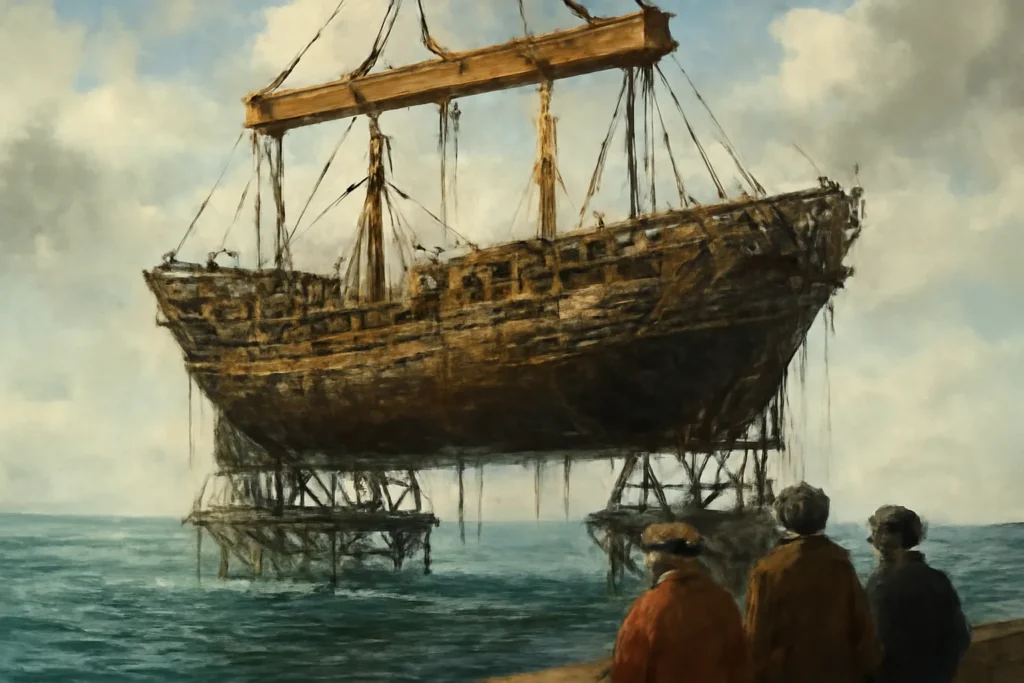
The moment of raising the Mary Rose from the Solent was the culmination of decades of planning and a convergence of engineering ingenuity, meticulous archeology, and patient conservation science. The operation relied on a combination of technologies and strategies designed to preserve both the hull and the artifacts. A number of the core ideas included the creation of a protective cradle around the hull, controlled buoyancy to ease lifting, and a careful transfer to a secure dry environment for stabilization.
Key elements of the lifting plan involved:
Timber cradles and supports designed to cradle the hull’s shape and distribute weight evenly.
Buoyancy control using air-filled devices and water ballast to modulate the hull’s rise from the seabed.
Divers and remotely operated equipment to attach lifting gear and monitor hull integrity during the lift.
A staged transport to a purpose-built facility where the hull could be stabilized in water-filled basins before long-term conservation.
Close collaboration with engineers, conservators, and museologists to plan every step in a way that minimized exposure to oxygen and physical stress.
The actual lift required careful choreography. The hull needed to be stabilized, supported, and gradually brought to the surface without suffering structural damage. The process balanced buoyancy against the hull’s weight and the risk of timbers cracking or warping. Once the hull was lifted to the surface, it did not immediately go on display. Instead, it was transported to a controlled environment where it could be desalted, dried, and treated with consolidants to prevent deterioration. The outcome of this careful lifting operation was a hull that could be studied in three dimensions, rather than merely photographed in a watery grave.
A critical element of the raising story is the artifacts recovery that accompanied the hull. While the hull itself is the centerpiece, hundreds of objects—ranging from bronze cannons to everyday utensils—were recovered, catalogued, and conserved. The operation demonstrated how a rigorous, interdisciplinary approach could turn a dramatic salvage into a durable research resource.
The Aftermath and Recovery: From Salvage to Preservation
After the hull was raised, the work did not end. The conservation process was long and intricate. Waterlogged wood is highly unstable when exposed to air. To preserve the Mary Rose’s timbers, conservators employed a staged process that involved replacing the water within the timber pores with a stabilizing substance, commonly a polymer such as polyethylene glycol (PEG). This treatment, sometimes accompanied by controlled dehydration and environmental stabilization, helps prevent the wood from warping, shrinking, or crumbling as it dries.
The artifacts—metals, leather, textiles, and the ship’s fittings—required specialized preservation pipelines. Metals were cleaned and treated to resist corrosion; leather and textiles were stabilized to retain their shape; and wooden components were consolidated to maintain their structural integrity. The long-term goal of these efforts has been to ensure that the Mary Rose’s story remains accessible to researchers and visitors alike, as the ship is interpreted within a broader narrative of Tudor life.
In parallel with conservation, significant efforts were made to create a public-facing interpretation. The Mary Rose Museum project sought not only to preserve but also to present the ship’s story in a way that people could understand. A purpose-built museum building and display spaces were designed to present the ship’s timber structure, artifacts, and the everyday realities of the crew. The result is a facility that blends scientific rigor with engaging storytelling, allowing visitors to experience the ship as a living history document.
Discoveries: Artifacts and What They Tell Us
Artifacts and daily life on a Tudor warship
The Mary Rose yielded a wealth of artifacts that painted a detailed portrait of life on board. Items of daily use—cookware, eating utensils, clothing remnants, and personal belongings—reveal how sailors and soldiers passed their days between battles. The presence of certain tools and equipment suggests the ship’s routines, from food preparation to maintenance tasks, and demonstrates the practical knowledge that kept a wooden warship seaworthy.
Weapons and ammunition reveal the ship’s role not only in transport but in combat. Cannons, shot, and mounting gear illustrate a culture of firearms and artillery that characterized Tudor naval warfare.
Metalwork and tools show the day-to-day labor on board—the carpenters, blacksmiths, sailmakers, and riggers who kept the ship functional under arduous conditions.
Clothing remnants provide clues about rank, provisioning, and the adaptation of sailors to the maritime climate.
Household items such as bowls, utensils, and cooking vessels demonstrate the social dimension of life on deck and below.
Sporting and personal items highlight moments of leisure, ritual, and personal identity aboard a flagship.
Beyond the sheer quantity of material, the arrangement of artifacts around certain areas of the ship offers insight into how space was used on board. For instance, the density of equipment and personal items near living quarters speaks to the intimate scale of life aboard a ship that could house hundreds of men in close quarters. Such details inform historians about crew dynamics, hierarchy, and the interplay between the ship’s war-making function and its social life.
Fortune and tragedy on the decks
Among the discoveries were human remains that remind us of the human dimension of Tudor naval life. While deciphering the remains, investigators sought to understand how the crew faced danger, disease, and the rigors of long oceanic campaigns. The remains can teach us about aging, health, injuries, and the kinds of illness that affected sailors in the early modern period. The careful study of these remains, conducted under legal and ethical guidelines, contributes to our broader portrait of life at sea during this era.
Architectural and material insights
The ship’s timber construction and the layout of its decks reveal how Tudor shipbuilders solved practical problems: maintaining buoyancy, distributing weight, and accommodating heavy guns. The Mary Rose also preserves examples of naval hardware such as anchors, rigging components, and hardware fittings that illuminate ship technology in a transitional moment of naval history. These discoveries enrich our understanding of how early modern naval fleets operated, how crews trained, and how political power was projected from the sea.
The journey from undersea artifact to museum exhibit requires a sequence of careful steps. After stabilization in water, materials are slowly reintroduced to life outside seawater through controlled environments. The goal is to maintain an essential balance: to preserve the past while enabling contemporary audiences to engage with it. The Mary Rose artifacts are now presented in galleries designed to convey both the technical aspects of preservation and the rich cultural context of Tudor maritime life.
In modern display, the ship’s hull and selected artifacts are presented with interpretive panels, reconstructions, and immersive exhibits. The museum experience blends object-based research with storytelling about the ship’s crew, the political climate of Henry VIII’s court, and the broader maritime culture of the period. The careful curation invites visitors to consider questions about technology, risk, identity, and legacy—topics that remain relevant to students of archaeology, history, and museology.
The museum space also emphasizes ongoing research. Even after removal from the water, conservation is a continuing, collaborative practice. Researchers monitor the long-term stability of timber and artifacts, refining methods for dehumidification, temperature control, and chemical stabilization. The Mary Rose continues to yield new insights as techniques evolve, underscoring the dynamic nature of heritage science.
Timeline and Milestones: A Structured View of the Raising
Discovery phase and documentation of the wreck site as a valuable Tudor-era archive.
Formation of a dedicated project that unites archaeology, conservation, and public education.
In-water stabilization and planning for a controlled lift that would protect the hull’s integrity.
The raise in 1982, a landmark achievement that brought the hull to daylight for the first time in centuries.
Initial stabilization on land in a purpose-built facility, followed by gradual drying and consolidation of timbers.
Conservation and analysis of artifacts, with interdisciplinary teams documenting findings for historical interpretation.
Public presentation through a dedicated museum and educational programs designed to bring Tudor maritime history to a broad audience.
Each milestone in this timeline reflects a balance between public access and scientific rigor. The Mary Rose project demonstrates how archaeological salvage can evolve into a sustained educational program that informs visitors about the complexities of early modern life, naval warfare, and statecraft.
Legacy, Education, and Lessons for Modern Salvage
The story of raising the Mary Rose offers a set of enduring lessons for contemporary heritage work. First, it shows the importance of interdisciplinary collaboration. Engineers, conservators, historians, educators, and community stakeholders all contributed to a project that no single discipline could complete alone. Second, it highlights the ethical responsibility involved in recovering and displaying human history. Decisions about what to preserve, how to present it, and how to interpret it publicly carry a moral as well as scientific weight. Third, the Mary Rose project demonstrates the value of public engagement in sustaining long-term interest and funding for archaeological work. The public’s sustained investment helps ensure that future generations can learn from the past in deep, meaningful ways.
Finally, the Mary Rose project offers a model of adaptive conservation. Techniques in conservation have evolved since the 1980s, and the ongoing research around the hull and artifacts continues to refine best practices for preserving waterlogged wood and metal objects. By sharing findings with the global community, heritage professionals can improve outcomes for submerged cultural resources around the world.
A Note on How to Read the Mary Rose Story
When engaging with the Mary Rose, readers should approach the narrative as a layered story, spanning architectural engineering, material science, social history, and cultural memory. The ship’s tale is not simply a tale of a single vessel; it is a lens through which we view the early modern world as a system of people, tools, politics, and sea. By studying how the Mary Rose was built, sank, and rose again, scholars can ask deeper questions about technology, risk, and resilience in histories that still resonate today.
Today, the Mary Rose serves as a powerful reminder that the past is not a static artifact but a living field of inquiry. Raising the Mary Rose—whether we speak of the initial lift from the seabed, the meticulous conservation process, or the display of thousands of artifacts—invites us to consider how careful stewardship can turn a moment of historical loss into a lasting source of knowledge and inspiration.









Leave a Reply