Revelation Timeline: Key Events and Interpretations
Revelation Timeline: Key Events and Interpretations
The revelation timeline is one of the most discussed and debated components of biblical prophecy. It provides a sequence of events that many readers associate with the end times, the combat between cosmic forces, and the ultimate restoration of creation. This article surveys the major phases commonly identified in the end-time timeline, highlights the key events often cited in the apocalyptic timeline, and explains the variety of interpretations that scholars and faith communities bring to these passages. Throughout, the discussion uses variations of the phrase revelation timeline to reflect the different ways people talk about the same sequence of visions in the Book of Revelation and related literature.
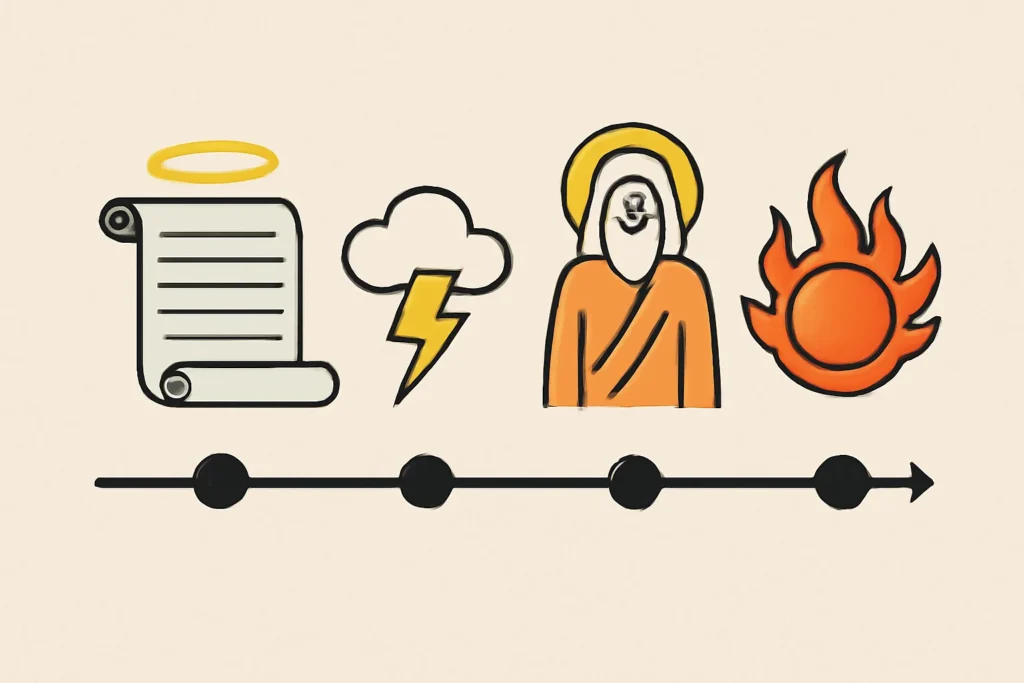
At a high level, the revelation timeline presents a forward-moving arc from close encounters with divine authority to the ultimate renewal of all things. While individual readers may emphasize different moments or interpret the order differently, there are several anchors that most readers recognize: the vision of Christ and the churches, the unveiling of judgments that intensify as time progresses, the climactic defeat of evil, and the creation of a new cosmic order. In this overview, the emphasis is on the sequence rather than on every symbolic detail. The aim is to show how the timeline of Revelation tends to be parsed by scholars, pastors, and lay readers across diverse traditions.
Major Phases in the End-Time Sequence
The opening visions and letters to the churches
The earliest section of the narrative centers on a vision of Christ amid symbols of cosmic authority and a series of messages addressed to seven specific churches. In this phase, readers encounter:
The vision of the glorified Christ walking among lampstands, with messages tailored to each church (Rev 1–3).
Promises and warnings directed to congregations facing pressure, compromise, spiritual fervor, or apathy.
The sense that the revelation is both immediate and cosmic: earthly communities are implicated in a larger divine drama.
The scroll with seven seals
The second major component of the revelation timeline involves a scroll in heaven that is sealed with seven seals. As each seal is opened, events unfold in rapid succession, gradually escalating the crisis and revealing the plan of God.
Seal 1: a rider on a white horse, symbolizing conquest and a brief beginning of conflict.
Seal 2: a rider on a red horse, representing war and bloodshed.
Seal 3: a rider on a black horse, with famine and economic imbalance indicated by the scales.
Seal 4: a rider on a pale horse, associated with death and Hades.
Seal 5: souls under the altar who cry out for justice and vindication.
Seal 6: a cataclysmic cosmic upheaval—a great earthquake, celestial phenomena, and symbols of upheaval among the rulers of the earth.
Seal 7: silence in heaven and the preparation for the trumpet judgments, signaling a transition to a different mode of divine judgment.
The trumpet judgments
The third major phase of the end-time sequence introduces a new layer of urgency: the seven trumpet judgments. These judgments affect land, sea, rivers, celestial bodies, and spiritual beings, intensifying the crisis and drawing attention to the sovereignty of God.
Trumpet 1: hail and fire mixed with blood, burning a third of the land and vegetation.
Trumpet 2: something like a great mountain burning with fire cast into the sea, turning a third of the sea into blood and destroying a portion of sea life.
Trumpet 3: a great star named Wormwood falls, making a third of the rivers and springs bitter.
Trumpet 4: a third of the sun, moon, and stars are darkened, affecting the heavenly light and the rhythms of time.
Trumpet 5: a plague of locusts from the abyss, tormenting those who do not bear the seal of God on their foreheads.
Trumpet 6: four angels release a vast army that brings judgment and massive loss of life, particularly to a third of humanity.
Trumpet 7: a powerful declaration from heaven, the temple of God is opened, and a sequence that leads into the bowls of wrath and the final climactic events.
The bowls of wrath
The final wave of divine judgments in the traditional reading of the revelation timeline is the seven bowls (or vials) of wrath. These judgments are often described as more concentrated and personal in their impact, affecting both the land and its inhabitants as the narrative moves toward culmination.
Bowl 1: sores come upon those who bear the mark of the beast and worship his image.
Bowl 2: the sea turns to blood, killing sea life and affecting maritime economies.
Bowl 3: rivers and springs become blood, affecting drinking water and life support systems.
Bowl 4: intense heat from the sun scorches people.
Bowl 5: darkness and pain afflict the beast’s followers, heightening their distress.
Bowl 6: the great river Euphrates dries up to prepare the way for kings from the east and a gathering for battle—often associated with Armageddon in tradition.
Bowl 7: a dramatic culmination—earthquakes, the division of the great city, Babylon’s fall, and hailstones of extraordinary size intensify judgment before the final victory is proclaimed.
Across many readers’ revelation timelines, the period of judgments leads to the decisive intervention of the Messiah, the defeat of evil, and the dawn of a transformed creation. The most widely recognized milestones in this climactic arc include:
The Parousia or Second Coming of Christ, when Christ returns in glory to establish righteous rule.
The defeat of the Beast and the False Prophet, the political and religious systems that oppose God are judged and removed from power.
The Millennium (variously interpreted), a period of renewed order in which Christ reigns or where the church experiences extended spiritual victory, depending on the tradition.
The Final Judgment, when all the dead are judged in accordance with their deeds and God’s justice is finally revealed.
The New Heaven and New Earth and the New Jerusalem, the creation of an eternal dwelling place with God for his people, where sorrow and death are no more.
Major Theological Interpretations and Their Timelines
Scholars and faith communities disagree about how to read the timeline of Revelation, especially the relative timing of events such as the Millennium and the scope of symbolic language. The following sections summarize several influential approaches. Each is a distinct revelation timeline lens that readers use to interpret the same biblical text.
In this view, the Second Coming occurs before a literal thousand-year reign of Christ on earth. The events of Revelation are primarily future and fulfillments are anticipated in a distinct, sequential order. Key features include:
Future fulfillment of most prophecies yet to occur at the end of the age.
A literal interpretation of Christ’s reign on earth during the millennium.
Often, a dispensational element that separates Israel from the church and emphasizes distinct programs for God’s people in different eras.
Amillennialism
Amillennialists interpret the Millennium symbolically rather than as a literal future thousand-year period. They typically view Revelation as describing present spiritual realities and historic patterns rather than a single, fixed chronology. Characteristics include:
The Millennium is understood as Christ’s reign in heaven and his spiritual reign within the church on earth during this present age.
The events of Revelation are often interpreted as symbolic representations of ongoing spiritual conflicts and victories, rather than a strict forecast of a future timeline.
A focus on the power and importance of the church in resisting evil in the present age and awaiting a final culmination at the resurrection and judgment.
Postmillennialism
Postmillennialists typically expect the world to gradually improve through the spread of the gospel and social reform, culminating in Christ’s return after a long era of peace and righteousness. In this framework, the apocalyptic timeline may be read as:
Beyond the broad millennial ranges, scholars categorize approaches to Revelation by how they place its prophecies in time:
Futurist readings see most of the prophecies as yet to be fulfilled in the future, often aligning with the classic end-time timeline that features a climactic sequence of judgments and a formal Second Coming.
Preterist readings interpret many prophecies as fulfilled in the first century, within the events of the Roman world and the early Christian era, offering a shorter, past-oriented revelation timeline.
Historist readings view Revelation as unfolding gradually through the entire course of church history, mapping its symbols onto historical eras, persons, and institutions.
Symbolic Figures and Objects Shaping the Timeline
Part of what makes the revelation timeline so rich—and so debated—are the symbols that populate its pages. These figures have been interpreted in many ways, but their presence consistently anchors readers in a shared field of imagery.
The Beast (often associated with the Antichrist in popular piety) represents political power that opposes God’s kingdom and persecutes the faithful.
The Dragon symbolizes Satan as the ultimate source of opposition and deceit behind worldly systems and spiritual forces.
Babylon the Great stands for oppressive worldly power, corruption, and persecution of the saints, often read as a critique of imperial Rome or later political systems depending on tradition.
The Two Witnesses symbolize prophetic voices that testify to God, call for repentance, and perform signs, often interpreted as representing faithful witness in every generation or as specific historical figures in certain readings.
The 144,000 and the multitude from every nation signify faithful remnant and redeemed humanity, illustrating the saving work across the ages.
The New Jerusalem and the New Heaven and New Earth depict the ultimate consummation: God’s dwelling with humanity in a transformed creation.
Chronological Milestones in Different Schools of Thought
To help readers navigate the diversity of viewpoints, this section outlines how different schools commonly order the major milestones. While the labels and specifics may differ, several milestones tend to appear across traditions as anchors in the revelation timeline.
Second Coming as the climactic event that definitively ends evil and inaugurates eternal life for the faithful.
Judgment for all people, leading to eternal destinies (heaven or hell or analogous outcomes, depending on tradition).
The Millennium as a defining period in which Christ’s reign is realized in some form, whether literal, symbolic, or spiritual depending on the position.
The Fall of Babylon and the collapse of oppressive powers that oppose the purposes of God.
The New Creation—the New Heaven and New Earth—where mortality ends and life with God is perfected.
Reading Revelation: Hermeneutical Notes and Methodology
Interpretation of the revelation timeline is not just about identifying events; it also involves careful literary and theological work. These notes help readers approach the text responsibly and thoughtfully:
Genre awareness: Revelation blends prophecy, apocalyptic imagery, symbolism, and letter-writing genres, requiring careful distinction between symbolic language and potential real-world referents.
Symbol versus sequence: Some elements symbolize spiritual realities (e.g., spiritual warfare, faithfulness under persecution) while others may point to concrete historical events; readers should distinguish symbolic meaning from literal prediction.
Typology and pattern recognition: Repetition of numbers (such as seven and twelve) and motifs (wilderness, exile, exile-deliverance) often point to deeper theological truths rather than to exact durations.
Historical context: Understanding the historical settings of the author and audience helps interpret the author’s choice of symbols and the urgency of the message in particular eras.
Practical Guides for Studying the Revelation Timeline
Readers who want to study the timeline of Revelation systematically can adopt a few practical approaches that balance careful exegesis with pastoral sensitivity. The following guidelines reflect common scholarly practices and are useful for personal study groups alike.
Start with the text itself: Read Revelation in smaller blocks (e.g., chapters 1–3, 4–7, 8–11, 12–16, 17–22) to observe how the narrative unfolds and how the imagery builds.
Note the sequence of visions: Pay attention to the progression from the messages to the churches, to the seals, to the trumpets, and then to the bowls. This helps in mapping the end-time timeline as a rising arc of judgment and vindication.
Compare translations: Different English translations render key terms slightly differently; a parallel reading with multiple translations can illuminate nuances.
Engage with commentary across traditions: Reading a range of perspectives—premillennial, amillennial, postmillennial, preterist, futurist—can deepen understanding of the revelation timeline without surrendering personal conviction.
Be mindful of symbolism: Emphasize the difference between symbols and anticipated events; when in doubt, note what the symbol communicates about reality (justice, oppression, faithfulness, hope) rather than what it predicts in detail.
What the Revelation Timeline Means for Faith and Ethics
Beyond historical or theological curiosity, the study of the revelation timeline has practical implications for how believers understand suffering, justice, and hope. Across traditions, common themes emerge:
Perseverance under pressure: The letters to the churches emphasize faithfulness in the face of trial; this endurance is often read as a model for Christian living in any era.
Hope rooted in divine sovereignty: Even when judgment is described, the overarching arc points to God’s ultimate control and the promise of a restored creation.
Ethical clarity: The confrontation with oppression and deception in the symbolic drama serves as a call to integrity, justice, and mercy in the present age.
Historical Reflections: How Past Generations Read the Timeline
Throughout church history, communities have approached the revelation timeline with differing expectations about the near or distant fulfillment of prophecy. Some periods emphasized imminent fulfillment and prepared for trial; others stressed spiritual preparation, moral reform, or mission expansion. This variability is a reminder that the core message of Revelation—God’s sovereignty, the defeat of evil, and the hope of a healed creation—has sustained believers across many contexts.
Cross-Textual Connections: Related Prophetic Streams
Readers frequently link the revelation timeline with other biblical prophetic strands to gain a fuller sense of its meaning. These cross-references illuminate the broader narrative arc of Scripture and how Revelation sits within it.
Danielic prophecy: The apocalyptic imagery, celestial visions, and themes of kingdoms and empires have clear resonances with the Book of Daniel, shaping how readers imagine the rise and fall of powers within the end-time panorama.
Gospel witness and martyrdom: The call to endure, witness, and repent echoes throughout the New Testament and informs how believers interpret trials as part of a larger redemptive drama.
New Covenant hope: The ultimate goal—God dwelling with humanity in a restored creation—ties Revelation to the broader biblical arc of salvation history.
Variations in Terminology: Keeping the Language Flexible
Because readers come from diverse linguistic and theological backgrounds, the revelation timeline is often described with a variety of terms. Some common phrases include the timeline of Revelation, the end-time chronology, the apocalyptic sequence, or the prophetic arc. Each phrasing points to the same core sequence but helps different audiences connect with the material in their own idiom. The use of these variations reflects a respectful recognition that the material invites thoughtful interpretation rather than a single, uniform reading.
Concluding Reflections: Why the Revelation Timeline Remains Vital
Ultimately, the revelation timeline serves both as a map and a mirror. It is a map insofar as it guides believers through a structured vision of ultimate outcomes and divine justice. It is a mirror insofar as it challenges readers to examine their allegiance, their hope, and their response to suffering within a world that often seems chaotic. While the exact chronology may differ across traditions, the essential shape—a decisive divine intervention, a verdict on human systems, and the creation of a new, harmonious order—offers a shared horizon for faith communities seeking to live with purpose and perseverance.
Glossary of Key Terms in the Revelation Timeline
To help readers navigate the vocabulary that frequently appears in discussions of the timeline of Revelation, here is a concise glossary of often-used terms:
Parousia: The Greek term usually translated as “arrival” or “presence,” referring to the Second Coming of Christ.
Armageddon: A term used to describe the prophesied place and moment of final confrontation between good and evil in some traditions, sometimes debated in its exact symbolic or geographic meaning.
New Jerusalem and New Heaven and New Earth: The ultimate restoration and dwelling place with God for his people, signaling the consummation of the created order.
Babylon: A symbol of oppressive powers, worldly pride, and spiritual corruption that oppose the purposes of God.
Beast and False Prophet: Figures representing political-religious systems that stand in opposition to divine sovereignty and deceive the nations.
Whether approached as futurist prophecy, symbolic literature, or a complex blend of genres, the revelation timeline remains a central frame for thinking about meaning, justice, and hope in the face of suffering. By engaging with the key events, the major interpretive options, and the ethical implications of the text, readers gain a richer understanding of both the biblical message and its enduring relevance for contemporary life.







Leave a Reply