Ten virgens: meaning, context, and practical lessons
Ten virgens: meaning, context, and practical lessons
The ten virgens is Jesus’ parable about staying spiritually ready for his return, found in Matthew 25:1–13.
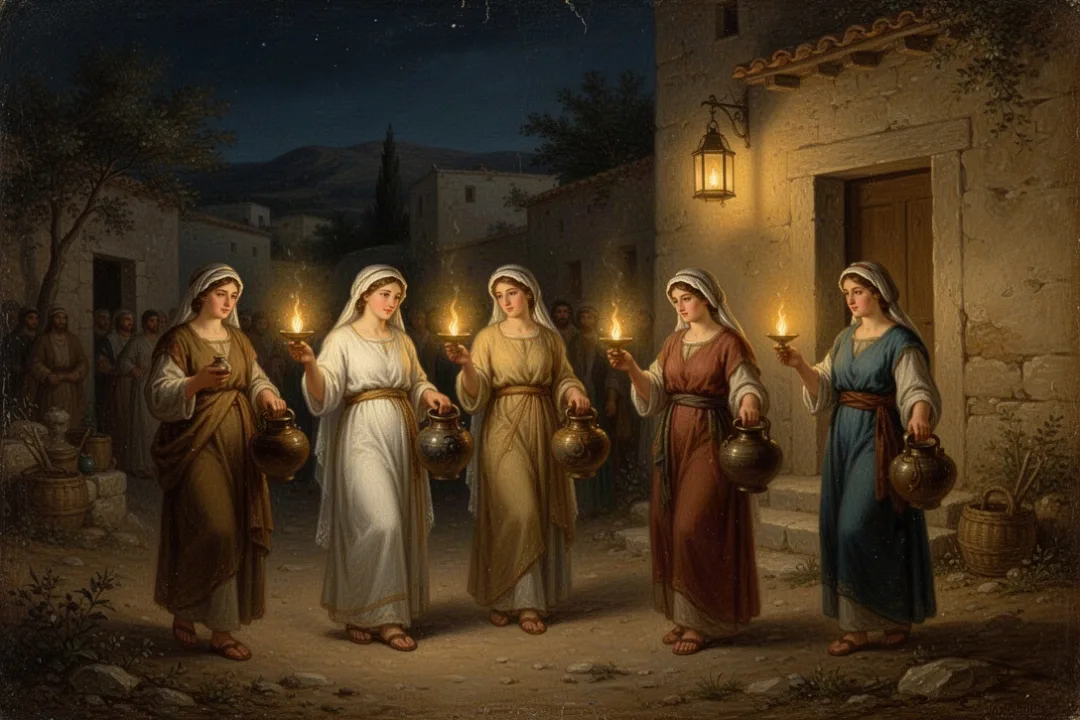
In the story, ten young women wait for a bridegroom who is expected to arrive for a wedding celebration. All carry lamps, but only five bring extra oil. When the bridegroom’s arrival is delayed, everyone becomes tired and falls asleep. At midnight, the announcement comes that he is approaching. The five prepared women can light their lamps, while the other five discover that their oil is running out.
The unprepared women leave to buy more oil. During their absence, the bridegroom arrives, and the five ready women enter the wedding banquet with him. The door is then shut. When the remaining women return and ask to be admitted, the bridegroom refuses them. Jesus ends with a direct warning: stay watchful, because no one knows the day or hour.
Central idea: Readiness for Christ’s return involves a continuing, personal faithfulness that cannot be borrowed from someone else or created at the last minute.
The parable belongs to a larger section of Jesus’ teaching about the future, judgment, and faithful living. Matthew 24 records Jesus speaking to his disciples about the destruction of the temple, the coming of the Son of Man, and the need to remain alert. Matthew 25 continues that theme through several stories, including the ten virgins, the talents, and the separation of the sheep and goats.
Jesus begins by comparing the kingdom of heaven to ten virgins who take their lamps and go out to meet the bridegroom. The women appear to share the same basic role. They are all waiting for the same person, carry lamps, and expect to participate in the same celebration. The distinction between them becomes clear only when the wait lasts longer than expected.
The bridegroom is commonly understood in Christian interpretation as representing Christ. The delayed arrival points to the fact that God’s timing may not match human expectations. The parable does not give a timetable for the bridegroom’s coming. Instead, it emphasizes that his delay should not be mistaken for a cancellation.
The ten women can represent people who identify with the community of faith and appear outwardly prepared. Yet Jesus separates them into two groups: the wise, who bring extra oil, and the foolish, who bring lamps without sufficient supply. Their outward similarities make the warning sharper. The issue is not simply who began waiting, but who remained prepared through the delay.
Why the lamps and oil matter in the parable
Lamps are necessary because the bridegroom arrives at night. The women need more than a visible lamp at the beginning of the wait; they need enough oil to keep it burning when the important moment comes. This gives the lamp a practical role in the story while also supporting its spiritual meaning.
Many readers understand the oil as a picture of genuine spiritual readiness. Some interpretations connect it with faith, obedience, the Holy Spirit, or a life shaped by God’s presence. The parable itself does not explicitly identify the oil with one particular doctrine, so it is wise not to make the symbol carry more detail than Jesus provides.
The clearest contrast is between preparation and presumption. The five foolish women have lamps, but they do not have enough oil for an uncertain wait. They are not described as openly hostile to the bridegroom. They expect to meet him, yet their preparation is incomplete.
That distinction speaks to people who may have a Christian identity, religious habits, or familiarity with biblical teaching but have not developed a steady relationship with God. Visible association with faith is not the same as faithful readiness. The story asks whether a person’s trust in God continues when waiting becomes inconvenient, confusing, or prolonged.
The oil should not be treated as a secret substance or a formula that lets someone predict the end times. The point is ethical and spiritual: live in a way that is ready for the Lord’s coming, even when the timing is unknown.
What the delay of the bridegroom teaches about waiting
The bridegroom does not arrive immediately. The delay affects every woman in the group, and all ten become drowsy and fall asleep. This detail matters because Jesus does not present ordinary human tiredness as the main failure. The wise women sleep too. The difference is that they have prepared for the possibility that the wait will be long.
Christian readiness is therefore not constant emotional intensity. You do not have to maintain a dramatic sense of urgency every minute of every day. Faithful waiting can include work, rest, family responsibilities, illness, uncertainty, and the ordinary rhythms of life.
The challenge is to remain spiritually prepared while the expected event seems delayed. The first believers waited for Christ’s return, and Christians have continued to wait across generations. The parable acknowledges that waiting may test confidence and expose shallow commitments.
Delay can tempt people to become careless. A person may think there is still plenty of time to change, reconcile, obey, pray, or take faith seriously. Jesus’ warning challenges that assumption because the decisive moment arrives unexpectedly.
Watchfulness does not mean trying to calculate a date. It means living with a settled awareness that your response to God matters now. The person who is ready does not need to create readiness after the announcement; preparation has already become part of daily life.
Why the foolish virgins cannot borrow preparation
When the bridegroom’s arrival is announced, the foolish women ask the wise women to share their oil. The wise women refuse, telling them to go and buy some for themselves. At first, that response may seem harsh. The point is not that generosity is wrong. Rather, the story shows that some forms of preparation are inherently personal.
No one else can give you a mature trust in God, a repentant heart, or a lifetime of faithful choices at the moment of crisis. Other people can teach, encourage, pray, counsel, and model faith. They cannot transfer their spiritual condition to you as if it were an object.
This principle appears throughout Christian teaching. Parents cannot believe on behalf of their children. A church community cannot replace personal repentance. A respected Christian’s faith cannot cover a person who has persistently refused to respond to God.
The women who are ready do not send the others away because they want them to fail. They understand that sharing their supply would leave everyone unprepared. The situation has reached a point where each person must answer for their own readiness.
Practical warning: Do not confuse access to Christian resources with personal faithfulness. Sermons, books, worship services, and godly relationships can support your growth, but they cannot make your spiritual decisions for you.
How the closed door contributes to the warning
The closed door is one of the most serious details in the parable. After the five prepared women enter the wedding banquet, the door is shut. The other women arrive later and ask the bridegroom to open it, but he says he does not know them.
This language communicates finality. Jesus is not describing an endless opportunity to delay a response. The parable warns that a time comes when preparation is no longer possible and judgment reveals the difference between genuine and superficial readiness.
The phrase about not being known should be read relationally, not merely as a lack of information. The bridegroom is not saying that he has never heard of these women. He is declaring that they do not belong to him in the relationship the celebration represents.
The story therefore presses beyond appearances. The five foolish women are close to the celebration, know about the bridegroom, and seem to be part of the waiting group. But closeness to a religious community is not identical to belonging to Christ.
Some readers focus only on the frightening image of the shut door. Jesus includes it to make the warning urgent, but the parable also implies that preparation is possible before the arrival. The appropriate response is not panic or speculation. It is honest self-examination and faithful action in the present.
How the ten virgins fits with the surrounding parables
The parable of the ten virgins is easier to understand when read beside the stories that follow it. In the parable of the talents, servants receive different amounts of money and are judged by how they respond to their master’s absence. The faithful servants act responsibly, while one servant hides what he has received.
That story emphasizes active faithfulness. The ten virgins emphasizes readiness during delay. Together, they show that waiting for Christ is not passive. It involves using what God has entrusted to you and remaining prepared for his return.
Matthew 25 then presents the judgment of the sheep and goats. There, people are distinguished by how they treated those in need. The passage connects allegiance to the Son of Man with concrete acts of mercy toward vulnerable people.
These passages should not be forced into one-to-one symbolism, but their shared message is clear: Christian hope should shape conduct. Readiness is not a claim made with words alone. It appears through perseverance, responsible service, mercy, and obedience.
The parable also follows Jesus’ teaching that no one knows the day or hour of his coming. The uncertainty of the timing is not meant to satisfy curiosity. It removes the possibility of postponing faithfulness until a more convenient moment.
What the parable says about genuine Christian readiness
Genuine readiness begins with a real response to Jesus, not simply an interest in religious ideas. In the New Testament, readiness is connected with repentance, faith, endurance, obedience, and love. These qualities do not earn God’s grace as a payment. They show that a person has received God’s call seriously.
Readiness also includes perseverance. Anyone can appear committed during an emotional moment or a season of excitement. The wise women are distinguished by what they have prepared for the long wait. Their faithfulness has enough depth to continue when there is no immediate reward.
That does not mean a prepared Christian never struggles. The women all become tired, and the parable does not describe the wise as perfect. Spiritual readiness is not sinless performance. It is a persistent orientation toward Christ, including the willingness to return to him after failure.
Readiness includes humility. You cannot prepare well if you assume you are already safe because of your background, reputation, church attendance, or knowledge. The warning is aimed at people who are waiting near the kingdom but may not have considered the condition of their own hearts.
It also includes hope. The bridegroom is delayed, but he does come. Christian watchfulness is not anxious waiting for an unknown disaster. It is expectant faith in the promised return of Christ and confidence that God’s purposes will be fulfilled.
Practical ways to live the ten virgins’ warning
The parable calls for habits that keep faith active and honest. These practices do not turn spiritual life into a checklist, but they can help you resist neglect and postponement.
Examine your relationship with Christ: Ask whether your faith is personal and active or based mainly on family tradition, social identity, or past experience.
Practice regular prayer: Bring your fears, decisions, gratitude, sins, and hopes to God instead of allowing spiritual life to become occasional.
Remain rooted in Scripture: Read the Bible carefully, paying attention to its call to trust God, obey Jesus, love others, and persevere.
Respond promptly to conviction: When you recognize a wrong that needs confession, repair, or change, do not assume you will always have more time.
Stay connected to faithful Christians: Community can strengthen your faith, correct blind spots, and help you continue when waiting becomes difficult.
Serve with what you have: Use your time, abilities, resources, and opportunities to honor God and benefit other people.
Practice mercy: Pay attention to people who are lonely, poor, sick, excluded, or in need of practical help.
Reject date-setting: Do not let predictions about the end times replace the daily work of faithfulness.
These practices are not ways to purchase salvation. They are ways of responding to grace with an undivided life. The wise women do not prepare because they know the exact arrival time. They prepare because they trust that the bridegroom will come.
Common mistakes when interpreting the ten virgins
The story is short, but several misunderstandings can obscure its main point. Careful reading keeps the focus on Jesus’ warning about readiness rather than on details the parable does not explain.
Trying to identify every object with a fixed symbol: The passage gives the lamps, oil, delay, announcement, banquet, and door narrative roles. It does not explain every item as a separate prophecy.
Claiming that sleep is the sin: All ten women sleep. The difference is their preparation, not their ability to remain physically awake all night.
Using the parable to calculate dates: Jesus specifically stresses that the timing is unknown. Date predictions conflict with the passage’s emphasis on constant readiness.
Assuming the wise women are selfish examples: Their refusal highlights the personal nature of readiness; it does not present selfishness as a Christian virtue.
Reducing oil to one narrow doctrine: The text does not explicitly define it as only the Holy Spirit, only good works, or only emotional faith.
Ignoring the wider teaching of Jesus: The parable belongs with calls to mercy, service, obedience, and perseverance. Readiness is not mere intellectual agreement.
Turning the warning toward other people first: The story invites self-examination before speculation about who belongs among the wise or foolish.
Another mistake is treating the parable as permission to live carelessly until a final moment of repentance. The foolish women do try to respond, but they wait until the decisive opportunity has passed. Jesus’ warning is designed to prevent that kind of delay.
How different Christian traditions read the parable
Christian traditions generally agree that the bridegroom points to Christ and that the story teaches readiness for his return. They may differ in how they describe the oil, the identity of the ten women, and the precise relationship between this parable and end-times events.
Some interpreters emphasize the Holy Spirit, understanding the oil as a sign of the Spirit’s presence and work. Others focus on persevering faith, practical obedience, or a life prepared through communion with God. These readings overlap in their insistence that outward religious appearance is not enough.
Some churches read the story primarily as a warning to individuals who have not truly responded to Christ. Others emphasize the danger of complacency within the visible Christian community. Both approaches can reflect the text’s contrast between people who appear to be waiting together and those who prove unprepared.
The parable should not be used casually to declare the eternal fate of particular people. Jesus gives a warning to his hearers, not a license for Christians to pronounce judgment based on appearances. Its proper effect is sober self-examination, faithful living, and renewed dependence on God.
Questions the ten virgins raises for your life
The story asks whether your faith can endure a long delay. If Christ does not return according to your expectations, will you continue to pray, obey, serve, and hope? The answer is shaped less by a single dramatic decision than by the patterns you practice now.
It also asks what you are relying on. Are you depending on another person’s faith, your church background, a past emotional experience, or your reputation? Those things may have value, but none can replace a living response to Christ.
The parable raises a question about postponed obedience. Is there a reconciliation you keep delaying, a sin you keep excusing, a call to serve that you keep avoiding, or a decision to trust God that you keep pushing into the future? The story does not tell you when the opportunity will end.
Finally, it asks whether you expect the bridegroom. Christian readiness is more than fear of being left outside. It is also desire for the promised presence of Christ. The banquet image points to joy, welcome, and fulfillment for those who are ready when he comes.
The most faithful response to the ten virgins is therefore simple but demanding: trust Christ now, remain faithful during the wait, and do not presume that tomorrow will provide the opportunity you have today.
Frequently asked questions
Where is the parable of the ten virgins found in the Bible?
The parable appears in Matthew 25:1–13. It follows Jesus’ teaching about remaining watchful for his return and comes before the parables of the talents and the sheep and goats. These surrounding passages help show that readiness includes endurance, responsible service, mercy, and obedience rather than mere awareness of future events.
Why are five virgins called wise and five called foolish?
The five wise women bring extra oil and are prepared for a delayed arrival. The five foolish women bring lamps but not enough oil to keep them burning. Their difference is revealed when the bridegroom arrives later than expected. The contrast concerns durable preparation, not intelligence, social status, or personal worth.
Does the oil in the parable specifically represent the Holy Spirit?
Some Christian traditions interpret the oil as representing the Holy Spirit, while others connect it with faith, obedience, or spiritual readiness. Matthew 25 does not explicitly define the symbol, so no single explanation should be treated as the only possible one. The central point is the need for genuine, personal preparation.
Does the parable teach that Christians should stay physically awake all the time?
No. All ten women fall asleep, including the wise ones. The story does not condemn normal rest; it contrasts adequate preparation with carelessness during a delay. Watchfulness means maintaining faithful readiness and living responsibly before God, not refusing sleep or attempting to predict the exact time of Christ’s return.












Leave a Reply