The book of Amos is a prophetic warning against injustice, exploitation, and empty worship. Amos announces that God will judge Israel because wealthy and powerful people have oppressed the poor while maintaining religious ceremonies. Yet the book does not end with judgment alone: its final vision points to restoration, renewed prosperity, and the rebuilding of David’s fallen house.
Amos speaks to people who assume that religious identity protects them from accountability. His message is direct: God cares about worship, but worship separated from honest business, fair courts, compassion, and obedience cannot please him. The book therefore connects justice toward people with faithfulness toward God.
Amos was a man from Tekoa, a town in Judah south of Jerusalem. He describes himself as a shepherd and a cultivator of sycamore figs rather than as a member of the professional prophetic class. God sent him north to the kingdom of Israel, where he spoke publicly at Bethel, one of Israel’s major religious centers.
Amos prophesied during the reigns of Uzziah of Judah and Jeroboam II of Israel. The opening identifies his ministry with an earthquake, and the historical setting was a period of political stability and economic growth for Israel. The kingdom had expanded its influence, and some citizens enjoyed substantial wealth.
That prosperity was unevenly distributed. The rich could live in luxury while the poor faced dishonest trade, predatory lending, land loss, and corrupt legal decisions. Amos exposes the contrast between public prosperity and private suffering.
Central idea: Amos does not condemn wealth merely because it exists. He condemns wealth gained through exploitation and protected by systems that deny vulnerable people fair treatment.
The prophet’s origin also matters. Amos was not preaching to his own southern kingdom as a court adviser. He crossed into Israel and challenged its leaders, priests, merchants, and comfortable citizens. His authority came from God’s call, not from social status or an official religious position.
What was happening in Israel when Amos spoke
Israel’s northern kingdom had separated from the house of David generations earlier. It developed its own political and religious centers, including Bethel and Dan, where golden calves represented the kingdom’s worship. By Amos’s time, Israel had its own institutions, priests, festivals, and national confidence.
That confidence had become dangerous. Many people assumed that being part of Israel meant they were secure because they belonged to God’s chosen people. Amos challenges that assumption by reminding them that election creates responsibility, not immunity.
Amos 3 makes this principle clear in its own argument: because Israel has received special knowledge and privilege, Israel will face a particularly serious accounting. The people cannot claim closeness to God while ignoring the obligations that come with that relationship.
Archaeological and historical evidence cannot supply every detail about Amos’s audience, but the book itself gives a vivid picture of social inequality. The wealthy own multiple houses, enjoy expensive furnishings, and arrange lavish meals. At the same time, judges accept bribes, merchants manipulate measurements, and the poor are treated as objects to be bought and sold.
The broader ancient Near Eastern world often connected royal power, economic control, and religious authority. Amos addresses all three. He does not limit wrongdoing to a few personally immoral individuals; he confronts patterns embedded in commerce, courts, land ownership, and worship.
How the book of Amos is organized
The book contains nine chapters and moves through several recognizable forms of prophetic speech. Its structure shifts between judgment oracles, accusations, visions, and promises. These changes create a developing argument rather than a random collection of sayings.
Chapters 1–2: Amos announces judgment on surrounding nations and then turns the accusation against Judah and Israel.
Chapters 3–6: He explains why Israel’s religious privilege will not prevent punishment and condemns social oppression, luxury, complacency, and false security.
Chapters 7–9: He reports symbolic visions, describes opposition from the priest Amaziah, and ends with a promise of restoration.
The opening judgments against neighboring nations draw listeners in. Amos condemns Damascus, Gaza, Tyre, Edom, Ammon, Moab, and Judah for violence and betrayal. An Israelite audience could easily agree with those denunciations. Then Amos reaches Israel, revealing that the people who welcomed judgment for other nations are also guilty.
This rhetorical movement is one of the book’s most effective features. The audience is not allowed to treat God’s justice as a weapon aimed only at outsiders. The same moral standard applies to Israel, including its religious leaders and wealthy citizens.
The book then develops its case through direct speeches, poetic images, and repeated calls to recognize the seriousness of the situation. The final chapters use visions to show that judgment is not a vague possibility. It is approaching, and Israel’s structures of power cannot hold it back.
Why Amos emphasizes justice for the poor
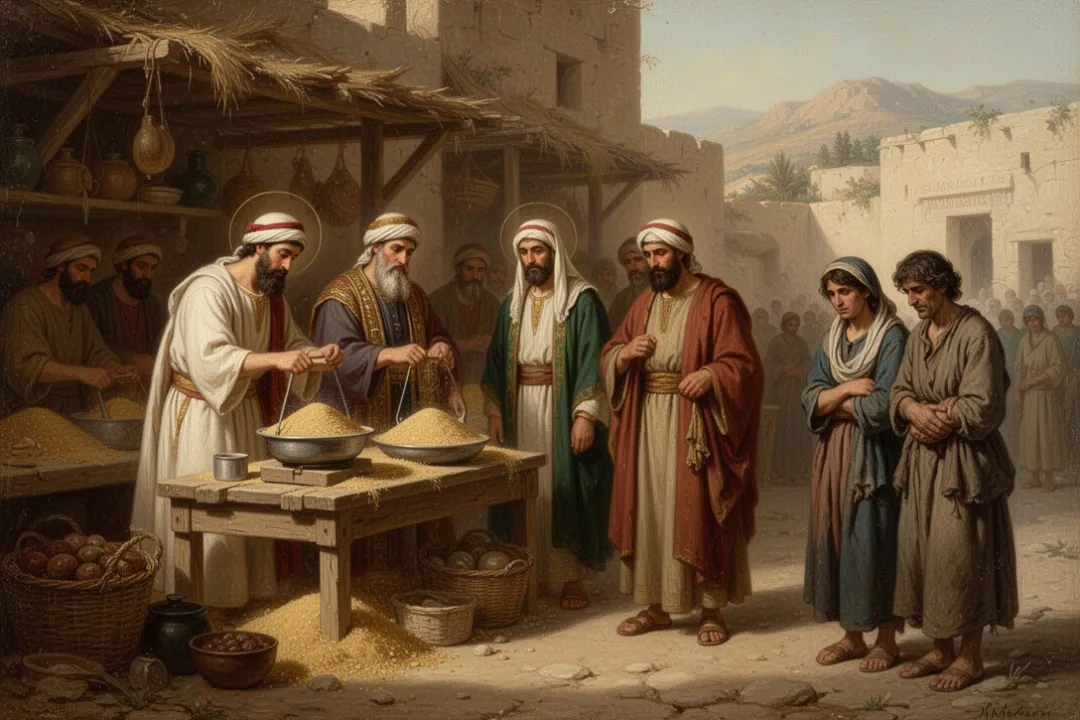
The strongest social criticism in Amos concerns the treatment of the poor. The wealthy sell people into debt slavery, take advantage of those with no power, and use courts to protect their own interests. The book describes merchants who alter scales and measures, eager to profit by giving customers less than they paid for.
Amos also condemns those who trample the needy, push aside the humble, and use legal or economic power to take land and property. The language shows that poverty is not being treated as an unfortunate accident. It is being produced and intensified by people who benefit from the arrangement.
Amos 2, 4, 5, and 8 all contribute to this picture. The prophet attacks sexual exploitation, unjust taxation or rent practices, bribery, dishonest trade, and the eagerness of merchants to resume business after religious observances. These examples show that the problem reaches into both private behavior and public institutions.
For Amos, justice is not a vague attitude of kindness. It includes truthful transactions, impartial courts, protection for people with limited power, and refusal to profit from another person’s desperation. A society cannot call itself faithful while its economic practices depend on deception.
“Let justice roll down like waters” is Amos’s best-known image, but its force comes from the surrounding demand for honest and consistent righteousness.
That famous image appears in Amos 5:24. The verse is not a decorative slogan detached from the chapter. It follows a rejection of festivals and songs offered by people whose public life contradicts their worship. Justice must flow continuously, like a dependable stream, rather than appear occasionally as a charitable gesture.
What Amos teaches about worship and religious hypocrisy
Amos is not against worship, music, feasts, prayer, or religious gatherings in themselves. His criticism is aimed at worship used as a cover for injustice. The people attend sanctuaries, bring offerings, sing songs, and observe sacred assemblies, yet they continue exploiting neighbors.
In Amos 5, God’s rejection of Israel’s festivals is deliberately severe. The prophet says, in effect, that ceremonies cannot compensate for corrupt conduct. The issue is not that worship must become less sincere or less beautiful; the issue is that worship must be joined to a life that reflects God’s character.
This is why Amos’s message remains challenging for religious communities. It is easier to measure attendance, offerings, music, programs, and public identity than to examine whether vulnerable people receive fair treatment. Amos pushes the test of faith beyond visible religious activity to the consequences of religious belief in everyday life.
The book also warns against separating personal devotion from social ethics. A person may pray sincerely and still participate in dishonest practices. A congregation may use faithful language and still ignore exploitation around it. Amos insists that these contradictions matter to God.
Read the criticism carefully: Amos is not saying that social action replaces worship. He is saying that worship loses integrity when it is used to avoid repentance, repair, and obedience.
What “the day of the Lord” means in Amos
Some Israelites expected the day of the Lord to mean victory for their nation and defeat for its enemies. Amos turns that expectation upside down. In Amos 5, he describes the day as darkness rather than light for people who have treated divine favor as automatic protection.
The phrase refers to a decisive act of God in history. It can involve judgment, rescue, or both, depending on the people and circumstances being addressed. In Amos, Israel’s expectation of triumph is corrected by a warning that God’s coming intervention will expose its guilt.
This teaching challenges the assumption that belonging to a favored community guarantees a favorable outcome. Religious identity cannot shield injustice from judgment. The same God who judges foreign violence also judges corruption within the covenant community.
Amos 5 links the day of the Lord to the people’s desire for divine intervention. They want God to act, but they have not considered what his holiness will mean for them. The prophet’s point is uncomfortable but clear: people should not ask for God’s justice while refusing to practice justice themselves.
How the visions show Israel’s coming judgment
Amos 7–9 contains several visions that communicate judgment through concrete images. The first involves locusts, the second a consuming fire, and the third a plumb line. Each vision presents a different aspect of Israel’s vulnerability and God’s examination.
In the plumb-line vision, God stands beside a wall with a tool used to test whether the structure is straight. Israel is measured against a standard and found unable to remain unchallenged. The image suggests that judgment is not arbitrary; God is exposing a serious moral distortion.
Amos also sees a basket of summer fruit in chapter 8. The visual wordplay connects ripe fruit with the end that has come upon Israel. The nation has reached a point of moral ripeness, but in this case ripeness signals that judgment is ready rather than blessing.
Another vision shows God beside an altar, with the sanctuary no longer functioning as a place of safety. The imagery communicates that no social class can escape by hiding in a building, climbing to a high place, or fleeing to a distant location. God’s judgment reaches beyond external defenses.
These visions should not be read as a timetable for every future disaster. They are prophetic symbols directed first at Amos’s own audience. Their purpose is to make Israel see that its political power, religious buildings, and economic status cannot cancel accountability.
Why Amaziah opposed Amos
Amaziah was the priest of Bethel, and he reported Amos to Jeroboam, the king of Israel. He accused Amos of plotting against the kingdom and ordered him to leave Bethel and return to Judah. Amaziah’s response shows the tension between official religion and an inconvenient prophetic message.
Amos answered that he had not chosen prophecy as a career or joined a prophetic guild for personal advantage. He was a shepherd and agricultural worker whom God had taken from his ordinary work and sent to speak to Israel. His defense is not a claim to personal importance; it is a claim that divine authority can come through an unexpected person.
The exchange also reveals how power reacts when criticism threatens its stability. Amaziah frames Amos as a political danger, while Amos presents himself as a messenger of moral accountability. The conflict is not simply between two personalities. It is between a comfortable institution and a word that exposes its failure.
This episode should be handled with care. Not every critic is automatically a prophet, and disagreement alone does not prove that one side speaks for God. Amos’s message is tested by its content: it calls for truth, repentance, justice, and faithfulness rather than personal fame or factional control.
What hope appears at the end of Amos
The closing passage, Amos 9:11–15, changes the tone from destruction to restoration. God promises to raise up the fallen booth or shelter of David, repair its breaches, and restore its people. The language pictures renewed stability, abundant harvests, restored land, and a secure future.
This promise does not erase the earlier warnings. Restoration comes after judgment, not as a denial that judgment mattered. The final vision shows that God’s purposes include both the end of corrupt structures and the renewal of what has been broken.
The reference to David is significant because the northern kingdom had separated from the Davidic dynasty. The restoration promise reaches beyond the immediate political divisions of Amos’s time and points toward a future in which the damaged people of God can be rebuilt.
Later biblical writers use this passage when discussing the inclusion of Gentiles among God’s people. In Acts 15, James appeals to the promise about David’s restored tent during the early church’s discussion of non-Jewish believers. The use of Amos there shows that restoration is understood as widening God’s people, not merely returning to former national conditions.
Amos therefore holds judgment and hope together. It would be misleading to reduce the book to social criticism alone, but it would be equally misleading to rush to the ending and ignore the accusations. The hope has meaning because it follows a serious exposure of sin and a promise that God can rebuild what injustice has ruined.
Practical ways to read Amos without missing its message
Amos can be misread when readers focus only on its strongest phrases or apply its warnings to everyone except themselves. A careful reading lets the prophet question both personal behavior and the systems in which people participate.
Read the accusations in context. Connect each statement about poverty, worship, or judgment to the surrounding chapters rather than treating one verse as an isolated slogan.
Ask who benefits. When the book describes exploitation, identify the people gaining wealth, influence, or security from another person’s weakness.
Examine ordinary practices. Consider pricing, contracts, wages, lending, hiring, property decisions, and treatment of customers, not only dramatic acts of wrongdoing.
Distinguish conviction from condemnation. Amos calls people and institutions to account, but readers should not use the book as permission for careless accusations against neighbors.
Keep worship and justice together. Do not treat prayer, generosity, community service, and ethical conduct as competing options.
Remember the historical audience. Apply the principles thoughtfully without pretending that every modern event is a direct repetition of ancient Israel’s judgment.
Look for hope after repentance and judgment. The final restoration promise prevents a one-sided reading in which God’s purpose is only to destroy.
These practices help preserve the book’s balance. Amos is severe because exploitation is severe, but the prophet is not interested in outrage for its own sake. His goal is to expose false security and call the people back to a life ordered by God’s justice.
Common mistakes people make when interpreting Amos
The book’s memorable language can invite oversimplification. Several common approaches distort what Amos is actually saying.
Reducing Amos to a political slogan: The book addresses public justice, but it also speaks about worship, covenant responsibility, pride, judgment, repentance, and restoration.
Assuming wealth itself is always condemned: Amos targets luxury linked to oppression and indifference. The issue is how wealth is acquired, protected, and used.
Using “justice” only in a personal sense: The prophet includes individual conduct, but he also addresses courts, commerce, land, leadership, and community structures.
Ignoring Israel’s religious life: Amos does not criticize a secular society that rejects God. He confronts people who worship God while practicing injustice.
Treating the judgment passages as obsolete: The original warnings concern ancient Israel, but the moral principle that privilege increases responsibility remains relevant.
Stopping before the final chapter: Ending with judgment leaves out the book’s promise that God can restore a broken people and renew their future.
A responsible reading also avoids turning Amos into a simple endorsement of one modern ideology. The prophet’s concerns may challenge people across political, economic, and religious divisions. His standard is not loyalty to a contemporary movement but faithfulness to God expressed through truth and justice.
How Amos can shape Christian and Jewish reflection today
Within Jewish and Christian traditions, Amos is often read as a call to reject the separation of devotion from ethics. The book asks communities to examine how their worship relates to people who lack money, influence, legal protection, or a public voice.
For a congregation, that examination might include its treatment of employees, renters, immigrants, debtors, neighbors, or people seeking assistance. It may also involve reviewing whether charitable activity addresses real needs respectfully or simply protects an institution’s reputation.
For an individual, Amos can prompt questions about consumer choices, business conduct, workplace power, and responses to poverty. The book does not provide a detailed modern policy program, but it supplies a demanding moral framework: do not profit by deception, do not manipulate the vulnerable, and do not use religion to avoid accountability.
Amos also offers guidance for speaking about injustice. His message is bold, but it is not centered on personal resentment. He speaks because God’s character requires truth and because the suffering of the poor matters. Readers who invoke Amos should therefore examine their motives, facts, and responsibilities before condemning others.
The book remains especially useful when prosperity creates complacency. Comfort can make suffering distant and injustice invisible. Amos restores moral visibility by naming the people harmed by wealth built on dishonesty and by reminding the comfortable that security is not the same as approval.
What the book of Amos ultimately asks from its readers
Amos asks whether your religious commitments reach the places where money, authority, and social status operate. It asks whether your worship produces honesty in business, fairness in judgment, protection for the vulnerable, and humility before God.
The book also asks you to reject false confidence. National identity, religious membership, prosperity, respected institutions, and public morality cannot substitute for genuine faithfulness. Privilege may bring greater responsibility rather than greater immunity.
At the same time, Amos does not leave the reader with despair. The God who tears down unjust confidence also promises to rebuild what has fallen. Judgment clears away false security, while restoration opens the possibility of a community marked by justice, stability, and renewed life.
Read as a whole, Amos is a warning to people who worship God while benefiting from oppression, a defense of those harmed by powerful systems, and a promise that God’s final purpose includes repair. Its central demand is simple but searching: let devotion become visible in the way people are treated.
Frequently asked questions
Was Amos from Israel or Judah?
Amos came from Tekoa in the southern kingdom of Judah, but God sent him to preach primarily to the northern kingdom of Israel. His southern origin made his ministry there especially striking, since he confronted Israel’s leaders and religious institutions as an outsider. The book identifies him as a shepherd and agricultural worker rather than a professional prophet.
Is the book of Amos mainly about social justice?
Social justice is central, but Amos addresses more than economic inequality. He also confronts false worship, national pride, religious privilege, corrupt leadership, coming judgment, and the hope of restoration. The book’s distinctive claim is that justice and worship cannot be separated: religious ceremonies are unacceptable when a community’s daily practices exploit vulnerable people.
What does Amos mean by “the day of the Lord”?
In Amos, the day of the Lord is God’s decisive intervention in judgment. Israelites expected that day to bring victory over enemies, but Amos warns that it will also expose Israel’s own wrongdoing. The phrase therefore challenges national and religious overconfidence. Divine action is not automatically favorable to people who claim God’s name.
How does Amos end?
Amos ends with a promise that God will restore David’s fallen house and renew the land and people. The imagery includes rebuilt ruins, secure settlement, abundant harvests, and lasting stability. This hope does not cancel the earlier judgment; it follows it. The ending presents restoration as God’s ability to repair what sin and injustice have damaged.




Leave a Reply