The Bible presents the women of Samaria as more than background figures: they appear as witnesses, believers, vulnerable people, and subjects of prophetic warning.
The best-known figure is the Samaritan woman Jesus meets at Jacob’s well in John 4. She is unnamed, yet her conversation with Jesus becomes one of the Gospel of John’s clearest accounts of personal faith and public testimony. Other passages mention women in Samaria more generally, especially when the gospel spreads through the region in Acts 8.
Samaria also appears in the Old Testament as the capital of the northern kingdom of Israel. Prophets address the city’s wealthy women when condemning exploitation and religious unfaithfulness. Reading these passages together gives a fuller picture of the women of Samaria than focusing on one famous encounter alone.
“The women of Samaria” can refer to several different groups, depending on the biblical passage. In John 4, the phrase points especially to the unnamed woman from Sychar who speaks with Jesus. In Acts 8, it includes Samaritan women and men who hear Philip’s preaching and respond to it.
In the prophets, “the women of Samaria” can mean the city’s prominent or affluent women. Amos calls them out for benefiting from a society that oppressed the poor. These references are not describing the same people or the same period, so they should not be blended into one biography.
Samaria itself changed meaning across biblical history. It was first the capital of the northern kingdom of Israel, established by King Omri according to 1 Kings 16. After the Assyrian conquest, the region developed a distinct Samaritan identity. By the time of Jesus, Jews and Samaritans had a long history of religious and social tension.
The Samaritans accepted the Torah, the first five books of the Hebrew Bible, but their worship centered on Mount Gerizim rather than Jerusalem. John 4 reflects this disagreement when the woman asks Jesus where people should worship. Jesus does not simply endorse one ethnic group; he directs attention to worship shaped by truth and the work of God’s Spirit.
Keep the stories distinct. The Samaritan woman in John 4 is not named, and the Bible does not say she was a prostitute. Her marital history is significant to the conversation, but Scripture does not provide enough information to label her with a profession or reduce her identity to her relationships.
What happens when Jesus meets the Samaritan woman?
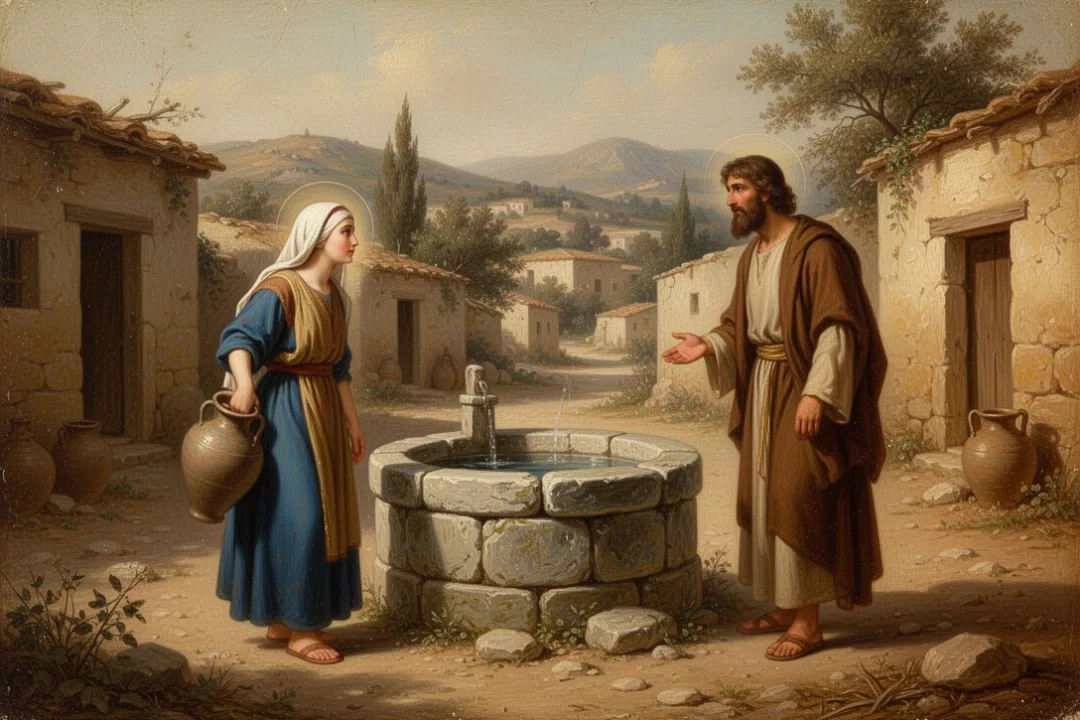
John 4 begins with Jesus traveling through Samaria and stopping near Sychar at Jacob’s well. His disciples go into town to buy food, while Jesus remains at the well. A Samaritan woman arrives to draw water, and Jesus asks her for a drink.
That opening request creates several layers of tension. Jesus is a Jewish man speaking publicly with a Samaritan woman, and Jews and Samaritans did not normally share easy social relations. John also emphasizes the ordinary physical need for water before the conversation moves toward spiritual thirst and eternal life.
The woman is surprised that Jesus would ask her for water. Jesus responds by speaking about “living water,” using an image that first sounds like flowing water but points toward the life God gives. As the conversation develops, she realizes that he knows facts about her life that a stranger would not normally know.
Jesus tells her to call her husband. She says she has no husband, and Jesus identifies the complicated truth behind that answer: she has had several husbands, and the man with whom she now lives is not her husband. The passage gives no explanation for those relationships. They might have involved death, divorce, abandonment, or other circumstances beyond her control.
That uncertainty matters. Many traditional retellings portray her as a notorious sinner who comes to the well at the hottest part of the day to avoid other women. John does not say either of those things. The text gives the time as about noon, but it does not explain why she came then or imply that the village rejected her.
Her response changes the direction of the discussion. She raises the dispute over worship on Mount Gerizim and in Jerusalem, showing that she is not merely a passive listener. Jesus answers her question and speaks of a time when worship will not be confined to either mountain. He also reveals that he is the promised Messiah, an unusually direct disclosure in John’s Gospel.
The woman leaves her water jar and returns to the town. She tells the people about Jesus, asking whether he could be the Christ. Her testimony brings the townspeople to Jesus, and many believe first because of what she says and then because they hear him themselves.
John 4 portrays her testimony as a bridge between a personal encounter with Jesus and a community’s decision to listen for itself.
The story ends with the Samaritans inviting Jesus to remain with them. Many more believe, and they identify him as the Savior of the world. The woman’s role is therefore not a minor episode in someone else’s ministry. She becomes the first recorded evangelist to her own Samaritan community in John’s Gospel.
Why the Samaritan woman’s conversation with Jesus matters
Jesus crosses ethnic and social boundaries
The encounter challenges several boundaries at once: Jew and Samaritan, man and woman, teacher and outsider, and respected religious figure and a person with a complicated public history. Jesus does not treat the woman as invisible or require her to enter a Jewish setting before he will speak with her.
His approach is neither careless nor patronizing. He begins with a request, listens to her questions, and engages her theological concern. Her Samaritan identity is part of the story, not an obstacle she must hide before receiving dignity.
She asks serious theological questions
The woman’s question about worship is sometimes treated as a distraction from her personal life. In the narrative, however, it is a serious question about the proper place to meet God. Jesus answers it rather than dismissing it.
Her exchange with Jesus shows that spiritual insight is not limited by ethnic identity, gender, or social reputation. She understands that the coming Messiah will make God’s purposes clear, and Jesus responds by identifying himself as that figure.
Her testimony is direct and effective
The woman does not present a long argument or claim expert status. She tells the town what happened and invites people to investigate. Her words lead others to encounter Jesus personally, and the community’s faith develops beyond her initial report.
This pattern gives her testimony both honor and proper limits. She is a genuine witness, but the people do not remain dependent on secondhand information. They listen to Jesus and come to their own conviction.
She is not reduced to her past
Jesus knows her history without treating it as the complete definition of her character. The conversation includes moral and relational truth, but it also includes worship, revelation, identity, and mission. The woman leaves the scene as someone who has received understanding and has something valuable to tell others.
That balance is especially important when interpreting women in Scripture. A woman’s marital history, suffering, or social vulnerability should not automatically become the only lens through which readers see her. John 4 gives her intellectual agency, spiritual curiosity, and a public voice.
What other women in Samaria appear in the New Testament?
John 4 is the most detailed Samaritan woman narrative, but it is not the only New Testament passage involving Samaritan women. Acts 8 describes Philip going down to a city in Samaria and proclaiming the Messiah. The people listen, and both men and women respond to the message and are baptized.
The wording in Acts is significant because it explicitly includes women among those who receive the gospel. They are not merely implied members of households. Luke names them as participants in the public response to Philip’s preaching.
Acts 8 also shows the Samaritans receiving healing and experiencing great joy. The passage later describes the apostles in Jerusalem hearing that Samaria has accepted God’s word and sending Peter and John. The events connect Samaritan faith with the wider Christian community rather than treating it as a separate or inferior movement.
The account does not give the women names or individual stories. That means readers should not invent details about them. What the passage does establish is clear: Samaritan women were among the people who believed, were baptized, and became part of the expanding church.
Several other Gospel passages use Samaritans to challenge assumptions about who acts faithfully. In Luke 10, Jesus makes a Samaritan the compassionate figure in a teaching about loving one’s neighbor. In Luke 17, a Samaritan is the one leper who returns to give thanks after being healed. Those stories concern men, not women, but they help explain why the Samaritan woman’s role in John 4 carries such force.
Jesus repeatedly presents Samaritans as people whom religious insiders should not dismiss. At the same time, the Gospels do not romanticize every Samaritan or pretend that Jewish-Samaritan tensions did not exist. The point is that God’s work cannot be confined to the group that expects to receive it.
John 4: an unnamed Samaritan woman speaks with Jesus, recognizes his significance, and tells her community.
Acts 8:4-25: Samaritan women and men hear Philip, believe, and are baptized.
Luke 10:25-37: a Samaritan provides a model of neighborly mercy.
Luke 17:11-19: a Samaritan healed from leprosy returns to thank Jesus.
What do the Old Testament prophets say about Samaria’s women?
The Old Testament uses “Samaria” both for a city and for the northern kingdom it represents. Prophetic references to its women often address social injustice among the wealthy. These passages should be read as corporate moral criticism, not as a claim that every woman in Samaria shared the same behavior.
Amos 4:1 addresses the “cows of Bashan” on Mount Samaria, a deliberately severe image aimed at women who oppressed the poor and demanded luxury from their husbands. The prophet accuses them of exploiting vulnerable people while enjoying abundance. The language is harsh because Amos is confronting a system in which wealth rests on injustice.
Isaiah 3:16-26 also describes the proud women of Jerusalem, not Samaria, condemning display, luxury, and social arrogance. It is sometimes connected with broader discussions of women in the divided kingdoms, but the passage itself should not be relabeled as a prophecy against Samaria. Precision matters when comparing biblical texts.
Hosea addresses Samaria’s unfaithfulness through imagery of idolatry and political dependence. The book frequently portrays the northern kingdom as a whole through feminine metaphors, especially as an unfaithful wife. These images describe the nation’s covenant relationship with God; they are not straightforward biographies of ordinary women.
Other passages show the consequences of Samaria’s political and religious collapse. The city fell to Assyria during the eighth century BC, and the northern kingdom was removed from the political map. The later Samaritan community emerged from a complicated history involving the remaining population, Assyrian resettlement, and continuing religious traditions.
These prophetic texts offer two cautions for modern readers:
Do not confuse metaphor with biography. When a prophet personifies a city as a woman, the image represents a nation or society.
Do not use Amos to condemn women as a class. The target is wealth joined to exploitation, not femininity or prosperity by itself.
Do not ignore economic injustice. The prophecy connects comfortable living with the treatment of poor and powerless people.
Do not erase marginalized women from the biblical story. The unnamed woman in John 4 and the women in Acts 8 are active participants, not merely symbols.
A responsible reading holds both themes together: the Bible can criticize powerful women who participate in oppression while honoring women whose faith, questions, and testimony help others encounter God.
How should you understand the women of Samaria today?
The Samaritan woman’s story invites readers to examine the assumptions they bring to people with complicated histories. It is easy to fill in gaps with familiar interpretations, but John 4 asks for a more careful reading. The woman is known by Jesus, challenged by truth, and entrusted with a message before she has a polished religious reputation.
Her story also presents conversation as a form of ministry. Jesus does not begin by demanding that she prove her worthiness. He engages her where she is, responds to her questions, and leads the discussion toward deeper understanding. That does not remove the need for repentance or moral honesty; it shows that truth and dignity belong together.
The women in Acts 8 reinforce another point: communities respond to the gospel through many people, including people whose names are not preserved. The unnamed women who believed in Samaria are still part of the biblical record. Their lack of individual biographies does not make their faith insignificant.
The prophetic passages add a necessary social dimension. Faith cannot be separated from how people treat the poor, use wealth, or participate in systems of power. Amos does not praise religious identity while overlooking exploitation. A community that claims devotion to God must also face the consequences of injustice.
For churches and Bible study groups, these passages can support careful questions:
What assumptions do we make about people whose relationships or backgrounds are complicated?
Do we allow women to ask theological questions and speak about their faith with authority?
Do we recognize unnamed believers whose service is essential even when their stories are not widely known?
How do our economic choices affect people with less power?
Are we willing to receive wisdom from people outside our ethnic, social, or religious comfort zone?
The women of Samaria therefore represent several complementary biblical themes. The woman at the well shows a person moving from questioning to witness. The women in Acts show a community receiving the gospel. Amos’s wealthy women warn that privilege without justice invites judgment.
Taken together, these accounts resist simple stereotypes. Samarian women are not presented as one type of person. They include a thoughtful questioner, public witnesses, unnamed believers, and wealthy figures confronted over oppression. The Bible’s picture is varied because real people are varied.
John 4 remains the central story because it brings these themes into one encounter: ethnic division, gender expectations, personal history, worship, revelation, and testimony. Jesus does not erase the woman’s identity as a Samaritan. He meets her within that identity and makes her part of a wider work that reaches an entire town.
Frequently asked questions
Is the Samaritan woman in John 4 named?
No. John does not give her a personal name. Later Christian traditions have assigned names to her, but those names are not supplied by the biblical text. The Gospel identifies her by her place of origin and preserves her conversation with Jesus, her response to his revelation, and her role in bringing other Samaritans to hear him.
Was the Samaritan woman a prostitute?
The Bible does not say that she was a prostitute. John 4 says she had had five husbands and was living with a man who was not her husband, but it gives no explanation for those relationships. She may have experienced circumstances outside her control. Calling her a prostitute goes beyond what the passage actually states.
What did Samaritan women do in Acts 8?
Acts 8 says that people in Samaria, including both women and men, believed Philip’s preaching about the Messiah and were baptized. The passage does not name individual women or describe their personal stories. It does clearly present them as active recipients of the gospel and members of the growing Christian community.
Why did Jesus speaking with a Samaritan woman matter?
The conversation crossed several boundaries involving ethnicity, religion, gender, and social expectations. Jesus treated her as a person capable of understanding spiritual truth and responding publicly. He answered her question about worship and revealed his identity to her. She then shared her experience with her town, and many Samaritans came to hear Jesus.












Leave a Reply