Have you ever wondered how the Israelites could escape Egypt when the sea blocked their path and Pharaoh’s army was close behind? The crossing of the Red Sea is one of the Bible’s best-known stories, describing how God delivered the Israelites from slavery and brought them safely toward the wilderness.
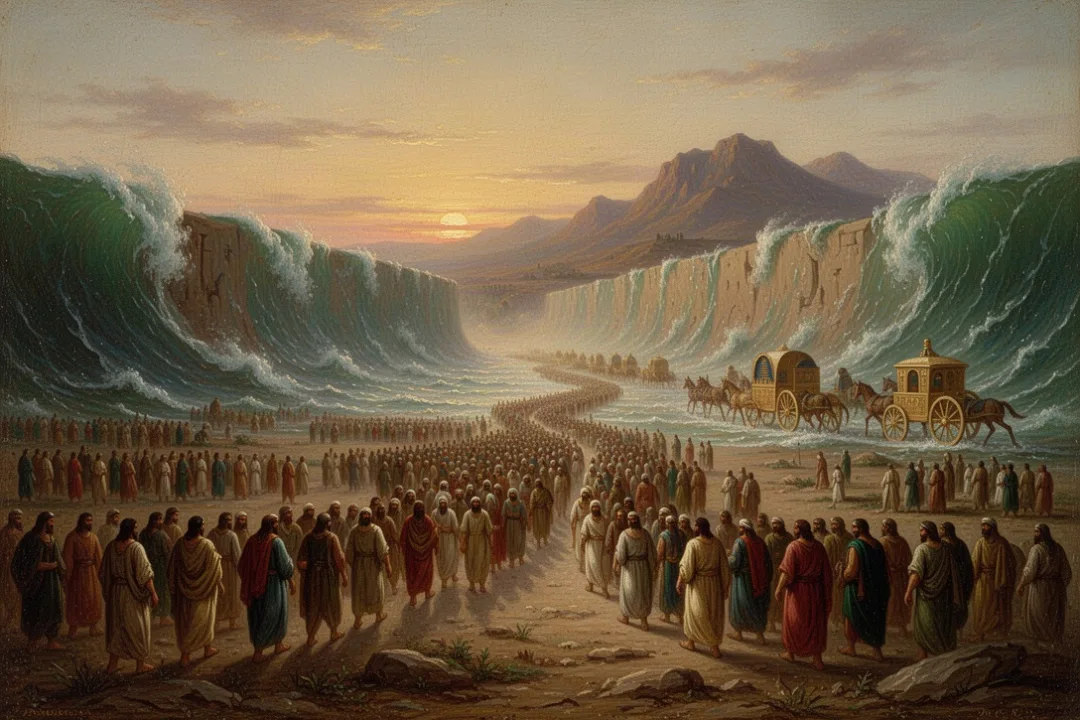
The account appears in Exodus 14. Moses leads the Israelites out of Egypt, but Pharaoh changes his mind and sends his army after them. With the sea in front and Egyptian soldiers behind, the people panic. Moses tells them to trust God, and the waters are divided so the Israelites can cross on dry ground. When the Egyptians follow, the waters return and the army is overwhelmed.
The story is both a dramatic escape narrative and a central statement about freedom, faith, and divine deliverance. Readers often ask whether the event should be understood as a miracle, a natural event guided by God, or a story whose exact location remains uncertain. The biblical text clearly presents it as an act of God, while historians and geographers continue to discuss its setting and possible physical processes.
The crossing takes place after a long period of Israelite oppression in Egypt. According to Exodus, the Israelites had been forced into labor, and Pharaoh had resisted Moses’ demand to let them leave. A sequence of plagues struck Egypt, ending with the death of the firstborn and leading Pharaoh to release the Israelites.
The departure was not a casual migration. The Israelites left quickly, taking families, livestock, and possessions. Exodus describes them as traveling in an organized community, guided by God through a pillar of cloud during the day and a pillar associated with fire at night. These signs represent God’s presence and direction as they move away from Egypt.
Pharaoh soon regrets allowing them to leave. He gathers chariots, horsemen, and troops and pursues the Israelites. The Egyptian response shows that the escape has become a national and military crisis, not merely the departure of a group of workers.
The central setting: Exodus 14 does not describe the event as a simple boat crossing. It presents the Israelites as trapped between a body of water and an approaching army, with the escape made possible through God’s intervention.
How the crossing of the Red Sea unfolds step by step
The narrative in Exodus 14 follows a clear sequence. Each stage raises the pressure before the escape and then reverses the situation.
The Israelites camp near the water. God directs them to a location near the sea rather than along the easiest or safest-looking route. Their position leaves them vulnerable when Pharaoh’s forces arrive.
Pharaoh pursues them. The Egyptian ruler realizes that the Israelites have left permanently and sends a force equipped to overtake them. The approaching army creates immediate fear among the people.
The Israelites panic. They accuse Moses of bringing them into the wilderness to die. Their reaction reflects the practical danger they face and the uncertainty of a newly freed people.
Moses tells them to stand firm. Moses reassures the people that God will act on their behalf. He then receives instructions to raise his staff and stretch out his hand over the sea.
A strong wind divides the waters. Exodus describes a powerful wind blowing through the night. The waters separate, and the Israelites move forward on dry ground with water described as standing on both sides.
The Israelites cross. Families, elders, children, and livestock pass through the opened path. The crossing is presented as a national escape, not the rescue of only a small group.
The Egyptian army follows. Pharaoh’s chariots enter the same passage. The pursuing force believes it can capture the Israelites, but the conditions soon become difficult for the soldiers and their vehicles.
The waters return. At Moses’ command, the waters come back over the passage. The Egyptian force is defeated, while the Israelites reach the opposite side safely.
The Israelites respond with fear and worship. Exodus says that the people fear God, trust God and Moses, and then sing. The next chapter records a victory song associated with Moses and, in another section, Miriam.
This sequence explains why the crossing has remained so memorable. The Israelites are not saved because they have greater military strength. They are saved because the threat behind them is removed and a path appears where no path seemed possible.
Where the biblical crossing may have taken place
The exact location of the crossing is uncertain. Many English Bibles use Red Sea, but the Hebrew expression in Exodus is commonly transliterated as Yam Suph. Depending on context and translation, this expression may refer to the Red Sea, the Sea of Reeds, or a marshy body of water connected with the northeastern edge of Egypt.
That difference matters because the geography of the ancient eastern Nile Delta was not identical to the landscape visible today. Shorelines, lagoons, wetlands, channels, and branches of the Nile have changed over time. A body of water mentioned in an ancient text may therefore be difficult to match with a modern map.
Several broad possibilities have been proposed:
The northern Gulf of Suez: Some interpretations place the event near the northern end of the Gulf of Suez, one of the two major arms of the modern Red Sea.
Lake or marsh areas east of the Nile Delta: Other proposals focus on shallow lakes, reed-filled wetlands, or lagoons that may have existed along the route from Egypt toward Sinai.
The Gulf of Aqaba: Some popular theories place the crossing near the eastern branch of the Red Sea, but this proposal is not established by the biblical text or by a settled historical consensus.
A now-altered waterway: The event may have occurred near an ancient channel or lake whose boundaries changed or disappeared over the centuries.
There is no universally accepted archaeological identification of the crossing site. Claims that a particular underwater formation, chariot wheel, or beach proves the route should be treated cautiously. Such claims often rely on uncertain dating, disputed identifications, or photographs that cannot establish the story’s location by themselves.
Why “Sea of Reeds” is part of the location debate
The expression often translated as Red Sea may originally have referred to a reed-filled water region rather than the large open sea familiar from modern geography. Ancient place names do not always correspond neatly to present-day names, and translators must weigh linguistic, geographical, and traditional evidence.
A marshy or shallow setting does not automatically make the story less significant. In the biblical account, the danger comes from both the water and the army. Even a shallow body of water could become impassable because of mud, marsh channels, strong winds, and rapidly changing water levels.
Some readers prefer the traditional identification with the Red Sea because it has shaped Jewish and Christian interpretation for centuries. Others consider a Sea of Reeds setting more plausible geographically. The safest statement is that the ancient location remains debated, while the narrative’s theological message does not depend on a precise modern label.
How wind and water may explain the physical setting
Exodus describes a strong wind blowing all night and exposing dry ground. This detail has led some researchers to discuss a process known as wind setdown. Under certain conditions, persistent wind can push water away from a shallow area, temporarily exposing land or reducing the depth enough for passage.
In a lake, lagoon, or marsh, wind-driven water movement could produce a temporary corridor. If the wind weakened or changed direction, water might rush back into the exposed area. A narrow passage could therefore become dangerous very quickly for anyone attempting to cross it.
This kind of explanation does not settle what happened. It can suggest a possible mechanism, but it cannot prove that the crossing occurred at a particular location or that the biblical event unfolded through ordinary weather alone. The text presents the timing, direction, and result of the wind as part of God’s purposeful action.
There are several ways readers understand the relationship between miracle and nature:
A direct miracle: God divided the waters in a way that cannot be explained by normal physical processes.
A providential natural event: God used wind, tides, shallow water, or local geography to create the opening at exactly the needed time.
A narrative account of deliverance: The text communicates the meaning of Israel’s rescue without requiring modern readers to reconstruct every physical detail.
These interpretations differ, but they share an important point: the story’s focus is not a science experiment. It is the claim that the Israelites were powerless, an escape became possible, and Egypt’s military power could not prevent their freedom.
What Moses does during the escape
Moses serves as both leader and intermediary in the account. The people look to him for direction, but the narrative repeatedly emphasizes that the rescue comes from God rather than from Moses’ personal strength or military planning.
When the Israelites complain, Moses does not answer with a strategy for defeating the Egyptian army. He calls them to trust that God will act. Afterward, he follows the command to stretch out his staff over the water. The staff functions as a visible sign of authority received from God.
Moses’ role also changes after the crossing. Before the escape, he is challenged by frightened people who doubt the decision to leave Egypt. After the army has been defeated, the people recognize that Moses is acting under divine direction. The crossing therefore confirms his leadership at a decisive moment.
The story does not portray Moses as fearless in every situation. Instead, it shows a leader who must act despite uncertainty and public pressure. That distinction helps explain why the account continues to resonate with people facing situations where they have responsibility but limited control.
What the story says about Pharaoh and Egyptian power
Pharaoh represents the political and economic system from which the Israelites are escaping. His pursuit is not simply a personal change of heart. It shows his refusal to accept the loss of forced labor and his belief that military power can restore control.
The Egyptian chariots symbolize speed, organization, and technological advantage. In the ancient Near East, chariot forces were associated with royal power and battlefield strength. The Israelites, by contrast, are depicted as a vulnerable population traveling with families and animals.
The reversal is central to the narrative. The force that appears unbeatable becomes trapped by the same passage it uses to pursue the Israelites. The account therefore presents imperial power as limited, especially when it is used to preserve oppression.
This theme connects the Red Sea story with the broader Exodus narrative. God hears the suffering of enslaved people, confronts the ruler who refuses to release them, and brings them into a new stage of life. Freedom is not shown as merely a change of location; it requires the destruction of the power that continues to claim ownership over the people.
Why the crossing matters in Jewish tradition
In Judaism, the Exodus is a foundational story of identity, memory, and liberation. The crossing belongs to the larger account of how the Israelites became a people freed from Egyptian bondage and brought toward covenant life.
The event is remembered through the Song of the Sea in Exodus 15. The song celebrates God’s victory, the defeat of Pharaoh’s forces, and the movement from danger toward a promised future. Miriam is also associated with singing and tambourine playing after the crossing, highlighting the participation of women in the communal response.
The Exodus story receives special attention during Passover, which commemorates Israel’s departure from Egypt. The festival focuses especially on the final plague and the departure, while the crossing remains an essential part of the larger liberation story recalled in Jewish worship and teaching.
Jewish interpretation does not reduce the story to a private spiritual metaphor. It concerns a real community, a history of oppression, and the duties that follow freedom. The people rescued from slavery are later commanded to remember their experience when treating strangers, workers, and vulnerable people.
Why the crossing matters in Christianity
Christian readers also treat the crossing as a major biblical account of salvation and deliverance. The New Testament refers to Israel’s passage through the sea when discussing the formation of the community under Moses. One example appears in 1 Corinthians 10, where Paul uses the story to warn and instruct Christians about faithfulness.
Christian interpretation often reads the Exodus as a pattern that points beyond itself. Israel passes from slavery into freedom, while later Christian teaching describes salvation as release from sin and entrance into new life. These connections are theological interpretations rather than a replacement for the original story’s setting and meaning.
The crossing is also associated with baptism in Christian reflection because both involve movement through water and a decisive change in identity. The comparison should be handled carefully: Exodus 14 is an account of Israel’s communal escape, while baptism belongs to Christian practice. The connection lies in the shared theme of passing from an old condition into a new one.
What “crossing the Red Sea” means as an expression
People sometimes use crossing the Red Sea to describe surviving an impossible situation, leaving oppression behind, or reaching safety after a long period of fear. The phrase can be meaningful when it recognizes genuine hardship and the need for help from beyond one’s own resources.
However, the expression should not be used carelessly. Not every inconvenience is comparable to slavery, forced displacement, or the threat faced by the Israelites. A respectful use of the phrase recognizes the story’s seriousness rather than turning it into a slogan for an ordinary setback.
As a metaphor, the crossing may describe several kinds of transition:
Leaving an abusive or controlling environment with appropriate support.
Moving from dependence on an unjust system toward genuine independence.
Facing a decision when every available option seems dangerous.
Remembering that freedom often requires both escape and a new way of living.
Finding courage to act before every detail of the future is known.
The image is especially powerful because the Israelites do not see a clear path before the waters open. Their movement begins with trust and obedience, not with complete certainty about what comes next.
What archaeology can and cannot establish
Archaeology can illuminate the ancient Egyptian setting, the geography of the eastern Nile Delta, patterns of travel, military technology, and the kinds of landscapes that may have existed near the route toward Sinai. It can also help researchers understand how Egyptian rulers recorded victories and organized labor.
Archaeology cannot currently identify a universally accepted crossing site or independently verify every detail in Exodus 14. The absence of direct evidence does not prove that the event did not happen, but it does mean that claims of certainty should be avoided.
Ancient people did not leave modern forms of documentation for every migration or disaster. Evidence may be incomplete, altered by later environmental changes, or difficult to connect with a specific narrative. At the same time, faith-based confidence and archaeological proof are different kinds of claims and should not be presented as interchangeable.
Use evidence carefully: A proposed location becomes more credible when it fits the language, ancient geography, travel route, environmental conditions, and historical context together. A single photograph or sensational discovery is not enough.
How the crossing connects with the rest of Exodus
The sea crossing is not an isolated miracle. It belongs to a sequence that begins with oppression, continues through Moses’ calling and the plagues, and moves toward covenant and law at Mount Sinai. The people are freed from Pharaoh, but they still need to learn how to live as a community.
That order matters. Exodus does not present freedom as the end of every problem. After crossing the sea, the Israelites face hunger, thirst, fear, internal conflict, and uncertainty in the wilderness. The event gives them a new identity, but it does not remove the difficult work of becoming a responsible people.
The crossing also marks a boundary between two conditions. Before it, Pharaoh’s army can still claim the Israelites and force them back toward Egypt. After it, the army is no longer a threat, and the people begin traveling toward Sinai. The water therefore functions as a boundary of release.
Later biblical writers repeatedly recall the Exodus when speaking about God’s faithfulness. References to bringing Israel out of Egypt and through the sea appear in poetry, prophecy, prayer, and teaching. The event becomes a shared memory that helps later generations interpret their own danger and hope.
What readers can learn without forcing the story into a simple lesson
The most direct lesson is that freedom may require movement before the destination is fully visible. The Israelites are not given a detailed map of every stage ahead. They are asked to leave the power that enslaved them and trust the guidance provided one step at a time.
The story also shows that fear can coexist with faith. The Israelites panic even after witnessing the plagues and receiving permission to leave. Their fear does not make the danger imaginary, and faith does not mean pretending that an approaching army is harmless.
Another lesson concerns leadership. Moses must listen, communicate, and act under pressure, while the community must decide whether to follow. Good leadership in a crisis does not deny danger; it helps people respond without allowing fear to dictate every decision.
Finally, the crossing directs attention toward the vulnerable. The people who pass through are not an elite army or a royal household. They are former slaves traveling with children, families, and animals. The narrative insists that their lives matter and that systems built on exploitation will not last forever.
How to read the crossing of the Red Sea responsibly
A careful reading keeps several questions together rather than using one question to cancel the others. You can ask what Exodus says, where the event may have occurred, how ancient readers understood it, and what the story means within Jewish and Christian traditions.
Start with the primary passage: Read Exodus 13:17 through 15:21 to follow the sequence from departure to song.
Separate the text from speculation: Mark which details come directly from Exodus and which belong to later theories about geography or natural mechanisms.
Respect translation differences: Compare how translations render the Hebrew place name, while remembering that no translation alone settles the location.
Consider the ancient setting: Think about travel, military power, wetlands, wind, and the relationship between Egypt and the Sinai region.
Notice the community’s response: The account includes fear, complaint, obedience, worship, and shared memory rather than presenting only a spectacular event.
Avoid exaggerated certainty: A meaningful religious interpretation does not require a claim that modern evidence has solved every historical question.
The enduring power of the crossing lies in the complete movement it represents: from forced labor to freedom, from pursuit to safety, and from fear to communal worship. Whether a reader emphasizes miracle, providence, history, symbolism, or all of these together, the account remains centered on a people who find a way forward when retreat would mean returning to oppression.
Frequently asked questions
Is the Red Sea crossing a historical event?
The Bible presents the crossing as a historical event in Israel’s escape from Egypt, but modern historians cannot independently verify every detail or identify the exact site. Evidence about ancient Egypt and the eastern Delta provides context, while the location and chronology remain debated. Religious belief in the event rests on the biblical testimony and tradition, not on a universally accepted archaeological discovery.
Does the Bible actually say “Red Sea”?
Most English translations use “Red Sea,” but the Hebrew term is commonly rendered as “Yam Suph.” Some scholars understand it as the Sea of Reeds, possibly referring to a marsh, lake, or lagoon near Egypt. Translation choices reflect both linguistic tradition and geographical interpretation, so the wording does not by itself establish the modern body of water involved.
How long did the Israelites take to cross?
Exodus describes a strong wind blowing through the night before the Israelites crossed, but it does not provide a precise duration for the crossing itself. The narrative emphasizes that the people passed through on dry ground while the Egyptian army pursued them. Exact estimates about hours, distance, or group size go beyond what the text clearly states.
Why did Pharaoh chase the Israelites after letting them go?
In Exodus, Pharaoh and his officials regret releasing the Israelites and decide to pursue them. Their decision reflects the economic and political value of forced labor and Pharaoh’s desire to restore control. The pursuit also creates the crisis that frames the crossing: the Israelites must leave Egypt permanently rather than simply receive temporary permission to depart.





Leave a Reply