The Passover in the Bible: meaning and significance
The Passover in the Bible: meaning and significance
If you have encountered Passover in Exodus, the Gospels, or a church service, you may wonder why one event carries so much meaning across the Bible. Passover began as Israel’s memorial of deliverance from slavery in Egypt. It remembers the night God spared the Israelite households and brought them toward freedom, while later biblical writers connect its themes of sacrifice, covenant, judgment, and redemption with Jesus.
The central account appears in Exodus 12. God told Moses and Aaron that the Israelites were to prepare for a final plague against Egypt, mark their homes with the blood of a lamb, eat a special meal, and be ready to leave. The event became an annual observance for Israel, so later generations would remember not only what God had done but also who they were as a people.
Passover takes place during the last of the ten plagues described in Exodus. Pharaoh had repeatedly refused to release the Israelites, who were living under forced labor and oppression. God announced that judgment would fall on Egypt’s firstborn, but he also provided a specific way for Israelite households to be spared.
Each household was to select a lamb without a defect, keep it until the appointed day, and slaughter it at twilight. Its blood was placed on the two doorposts and the lintel of the house. When God passed through the land, he would see the blood and pass over that home rather than allowing the plague to strike it, as described in Exodus 12.
The sign on the doorway did not represent a human attempt to control God. It was an act of obedient trust in God’s instruction. The story presents deliverance as something God provided, while the Israelites responded by listening, preparing the meal, marking their homes, and remaining inside until morning.
Central idea: Passover remembers God’s action to protect and release Israel. The meal was both a response to immediate danger and a permanent reminder that the nation’s freedom began with God’s deliverance, not its own strength.
The name “Passover” comes from the account’s description of God passing over the Israelite houses. The Hebrew term is associated with this act of sparing, although the wider meaning of the celebration includes more than avoiding the plague. Passover also marks the beginning of Israel’s departure from Egypt and the formation of a people who would live under God’s covenant.
Exodus portrays the final plague as a decisive break between Pharaoh’s rule and God’s purpose for Israel. After the death of the firstborn, Pharaoh finally told Moses and Aaron to leave. The Israelites departed quickly, carrying bread dough before it had time to rise. In this way, Passover is linked directly to the Exodus, not treated as an isolated religious ceremony.
How the first Passover meal was observed
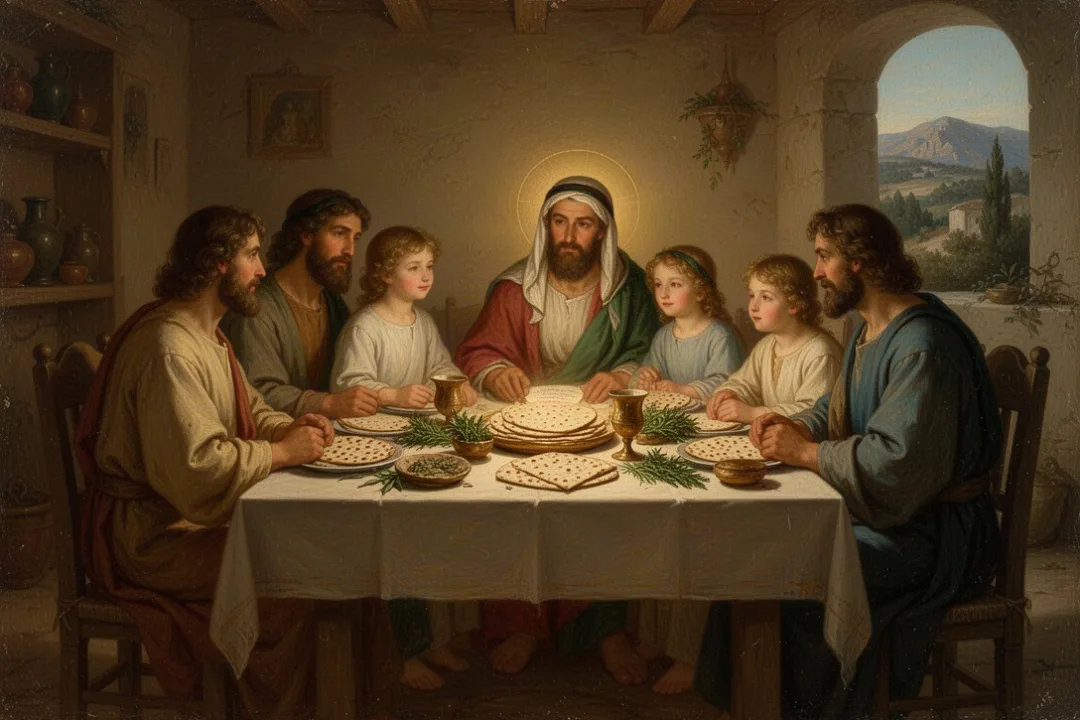
The first Passover meal had several features that communicated urgency, separation, and remembrance. The lamb was roasted and eaten with unleavened bread and bitter herbs. The people were instructed to eat with their belts fastened, sandals on their feet, and staffs in hand, prepared to leave without delay.
Each part of the meal helped preserve the memory of the night. The lamb recalled the means of protection. The unleavened bread recalled the hurried departure. The bitter herbs represented the harshness of life in Egypt. These elements made the memory physical and communal rather than merely intellectual.
The lamb: It was to be whole and without defect, and its blood marked the household’s doorway.
Unleavened bread: The dough had no time to rise before the people left Egypt.
Bitter herbs: They helped recall the bitterness of slavery and oppression.
Readiness to travel: The meal was eaten as people prepared for immediate departure.
Exodus 12 also gives rules about who could eat the meal and how the household was to handle the lamb. The Israelites were not to break its bones, and any remaining portion was to be burned rather than saved for later. These details underline that the meal was a sacred observance with defined boundaries, not an ordinary dinner.
The celebration was to be repeated every year. Parents were expected to explain its meaning when their children asked why they kept the ceremony. Exodus 12 and Exodus 13 present this teaching pattern clearly: the ritual was a way for one generation to tell the next that God brought Israel out of Egypt.
This question-and-answer pattern matters because Passover was designed to form historical memory and religious identity. Children were not simply told that a distant ancestor had escaped. They were taught to see themselves as part of the people whom God delivered. The annual meal made the past present in the life of the community.
Passover throughout Israel’s Old Testament story
After the Exodus, Passover remained one of Israel’s appointed celebrations. Leviticus 23 includes it among the sacred times of the nation, placing it at the start of the month later associated with Israel’s spring festivals. The observance was tied to the wider religious calendar and followed by the seven-day Feast of Unleavened Bread.
The biblical books do not describe every year of Passover observance. They do, however, highlight certain celebrations when leaders renewed the nation’s commitment to God. Joshua 5 describes Israel keeping Passover after entering the land of Canaan. The event signals a major transition: the wilderness period has ended, and the people are beginning life in the land God promised.
Second Chronicles 30 describes a large Passover held during the reign of Hezekiah. The king invited people from across Israel and Judah to return to the Lord and worship at Jerusalem. The account emphasizes renewed faithfulness, national gathering, and the restoration of proper worship after a period of neglect.
Another significant observance appears during the reforms of King Josiah in 2 Kings 23 and 2 Chronicles 35. Josiah’s workers found the Book of the Law during temple repairs, and the king responded by removing idolatrous practices and renewing covenant obedience. The Passover that followed is presented as unusually significant because it expressed a broad return to the instructions given through Moses.
Ezra 6 records Passover after the Jewish exiles returned from Babylon and rebuilt the temple. Here the festival marks restoration after national judgment and displacement. The returned community celebrates God’s work in bringing them back, showing that Passover could speak not only of the original escape from Egypt but also of renewal after catastrophe.
These accounts show a recurring biblical pattern:
Remember God’s deliverance. The people look back to the Exodus as the foundation of their identity.
Examine present faithfulness. Passover can expose whether worship and community life have turned away from God.
Restore communal worship. Leaders use the festival to gather the people and renew shared commitment.
Teach the next generation. The celebration keeps the story alive through family and public practice.
Passover also appears in the prophetic and historical background of the Bible as a symbol of Israel’s relationship with God. The Exodus itself becomes a model for later deliverance. Yet the Old Testament does not treat the festival as a magical guarantee of safety. The prophets repeatedly insist that ritual must be joined to justice, repentance, and loyalty to God.
Passover and the Last Supper in the New Testament
The Gospels place Jesus in Jerusalem during Passover, when Jewish pilgrims gathered to remember the Exodus. The timing is central to the story of his death. Matthew, Mark, and Luke describe Jesus sharing a final meal with his disciples in Passover settings, while John presents the chronology with distinct details connected to the festival.
During the meal described in the Synoptic Gospels, Jesus takes bread and wine and gives them particular significance. He identifies the bread with his body and the cup with his blood, associating the cup with the new covenant. The exact wording differs among the Gospel accounts, so it is best to read Matthew 26, Mark 14, and Luke 22 together rather than depend on one short phrase.
Jesus’ actions place his coming death within the story of Israel’s redemption. Passover already remembered rescue through God’s intervention. At the Last Supper, Jesus presents his death as the means through which God establishes a new covenant and brings forgiveness. Christian interpretation therefore sees a strong connection between the Exodus and the cross.
The Gospel of John uses Passover imagery in several ways. John the Baptist calls Jesus the “Lamb of God” in John 1:29, meaning that Jesus is identified as the one who deals with human sin. John’s account of the crucifixion also includes details that readers associate with the Passover lamb, including the statement that Jesus’ bones were not broken, connected with Exodus 12:46 and Psalm 34:20.
Paul makes the connection directly in 1 Corinthians 5:7, where he describes Christ as the Passover sacrifice for believers. This does not erase the historical meaning of the Jewish festival. Instead, it shows how an early Christian writer interpreted Jesus’ death through the categories of Israel’s Scriptures: sacrifice, deliverance, purity, covenant, and a new beginning.
Read the connection carefully: The New Testament’s use of Passover imagery is a Christian theological interpretation of Jesus. It should not be used to dismiss Jewish Passover practice or to suggest that the Jewish festival has no continuing meaning for Jewish people.
Why Christians connect Passover with salvation
Christian teaching commonly connects Passover with salvation through several shared themes. In both accounts, people face a serious threat, God provides a way of deliverance, and a marked act of faith separates the delivered community from the power that holds it captive.
The connection begins with rescue from bondage. Israel is released from Pharaoh’s authority and led toward a new life as God’s covenant people. Christians understand Jesus’ death and resurrection as deliverance from sin and death, not as a political escape from Egypt. The two events are not identical, but the Exodus supplies a foundational pattern for thinking about salvation.
A second theme is sacrifice. The first Passover includes the death of a lamb and the use of its blood as a sign over the household. The New Testament interprets Jesus’ death sacrificially, especially in passages such as Romans 3, 1 Corinthians 5, and Hebrews 9–10. Different Christian traditions explain this sacrifice in different ways, but they agree that Jesus’ death is central to the saving message of the Gospel.
A third theme is covenant. The Exodus does not end with the people merely escaping Egypt. Israel is brought into a relationship with God, receives his commandments, and becomes a distinct community. Likewise, the Last Supper’s language about a new covenant indicates that Christian salvation involves a changed relationship with God, not only the removal of guilt.
A fourth theme is new life. Israel’s departure begins a new chapter, although the people still have a long journey ahead. In the New Testament, Jesus’ resurrection gives the Passover connection a future-facing dimension. Christians celebrate not only a death associated with Passover but also the resurrection that they believe confirms Jesus’ victory and inaugurates new life.
These themes explain why many Christian churches observe the Lord’s Supper or Communion with Passover in mind. The practice is not identical to the Jewish Passover seder. It comes from the New Testament accounts of Jesus’ meal with his disciples and varies among Christian traditions in its theology, frequency, and form.
Jewish Passover and Christian interpretation
Passover remains a major Jewish festival with its own living traditions, prayers, foods, family customs, and interpretations. Jewish observance today is shaped by the Torah, rabbinic tradition, and the history of Jewish communities. The biblical Passover sacrifice at the Jerusalem temple is not practiced today because the temple no longer stands, so modern seders do not simply reproduce the first Exodus meal.
A traditional Jewish seder includes the retelling of the Exodus, questions from children, symbolic foods, blessings, and the reading of the Haggadah. Customs differ among Jewish families and communities, but the central purpose remains remembering freedom from Egyptian slavery and recognizing the continuing significance of the story.
Christians reading the New Testament should hold two facts together. First, Jesus and his disciples were Jewish, and the Last Supper belongs to a Jewish biblical and historical setting. Second, the New Testament writers apply Passover language to Jesus in ways that express Christian convictions about his death and resurrection.
That means a respectful reading avoids replacing one tradition with the other. Christians may see Jesus as the fulfillment of Passover imagery, while Jewish people continue to observe Passover as a central festival of their own faith. The shared biblical story does not erase the differences between Jewish practice and Christian theology.
For personal study, read the passages in their literary order and compare their purposes:
Exodus 12–13: The first Passover, the Exodus, and instructions for teaching future generations.
Leviticus 23: Passover and Unleavened Bread within Israel’s sacred calendar.
Joshua 5: Passover celebrated after Israel enters the promised land.
2 Chronicles 30 and 35: National renewal and reform expressed through Passover.
Matthew 26, Mark 14, Luke 22, and John 13–19: Jesus’ final meal, death, and Passover setting.
1 Corinthians 5 and Hebrews 9–10: Christian interpretations of sacrifice, purity, covenant, and redemption.
As you read, ask what each passage emphasizes. Does it focus on freedom, worship, family memory, sacrifice, covenant, judgment, or hope? The answer may change from one biblical book to another, but the central thread remains clear: Passover is the Bible’s foundational story of God delivering a people and calling them to remember.
Frequently asked questions
Is Passover the same as Easter?
No. Passover is a Jewish festival rooted in the Exodus from Egypt. Easter is a Christian celebration of Jesus’ resurrection. The New Testament places Jesus’ death and resurrection during the Passover season, so Christians connect the events theologically, but the observances have different histories, rituals, and meanings.
What does the blood of the lamb represent in Exodus?
In Exodus 12, the blood marks the Israelite homes so the plague does not strike them. It functions as the sign God commanded for protection. Christian readers often connect this image with Jesus’ sacrificial death, but the original passage first describes God’s deliverance of Israel from Egypt.
Did Jesus celebrate Passover?
The Synoptic Gospels present Jesus sharing a final meal with his disciples in a Passover setting. John’s Gospel arranges the events with different chronological details, leading scholars and Christian traditions to discuss how the meal relates to the festival. All four Gospels connect Jesus’ death closely with Passover.
Why is unleavened bread used during Passover?
The Israelites left Egypt in such haste that their dough did not have time to rise. Unleavened bread therefore became a lasting reminder of the hurried Exodus. The seven-day Feast of Unleavened Bread follows Passover and reinforces the connection between the meal and Israel’s departure from slavery.








Leave a Reply