The story appears in Luke 10:25–37, where Jesus responds to a question from a lawyer who asks what he must do to inherit eternal life. The man already knows that the law calls people to love God fully and to love their neighbors as themselves, but he asks for a narrower definition of “neighbor.”
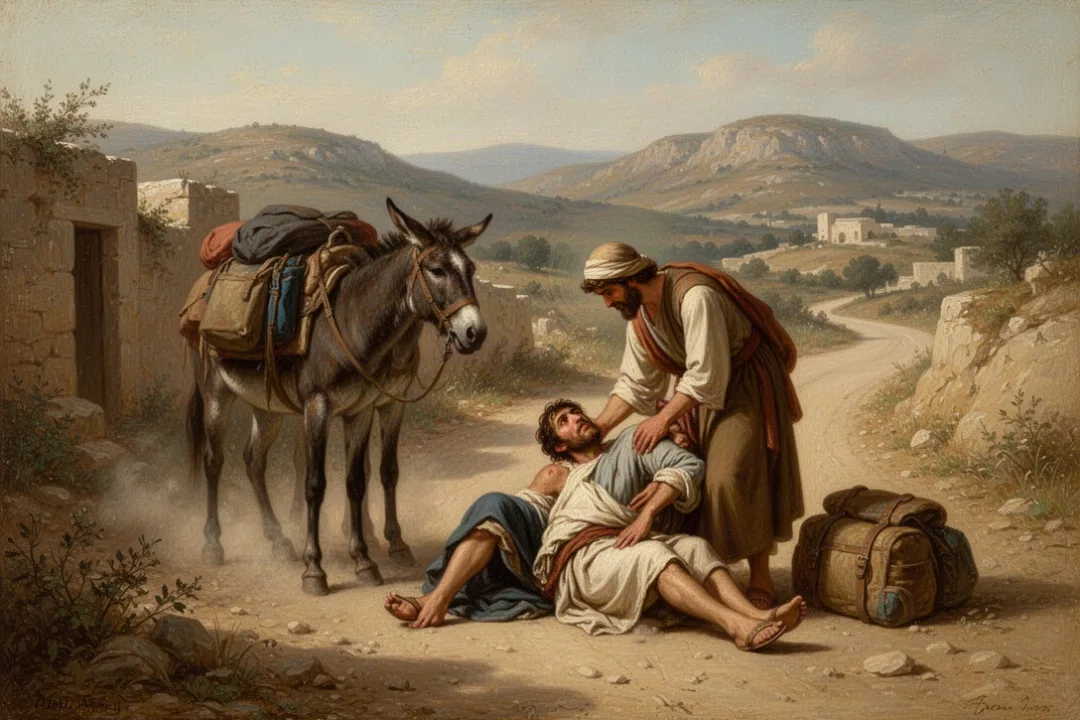
Jesus answers with a story instead of giving a boundary around the word. A traveler goes from Jerusalem to Jericho and is attacked, robbed, stripped, and left badly injured. A priest sees him and passes by, followed by a Levite. Then a Samaritan arrives, stops, treats the wounds, transports the injured man to an inn, and pays for his care.
The story ends with a question about which person acted as a neighbor. The answer is the one who showed mercy. Jesus then tells the questioner to do the same, shifting attention from identifying who deserves help to becoming a person who gives help.
Central idea: The parable does not define a neighbor by nationality, religion, friendship, or social status. It shows that neighborly love is an active response to another person’s need.
Why the Samaritan’s role would have shocked Jesus’ audience
To understand the force of the story, you need to know that Jews and Samaritans had a long history of religious, political, and cultural hostility. They shared some traditions but disagreed about worship, sacred places, authority, and identity. Tensions could be strong enough that “Samaritan” was used as a serious insult in some conflicts.
Jesus could have made a respected religious leader the hero. Instead, he placed a Samaritan at the center of an example of faithful compassion. The priest and Levite were associated with religious life, yet the story does not say that they lacked knowledge of religious duties. It simply shows that their knowledge did not become mercy when they encountered suffering.
This reversal makes the parable more than a general appeal to kindness. It challenges assumptions about who is morally trustworthy and who is worth listening to. The person considered an outsider becomes the example, while respected insiders fail to act.
The Samaritan is not praised because of his ethnic identity alone. He is praised because he sees the wounded man, feels compassion, and takes responsible action. The story connects character with conduct rather than reputation.
What happens in the story, step by step
A traveler is attacked. A man traveling alone is robbed and severely beaten on the road between Jerusalem and Jericho. He is left helpless, exposed, and unable to secure his own rescue.
A priest passes by. The priest sees the situation but continues on the other side. The text does not explain his motive, so readers should be cautious about inventing one.
A Levite also passes by. Like the priest, he encounters the injured man but does not provide assistance. The repetition emphasizes that seeing suffering does not automatically produce compassion.
A Samaritan notices and responds. He approaches the injured man and is moved with compassion. He does not treat the victim’s identity or social background as a reason to withhold care.
He gives immediate aid. He tends the wounds, using the supplies available to him. His response is practical rather than merely emotional.
He transports the man to safety. The Samaritan places the injured traveler on his own animal, which likely means he walks while the wounded man rides.
He pays for continued care. At an inn, he takes responsibility for the man’s recovery and promises to cover additional expenses when he returns.
Jesus changes the question. Instead of asking who qualifies as a neighbor, Jesus asks who acted neighborly. The command is to imitate that mercy.
What “neighbor” means in the parable
The questioner wants to know the limits of his duty: “Who is my neighbor?” That wording can imply that some people are inside the obligation and others are outside it. Jesus does not provide a list of approved recipients. He presents a vulnerable person and asks what love requires in that moment.
The parable therefore treats neighbor as a role you choose to fulfill, not merely a label assigned to people who live near you. A neighbor is someone who moves toward another person’s need with mercy. This does not erase the reality of family, community, or special responsibilities, but it prevents those responsibilities from becoming an excuse for indifference.
The injured traveler may have been a stranger. The Samaritan does not know whether the man will thank him, repay him, or share his beliefs. He responds before receiving any assurance of personal benefit. His compassion is directed toward a human being in danger.
Jesus’ answer also turns the listener into the subject of the moral question. Instead of asking, “Which people must I help?” you are invited to ask, “How can I become a neighbor here?” That change makes mercy personal and immediate.
What the Good Samaritan teaches about compassion
Compassion begins with paying attention
The Samaritan does not help because the injured man sends a clear request or explains his circumstances. He notices suffering and allows it to affect his decisions. The priest and Levite also see the man, but their sight does not lead to involvement.
That distinction matters in ordinary life. Need is not always presented neatly. A coworker may appear withdrawn, a neighbor may struggle with basic tasks, or a stranger may be in medical danger. Compassion requires attention before it can become a meaningful response.
Compassion crosses social boundaries
The story makes the helper and the victim members of groups divided by suspicion and hostility. Their differences are not erased, but they do not prevent the Samaritan from acting. He recognizes that the other man’s need creates a moral responsibility.
This does not require you to pretend that every disagreement is insignificant. It means that human dignity comes before tribal loyalty when someone is suffering. A person’s politics, religion, nationality, income, or reputation should not determine whether you regard their pain as worthy of attention.
Compassion involves risk and inconvenience
The Samaritan interrupts his travel, approaches a potentially dangerous scene, uses his own supplies, gives up the use of his animal, and pays for lodging. His mercy costs him time, money, energy, and control over his schedule.
Not every helpful action must be dramatic or expensive. Still, the parable challenges a version of kindness that costs nothing and changes nothing. Real care often requires inconvenience, especially when another person cannot solve the problem alone.
Compassion is practical
The Samaritan does not stop at feeling sorry for the injured man. He cleans and binds the wounds, transports him, arranges shelter, and provides financial support. His actions meet immediate physical needs and create a plan for continued care.
This practical quality protects compassion from becoming vague sentiment. You may care deeply about someone and still need to ask what would help: a ride, a meal, a phone call, professional treatment, temporary housing, or assistance contacting a trusted person.
Compassion includes follow-through
The Samaritan’s responsibility continues after the first moment of rescue. He leaves the injured traveler in a place where others can provide care and commits to paying further costs. The parable presents dependable mercy, not a brief gesture performed for recognition.
Follow-through does not mean taking complete responsibility for every crisis. It means making sure that your first action does not leave a vulnerable person in a worse position. Sometimes the best follow-through is connecting someone with emergency services, a shelter, a doctor, a counselor, or a reliable community organization.
What the priest and Levite reveal about failing to help
The story does not tell readers exactly why the priest and Levite pass by. They may have feared danger, been concerned about ritual matters, assumed someone else would help, or simply chosen not to get involved. Because the text leaves their motives unstated, the strongest lesson comes from their behavior: they saw a person in urgent need and did not act.
That silence invites self-examination without giving permission to condemn every person who hesitates. Sometimes you may lack the training, safety, time, or resources to provide direct care. The relevant question is not whether you can solve everything. It is whether you can take a wise, proportionate step toward help.
There is also a warning about religious knowledge. The people who pass by are not portrayed as ignorant outsiders. Their religious identities make their failure more pointed because the problem is not a lack of information about goodness. They fail to translate what they know into mercy.
Safety matters: Helping someone does not require reckless behavior. Call emergency services, keep a safe distance when violence may be present, involve trained professionals, and protect your own physical and emotional limits.
How to practice the Good Samaritan’s response today
The parable is ancient, but its pattern can guide decisions in ordinary situations. You do not need to copy every physical detail of the story. You can follow its underlying movement: notice, approach wisely, provide appropriate care, connect the person with further help, and follow up when possible.
Notice the person in front of you. Pay attention to visible distress, isolation, injury, hunger, confusion, or fear.
Assess immediate danger. Decide whether the situation requires emergency services, trained responders, or additional people before you intervene.
Ask what is needed. A calm question can prevent you from imposing an unhelpful solution.
Offer a concrete action. Provide water, make a call, arrange transportation, share a meal, or help locate a qualified service.
Respect dignity and consent. Do not photograph, publicize, or take control of someone’s situation unnecessarily.
Connect rather than isolate. Bring in family, medical professionals, social workers, faith communities, or local organizations when they can help.
Follow up within your limits. Check whether the person reached safety, while remembering that you are not required to manage every part of the crisis.
For example, if you see someone collapse in a public place, neighborly action may mean calling 911, asking nearby staff for an automated external defibrillator, and keeping the area clear. If a coworker is facing food insecurity, it might mean listening privately and sharing accurate information about local assistance rather than making assumptions.
If a neighbor is elderly and struggling after a storm, useful help could include checking on them, helping charge a phone, or connecting them with municipal services. The form of mercy changes with the need, but the underlying commitment remains steady: do not ignore preventable suffering when a safe response is available.
How to help without causing additional harm
Good intentions do not guarantee good results. A person in crisis may need specialized care, privacy, or protection from exploitation. The Good Samaritan’s example encourages active mercy, but it does not command you to abandon judgment.
Before acting, consider whether the person faces immediate medical danger, violence, exposure, abuse, or coercion. If so, contact appropriate emergency or professional support. Avoid entering unsafe buildings, confronting an armed person, giving medical treatment beyond your training, or transporting a stranger when safer options exist.
Respecting dignity also means asking before touching someone or sharing their story. Children and adults who are vulnerable may need safeguarding procedures rather than informal promises. Responsible compassion combines warmth with boundaries.
Financial help requires similar care. Giving directly may be appropriate in some situations, but paying a verified provider, purchasing a needed item, or supporting a reputable local organization may be safer. The goal is not to control the person’s choices; it is to reduce harm and support recovery.
What the parable does not mean
The Good Samaritan does not mean that one individual must personally solve every social problem. The Samaritan helps one injured traveler in one immediate crisis. The story honors personal mercy, but it does not remove the role of families, hospitals, governments, charities, public safety systems, or professional caregivers.
It also does not mean that boundaries are selfish. A person can love a neighbor while refusing abuse, manipulation, unsafe contact, or endless financial demands. Sometimes the most responsible action is to involve trained authorities or create distance while still seeking the person’s safety.
Nor does the parable teach that people in need are valuable only when someone rescues them. The injured man’s dignity exists before the Samaritan arrives. The helper’s task is to recognize that dignity and respond to it, not to become a hero or gain power over the person receiving care.
Finally, the story is not merely a command to perform random acts of kindness. Its deeper challenge concerns prejudice, moral responsibility, and the excuses people use to keep suffering at a distance. It asks you to see the person others might dismiss and to let mercy interrupt your preferred boundaries.
How the Good Samaritan connects love of God and love of neighbor
In Luke 10, the conversation begins with the command to love God and love your neighbor. The story shows that these two commitments cannot be separated into private devotion and public behavior. Love of God is presented as something that becomes visible in mercy toward vulnerable people.
The Samaritan’s actions do not include a speech about belief. His care functions as the evidence Jesus chooses to highlight. That does not make words, worship, or doctrine irrelevant; it does show that religious claims are hollow when they are used to avoid compassion.
The parable also protects love from becoming merely emotional. Biblical love here is not a warm feeling reserved for people you already like. It is a decision to seek another person’s good, including when the relationship is inconvenient or socially uncomfortable.
Questions to ask when deciding how to respond
When you encounter someone who needs help, a few questions can turn concern into wise action. These questions do not replace professional guidance in an emergency, but they can prevent passivity and impulsive decisions.
What am I actually seeing? Separate observable facts from assumptions about the person or their circumstances.
What is the most urgent need? Medical danger, immediate safety, food, shelter, transportation, and emotional support require different responses.
What can I safely do? Be honest about your skills, resources, location, and personal boundaries.
Who else should be involved? Consider emergency responders, relatives, social services, counselors, community groups, or trusted leaders.
Will my help preserve dignity? Choose private, respectful assistance rather than public attention or unnecessary exposure.
What follow-up is realistic? Make a clear commitment you can keep instead of promising more than you can deliver.
These questions express the same balance found in the parable: compassion that is willing to move toward suffering and wisdom that understands how care can be provided responsibly. The aim is not to wait for perfect certainty. It is to take the next faithful step.
Why the Good Samaritan remains a demanding example
The story remains challenging because it does not let morality stay abstract. It places a wounded person on the road and asks what love looks like when helping costs something. It also removes the comfort of assuming that the “right” people will always be the ones who act well.
The Good Samaritan is therefore both an ethical example and a challenge to prejudice. He crosses a hostile boundary, gives practical care, accepts inconvenience, and arranges continued support. Jesus presents this outsider’s mercy as the model for anyone who wants to live out the command to love a neighbor.
When you encounter need, the parable does not ask you to become responsible for everyone. It asks you not to use distance, difference, uncertainty, or inconvenience as automatic reasons to pass by. Mercy begins when you recognize another person’s humanity and choose a responsible way to act.
Frequently asked questions
Is the Good Samaritan a real historical person?
The Good Samaritan is the central character in a teaching story told by Jesus in Luke 10:25–37. The passage does not identify him by name or present independent historical details about his life. The story’s purpose is to reveal what neighborly love looks like and to challenge assumptions about which groups can serve as moral examples.
Why did the Samaritan help someone from a hostile group?
The Samaritan’s response shows that compassion is not limited by ethnic, religious, or social loyalty. Jesus deliberately makes an outsider the example of neighborly behavior. The Samaritan does not wait for friendship or agreement before helping; he recognizes urgent human need and responds with practical care.
Does being a Good Samaritan mean helping every person who asks?
No. Neighborly love should be combined with sound judgment, consent, and personal safety. You can call emergency services, involve trained professionals, provide resources, or offer limited assistance without taking complete responsibility for another person. Healthy boundaries can make help more reliable and reduce the risk of further harm.
What is the main lesson of the parable for Christians?
The central lesson is that love of neighbor becomes visible through mercy toward people in need, including those outside your usual group. The parable calls Christians to notice suffering, reject prejudice, act practically, and follow through responsibly rather than using religious knowledge or social boundaries as reasons to remain uninvolved.










Leave a Reply