Have you ever worked hard for something, only to see someone else receive the same benefit after doing far less? That reaction is at the center of the parable of the laborers in the vineyard. In Matthew 20:1–16, Jesus describes a landowner who hires workers at different times of the day but pays every worker the same daily wage. Those who worked from dawn feel cheated, even though they received exactly what was promised.
The parable’s answer is not that effort has no value. Its sharper point is that God’s generosity cannot be measured by human comparisons. The landowner represents God, the vineyard represents the sphere of God’s work, and the workers represent people invited to serve at different stages of life. The equal payment highlights grace rather than earned status.
What happens in the parable of the laborers in the vineyard
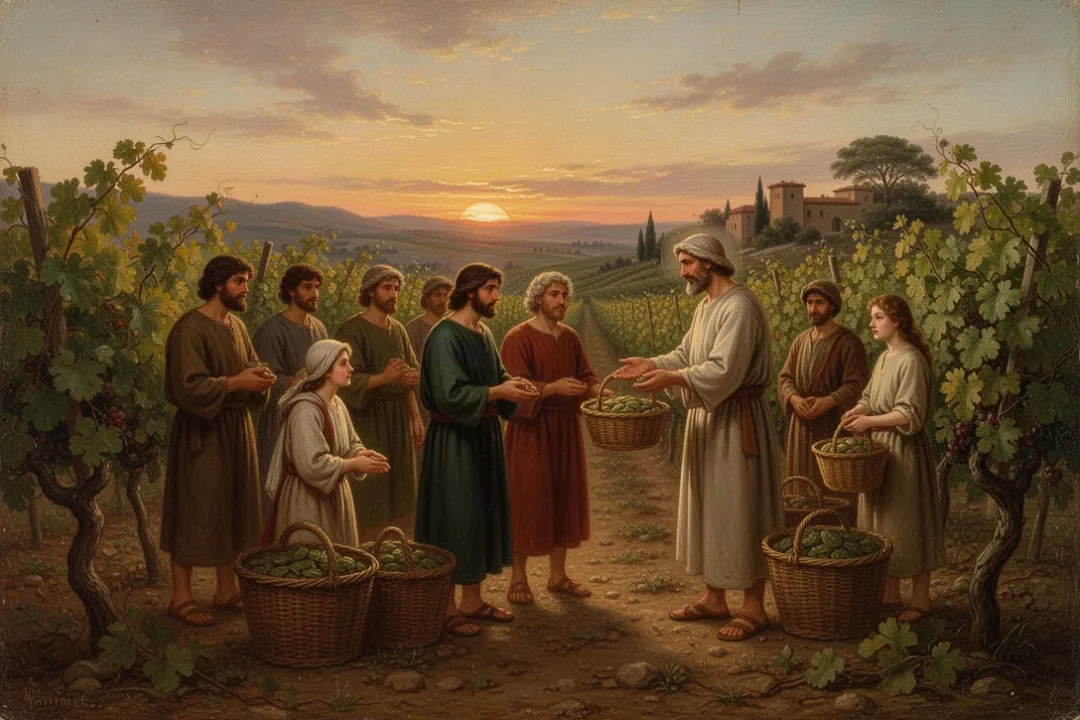
Jesus begins with a landowner who goes out early in the morning to hire laborers for his vineyard. He agrees with the first group on a standard day’s wage, often identified as a denarius. These workers enter the vineyard with a clear promise and spend the day doing the work they were hired to do.
The landowner returns to the marketplace several more times. He finds additional workers later in the morning, around midday, and again in the afternoon. Near the end of the workday, he hires a final group who have spent most of the day waiting for employment. Their repeated presence in the marketplace suggests uncertainty and vulnerability: they want to work but have not yet been given an opportunity.
When evening arrives, the landowner tells his manager to pay the workers. The payment begins with those hired last and proceeds toward those hired first. Each group receives the same amount. The early workers are not underpaid; they receive the wage they accepted. Their anger comes from seeing the latecomers receive an equal payment.
One of the early workers objects to the landowner’s decision. He points out that the late workers labored for only a short time, while the first group endured the full heat and burden of the day. The landowner answers that he has not broken the agreement. He has paid the first workers what was promised and has chosen to be generous to the others.
The parable ends with Jesus’ statement that the last may be first and the first may be last. That reversal connects the story to the surrounding teaching in Matthew’s Gospel. Jesus is addressing assumptions about who deserves honor in God’s kingdom and whether long service gives someone a stronger claim than another person’s late response.
Why the equal payment feels unfair
At first glance, the workers’ complaint seems reasonable. A person who works twelve hours would normally expect more than someone who works one hour. In ordinary employment, equal pay for very unequal hours could violate the terms of a contract or create a serious workplace problem.
That observation helps clarify the parable. The first workers agreed to a specific wage, and the landowner honored that agreement. The story does not describe him secretly reducing their pay or breaking a contract. The conflict begins when they compare their payment with someone else’s.
Their resentment is summarized by the landowner’s question: are you resentful because I am generous? Jesus is exposing a difficult human tendency. We often judge our situation not by what we received, but by what another person received. A blessing can feel smaller when someone nearby receives a similar blessing with less visible effort.
This comparison can appear in religious life. Someone may think, “I have served for decades, so I should have a higher place than a person who turned to God late in life.” Another person may think, “I have endured more hardship, so my faithfulness should earn special recognition.” The parable does not dismiss perseverance. It challenges the idea that perseverance gives us ownership over God’s generosity.
The central tension: The early workers want justice defined by comparison, while the landowner applies both justice and generosity. He keeps his promise to the first group and gives freely to the last group.
What the vineyard represents in Jesus’ teaching
In the ancient world, a vineyard could represent fruitful work, a community under care, or the people of God. Jesus’ listeners would have recognized agricultural images from Israel’s Scriptures and from daily life. Vineyard work was seasonal, physical labor, and a day without employment could mean that a worker’s household lacked enough money for food.
In this parable, the vineyard functions primarily as the place where the landowner’s work is carried out. Workers are invited into that work at different times. The image can therefore point to participation in God’s kingdom, service among God’s people, and the privilege of responding to God’s call.
The landowner’s repeated trips to the marketplace also emphasize his initiative. The workers do not force their way into the vineyard. They are found, invited, and sent. Even the final group enters because the landowner chooses to give them an opportunity near the end of the day.
This does not mean human response is irrelevant. Every worker must accept the invitation and enter the vineyard. The point is that the invitation itself begins with the landowner’s action. In theological terms, grace comes before human achievement.
What the daily wage means in the parable
The daily wage represents more than a paycheck. It points to the gift of belonging to God’s kingdom and receiving the life God gives. The story does not provide a detailed chart of rewards for every kind of service. Instead, it presents one generous payment to workers who arrive at different times.
That equal payment is especially meaningful for people who believe they have little to offer. Someone may come to faith late, return after years away, or begin serving after a long period of confusion and failure. The parable offers hope that God’s welcome is not reserved for people with the longest record of religious activity.
It also corrects the opposite error: treating faith as a wage earned through accumulated merit. The first workers do receive what they were promised, but the payment remains a gift from the landowner’s authority and generosity. No worker can claim to have created the vineyard, arranged the work, or supplied the final reward.
Other New Testament passages describe differences in responsibility, faithfulness, and reward. The laborers in the vineyard should not be used to erase every biblical distinction between kinds of service. Its particular emphasis is that God’s saving grace is not rationed according to seniority.
How Matthew 19 prepares readers for the parable
The parable does not stand alone. It follows Jesus’ conversation with a wealthy man who asks about eternal life and then leaves sorrowfully when Jesus challenges his attachment to possessions. Jesus tells his disciples how difficult it can be for the wealthy to enter God’s kingdom, while also emphasizing that God can do what human beings cannot.
Peter then points out that the disciples have left much to follow Jesus. His question is understandable: if they have made significant sacrifices, what will they receive? Jesus promises that those who follow him will not be forgotten, but he also warns that many who seem first will be last and many who seem last will be first.
The vineyard story addresses that concern. The disciples’ sacrifices matter, but they must not become grounds for superiority. Service is a response to grace, not a claim that places God in debt. The parable protects both truths: God sees faithful service, and God remains free to give generously to others.
This context also explains why the story can unsettle people who have been religious for a long time. Jesus is not only comforting outsiders. He is also correcting insiders who assume closeness to him gives them permission to rank other people’s worth.
What the parable teaches about grace and merit
Grace is favor that cannot be demanded as a payment for performance. In the vineyard, the landowner gives the late workers a full wage even though their labor does not match the hours of the first group. The gift is intentionally larger than their measurable contribution.
The early workers are not condemned for working hard. Their mistake is their attitude toward the landowner and the other workers. They treat generosity as though it were a limited resource. If the late workers receive a full wage, the early workers assume their own labor has been devalued.
Jesus shows that grace does not become less gracious when it is extended to someone else. Another person’s forgiveness does not cancel your forgiveness. Another person’s restoration does not erase your faithfulness. Another person’s welcome does not reduce your place in God’s care.
At the same time, grace can feel threatening when identity has been built around being more deserving than others. If a person’s confidence depends on having a better religious record, a more respectable past, or a longer period of service, the equal payment challenges that foundation.
The parable invites a different foundation: gratitude for being included at all. The first workers had the privilege of spending the whole day in the vineyard. The story asks them to see that privilege as a gift, not as leverage against people who arrived later.
How the parable challenges religious comparison
Comparison is one of the clearest practical issues in the story. People compare conversion dates, years of service, visible sacrifices, spiritual gifts, family backgrounds, and public recognition. These comparisons can produce pride in one person and discouragement in another.
The vineyard workers illustrate both sides of that problem. The early workers feel entitled because they have done more. The late workers may feel inferior because they have done less. The landowner’s action interrupts both assumptions by giving every worker a secure place and a full wage.
Healthy communities still need to recognize effort and responsibility. A volunteer who serves every week may need appreciation and support. A person with greater responsibility may need accountability. But recognition is different from assigning greater human worth. God’s grace gives dignity before performance.
This distinction matters in churches, families, workplaces, and friendships. If you help someone, you can honor the time and energy involved without turning that help into a permanent claim over the other person. If you receive help, you can show gratitude without believing you are permanently beneath the person who assisted you.
Common mistakes when interpreting the laborers in the vineyard
The parable is easy to reduce to a slogan, but several popular interpretations miss its main force. These mistakes can make the story either more confusing or less challenging than Jesus intended.
“The parable says work does not matter.” The workers genuinely labor, and the first group receives the wage promised to them. The story addresses entitlement and comparison, not laziness.
“God pays everyone exactly the same in every situation.” The equal wage represents kingdom grace in this story. It should not be used as a universal rule for every workplace, contract, or human responsibility.
“The late workers are irresponsible.” The story does not say they refused earlier jobs. They repeatedly explain that no one hired them, which presents them as people waiting for an opportunity.
“The first workers were cheated.” They received the agreed amount. Their distress came from the landowner’s generosity toward others, not from a broken promise.
“The parable teaches that all religious commitment is the same.” Jesus is not denying the value of faithful service over time. He is denying that seniority gives people control over God’s grace.
“The last workers earned the full wage through their brief labor.” Their work matters, but the equal payment highlights the landowner’s decision to give beyond what their hours would seem to justify.
“The last will be first” means every social ranking will simply reverse. The statement is a warning against status-based confidence and a promise that God’s kingdom does not follow ordinary prestige.
How to apply the parable to your own life
Start by identifying the comparison that most often shapes your sense of worth. You may compare yourself with a more successful coworker, a more experienced church member, a parent who seems more capable, or a person whose life changed later than yours. The question is not whether the comparison is accurate. The question is what it is doing inside you.
Then separate faithful responsibility from personal entitlement. You can acknowledge that you have worked hard, kept promises, or served sacrificially. You can also admit that these actions do not give you ownership over another person’s opportunities, forgiveness, recognition, or relationship with God.
Practicing gratitude can help. Instead of focusing only on what others receive, name the good you have already been given: time in the vineyard, meaningful work, supportive relationships, forgiveness, spiritual growth, or another chance to serve. Gratitude does not deny difficulty; it prevents difficulty from becoming the only measure of your life.
The parable also encourages you to welcome people who arrive late. A new believer, returning family member, recovering addict, former outsider, or person who has made serious mistakes may need patience rather than suspicion. They may have less experience, but they are not a lesser recipient of grace.
Notice the comparison. Ask whose reward, opportunity, or acceptance has triggered resentment in you.
Check the promise. Remember what you were actually given instead of measuring your life by someone else’s portion.
Name the gift. Describe the privilege hidden inside your responsibilities, even when the work has been difficult.
Release the ranking. Refuse to use seniority, sacrifice, or past success as proof that you deserve more dignity than another person.
Make room for late arrivals. Offer practical welcome and patient guidance to people who are beginning after you.
A useful question: Am I upset because I received less than was promised, or because someone else received generosity I wanted to keep for myself?
What the parable says to people who came late
The workers hired near the end of the day may identify with people who feel behind. Perhaps you came to faith later than your peers, began serving after years of failure, or discovered your calling after others had already built impressive lives. The parable says that late does not mean disqualified.
There may still be consequences to lost time. A late start can mean missed opportunities, damaged relationships, or skills that must be developed slowly. Grace does not always remove those consequences. It does mean that your present response matters and that God’s welcome is not limited to people with a perfect timeline.
The final workers also remind us that lack of opportunity is not the same as lack of willingness. Some people have been excluded by poverty, disability, prejudice, family duties, trauma, or poor guidance. Their visible record may look short because their path has been obstructed, not because they have refused to contribute.
For people who feel overlooked, the landowner’s invitation carries dignity. You do not have to invent a résumé of religious achievements before responding. You can begin with the opportunity in front of you, trusting that God sees both your willingness and the circumstances that shaped your past.
What the parable says to people who have served for years
Long-term faithfulness has real value. The early workers endure the full day, and the landowner does not deny their effort. People who have served for years often carry responsibilities that others do not see: teaching, caregiving, prayer, financial sacrifice, leadership, or steady presence during difficult seasons.
Yet long service can gradually become a source of possession. A person may begin by serving out of love and later expect special treatment, unquestioned authority, or greater spiritual worth. The parable asks whether service has produced gratitude or a ledger of supposed debts.
If you have worked in the vineyard for a long time, the invitation is not to minimize your labor. It is to receive it again as a privilege. You were not merely waiting for payment; you were given meaningful participation in the landowner’s work throughout the day.
That perspective can make it easier to mentor newcomers without resentment. You can teach what you know, protect people from avoidable mistakes, and celebrate their growth without requiring them to earn the same welcome through decades of effort.
How the parable shapes a generous community
A community shaped by this parable does not ignore standards. It keeps promises, provides fair treatment, and takes work seriously. But it also resists turning contribution into a ranking system in which newcomers must remain permanently inferior.
Such a community creates room for people with different histories. It honors older members without making them gatekeepers of grace. It gives new members real opportunities rather than treating them as permanent spectators. It also recognizes that people arrive with unequal resources, experience, and freedom.
Leaders can apply the parable by examining how recognition is distributed. Are the same people always praised while quiet service goes unseen? Are new participants expected to prove their worth before they are trusted with meaningful responsibility? Are people with complicated pasts treated as permanent risks even after genuine change?
Generosity should be paired with wisdom. Welcoming someone does not require ignoring abuse, abandoning accountability, or giving immediate authority. The vineyard image calls for grace without favoritism and trust that grows with responsible conduct.
At its deepest level, the parable changes the question from “Who deserves more?” to “What has the landowner given, and how should I respond?” That shift can soften resentment while preserving honesty about effort, responsibility, and the real burdens people carry.
Why Jesus ends with the first and the last
The closing reversal is not a decorative ending. It summarizes the danger of assuming that visible position reveals spiritual importance. In Jesus’ setting, respected religious status, wealth, public honor, and length of association could all seem to indicate who stood closest to God.
Jesus turns that assumption upside down. People who appear first may be last because they trust their status more than God’s mercy. People who appear last may be first because they receive the invitation with humility. The reversal is about the kingdom’s values, not a simple exchange of social positions.
The final saying also keeps every reader alert. No one can safely assume that being early, prominent, experienced, or respected guarantees a superior standing. The proper response is neither anxiety nor passivity, but humble gratitude and faithful participation.
The laborers in the vineyard ultimately direct attention away from a competition over merit. They show a landowner who keeps promises, seeks workers, notices those who are waiting, and gives generously. The story asks you to work faithfully, receive grace humbly, and rejoice when another person is welcomed into the same generosity.
Frequently asked questions
Where is the parable of the laborers in the vineyard found?
The parable appears in Matthew 20:1–16. It follows Jesus’ teaching about sacrifice, reward, and the reversal of human status. The story begins with a landowner hiring workers at different times and ends with all of them receiving the same daily wage.
Does the parable mean Christians should not be paid fairly?
No. The story does not establish a general rule for wages or employment. The first workers receive the amount they agreed to, so the landowner does not defraud them. Jesus uses the payment to illustrate God’s generosity and to challenge resentment toward people who receive grace later or with less visible service.
Who do the late workers represent?
They can represent people who respond to God late in life, return after a period of rejection, or enter a community after being overlooked. Their short time in the vineyard emphasizes that God’s welcome is based on grace, not merely on the length of a person’s religious record or service.
What is the main lesson of the vineyard parable?
The main lesson is that God remains generous and free, while human beings often measure worth through comparison. Faithful service matters, but it does not give anyone the right to resent another person’s welcome. The parable calls for gratitude, humility, and generous treatment of people who arrive later.










Leave a Reply