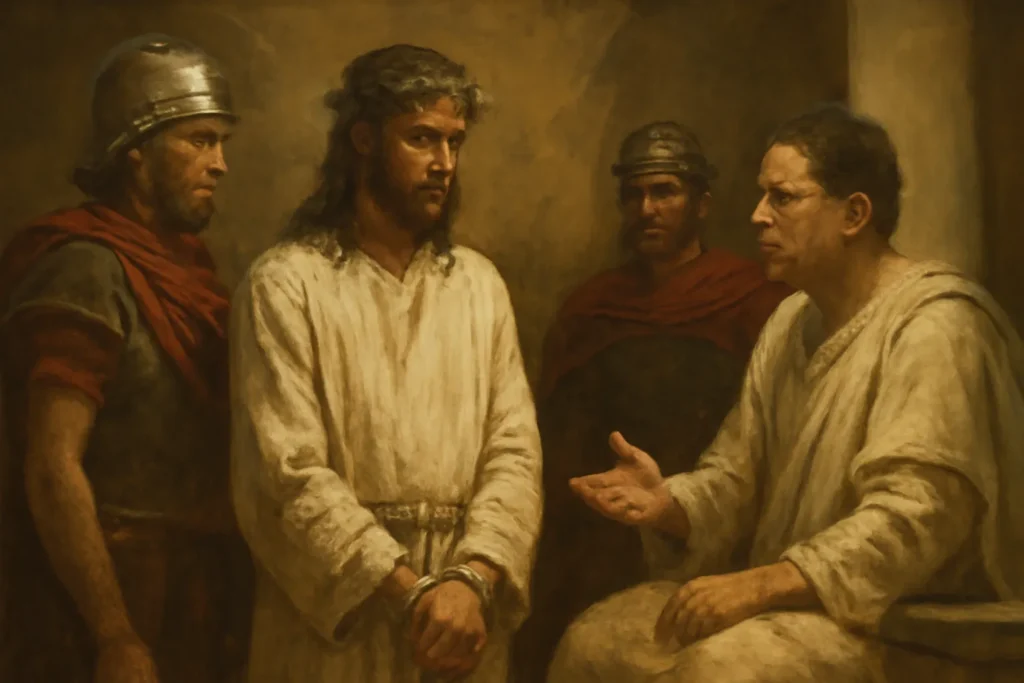
The narrative commonly titled the Trial Before Pontius Pilate sits at the intersection of history, law, and theology. It unfolds within the broader context of Roman governance in the eastern provinces, where Judea was governed by a Roman prefect, later termed a procurator by some scholars. Pontius Pilate, as the governing authority in the region, held the power to authorize or refuse crucifixion, to determine the fate of accused individuals, and to balance the delicate political equations of a province inhabited by a restless population with both religious fervor and political grievance.
To understand this hearing, it helps to keep several strands in view. First, there was the legal framework of the Roman state: a functional system in which accusations often arrived from a local jurisdiction or a ruling council but required confirmation by the imperial authorities when it carried political or capital significance. Second, there was the religious authority of the Sanhedrin, the governing council of Jewish leadership, which operated within its own laws and customs. Third, there was the public theater of Jerusalem—crowds, passersby, and imperial symbols—that could magnify the perceived threat to order. Finally, there was the theological dimension that would make this encounter a focal point for Christian interpretation for centuries to come.
Roman imperial sovereignty and the authority to authorize sentence and crucifixion.
The Sanhedrin’s role in religious judgment and its interaction with civil power.
The political symbolism of claims about kingship and the potential destabilization of the province.
Historical sources beyond the Gospels that attest to Pilate’s role, alongside questions of how the narrative functions theologically.
Narrative Sources and Historical Grounding
The core of the Pontius Pilate trial narrative resides in the canonical Gospels. Each account presents the hearing before the Roman governor with distinctive emphases, variables in detail, and selective memories. In addition to the New Testament testimonies, a handful of historical references from the first century—such as the works of Tacitus and the Jewish historian Josephus—provide a non-Christian corroboration that a figure named Pilate presided over Judea during this period and that a controversial event involving the accusation of a man named Jesus occurred in that time frame.
From a historical-critical perspective, scholars distinguish between the core factual markers—the arrest, the examination, the involvement of the Roman prefect, the ultimate sanction of crucifixion—and the theological interpretive layers that the Gospel writers bring to these events. Some scholars emphasize that the trial narrative is best understood as a literary and theological construction aimed at proclaiming the nature of Jesus’ mission, his relationship to political and religious powers, and the meaning of suffering and obedience under imperial authority.
Inside the Hearing: The Chronology Across the Gospels
Matthew’s account: a royal implication and a public decision
In the Gospel of Matthew, the sequence emphasizes the accusation that Jesus claimed to be “King of the Jews”, a charge heard by the Roman governor as a potential threat to Roman order and the Pax Romana. The text is careful to present Pilate as one who seeks to balance competing pressures—on the one hand, a crowd shouting for crucifixion; on the other hand, a governor who insists he finds no guilt in Jesus. The famous phrase Iesus Nazarenus Rex Iudaeorum (in English, “Jesus of Nazareth, the King of the Jews”) is displayed on the placard placed above Jesus on the cross, which Matt’s account suggests Pilate authorized after finding the charges dubious yet politically dangerous to ignore.
The trial before Pilate in Matthew is marked by Pilate’s questioning, a public verdict, and a decisive act of delegation: the crowd’s insistence on crucifixion leads Pilate to symbolically wash his hands of responsibility, signaling that he has discharged responsibility while still executing the sentence.
Mark’s account: succinct, urgent, and juridically compact
The Gospel of Mark presents the hearing as brisk and more focused on the political implications of the accusation. Mark foregrounds the crowd dynamics, the tension between Jewish leadership and imperial authority, and Jesus’ own responses within the legal situation. The phrase “Are you the King of the Jews?” functions as a loaded question, and Jesus’ replies illuminate a distinction between a spiritual kingship and a political leadership that could threaten Roman rule. Pilate’s posture is pragmatic: he recognizes the potential for unrest and seeks to minimize danger while still fulfilling a sentence when the crowd presses for a verdict.
Luke’s account: smoothed edges, political maneuvering, and Herodian echoes
Luke uniquely situates Jesus before Pilate in a narrative of formal judicial exchange but also includes Pilate’s interactions with Herod Antipas and the broader political theater. Luke emphasizes moral motives and innocence, while allowing the crowd’s vote for Barabbas to complicate the governor’s decisions. In Luke’s telling, Pilate’s attempts to pass responsibility to others—by sending Jesus to Herod and then choosing to scourge him first—illustrate a more nuanced engagement with the political calculus and the religious factions at play.
John’s account: prolonged dialogue and royal theology
The Gospel of John expands the dialogue between Jesus and Pilate, offering extended debates about the nature of kingship, truth, and the mission of Jesus. John’s portrayal is less concerned with logistical detail and more with the theological meaning of the trial. Jesus speaks about his kingdom being “not of this world,” a claim that reframes the issue from mere political power to the heart of a divine mission. Pilate’s famous exchange—“What is truth?” and the retort that Jesus has come into the world for judgment—frames the hearing within a cosmic perspective, where political decisions are bound up with spiritual realities.
Legal and Theological Dimensions
The hearing before Pontius Pilate raises persistent questions about Roman law, Jewish legal procedures, and the ways in which religious authorities intersect with imperial governance. Several key dimensions deserve attention:
Charge formulations: The Sanhedrin’s initial accusations centered on religious infamy and blasphemy within Jewish law, whilePilate faced the prospect of crowd-driven political danger, including a charge framed as sedition or the claim to kingship.
Jurisdiction and jurisdictional boundaries: The Roman governor’s authority to adjudicate capital cases, and the way in which local judgments could be confirmed, appealed to, or overridden by imperial authorities.
Procedural realism vs. theological purpose: The Gospel narratives often foreground moral and redemptive aims, which can shape the presentation of legal steps and the chronology, sometimes at the cost of strict historical replication.
Prophetic fulfillment and authority: The trial is read in Christian tradition as part of a larger scriptural arc—prophecies that point to Jesus’ suffering, death, and vindication—creating a tension between legal proceedings and theological destiny.
Charges, Speech, and the Placard: Key Elements of the Hearing
Several elements recur across versions of the trial before the Roman authority:
The charge of political insurrection or sedition, often linked to claims of kingship that could undermine Caesar's authority.
The charge of religious blasphemy as a matter under Jewish law, which the Sanhedrin would have pursued within their own jurisdiction.
The placard inscription (often cited as INRI in later Christian tradition) announcing Jesus’ crime in the words that the Romans used for public display.
Attempts to shift responsibility away from leadership to the crowd, to the urban environment, or to the personal innocence of Jesus.
Theological Significance and Interpretive Threads
Across Christian traditions, the trial before Pilate is less a simple historical episode than a rich theological locus. It has been read as:
A test of authority: Pilate’s governance is tested by political realities and moral questions about power, responsibility, and the use of force.
A prelude to sacrifice: The crucifixion that follows the hearing is often interpreted as the culmination of a divine plan of atonement in which Jesus’ suffering serves a salvific purpose.
A study in truth and perception: Each Gospel asks different questions about truth-telling, blindness, and recognition—who sees who Jesus is, and who remains unaware or obstinately blind.
Ecumenical implications: The narrative has shaped Christian churches’ liturgy, art, and preaching for centuries, raising persistent questions about collective responsibility, justice, and forgiveness.
Historical Questions: How the Hearing is Read by Modern Scholarship
Modern scholarship often separates the historical core from the theological elaborations. Key lines of inquiry include:
Historic Pilate: The existence and role of Pontius Pilate are supported by non-Christian sources, with the extra-biblical evidence focusing on his governance style, political caution, and a history of maintaining order in a volatile region.
Historical plausibility: Some scholars emphasize that the exact sequence of events—arrests, hearings, and exchanges—may differ from Gospel to Gospel, suggesting that the authors shaped the story to convey theological truths rather than to supply a modern, courtroom-style chronology.
Inscriptions and artifacts: The artifacts associated with the period, including inscriptions mentioning Pilate and the broader imperial apparatus, help anchor the historical milieu in which the hearing took place.
Relation to other sources: Tacitus and Josephus provide context for the era; while these sources do not duplicate the Gospel narrative, they confirm that a figure named Pilate presided over Judea and that Jesus’ execution occurred under Roman authority.
Legacy and Reception Across Centuries
The trial before Pontius Pilate has remained a focal point of Christian reflection and artistic representation. It has been interpreted as a case study in how power operates under pressure, how truth is perceived in political contexts, and how divine purposes are understood in the face of human fragility.
Liturgy and Passion narratives: The events surrounding Jesus’ arrest, interrogation, and crucifixion are central to Holy Week observances in many Christian traditions, shaping sermons, hymns, and devotional practices.
Artistic expressions: Throughout Western art and literature, scenes of Pilate’s hearing appear in altarpieces, frescoes, and evocative poetry, often emphasizing Pilate’s inner conflict or the crowd’s roar.
Historical humility: In modern ecumenical dialogue, many traditions have sought to temper interpretations that blame one group or another for Jesus’ death, instead focusing on shared human responsibility and the complexity of political power in antiquity.
Contemporary Scholarship and Ecumenical Perspectives
In contemporary study, scholars approach the trial before Pontius Pilate with a blend of historical theory, literary analysis, and theological reflection. Several points are often highlighted:
The historical Pilate likely faced a volatile political climate in Jerusalem, where messianic expectations and Roman control collided in high-tension moments.
The Gospel writers crafted their narratives to address their communities’ concerns, including how to interpret power, justice, and the meaning of Jesus’ mission.
Some scholars note the differences among the Gospel accounts as meaningful variations rather than errors, each highlighting distinct theological emphases (e.g., Mark’s urgency, Luke’s social concern, John’s cosmic frame).
Modern ethical reflection emphasizes avoiding supersessionist violence and recognizing the human dimensions of political decisions, while still acknowledging the deep significance of the Passion narratives for faith communities.
The discussion around the Pontius Pilate trial is complemented by archaeological and epigraphic evidence from the first century. The discovery of inscriptions and artifacts from the era—most notably those associated with the city of Caesarea Maritima and the governance apparatus of the Roman Empire—offers tangible context for the description of imperial governance in Judea. The so-called Pilate Stone and other materials help confirm that a figure bearing the title of governor or prefect wielded executive power in the region. While such discoveries do not replicate the Gospel scene in detail, they provide a concrete backdrop for understanding the legal and political framework in which the hearing occurred.
For readers who study the trial before Pontius Pilate as a literary and theological composition, it is productive to compare how each Gospel mode frames the scene:
Matthew emphasizes the political danger of Jesus’ kingly claim and the public dimension of Pilate’s decision, including the act of washing hands as a symbolic gesture.
Mark concentrates on the immediacy of the verdict and the crowd’s role, keeping the narrative brisk and centered on the tension between authority and accusation.
Luke enriches the drama with procedural steps (Herod’s involvement, the scourging) and moral considerations, highlighting innocence and political complexity.
John places Jesus’ dialogue with Pilate at the center, framing the encounter as a confrontation over truth, authority, and ultimate purpose.
Readers today should approach the trial before Pontius Pilate with both curiosity about historical details and reverence for the interpretive questions it raises. The narrative provides a lens through which to examine:
How political power seeks to manage instability without fully surrendering authority.
How religious leadership engages with civil authority in moments of crisis.
How truth is proclaimed, recognized, or denied in the presence of competing pressures.
The Trial Before Pontius Pilate stands as a defining moment in the Passion narratives, a junction where history, law, faith, and literature converge. Whether one approaches it as a historical episode, a literary device, or a theologically charged event, the hearing before the Roman governor invites readers to consider how power operates under pressure, how responsibility is assigned in moments of political danger, and how a single decision can reverberate through centuries of faith and interpretation.
Guided Glossary: Key Terms for Reading the Trial Narrative
For readers new to this topic, the following terms are helpful to understand in their specific historical and literary contexts:
Pontius Pilate: The Roman prefect/governor of Judea who presided over the trial and authorized the crucifixion in most Gospel accounts.
Sanhedrin: The Jewish governing council that initially examined Jesus and brought charges that were later considered in Roman court.
Crucifixion: The form of execution used to punish Jesus according to the Gospel narratives, carried out under Roman authority.
INRI: The traditional abbreviation for the inscription placed on the cross—“Iesus Nazarenus Rex Iudaeorum”—reflecting the accusation of kingliness.
Barabbas: The criminal released by the crowd in Luke and Matthew narratives, a move that underscores the crowd’s agency in the pronunciation of judgment.
The way the trial before Pontius Pilate is told emphasizes different aims in each Gospel. The language often reveals more about the community for which the Gospel was written than about the precise legal mechanics of a first-century hearing. Yet the convergence of the four accounts around the same historical anchor strengthens the sense that a pivotal event—Jesus’ appearance before a Roman governor—was both a real occurrence and a symbol with far-reaching implications.
The hearing before Pilate never operates in a vacuum. It has lived on in preaching, liturgy, and ethical discussion because it presses important questions about political authority, human responsibility, and the moral dimensions of governance. In translating the ancient text into modern guidance, many communities stress:
That political power must be exercised with humility and accountability to justice.
That truth-telling may entail uncomfortable consequences, yet is essential for integrity in leadership.
That mercy and forgiveness can coexist with justice, even when the political climate is harsh or ambiguous.
Scholars and faith communities alike are called to read the Trial Before Pontius Pilate with critical discernment and pastoral care. The aim is not to adjudicate guilt or innocence in antiquity alone but to explore how the episode can illuminate present concerns about power, truth-telling, and the responsibilities of authority. A responsible reading acknowledges historical complexity, respects diverse interpretive voices, and seeks to apply the enduring moral insights in ways that promote justice, compassion, and peace in contemporary societies.
In sum, the encounter between Jesus and Pontius Pilate—as it appears across the Gospels and as it has echoed through history—offers a rich field for inquiry. It invites readers to weigh the political and religious factors that shaped a crucifixion, to examine how communities remember and retell the event, and to reflect on the deeper meanings that persist when power, conscience, and faith intersect in the citizenry of a nation.







Leave a Reply