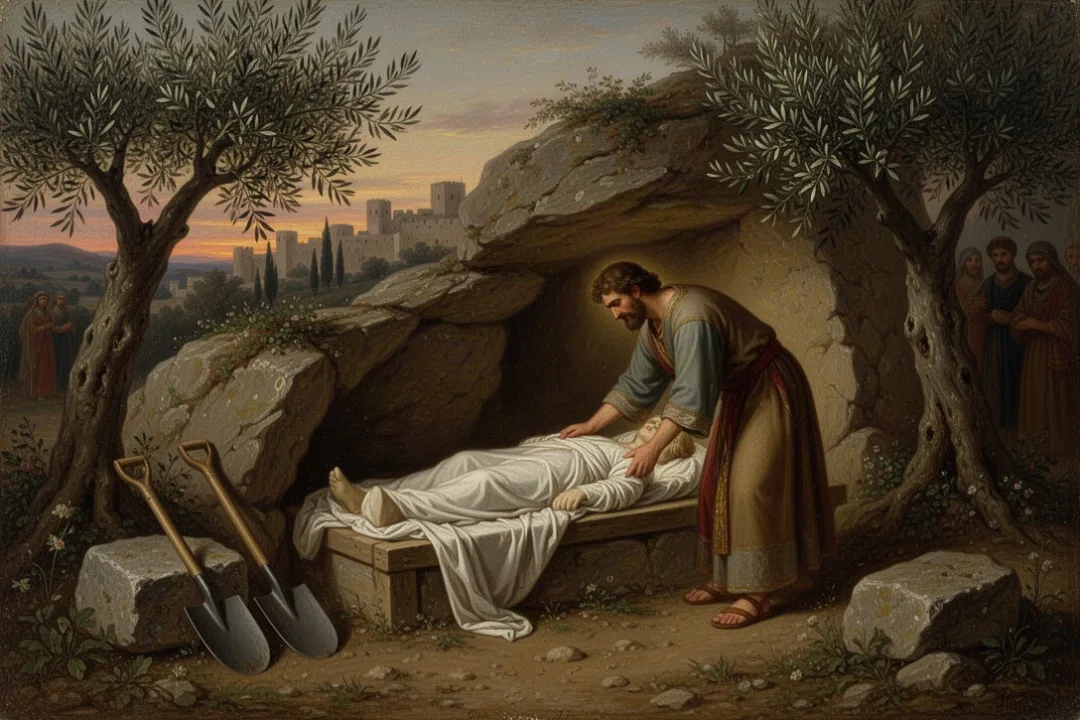
Arimathaea is the place associated with Joseph of Arimathea, the man who requested Jesus’ body from Pontius Pilate and placed it in a tomb. The name appears in some English Bible traditions, while Arimathea is the more common modern spelling.
The New Testament presents Joseph as a respected Jewish council member who was waiting for God’s kingdom. The Gospels do not identify Arimathaea’s exact location with certainty, so the place is best understood through Joseph’s role in the burial narratives and the limited geographical clues preserved in the text.
Arimathaea is not the name of a person. It is a place name connected with Joseph, usually described as “Joseph of Arimathea.” In biblical naming practice, identifying someone by a hometown helped distinguish that person from others with the same or similar name.
The name appears in the accounts of Jesus’ burial in Matthew 27, Mark 15, Luke 23, and John 19. The accounts differ in small details, but they agree on the central sequence: Joseph went to Pilate, received Jesus’ body, prepared it for burial, and placed it in a tomb.
Some English translations and older Christian writings use Arimathaea, while many contemporary translations use Arimathea. These forms refer to the same biblical place. The variation comes from differences in how the ancient Greek name was carried into Latin and English, not from two separate towns.
Quick answer: Arimathaea was Joseph’s hometown, not the location of Jesus’ crucifixion or resurrection. The New Testament connects it with Joseph’s burial service, but does not provide enough information to identify its location with complete confidence.
How to understand Arimathaea from the Gospel accounts
The most reliable way to study Arimathaea is to begin with what each Gospel actually says. Rather than assuming later traditions are equally certain, separate the New Testament evidence from proposed locations and devotional stories.
Identify the person connected with the name. Joseph is called Joseph of Arimathea, making Arimathaea his place of origin or association.
Read the burial accounts together. Matthew, Mark, Luke, and John each describe Joseph’s involvement, with different details and emphases.
Observe Joseph’s public position. He is described as a respected council member or member of the Jewish council, depending on the Gospel wording.
Notice his spiritual expectation. The Gospel writers portray him as someone looking for God’s kingdom and, in John, as a disciple of Jesus whose loyalty had previously been private.
Separate biblical evidence from later tradition. Stories about Joseph’s later travels or objects connected with him belong to Christian tradition, not to the core Gospel account.
State the geographical conclusion cautiously. Arimathaea was probably a Judean settlement, but its precise location remains debated.
What the New Testament says about Joseph of Arimathea
Joseph first appears in the burial narratives as a person of social standing. Matthew calls him a rich man from Arimathea and says he had become a disciple of Jesus. Mark identifies him as a respected council member who was waiting for God’s kingdom. Luke similarly describes him as a good and righteous man who had not agreed with the council’s decision and was also looking for the kingdom.
These descriptions establish several important points. Joseph was not an anonymous laborer who happened to find the body. He had enough authority to approach Pontius Pilate, enough resources to provide a tomb, and enough courage to associate himself publicly with a condemned teacher.
John gives a slightly different emphasis. Joseph is described as a disciple who had kept his allegiance hidden because he feared the Jewish authorities. John also names Nicodemus as participating in the burial preparations. Together, the two men handle Jesus’ body in a manner consistent with a careful and honorable burial.
The Gospels do not say that Joseph was one of the Twelve apostles. They identify him as a disciple or follower in a broader sense and connect him with the council. This distinction matters because the word disciple can refer to a follower of Jesus without meaning one of the twelve primary apostles.
Why Joseph’s burial request matters
After the crucifixion, Joseph went to Pilate and asked for Jesus’ body. This action carried personal and social risk. Jesus had been executed under Roman authority, and publicly claiming responsibility for his burial could expose Joseph to criticism from political and religious leaders.
Mark reports that Joseph acted with boldness when he approached Pilate. Matthew says he placed Jesus in his own new tomb, while Luke and John provide additional details about the tomb and the burial preparations. Although the accounts are not identical in every phrase, all present Joseph as the person who took practical responsibility for the burial.
The burial also reflects Jewish concerns about treating the dead properly. Deuteronomy 21:22–23 is associated with the requirement not to leave an executed person’s body exposed overnight. The Gospel narratives take place near the Sabbath, giving the timing additional urgency. Joseph’s action therefore has both compassionate and religious significance.
In the Christian story, the burial is not a minor detail between the crucifixion and resurrection. It establishes that Jesus truly died and that his body was placed in a known tomb. Joseph’s involvement gives the burial a named witness and connects the event with a specific person, place, and physical setting.
What each Gospel emphasizes about Arimathea and Joseph
Matthew presents Joseph as a wealthy disciple
Matthew 27:57–61 introduces Joseph as a rich man from Arimathea who had become a disciple of Jesus. He asks Pilate for the body, wraps it in clean linen, places it in his own new tomb, and has a large stone positioned at the entrance.
Matthew’s account also mentions women observing where the burial occurred. That detail supports the continuity between the burial and the later discovery of the empty tomb. Joseph’s identity as a wealthy man also helps explain why he could provide a newly prepared burial place.
Mark presents Joseph as a respected council member
Mark 15:42–47 calls Joseph a respected member of the council who was waiting for God’s kingdom. He courageously approaches Pilate, confirms that Jesus has died, and receives permission to take the body down.
Mark emphasizes the urgency of the situation because it is the day before the Sabbath. Joseph wraps Jesus in linen and places him in a tomb cut from rock. Mary Magdalene and another Mary are described as observing the location.
Luke highlights Joseph’s integrity
Luke 23:50–56 describes Joseph as a good and righteous man who had not approved the council’s decision. Luke also says he came from Arimathea, a town associated with Judea, and that he was waiting for God’s kingdom.
This presentation makes Joseph a morally independent figure. He is linked to the council, but the text specifically separates him from the decision to condemn Jesus. Luke also describes the women preparing spices and then resting on the Sabbath according to the commandment.
John includes Nicodemus and detailed burial materials
John 19:38–42 describes Joseph as a disciple who had remained hidden because of fear. Nicodemus joins him, bringing a large quantity of myrrh and aloes. They wrap Jesus’ body with spices in linen cloths, following Jewish burial customs.
John places the tomb in a garden near the crucifixion site. Because the tomb was nearby and the Sabbath was approaching, the burial took place there. John’s account gives special attention to the physical care shown to Jesus after the violence of the execution.
Where was Arimathaea located?
The exact location of Arimathaea has not been established. Luke associates Arimathea with Judea, but the Gospels do not provide a distance from Jerusalem, a nearby landmark, or a description detailed enough to settle the question.
Several places have been proposed over the centuries. One frequently discussed possibility is Ramah, a settlement known from the Hebrew Bible and associated with the region north of Jerusalem. Some interpreters connect Arimathea with Ramathaim-Zophim, the home of Samuel in 1 Samuel 1:1, though the identification is not universally accepted.
Another proposal is Rantis, a village northwest of Jerusalem. Some historical and linguistic arguments have linked this location with Arimathea, but the evidence remains debated. Proposed identifications often depend on changes in pronunciation, ancient geographical descriptions, and how place names were transmitted across languages.
A third group of proposals places Arimathea elsewhere in the Judean highlands or in a location associated with an ancient settlement whose name has since changed. Because ancient place names could shift over time, a modern village does not need to preserve the exact biblical form to be considered a candidate.
The safest conclusion is limited but useful: Arimathea was likely a settlement in or connected with Judea, and Joseph was known by that place. The New Testament does not claim that the town was near the tomb, nor does it identify the tomb as being in Arimathea. The burial occurred in the Jerusalem area, while Joseph’s hometown was elsewhere or at least distinct from the burial site.
Geographical caution: A proposed location should be described as a possibility, not a proven fact. Ancient place-name studies can narrow the options, but they cannot turn an uncertain identification into a confirmed archaeological discovery.
Why the spelling varies between Arimathaea and Arimathea
Arimathaea is familiar from the King James Version and other older English traditions. Modern translations more often print Arimathea, reflecting a simpler English form of the name. Readers may also encounter forms such as Arimathia in older references or discussions of ancient manuscripts.
These spellings do not indicate different biblical characters or different episodes. They are transliteration variants: attempts to represent a name from one language using the letters and pronunciation patterns of another.
Searches for “Arimathaea” often lead to the same material as searches for “Arimathea.” If you are comparing Bible translations, commentaries, maps, or historical studies, checking both spellings will help you find the fullest range of information.
What Arimathaea symbolizes in Christian interpretation
Christian readers have often viewed Joseph’s connection with Arimathea through the theme of courageous discipleship. Earlier, Joseph’s allegiance may have been private or cautious. At the moment when Jesus’ closest public support had collapsed, Joseph took a visible and costly step.
His story also shows that discipleship can involve practical service. Joseph does not preach a sermon in the burial account. He uses his access, property, social position, and time to care for Jesus’ body. The action is quiet, but the Gospels treat it as significant.
Joseph’s role can also be read alongside the actions of the women who observed the tomb and prepared spices. The burial scene includes several kinds of faithfulness: requesting the body, providing a tomb, wrapping the body, bringing burial materials, witnessing the location, and respecting the Sabbath.
At the same time, readers should avoid claiming more than the text says. The Gospels do not explain Joseph’s later life, his relationship with the council in detail, or the exact location of his hometown. Symbolic interpretation can draw meaning from the account, but it should remain grounded in the narrative’s actual details.
Later traditions about Joseph of Arimathea
Centuries of Christian tradition expanded Joseph’s story beyond the four Gospels. Some legends claim that he traveled to distant regions, founded churches, or became connected with the Holy Grail. Other traditions associate him with Britain, especially with Glastonbury.
These accounts have cultural and religious importance for many communities, but they should be distinguished from the New Testament evidence. The canonical Gospels do not say that Joseph traveled to Britain, carried a sacred cup, or founded a particular church after the burial.
Some later Christian texts also present Joseph as a central character in narratives about the period after the crucifixion. Such writings may preserve devotional imagination, theological reflection, or local tradition. They are valuable for studying Christian history, but they do not provide the same kind of evidence as Matthew, Mark, Luke, and John.
Gospel evidence: Joseph is associated with Arimathea and arranges Jesus’ burial.
Historical interpretation: Researchers debate the town’s precise location and the details of Joseph’s background.
Later legend: Stories connect Joseph with the Grail, Britain, or other traditions not recorded in the Gospels.
How Arimathaea relates to the empty tomb
Arimathea is connected indirectly to the resurrection narratives through Joseph’s tomb. The Gospels describe Jesus being placed in a tomb after the crucifixion, and they later describe women finding the tomb open and Jesus’ body absent.
The texts do not say that the resurrection occurred in Arimathea. They locate the tomb in the area of Jerusalem, with John specifically describing a garden near the place of crucifixion. Arimathea identifies Joseph; it does not name the tomb’s location.
Joseph’s role therefore helps establish the narrative setting without making him a witness to the resurrection itself. The Gospel writers present him as someone who knew where Jesus had been laid. His connection with the tomb supports the continuity of the burial account, while the resurrection appearances are attributed to other witnesses in the Gospel narratives.
How to study Arimathaea in a Bible or church setting
If you are preparing a Bible study, sermon, lesson, or personal reading plan, begin with the four burial accounts rather than with later legends. Read each passage in its own context, then compare the details that recur across the narratives.
Read Matthew 27:57–66. Focus on Joseph’s wealth, his new tomb, and the witnesses who observe the burial.
Read Mark 15:42–47. Notice Joseph’s council position, his courage before Pilate, and the urgency created by the approaching Sabbath.
Read Luke 23:50–56. Consider Joseph’s character, his disagreement with the council’s decision, and his expectation of God’s kingdom.
Read John 19:38–42. Observe Joseph’s previously hidden discipleship, Nicodemus’s participation, and the burial preparations.
Compare repeated details. Look for Joseph’s identity, Pilate’s permission, the linen wrapping, the rock-cut tomb, and the witnesses.
Mark uncertain details clearly. Label proposed locations and later traditions as interpretations rather than direct biblical statements.
This method prevents a common mistake: treating every story told about Joseph as though it came from the same source. It also keeps the geographical question in proportion. Knowing the exact location of Arimathea would be interesting, but the Gospels focus more strongly on Joseph’s response and the reality of Jesus’ burial.
Common misunderstandings about Arimathaea
Arimathaea was not another name for Jerusalem
The Gospel descriptions distinguish Joseph’s hometown from the location of Jesus’ execution and burial. Joseph came from Arimathea, while the burial took place near Jerusalem. The two places may have been within the broader Judean region, but they are not presented as the same settlement.
Arimathaea was not the tomb
Arimathea names the town associated with Joseph. The tomb is described separately as a new or unused tomb, a rock-cut tomb, and in John as one located in a garden near the crucifixion site. Calling the tomb “Arimathaea” confuses the man’s hometown with the burial place.
Joseph was not described as Jesus’ biological relative
The Gospels do not identify Joseph as Jesus’ uncle, cousin, or other family member. He is presented as a respected man, a council member, a disciple, and the person who arranged the burial. Claims about a family relationship belong to later speculation or tradition.
The exact town has not been proven
Several proposed sites may fit some of the linguistic or geographical clues, but none can be declared certain on the basis of the New Testament alone. A careful explanation uses words such as possibly, often identified with, or proposed by some scholars.
Why the name still matters when the location is uncertain
The uncertainty surrounding the town’s location does not make the name unimportant. In the Gospel accounts, Arimathea anchors Joseph’s identity and links a particular person to one of the most significant moments in the Christian narrative.
The name also illustrates how biblical interpretation works. Some questions can be answered directly from the text, such as who Joseph was and what he did. Other questions, including the town’s exact site, require historical, linguistic, and archaeological reasoning that may remain inconclusive.
For readers, the clearest understanding is therefore both confident and careful: Arimathaea was Joseph’s hometown, Joseph arranged Jesus’ burial, and the location of the town remains uncertain. That distinction preserves the strength of the Gospel account without adding unsupported details.
Frequently asked questions
Is Arimathaea the same place as Arimathea?
Yes. Arimathaea and Arimathea are spelling variants for the same biblical place. Arimathaea appears especially in older English Bible traditions, while Arimathea is more common in modern translations. Both names identify the hometown associated with Joseph, who arranged Jesus’ burial after the crucifixion.
Where is Arimathaea located today?
Its exact location has not been proven. Proposed sites include places connected with Ramah, Ramathaim-Zophim, and Rantis, but each identification has limitations. The New Testament gives only broad geographical information, so a modern map cannot confidently label one surviving town as the certain location of biblical Arimathea.
Was Joseph of Arimathea one of Jesus’ apostles?
The Gospels describe Joseph as a disciple or follower of Jesus and as a respected member of the Jewish council. They do not identify him as one of the Twelve apostles. His importance comes from arranging Jesus’ burial and publicly acting on Jesus’ behalf after the crucifixion.
Does the Bible say Joseph of Arimathea traveled to Britain?
No. The four Gospels do not describe Joseph traveling to Britain or founding a church there. Those ideas come from later Christian traditions, particularly stories associated with Glastonbury. They may be historically and culturally interesting, but they should not be presented as direct biblical information.







Leave a Reply