Elijah first appears in 1 Kings 17, during the reign of King Ahab of Israel. He confronts Ahab over the nation’s worship of Baal and announces a severe drought. The account continues through 1 Kings 18–22, where Elijah performs miracles, challenges the prophets of Baal, speaks against royal injustice, and receives further direction from God.
His story continues into 2 Kings 1–2. In these chapters, Elijah confronts King Ahaziah, calls down judgment on the king’s messengers, and is taken from the earth in a dramatic event witnessed by Elisha. After that, Elisha becomes the central prophetic figure in the narrative.
Short answer: Read 1 Kings 17 through 2 Kings 2 for the main story of Elijah. The rest of the Bible also refers to him, especially in connection with John the Baptist, the Messiah, and the Transfiguration.
How to read Elijah’s story step by step
If you want to follow Elijah’s life without searching through unrelated chapters, read the passages in this order:
1 Kings 17: Elijah announces the drought, is fed near the brook Cherith, stays with a widow at Zarephath, and raises her son.
1 Kings 18: Elijah returns to Israel, challenges the prophets of Baal at Mount Carmel, and prays for the drought to end.
1 Kings 19: Elijah flees from Jezebel, meets God at Mount Horeb, and receives renewed instructions, including the call of Elisha.
1 Kings 21: Elijah condemns Ahab and Jezebel after Naboth is killed so the king can take Naboth’s vineyard.
1 Kings 22: Elijah’s message about Ahab’s coming defeat is confirmed through the wider account of Israel and Judah’s kings.
2 Kings 1: Elijah confronts Ahaziah after the king seeks guidance from Baal-Zebub instead of the God of Israel.
2 Kings 2: Elijah crosses the Jordan with Elisha and is taken up while Elisha watches.
These chapters give you the complete continuous account of Elijah’s public ministry. They show both his extraordinary faith and his human weakness. Elijah is bold before kings and false prophets, yet he also experiences fear, exhaustion, loneliness, and discouragement.
What happens in 1 Kings 17
Elijah enters the biblical narrative suddenly. He is introduced as a prophet from Tishbe in Gilead, and his first recorded message is directed to King Ahab. Elijah declares that there will be no dew or rain for a period of time except when he gives the word. The announcement confronts the king’s support of Baal, a deity associated by surrounding cultures with fertility and storms.
After delivering the message, Elijah obeys God’s command to hide near the brook Cherith. According to the account, ravens bring him food, while he drinks from the stream. When the brook eventually dries up because of the drought, God sends him to Zarephath in the region of Sidon.
At Zarephath, Elijah meets a widow gathering sticks. She has only a small amount of flour and oil left for herself and her son. Elijah asks her to prepare food and promises that the flour and oil will not run out before the drought ends. The story presents the woman’s limited supplies as an example of trust during scarcity, and Elijah remains in her household.
The widow’s son later becomes seriously ill and dies. Elijah carries the boy upstairs, prays, and appeals to God. The child’s life is restored, and the widow recognizes Elijah as a genuine man of God. This first major section of Elijah’s story therefore includes both a public prophecy against the king and a private act of compassion toward a vulnerable family.
Why the drought matters in Elijah’s ministry
The drought is more than a dramatic backdrop. It functions as a direct challenge to the religious claims of Ahab’s court. If Baal was believed to control rain and agricultural fertility, the drought exposed the inability of the king’s favored god to provide what the land needed.
Elijah’s message also reflects themes found earlier in the law of Moses. Israel’s covenant warnings included drought and agricultural failure as consequences of turning away from God. The narrative portrays Elijah as a prophet calling the nation back to exclusive worship of the Lord, not merely as a wonder-worker performing isolated miracles.
Reading tip: Pay attention to the contrast between public power and true authority. Ahab has a palace, political influence, and royal support, while Elijah often appears alone. The story repeatedly shows that authority does not belong automatically to the person on the throne.
What happens at Mount Carmel in 1 Kings 18
After the drought has continued for some time, God sends Elijah to meet Ahab. The king blames Elijah for troubling Israel, but Elijah replies that Ahab and his family have caused the trouble by abandoning God’s commands and following the Baals.
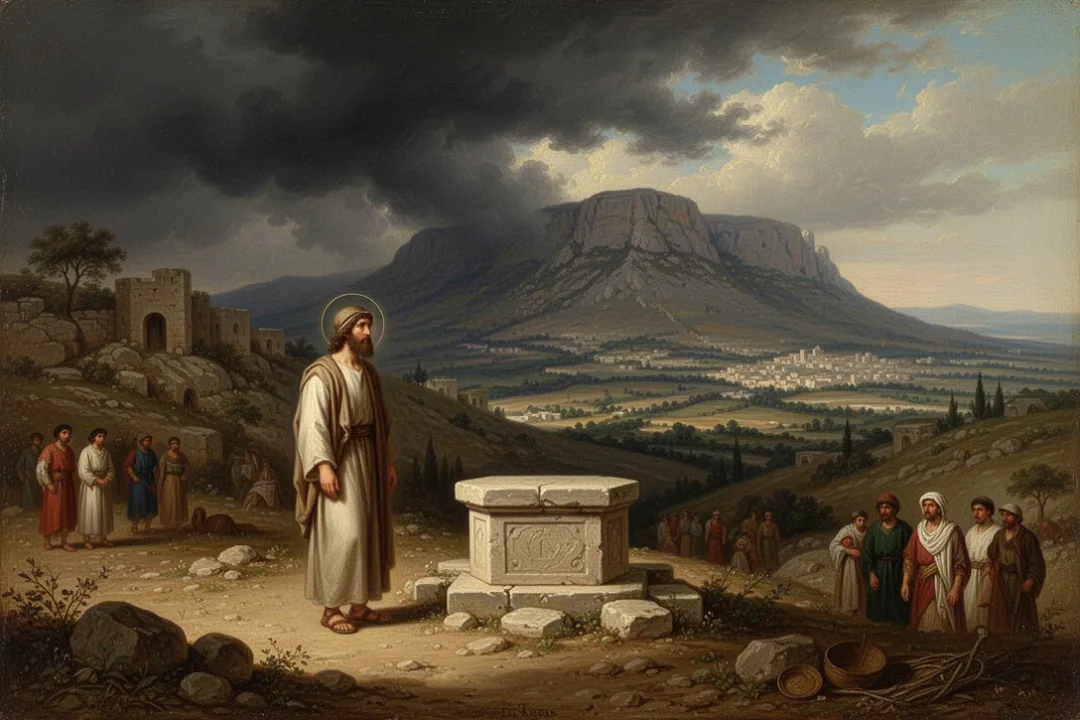
Elijah then calls for a public contest on Mount Carmel. The prophets of Baal gather there, along with the people of Israel. The challenge is simple: two sacrifices are prepared, but neither side is allowed to light the fire. The god who answers with fire will demonstrate who is truly God.
The prophets of Baal call on their deity for much of the day. Their rituals receive no answer. Elijah then repairs an altar associated with the Lord, uses twelve stones representing the tribes of Israel, prepares the sacrifice, and has water poured over everything. He prays briefly, asking God to show the people that he is the true God and to turn their hearts back.
Fire falls and consumes the offering, the wood, the stones, the soil, and the water around the altar. The people respond by acknowledging the Lord. The prophets of Baal are then seized and executed at the Kishon Valley, an event that reflects the severe religious and political conflict in the setting of the story.
Afterward, Elijah climbs to the top of Carmel and prays for rain. His servant repeatedly looks toward the sea until a small cloud appears. The sky soon grows dark, wind rises, and heavy rain arrives. The drought ends, but Elijah’s conflict with the royal household is not over.
What 1 Kings 19 reveals about Elijah’s fear and exhaustion
Jezebel threatens Elijah after the events at Mount Carmel, and he runs for his life. He travels into the wilderness, sits beneath a broom tree, and becomes so discouraged that he asks God to take his life. The passage is significant because Elijah has just experienced a major public victory, yet that victory does not prevent emotional collapse.
An angel provides food and water, and Elijah rests. He then travels to Mount Horeb, also called Mount Sinai, where he spends the night in a cave. God asks him what he is doing there, and Elijah describes his faithfulness, Israel’s abandonment of the covenant, the destruction of the altars, and the danger he faces as the only remaining prophet.
Elijah witnesses a powerful wind, an earthquake, and a fire, but the narrative says God’s communication comes through a quiet, gentle sound after those events. The point is not that God is absent from dramatic displays. Instead, the scene teaches that God’s presence and guidance are not limited to spectacle.
God gives Elijah several assignments. He is told to anoint new leaders and to call Elisha as his successor. The Lord also corrects Elijah’s belief that he is entirely alone, revealing that many in Israel have not bowed to Baal. Elijah’s work will continue, but it will not depend on him being the only faithful person left.
How Elisha becomes Elijah’s successor
Elijah finds Elisha plowing with oxen and places his cloak over him, a symbolic act showing that Elisha is being called to prophetic service. Elisha leaves his former work and follows Elijah. From this point onward, the two prophets are linked, although Elijah remains the leading figure for the rest of the account in 1 Kings.
The relationship between them adds an important dimension to Elijah’s story. Elijah’s ministry is not presented as a solitary performance that ends when he leaves the scene. He is responsible for preparing another servant who will carry the prophetic mission forward.
Elisha’s presence also becomes essential in 2 Kings 2. He refuses to leave Elijah during the prophet’s final journey, even when Elijah tells him to remain behind. His persistence demonstrates loyalty and prepares the narrative for the transfer of Elijah’s prophetic authority.
What happens with Naboth’s vineyard in 1 Kings 21
One of the clearest examples of Elijah confronting royal injustice appears in the story of Naboth’s vineyard. Ahab wants Naboth’s land because it is near the palace, but Naboth refuses to sell it. He explains that the land is part of his ancestral inheritance, so he will not give it to the king.
Ahab returns home distressed, and Jezebel arranges a false accusation against Naboth. Naboth is condemned and killed, allowing Ahab to take possession of the vineyard. Elijah then receives God’s message and meets Ahab there. He announces judgment against the king’s household because Ahab has abused royal power and participated in the wrongful seizure of Naboth’s property.
This episode shows that Elijah’s role is not limited to confronting foreign worship. He also defends justice, property rights, and the vulnerable against a powerful ruler. The prophet’s message makes clear that religious devotion cannot be separated from ethical conduct.
Ahab responds with grief and humility, and the judgment is delayed in part because of his response. The account does not erase the seriousness of his wrongdoing, but it shows that the narrative recognizes a difference between hardened rebellion and genuine repentance.
What Elijah says about King Ahaziah in 2 Kings 1
After Ahab’s death, his son Ahaziah becomes king. Ahaziah suffers an injury after falling through a lattice and sends messengers to ask Baal-Zebub, the god of Ekron, whether he will recover. Elijah intercepts the messengers and asks why the king is seeking an answer from that deity rather than from the God of Israel.
Elijah announces that Ahaziah will not leave his sickbed. When the king learns who delivered the message, he sends military groups to capture the prophet. The first two commanders approach Elijah arrogantly and demand that he come down from the hill. Fire falls from heaven and consumes each group.
The third commander approaches differently, kneels before Elijah, and asks for mercy. An angel tells Elijah to go with him, so Elijah appears before Ahaziah and repeats the judgment personally. The king later dies according to the prophetic word.
The chapter emphasizes that a ruler’s authority does not place him beyond accountability. It also contrasts the king’s dependence on an idol with Elijah’s confidence that the God of Israel is the true source of life and revelation.
How Elijah is taken up in 2 Kings 2
Elijah’s final appearance is recorded in 2 Kings 2. He and Elisha travel from Gilgal to Bethel, then to Jericho, and finally to the Jordan River. At each stage, Elijah tells Elisha to stay behind, but Elisha refuses. The repeated journey highlights Elisha’s commitment to remain with his mentor.
At the Jordan, Elijah rolls up his cloak and strikes the water. The river divides, and the two prophets cross on dry ground. Elijah asks what he can do for Elisha before he is taken away. Elisha asks for a double portion of Elijah’s spirit, a request connected with the inheritance rights of a firstborn son and with the continuation of Elijah’s prophetic ministry.
A chariot and horses associated with fire separate the two men, and Elijah is carried up into heaven by a whirlwind. Elisha sees the event, tears his clothes in grief, and picks up Elijah’s fallen cloak. He then returns to the Jordan, strikes the water with the cloak, and asks where the Lord, the God of Elijah, is. The river divides again, showing that Elisha has succeeded Elijah as God’s prophet.
The story does not describe Elijah’s death in the ordinary way. His departure makes him one of the Bible’s most distinctive prophetic figures and helps explain why later Jewish and Christian readers connect his name with the expectation of God’s future intervention.
Where Elijah appears elsewhere in the Bible
Elijah’s main narrative ends in 2 Kings 2, but he appears or is mentioned elsewhere. The book of Malachi speaks of God sending Elijah before the great and significant day of the Lord. This passage contributed to later expectations that Elijah would return before the Messiah or before a decisive act of restoration.
In the Gospels, people wonder whether John the Baptist is Elijah returned. John is not presented as Elijah reincarnated, but his ministry resembles Elijah’s in its call to repentance and its confrontation with corrupt leadership. The Gospel accounts connect John with the prophetic role associated with Elijah.
Elijah also appears with Moses during Jesus’ Transfiguration in the Synoptic Gospels. The scene places Elijah alongside Moses while Jesus is revealed in glory. Moses and Elijah are often understood as representing the law and the prophets, although the passage’s central focus is the identity and authority of Jesus.
The New Testament also refers to Elijah’s prayer during the drought and to his human weakness. James uses Elijah as an example of a person who prayed earnestly, while also emphasizing that Elijah shared the ordinary limitations of human beings. That combination keeps the prophet from being portrayed as an unreachable superhero; his faith mattered, but he still needed rest, correction, and support.
What themes to watch for when reading Elijah’s story
Faithfulness under political pressure: Elijah speaks to kings even when the message threatens his safety.
Exclusive worship: The conflict with Baal centers on whether Israel will serve the Lord or divide its loyalty among competing gods.
God’s care in scarcity: The ravens, the widow’s supplies, and the rain all show provision during the drought.
Justice for the powerless: Naboth’s story demonstrates that royal power is judged by how it treats ordinary people.
Human vulnerability: Fear and exhaustion affect Elijah even after a dramatic spiritual victory.
Continuity of leadership: Elijah’s call of Elisha shows that prophetic work continues through faithful succession.
Prayer and dependence: Elijah repeatedly acts on God’s instruction and asks God to reveal his power.
Reading these themes together gives a fuller picture than focusing only on Mount Carmel. Elijah is remembered for fire from heaven, but his story also includes a widow’s home, a lonely wilderness, a quiet encounter with God, a murdered landowner, and a young successor.
Which chapters should you read first if you have limited time?
If you want the shortest complete route through Elijah’s story, read 1 Kings 17, 18, 19, and 21, followed by 2 Kings 1 and 2. These chapters contain his first appearance, the Mount Carmel confrontation, his crisis and renewed calling, the Naboth incident, his encounter with Ahaziah, and his departure.
For the fullest context, begin at 1 Kings 16, where Ahab’s reign and religious policies are established. Then continue through 1 Kings 22 before reading 2 Kings 1–2. This broader reading helps you see how Elijah’s messages fit into the political history of Israel.
As you read, distinguish between the narrative itself and later references to Elijah. The historical account of his ministry is concentrated in Kings, while Malachi and the New Testament interpret his significance in connection with repentance, prophecy, and God’s future purposes.
Why Elijah’s story is found in two Bible books
The division between 1 Kings and 2 Kings is a division between two volumes of one larger historical work. Elijah’s ministry begins in 1 Kings and continues naturally into 2 Kings because the account follows the changing reigns of Israel’s kings and the succession from Elijah to Elisha.
The chapter break does not signal a new subject. It simply reflects how the biblical books were arranged. When you read 1 Kings 17–22 and 2 Kings 1–2 together, Elijah’s story has a clear progression: confrontation, provision, victory, discouragement, justice, final warning, and succession.
For the direct answer, start with 1 Kings 17. Continue through 1 Kings 18–22, then read 2 Kings 1–2 to reach the end of Elijah’s recorded earthly ministry.
Frequently asked questions
Is the entire story of Elijah in 1 Kings?
No. The story begins in 1 Kings 17 and continues through the end of 1 Kings, but Elijah’s final events are recorded in 2 Kings 1–2. His confrontation with King Ahaziah and his being taken up into heaven appear in 2 Kings, so reading both books gives you the complete narrative.
What is the most famous story about Elijah?
The contest between Elijah and the prophets of Baal on Mount Carmel is probably the best-known episode. It appears in 1 Kings 18 and centers on a public test to show which deity answers with fire. The chapter also includes Elijah’s prayer for rain after the drought.
Did Elijah die in the Bible?
The Bible does not describe Elijah dying in the usual way. In 2 Kings 2, he is carried away from Elisha in a whirlwind, with fiery horses and a chariot appearing between them. Elisha witnesses the event, and Elijah’s cloak remains behind as a sign of prophetic succession.
Is John the Baptist the same person as Elijah?
John the Baptist is not identified as Elijah returned to earth as the same person. However, the New Testament presents John as carrying out a prophetic mission comparable to Elijah’s, especially in calling people to repentance and confronting wrongdoing. This connection explains why people associated John with the promised return of Elijah.








Leave a Reply