Elijah was a prophet of God who lived in the northern kingdom of Israel during the reign of King Ahab. He is best known for confronting Ahab and Queen Jezebel, challenging the worship of Baal, calling Israel to return to the Lord, and demonstrating that God—not Baal—controlled the rain, fire, and course of history.
His story appears mainly in 1 Kings 17–19 and 21, followed by 2 Kings 1–2. Elijah was not a king, priest, or military commander. He was a prophetic messenger who spoke boldly to powerful people, experienced fear and exhaustion, and continued serving God even when he felt alone.
Elijah came from Tishbe in Gilead, a region east of the Jordan River. The biblical account introduces him suddenly, without describing his parents, childhood, education, or earlier ministry. That abrupt entrance emphasizes the message he carried rather than his family background.
Elijah ministered in the northern kingdom of Israel, probably during the ninth century BC. Israel had separated from the southern kingdom of Judah after the reign of Solomon. Its rulers often encouraged forms of worship that conflicted with Israel’s covenant with the Lord, and the political leadership during Elijah’s ministry intensified that problem.
King Ahab ruled Israel, while his wife Jezebel strongly promoted the worship of Baal, a Canaanite storm and fertility deity. Baal worship presented a direct challenge to Israel’s faith because Baal was associated with rain, crops, and agricultural prosperity. Elijah’s first recorded message addressed that claim by announcing that rain would stop at the word of the Lord.
Essential answer: Elijah was a covenant prophet who confronted idolatry in Israel, especially the royal promotion of Baal worship. His ministry showed that Israel’s God alone was Lord over nature, kings, life, and death.
What Elijah’s drought message meant
Elijah told Ahab that there would be no dew or rain except by his word, according to the word of the Lord. This was not a claim that Elijah possessed divine power. He acted as God’s messenger, announcing judgment and making clear that the drought came under God’s authority.
The drought had spiritual as well as physical significance. Baal was believed to control storms and fertility, so the absence of rain exposed the weakness of that rival claim. The crisis also reflected the covenant warnings found in Israel’s law, where persistent worship of other gods was connected with national judgment, including the withholding of rain.
After delivering his message, Elijah went into hiding. God directed him to a ravine where ravens brought him food, and he drank from the stream until it dried up. The detail shows both divine provision and the seriousness of the drought: even the prophet who announced judgment had to depend on God day by day.
How God provided for Elijah at Zarephath
When the stream dried, God sent Elijah to Zarephath in Sidon, outside Israel’s territory. There he encountered a widow gathering sticks. She had only enough flour and oil for one final meal for herself and her son, but Elijah asked her to prepare food for him first and trust God’s promise that the supplies would not run out during the drought.
The widow’s flour and oil continued to provide food. This account highlights an unexpected feature of Elijah’s ministry: God cared for a vulnerable foreign woman and her child while many in Israel were resisting the prophetic message. The story also places a non-Israelite woman among those who responded to God with trust.
Later, the widow’s son became seriously ill and died, according to the biblical narrative. Elijah carried the child upstairs, prayed intensely, and appealed to God. The child was restored to life, and the widow acknowledged that Elijah was truly a man of God whose message could be trusted.
This episode presents Elijah as more than a prophet who announced national judgment. He was also a servant who interceded for individuals. His prayer did not make him independent of God; instead, it showed his dependence on God’s compassion and power.
Why Elijah confronted Ahab and Obadiah
After the drought had lasted for some time, God told Elijah to present himself to Ahab. Ahab had searched widely for him, and the king blamed Elijah for troubling Israel. Elijah answered that Ahab and his family were responsible because they had abandoned the Lord’s commands and followed the Baals.
During this period, a royal official named Obadiah served in Ahab’s household. Although he held an important position, Obadiah feared the Lord. When Jezebel attempted to destroy the Lord’s prophets, Obadiah hid one hundred prophets in two groups and supplied them with food and water.
Obadiah’s story adds complexity to the situation in Ahab’s court. Not everyone connected with the royal administration supported its religious policy. Some people served faithfully in dangerous circumstances, using their position to protect others even when they could not confront the king publicly.
Elijah’s meeting with Ahab set the stage for the contest on Mount Carmel. The central question was not whether Elijah was more impressive than the prophets of Baal. It was whether Israel would recognize the Lord as God rather than continuing to divide its loyalty.
What happened on Mount Carmel
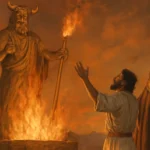
Elijah gathered the people and the prophets of Baal on Mount Carmel. He challenged the nation to stop wavering between competing loyalties. The contest involved two altars and two sacrifices: the prophets of Baal would call on their god, and Elijah would call on the Lord. The deity who answered by fire would be recognized as God.
The prophets of Baal cried out from morning until afternoon, performing the ritual actions associated with their worship, but no answer came. Elijah mocked their silence in language that reflected the dramatic confrontation, though the biblical narrative presents his taunts as part of the challenge to Baal’s supposed power. Their efforts remained fruitless.
Elijah then repaired an altar associated with the Lord and used twelve stones, representing the twelve tribes of Israel. He arranged the sacrifice, had water poured over it repeatedly, and prayed briefly. His prayer appealed to the God of Abraham, Isaac, and Israel and asked that the people learn who had turned their hearts back.
Fire fell and consumed the sacrifice, wood, stones, soil, and water in the trench. The people responded by acknowledging the Lord as God. The event was meant to settle the question of who truly ruled Israel, not to elevate Elijah as a magician or independent miracle worker.
Afterward, Elijah ordered the capture of the prophets of Baal, who were executed at the Kishon Valley. This action belongs to the violent setting of ancient royal and religious conflict and should not be treated as a general instruction for religious coercion today. It reflects the judgment described within the biblical narrative against prophets who promoted Baal worship in Israel.
How Elijah responded when rain returned
After the contest, Elijah told Ahab to prepare for heavy rain. He went to the top of Carmel, bowed down, and prayed. He sent his servant to look toward the sea repeatedly, and the servant eventually saw a small cloud. Soon the sky darkened, wind rose, and heavy rain arrived.
The return of rain completed the sign begun by the drought. The Lord had shown authority over the weather that Baal was believed to control. Elijah’s posture also matters: even after the public victory, he remained a praying servant waiting for God to act.
Elijah then ran ahead of Ahab toward Jezreel. The biblical account describes this as an extraordinary moment of strength. Yet the following events show that public success did not remove Elijah’s emotional vulnerability or guarantee immediate safety.
Why Elijah became afraid and discouraged
When Jezebel heard what had happened on Mount Carmel, she threatened Elijah’s life. He fled into the wilderness, left his servant behind, and sat beneath a broom tree. He felt overwhelmed and asked God to take his life, expressing the exhaustion of a prophet who believed his work had failed.
Elijah’s fear may seem surprising after the events on Carmel, but the narrative does not present him as fearless at all times. He had endured a long drought, confrontation with the royal household, intense public pressure, and the threat of execution. His collapse shows that spiritual courage and human weakness can exist together.
An angel provided food and water, allowing Elijah to rest and continue. He traveled for forty days and nights to Horeb, also called Mount Sinai, the mountain associated with Israel’s covenant history. There he entered a cave and encountered a question from God: why was he there?
Elijah answered that he had been zealous for the Lord, that Israel had abandoned the covenant, that the altars had been demolished, that the prophets had been killed, and that he alone remained. Some of these statements describe his perception of the crisis rather than a complete count of faithful people, since God later revealed that thousands in Israel had not worshiped Baal.
What Elijah learned at Mount Horeb
At Horeb, Elijah witnessed a powerful wind, an earthquake, and a fire. The biblical account says that the Lord’s presence was not identified with those displays. After them came a quiet, gentle sound, and Elijah covered his face before God.
The passage does not mean that God never works through dramatic events. Elijah had just seen fire fall on Mount Carmel. Instead, the scene teaches that God’s presence and purposes cannot be reduced to spectacle. The prophet needed to hear God’s direction in a quieter encounter after the noise of public conflict.
God gave Elijah a renewed assignment. He was to return through the wilderness, anoint Hazael as king over Aram, anoint Jehu as king over Israel, and appoint Elisha to succeed him as prophet. These instructions showed that God’s work did not depend on Elijah’s strength alone and that judgment would unfold through future leaders.
God also corrected Elijah’s belief that he was completely alone. A faithful remnant remained in Israel. The exact number given in the account represents those who had not bowed to Baal, reminding Elijah that hidden faithfulness existed even when it was not visible to him.
Who was Elisha to Elijah?
Elisha was a prosperous farmer when Elijah found him. Elijah placed his cloak over Elisha, a symbolic act that indicated a prophetic calling. Elisha understood the significance of the moment, left his former occupation, and became Elijah’s attendant.
The relationship between them was both practical and spiritual. Elisha served Elijah, watched his ministry, and learned what it meant to speak for God in a hostile environment. Elijah, in turn, prepared a successor rather than treating his own role as permanent or irreplaceable.
Elisha later asked for a double share of Elijah’s spirit. This request should not be understood simply as a demand to perform twice as many miracles. It resembles the request of an heir for a firstborn portion and expresses Elisha’s desire to continue Elijah’s prophetic ministry with God’s empowering presence.
When Elijah was taken up, Elisha saw him depart and picked up the cloak that had fallen from him. Elisha then began his own prophetic work, showing that God’s mission continued beyond Elijah’s earthly ministry.
How Elijah confronted King Ahab over Naboth’s vineyard
Elijah appeared again during the account of Naboth’s vineyard. Ahab wanted Naboth’s vineyard because it was near the palace, but Naboth refused to surrender the family property. Jezebel arranged a false accusation against Naboth, leading to his execution and allowing Ahab to claim the vineyard.
Elijah confronted Ahab at the site of the injustice. He announced judgment on Ahab’s royal house because the king had taken possession of Naboth’s life and property. The prophet’s message made clear that worship and ethics could not be separated: a king could not claim devotion to God while using power to steal land and destroy an innocent person.
Ahab responded with grief and humility, and God delayed part of the announced judgment during Ahab’s lifetime. This does not erase the wrongdoing or make Ahab a righteous king. It shows that the biblical account leaves room for genuine humility to affect how judgment unfolds.
Elijah’s confrontation with Ahab over Naboth expands the prophet’s role beyond the debate about Baal. He defended justice for the vulnerable and challenged the misuse of political power. His message remains relevant wherever authority is used to exploit people who have less influence.
What Elijah said to Ahaziah
After Ahab died, his son Ahaziah became king. Ahaziah was injured in an accident and sent messengers to inquire of Baal-Zebub, the god of Ekron, about whether he would recover. Elijah intercepted the messengers and asked why the king was seeking guidance from a foreign deity instead of the God of Israel.
Elijah announced that Ahaziah would not leave his sickbed. The king recognized the description of the prophet and sent military groups to arrest him. The first two commanders approached Elijah with demands, but fire came down from heaven and consumed them and their men.
The third commander approached differently, showing humility and pleading for his life and the lives of his soldiers. An angel told Elijah to go with him, and Elijah delivered the message directly to the king. The story emphasizes that the prophet’s authority came from God’s commission, not from his own social status.
This account can be difficult because it includes judgment against soldiers carrying out royal orders. It belongs to the larger biblical portrayal of conflict between a king who sought forbidden guidance and a prophet defending the Lord’s exclusive authority. It should be read carefully rather than detached from its historical and literary setting.
How Elijah was taken up from the earth
Near the end of his ministry, Elijah traveled with Elisha through several locations, including Gilgal, Bethel, Jericho, and the Jordan River. Elijah repeatedly told Elisha to remain behind, but Elisha insisted on staying with him. Their final journey portrayed loyalty, succession, and the approaching end of Elijah’s public work.
At the Jordan, Elijah rolled up his cloak and struck the water, which divided so that the two men crossed on dry ground. Elisha then asked to receive a double share of Elijah’s spirit. A chariot and horses of fire appeared, and Elijah was taken up by a whirlwind into heaven.
The text does not describe Elijah’s death in the ordinary way. It presents his departure as a unique act of God. Elisha saw what happened, tore his clothes in grief, and then picked up Elijah’s cloak, a sign that the prophetic responsibility had passed to him.
Elijah’s departure became an important part of later Jewish expectation. The prophet Malachi speaks of Elijah’s future role before the day of the Lord, and the New Testament connects John the Baptist with Elijah-like prophetic work. These references do not mean that John was literally Elijah returned from the sky; they present him as ministering in a comparable prophetic spirit and mission.
How Elijah appears in the New Testament
Elijah is mentioned several times in the New Testament. Jesus referred to the days of Elijah when discussing God’s care for the widow of Zarephath and the healing of Naaman, a Syrian commander. These examples showed that God’s mercy could reach outsiders when many in Israel were unresponsive.
Elijah also appeared with Moses during Jesus’ transfiguration, according to the Synoptic Gospels. Their presence connected Jesus with Israel’s law and prophets. The scene presents Jesus as the central figure, while Moses and Elijah represent the earlier revelation that pointed toward him.
James used Elijah as an example of a righteous person praying earnestly. James also emphasized that Elijah shared ordinary human limitations. The point is not that Elijah possessed a special nature unavailable to other believers, but that God responded to the prayer of a faithful servant.
John the Baptist was not Elijah in a literal reincarnation. Jesus and the Gospel writers associate John with Elijah because John called people to repentance, confronted corrupt leadership, and prepared the way for the Lord. Elijah’s prophetic pattern therefore remained influential in the New Testament understanding of faithful ministry.
What Elijah’s life teaches about faith and leadership
Elijah’s story brings together public courage, private discouragement, prayer, justice, and succession. He could challenge a king in one chapter and feel unable to continue in the next. The biblical portrait is powerful partly because it does not flatten him into an emotionless hero.
Faithfulness may require confrontation: Elijah opposed idolatry and royal abuse even when doing so placed him in danger.
Prayer is dependence, not performance: The prophet repeatedly asked God to act rather than claiming power for himself.
Spiritual exhaustion deserves attention: Rest, food, safety, and renewed perspective were part of Elijah’s recovery at Horeb.
Visible success does not remove vulnerability: The victory on Mount Carmel was followed by fear and despair.
Faithful people may be hidden: Elijah believed he was alone, but God knew of many others who had remained loyal.
Good leadership prepares successors: Elijah’s relationship with Elisha shows the value of mentoring and releasing responsibility.
Common mistakes people make when reading Elijah’s story
Several misunderstandings can obscure what the biblical accounts are actually saying. Careful reading keeps Elijah’s actions in their setting and distinguishes what the text reports from assumptions added later.
Calling Elijah a king: He was a prophet who confronted kings, not a ruler of Israel.
Assuming he was perfect: Elijah showed courage, but he also became afraid, exhausted, and discouraged.
Treating Mount Carmel as a magic contest: The event centers on the Lord’s covenant authority, not on Elijah’s personal abilities.
Believing Elijah was literally the same person as John the Baptist: John carried an Elijah-like prophetic mission, but the New Testament distinguishes them.
Ignoring the justice issues: The Naboth episode shows that Elijah challenged exploitation as well as false worship.
Using Elijah’s judgment scenes as simple modern instructions: Those events belong to a specific ancient covenant and royal context and require responsible interpretation.
Practical reading tip: Read Elijah’s story in sequence from 1 Kings 17 through 2 Kings 2. Watch how drought, provision, confrontation, exhaustion, renewal, justice, mentorship, and succession develop across the narrative.
How to read Elijah’s story for personal application
Elijah’s example can encourage you to remain truthful when leaders misuse power or when popular beliefs conflict with your convictions. His ministry shows that faithfulness may involve public speech, private prayer, practical care for others, and willingness to pass responsibility to someone else.
His experience at Horeb also offers a responsible way to think about discouragement. Elijah did not receive a rebuke for needing food, sleep, and shelter. God met him with care, then gave him perspective and a next assignment. That pattern does not replace professional mental-health care or community support, but it does challenge the belief that exhaustion is proof of spiritual failure.
The story also encourages patience with unseen faithfulness. Elijah judged the situation from what he could observe and concluded that he was alone. God knew otherwise. When your view is limited by fear or isolation, the account invites you to seek truthful perspective from God and from trustworthy people rather than relying only on your immediate impressions.
Finally, Elijah’s life points beyond the prophet himself. He was remarkable, but he remained a servant whose authority came from God. His ministry ended with Elisha continuing the work, reminding readers that faithful service is larger than one person’s public success.
Where to find Elijah’s story in the Bible
The most useful passages are concentrated in a small group of books and chapters. Reading them together gives a fuller picture than relying only on the Mount Carmel scene.
1 Kings 17: Elijah announces the drought, is fed by ravens, helps the widow of Zarephath, and prays for her son.
1 Kings 18: He meets Ahab, confronts the prophets of Baal on Mount Carmel, and prays for rain.
1 Kings 19: Elijah flees Jezebel, encounters God at Horeb, receives renewed direction, and calls Elisha.
1 Kings 21: He condemns Ahab and Jezebel after Naboth is killed and his vineyard is taken.
2 Kings 1: Elijah confronts Ahaziah’s reliance on Baal-Zebub and announces the king’s fate.
2 Kings 2: Elijah is taken up, and Elisha begins his prophetic ministry.
Malachi 4:5–6: Elijah is associated with the coming day of the Lord.
Matthew 11:14, 17:1–13; Mark 9:2–13; Luke 1:17, 4:25–27, 9:28–36; James 5:17–18: These passages explain Elijah’s significance in the New Testament.
Taken together, these passages portray Elijah as a courageous but human prophet. He opposed idolatry, defended the powerless, prayed for God’s intervention, received care in his own weakness, and prepared another servant to continue the work. His story is ultimately about God’s faithfulness through a prophet who was powerful in ministry yet deeply aware of his dependence.
Frequently asked questions
Was Elijah a prophet of Israel or Judah?
Elijah was primarily a prophet in the northern kingdom of Israel. His ministry took place during the reigns of Ahab and Ahaziah, whose capital was Samaria. Although he served in the north, his message concerned the whole covenant people, including their shared worship, law, leadership, and responsibility before God.
Did Elijah really perform miracles?
The biblical accounts attribute several miracles to God through Elijah, including the drought, the continuing flour and oil at Zarephath, the restoration of the widow’s son, fire on Mount Carmel, and the division of the Jordan. Elijah consistently appears as God’s servant rather than an independent source of supernatural power.
Why did Elijah run from Jezebel after Mount Carmel?
Elijah had just endured prolonged physical and emotional strain, and Jezebel’s death threat made the danger immediate. His flight reveals fear and exhaustion rather than a lack of faith. At Horeb, God restored him through food, rest, renewed perspective, and a new assignment.
How are Elijah and John the Baptist connected?
John the Baptist was not literally Elijah returned to life. The connection is that John carried a similar prophetic mission: calling people to repentance, confronting wrongdoing, and preparing people for the Lord. The New Testament presents John as fulfilling the pattern associated with Elijah rather than being the same individual.









Leave a Reply