When people ask what happened to Mary after Jesus died, they are usually looking for a simple timeline: Where did she live, who cared for her, and how did her life end? The Bible gives a few important details, but it does not provide a full biography of Mary’s later years or describe her death.
According to the New Testament, Mary was present with Jesus’ followers after his ascension and remained part of the early Christian community. After that point, the biblical record becomes silent. Catholic and Orthodox traditions preserve accounts about her final days, while many Protestant Christians rely only on what Scripture directly records and therefore leave the question open.
What the Bible says about Mary after Jesus’ resurrection
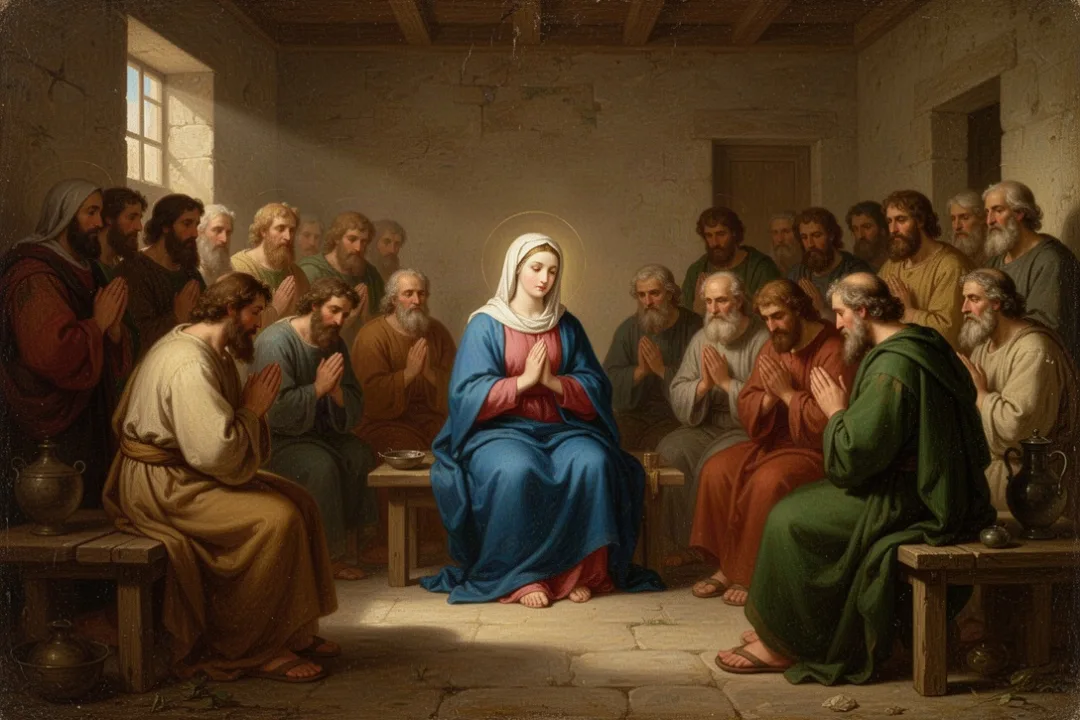
The clearest biblical reference to Mary’s later life appears in Acts 1:14. After Jesus had ascended into heaven, his apostles gathered in Jerusalem with several women, Jesus’ brothers, and Mary the mother of Jesus. They were devoted to prayer as they waited for the promised Holy Spirit.
This passage places Mary among the earliest believers in the period between Jesus’ ascension and Pentecost. She was not presented as a distant figure from the past. Instead, she was living in the community of disciples and sharing in their prayer and expectation.
The Gospel of John also gives an important detail from the time of Jesus’ crucifixion. Jesus entrusted his mother to the disciple described as “the disciple whom he loved,” traditionally identified as John. John 19:26–27 records that the disciple took Mary into his household. The passage suggests that she received ongoing care from him, although the text does not spell out every detail of their living arrangement.
The direct biblical answer: Mary was with Jesus’ followers after his ascension, but the New Testament does not say when she died, where she died, or what happened to her body.
A short timeline of Mary’s recorded life after Jesus’ death
The New Testament’s references can be arranged in a short sequence. This helps separate what the Bible states from what later Christian tradition teaches.
Jesus entrusts Mary to a disciple. At the crucifixion, Jesus gives responsibility for his mother’s care to the beloved disciple, according to John 19:26–27.
Mary is present with the disciples. After Jesus’ ascension, Acts 1:14 names her among those praying together in Jerusalem.
Mary’s later life is not described. The New Testament does not record her death, burial, final words, or a physical appearance after the early chapters of Acts.
Later traditions develop. Christian communities preserve different accounts of Mary’s final years, death, and relation to heaven.
That timeline explains why answers to this question often sound different. One answer may focus on the biblical record, another on Roman Catholic teaching, and another on Eastern Orthodox tradition. These answers are addressing the same historical figure but using different sources of authority.
Where Mary may have lived after Jesus’ crucifixion
The most direct clue is John’s statement that the disciple took Mary into his own home. Many Christians understand this to mean that Mary lived with or was cared for by John after Jesus’ death. Since Christian tradition commonly identifies the disciple as the apostle John, some conclude that she spent her remaining years with him.
The New Testament does not identify the house, neighborhood, or city connected with this arrangement. It also does not explicitly state that Mary traveled with John when he later served Christian communities. The text supports the idea of care and companionship, but it does not establish a complete itinerary.
Two locations are especially important in later traditions:
Jerusalem: Acts places Mary with the disciples in Jerusalem after Jesus’ ascension. Some traditions therefore connect her final years with the city where the early church began.
Ephesus: A separate Christian tradition associates Mary’s later life with Ephesus in Asia Minor, often in connection with John. A house near Ephesus is visited as a traditional site connected with Mary, but the New Testament does not confirm that she lived there.
Because the biblical texts do not settle the question, Christians should distinguish between a scriptural statement, a long-standing tradition, and a later devotional claim. Saying that Mary was cared for by a disciple is directly grounded in John. Saying exactly where she lived requires additional tradition or inference.
What happened to Mary during the early Christian movement?
Acts 1:14 shows Mary praying with the apostles and other believers before Pentecost. This is significant because it places her inside the community that received the Holy Spirit and began proclaiming Jesus publicly. Mary is not described as leading the apostles, but neither is she excluded from the group.
Her presence also connects the story of Jesus’ earthly life with the story of the church. She had known Jesus from his birth, had witnessed his ministry and death, and was present among his followers after his resurrection and ascension. The passage in Acts gives a quiet picture of faithful participation rather than a dramatic public role.
The book of Acts does not mention Mary by name after this opening reference. The apostles, Paul, Stephen, and other church leaders receive much more attention as the story moves beyond Jerusalem. That silence does not necessarily mean Mary left the community or died immediately; it simply means that the author’s focus moved elsewhere.
The Gospel of John also does not name Mary at the empty tomb or among the first recorded witnesses to the resurrection. Other Gospel accounts emphasize different people who encountered the risen Jesus. The absence of a later story about Mary should not be turned into a claim that she was uninvolved in the Christian community.
What the Bible does not say about Mary’s death
The New Testament does not tell readers whether Mary died naturally, how old she was, where she died, or who attended her burial. It does not describe a tomb identified as hers, and it does not record a final appearance by Jesus to her after the resurrection.
The Bible also does not state directly that Mary was taken bodily into heaven. That teaching belongs to later Christian doctrine and tradition rather than to an explicit New Testament narrative. Some Christians believe it is consistent with the church’s faith, while others do not consider it biblically established.
Several popular claims about Mary’s death circulate in sermons, books, videos, and religious art. They may come from ancient writings, local traditions, or theological interpretations. Their age or popularity does not make them part of the biblical text.
Keep the sources separate: The Bible confirms Mary’s presence with the disciples after Jesus’ ascension. Details about her death or bodily departure come from Christian traditions and doctrinal interpretations, not from a clear New Testament account.
What Catholic teaching says about Mary’s final destiny
The Roman Catholic Church teaches the Assumption of Mary: at the end of her earthly life, Mary was taken body and soul into heavenly glory. The doctrine does not require Catholics to believe that Mary definitely died first. Catholic teaching leaves open whether she experienced death before being assumed.
The word “Assumption” refers to Mary being taken into heaven by God. It is different from the Christian belief about Jesus’ Ascension, in which Jesus rises to heaven by his own divine authority. This distinction is central to Catholic theology: Mary is honored as receiving God’s action, not as possessing the same status as Jesus.
Catholic teaching about the Assumption was formally defined by Pope Pius XII in 1950. The definition presents the doctrine as part of the church’s faith, although belief in Mary’s assumption had been expressed in liturgy, preaching, and devotion for many centuries before that formal statement.
The Assumption is connected with Catholic beliefs about Mary’s unique role in salvation history. Catholics see her as the mother of Jesus, a model of faithful discipleship, and a person specially associated with the incarnation. The doctrine is meant to point toward the future resurrection and glorification promised to believers, not to make Mary equal to God.
What Eastern Orthodox Christians mean by the Dormition
Eastern Orthodox Christians commonly speak of the Dormition of the Theotokos, meaning the “falling asleep” of Mary, whom they honor as the God-bearer or Mother of God. Orthodox tradition generally teaches that Mary died peacefully, was buried, and was then received into heavenly life.
The exact way Orthodox Christians explain the relationship between Mary’s death and her glorification can vary in wording. In general, the Dormition emphasizes that Mary truly shared in human death while also receiving a special place in God’s purposes.
Orthodox churches celebrate the Dormition as a major feast. Liturgical tradition, icons, hymns, and homilies provide a fuller account than the New Testament does. These sources are important within Orthodox Christianity, but they are not the same type of evidence as a direct biblical narrative.
Many Orthodox Christians would regard the Assumption and Dormition as closely related teachings with different historical and theological language. The main difference is often the emphasis: Catholic teaching leaves the question of Mary’s death open, while Orthodox tradition generally affirms that she died before her glorification.
How many Protestant Christians understand Mary’s later life
Protestant churches do not all hold one view, but many place primary authority on the Bible and therefore avoid declaring details that Scripture does not directly provide. From this perspective, Mary was present with the believers after Jesus’ ascension, and the Bible then gives no further reliable account of her life.
Some Protestant Christians accept that Mary may have lived with John or may have traveled to Ephesus, treating those ideas as plausible traditions rather than doctrines. Others believe ancient traditions about her final years deserve little weight because they cannot be verified from the New Testament.
Most Protestant perspectives reject the idea that Mary should receive worship. They may still honor her as Jesus’ mother and as an example of trust in God. The disagreement concerns not only what happened to her but also how much authority later traditions should have in answering questions left open by Scripture.
Common ground: Mary was the mother of Jesus, was present among the early believers, and should not be confused with a divine figure.
Different conclusions: Churches disagree about her death, bodily assumption, intercession, and the authority of later traditions.
A careful position: The Bible’s silence should be acknowledged rather than filled with certainty.
Why the early sources about Mary’s death are difficult to evaluate
Writings about Mary’s final days began circulating outside the New Testament. Some are associated with traditions about her death and departure, but they were written later than the events they describe and were not accepted equally by all Christian communities.
These writings can help historians understand how Christians in later centuries remembered Mary. They may reveal the development of liturgy, popular devotion, and church teaching. They do not automatically establish that every reported detail is historical.
Several factors make the evidence difficult to assess:
Different accounts: Traditions do not always agree about whether Mary died in Jerusalem or elsewhere, who was present, or what happened afterward.
Late composition: Some texts appeared long after the first generation of Christians, making direct eyewitness claims difficult to verify.
Theological purpose: Many accounts were written to express beliefs about Mary’s holiness and heavenly destiny, not simply to preserve a neutral biography.
Regional customs: Communities in different parts of the Christian world developed their own locations, celebrations, and explanations.
A responsible answer can respect these traditions without presenting them as certain historical facts. It can also recognize that religious traditions often preserve meaning and worship practices even when the available historical evidence cannot confirm every detail.
Did Mary die before being taken to heaven?
The answer depends on the Christian tradition being used. Roman Catholic teaching does not define whether Mary died before her Assumption. Catholics may believe either that she died and was then assumed or that she was taken into heavenly glory without undergoing death.
Eastern Orthodox tradition generally teaches that Mary died, or “fell asleep,” before being glorified. This belief is expressed in the Dormition feast and in Orthodox worship. The emphasis is not on a secret disappearance but on Mary’s peaceful death and her entrance into heavenly life.
Many Protestants say the Bible does not answer the question. They may regard Mary’s death as historically likely because she was human, but they do not consider that likelihood a foundation for a doctrine about her body or heavenly assumption.
It is also useful to distinguish Mary’s destiny from Jesus’ resurrection. Christian belief about Jesus rests on the apostolic proclamation of his death, burial, resurrection, and appearances. Claims about Mary’s final departure are based on later church tradition and theological reflection, with much less direct narrative evidence.
What happened to Mary’s other children?
The New Testament mentions Jesus’ brothers, including James, Joses, Judas, and Simon, as well as sisters in Mark 6:3 and Matthew 13:55–56. Christian traditions interpret these references differently. Some understand the brothers and sisters as Mary’s other children, while others believe they were relatives or children of Joseph from an earlier marriage.
This difference affects how people imagine Mary’s household after Jesus’ death. If the brothers were Mary’s biological children, they may have been part of her family support. If the term refers to other relatives, John’s role in caring for Mary may receive greater emphasis.
The New Testament does not provide enough information to settle every family detail. What it does show is that Jesus’ brothers were connected with the early Christian community: Acts 1:14 includes them among those gathered in prayer. James later became a prominent leader in the Jerusalem church, as shown in Acts and Paul’s letters.
Mary’s relationship with these family members after the crucifixion is not described in detail. The texts give glimpses rather than a continuous account, so claims about her daily life should be expressed with appropriate caution.
What Mary’s later story means for Christian faith
Even though the Bible says little about Mary’s final years, the details it does provide are meaningful. She appears after Jesus’ ascension as a person who remains connected to the believing community. Her role is marked by faithfulness, prayer, and presence, not by a quest for prominence.
For Catholics and Orthodox Christians, Mary’s heavenly destiny also reflects a wider hope: human beings are called to share in resurrection and life with God. Mary is understood as receiving a distinctive grace because of her role in bearing Jesus, while Jesus remains the central figure of Christian salvation.
For Christians who do not accept the Assumption or Dormition as established doctrine, Mary can still be honored as a faithful disciple. The lack of a recorded ending does not diminish the importance of her witness in the Gospel accounts or her presence among the first believers.
When someone asks what happened to Mary, the most accurate answer has several layers:
Historically and biblically: She was entrusted to a disciple and was present with Jesus’ followers after the ascension.
Regarding the New Testament: It does not record her death, burial, or final years.
In Catholic belief: She was assumed body and soul into heavenly glory at the end of her earthly life, with the question of whether she died left open.
In Orthodox belief: She died peacefully in the Dormition and was received into heavenly life.
In many Protestant views: The biblical evidence ends with Acts 1:14, so later claims remain matters of tradition rather than certainty.
That layered answer avoids two opposite mistakes: saying that nothing is known about Mary after Jesus’ death, or claiming that every later tradition is directly stated in the Bible. The evidence supports a careful distinction between Scripture, historical possibility, and church doctrine.
How to answer the question accurately
If you are explaining Mary’s story to someone else, begin with the point that has the strongest biblical support: Jesus arranged for her care, and she later joined the disciples in prayer. Then say plainly that the New Testament does not record her death or provide a final biography.
After that, identify the tradition being discussed. A Catholic answer will usually mention the Assumption, an Orthodox answer the Dormition, and many Protestant answers the limits of the biblical record. Naming the tradition prevents a religious interpretation from being mistaken for an undisputed historical fact.
Mary’s story therefore ends differently depending on the source a person accepts. The Bible leaves her later life largely unrecorded, while historic Christian communities preserve teachings about her final destiny. What can be stated with confidence is that Mary remained connected to Jesus’ followers after his ascension and was remembered as an important witness to the life of Jesus.
Frequently asked questions
Is Mary mentioned after Jesus went to heaven?
Yes. Acts 1:14 names Mary among the people gathered in Jerusalem with the apostles, other women, and Jesus’ brothers. They were praying and waiting for the Holy Spirit. This is the last direct reference to Mary in the New Testament, and the Bible does not provide a later narrative about her daily life or death.
Did Mary live with the apostle John?
John 19:26–27 says that Jesus entrusted his mother to the beloved disciple, who took her into his household. Many Christians understand this disciple to be John and conclude that he cared for Mary. The passage supports that responsibility, but it does not specify the home’s location or describe how long the arrangement continued.
Where is Mary believed to have died?
Christian traditions identify both Jerusalem and Ephesus as possible settings connected with Mary’s final years. Neither location is confirmed by a direct New Testament account. Jerusalem fits the setting of Acts 1, while Ephesus is associated with later tradition about Mary and John. The evidence is therefore traditional rather than conclusive.
Do all Christians believe that Mary was taken bodily into heaven?
No. Roman Catholics teach the Assumption, while Eastern Orthodox Christians teach the Dormition and generally affirm that Mary died before her glorification. Many Protestants do not regard bodily assumption as established by Scripture. They may honor Mary deeply while holding that the Bible does not reveal what happened to her body.









Leave a Reply