Manna was the food God provided for the Israelites during their wilderness journey after the exodus from Egypt.
The story appears chiefly in Exodus 16, where the Israelites find a mysterious substance on the ground each morning and gather it as food. Manna is not presented merely as an unusual desert plant or an accidental discovery. In the biblical account, it is a daily provision from God, given to sustain a people who had left Egypt but had not yet reached the promised land.
The word “manna” has also become a common expression for unexpected help or a welcome supply that arrives when it is needed. To understand the original meaning, however, you have to look at its setting: hunger in the wilderness, dependence on God, rules about gathering, and the lessons the story teaches about trust.
The main account of manna is found in Exodus 16. After the Israelites leave Egypt, they travel through the wilderness and complain that they have no dependable food. God responds by providing bread from heaven in the morning and quail in the evening. Manna is therefore part of a larger story of nourishment, not the only food mentioned in the passage.
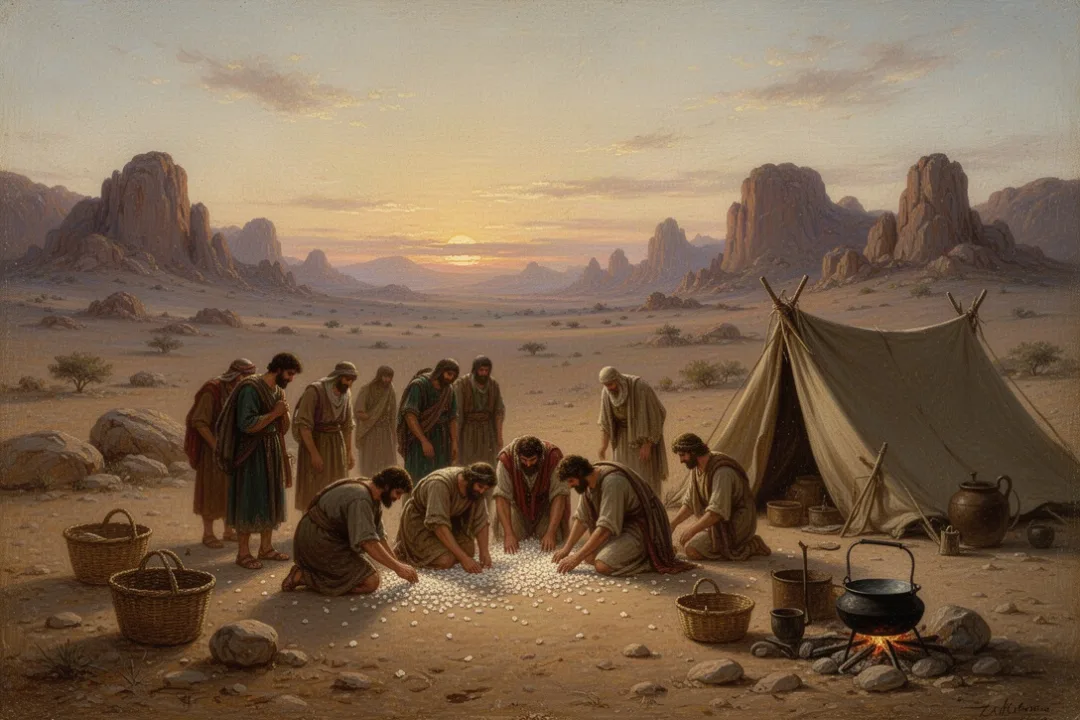
The narrative gives manna a regular rhythm. Each morning, after the dew disappears, a fine substance appears on the ground. The people gather only what they need for the day. On the sixth day, they collect twice as much because the seventh day is the Sabbath, when they are not to gather food.
Other biblical passages add details. Numbers 11 describes the people collecting manna, grinding it, pounding it, and cooking it. Deuteronomy 8 reflects on the wilderness experience as a test that taught the Israelites that human beings do not live by bread alone, but depend on God’s provision and instruction.
The story is also mentioned later in Israel’s Scriptures. Joshua 5 says that the manna stopped after the Israelites ate the produce of the land of Canaan. That detail gives the food a defined role: manna was associated with the wilderness years rather than with ordinary life after settlement.
What manna looked and tasted like
The biblical description is brief but specific. Manna is portrayed as something small, flaky, and fine, appearing on the ground after the morning dew. Exodus compares its appearance to coriander seed and describes it as pale or white. These comparisons help readers imagine its size and color, but they do not identify a modern species with certainty.
The Israelites could prepare manna in more than one way. They gathered it, ground or crushed it, and cooked it into cakes or similar food. Exodus associates its taste with something sweet, while Numbers describes it as having a flavor resembling food prepared with oil. The two descriptions emphasize that manna could be eaten as a pleasant, sustaining staple.
The term itself is connected with the Israelites’ first reaction to seeing it. They ask a question commonly understood as meaning, “What is it?” The Hebrew word behind “manna” may reflect that question, although the precise wordplay and etymology have been discussed by scholars. The name captures the people’s uncertainty: they receive food before they fully understand what it is.
Plain meaning: In the biblical story, manna is not simply “bread that fell from the sky.” It is a recurring wilderness provision with a particular gathering pattern, preparation method, and religious purpose.
How the manna gathering rules worked
Manna came with instructions. The people were told to gather according to their daily needs rather than storing large quantities for later. When some tried to keep it overnight, the stored manna spoiled and developed worms, according to Exodus 16. The exception was the sixth day, when an extra portion could be kept for the Sabbath without spoiling.
These rules make manna different from an ordinary food supply. The people could not treat it as a resource they controlled completely. They had to collect it regularly, prepare it, and trust that the next day’s provision would come. The command concerning the Sabbath also connects food with rest and worship, not only with survival.
The biblical account gives an approximate measure for each person, often translated as an omer. The exact modern equivalent is uncertain, so it is better not to assign a precise cup or pound measurement. The point is that the supply was sufficient for each person, and that gathering more than needed was not the intended pattern.
On the sixth day, the people were instructed to gather a double portion. This arrangement allowed them to rest on the seventh day without going hungry. Some people still went out to search for manna on the Sabbath, but the story presents that action as disobedience rather than as a practical food-gathering choice.
Gather it in the morning: The supply appeared as the day began and disappeared or became unavailable as the heat increased.
Collect what each person needs: The normal pattern discouraged anxious stockpiling.
Gather extra before the Sabbath: The sixth-day portion was the intended exception to the daily limit.
Prepare it as food: The people could grind, crush, and cook the substance.
Recognize its temporary purpose: Manna continued during the wilderness period and stopped after the people entered Canaan.
Why manna mattered to the Israelites
Manna addressed a real physical need, but the story gives it a deeper meaning. The Israelites had escaped slavery, yet freedom did not immediately provide homes, farms, or dependable food supplies. In the wilderness, manna demonstrated that deliverance from Egypt required continued care. Leaving danger was one stage; being sustained afterward was another.
The food also exposed the Israelites’ fears. They had known the food available in Egypt, even though they had suffered oppression there. In the wilderness, they had to depend on a provision they could not predict or preserve in the usual way. Their complaints show how quickly hunger can make a former situation seem safer than it really was.
Within the narrative, manna teaches daily dependence. The people are not given a permanent warehouse of food at the beginning of their journey. Instead, they receive enough for the present day, with a special provision for the Sabbath. The pattern challenges both panic and greed: gathering too little creates anxiety, while gathering too much in defiance of the command leads to waste.
Manna also reinforces the authority of Moses and the covenant instructions. The instructions about when and how to gather it are not optional suggestions. The people’s response to manna becomes one way the story measures their willingness to listen to God during a difficult transition.
Manna represents provision received day by day rather than security created through unlimited accumulation.
That theme has made the story meaningful to many readers beyond its original setting. People often connect manna with moments when they have enough for the next step but not a complete map of the future. The biblical emphasis, however, is not that planning is wrong. It is that planning and possession do not give human beings absolute control over life.
What the manna story means in Judaism
In Jewish interpretation, manna is closely associated with the wilderness generation, the exodus, and God’s care for Israel. The account is read within the larger pattern of the Torah, where food, Sabbath, obedience, and communal responsibility are connected. Manna is not treated as an isolated miracle but as part of the formation of a people after slavery.
The Sabbath connection is especially significant. On most days, the manna could not be stored successfully overnight, but the sixth-day portion remained usable through the Sabbath. This pattern supports the idea that the weekly day of rest is built into the community’s life. Food provision does not cancel the need for rest; it makes rest possible.
The Hebrew Bible also describes a portion of manna being preserved as a memorial. In Exodus 16, Moses tells Aaron to place an omer of manna before the Lord so that later generations can see what sustained their ancestors in the wilderness. The preserved portion functions as a memory of dependence, not as a regular food reserve.
Jewish tradition later expanded reflection on manna through interpretation and teaching. Some rabbinic discussions describe manna in imaginative and theological ways, emphasizing its suitability to each person or its connection with study and divine care. Those later traditions should be distinguished from the basic biblical description, but they show how strongly manna remained part of Jewish religious memory.
How Christians understand manna
Christian readers often connect the manna of Exodus with Jesus’ teaching in John 6. In that chapter, Jesus refers to the wilderness food while explaining that the Father gives true bread from heaven. The passage presents manna as a sign of God’s earlier provision and uses it to point toward a deeper source of life.
John 6 does not treat the manna story as irrelevant. Instead, it places the earlier event within a larger theological comparison. The Israelites ate manna and still eventually died, while Jesus describes the bread he gives as connected with lasting life. Christians differ in how they interpret the chapter’s language, especially in relation to the Eucharist, but the connection with Exodus is central.
Christian theology also uses manna as a picture of God’s daily care. The Lord’s Prayer asks for daily bread, and many Christians see an echo of the wilderness pattern in that request. The comparison does not mean that every need will be met in an identical or miraculous way. It expresses dependence on God for ordinary sustenance as well as spiritual life.
The New Testament mentions manna again in Revelation 2, where “hidden manna” is promised in a symbolic message to believers who remain faithful. Because the passage is apocalyptic, its imagery is not a straightforward description of a future meal. It draws on the memory of the wilderness food to represent God’s hidden reward and sustaining presence.
Could manna have a natural explanation?
People have proposed several natural explanations for manna. One possibility is a sweet substance produced by insects feeding on tamarisk trees in parts of the Sinai region. Another is a plant resin or other edible secretion found in a desert environment. These substances can be small, pale, and sweet, which makes them interesting comparisons.
Some researchers and popular writers have also compared manna with honeydew secretions, desert fungi, lichens, or other seasonal materials. These theories may help explain particular features of the description, such as sweetness or appearance. They do not establish that one specific organism was the biblical manna.
Several difficulties remain. The biblical account says that manna appeared regularly over a long period, served a large traveling population, spoiled under ordinary storage conditions, and remained fresh when gathered before the Sabbath. A local natural product might resemble some of these details but not necessarily all of them.
The story also has a theological shape that cannot be tested by identifying a substance. Even if a natural food helped inspire the account, the biblical writers present it as God’s provision and connect it to obedience, Sabbath, and Israel’s formation. A botanical explanation and a religious interpretation answer different questions.
How to handle proposed identifications: A natural substance may resemble manna, but resemblance is not proof. No widely accepted scientific identification explains every biblical detail or settles the story’s theological meaning.
What “manna” means outside the Bible
In ordinary English, “manna” can mean any unexpected benefit that arrives at a crucial time. Someone might describe emergency assistance, a sudden supply of food, or an unanticipated opportunity as “manna from heaven.” The phrase comes from the biblical story’s association with help that appears when people have no obvious source of support.
The word is also used in the names of some plants and natural products. In botany and traditional medicine, “manna” can refer to sweet exudates or sap-like substances collected from certain trees. This modern usage does not mean that those products are identical to the biblical food. It reflects the lasting influence of the scriptural name.
When people use the word metaphorically, they often emphasize timing. The gift is valuable because it arrives during scarcity or difficulty. Manna is not merely something pleasant; it is provision that answers a serious need. That sense is why the word appears in discussions of relief, unexpected income, rescue, and other forms of timely help.
The metaphor can also be misunderstood. Calling something manna does not necessarily mean it required no effort. In Exodus, the Israelites still had to go out, gather the food, prepare it, and follow instructions. The term therefore combines gift and participation: provision is received, but people must respond to it responsibly.
Common mistakes when explaining manna
Manna is familiar enough that it is easy to repeat simplified versions of the story. A careful explanation separates what the biblical text says from later assumptions, artistic images, and modern guesses about its physical identity.
Calling it only “bread from heaven”: This phrase captures part of the story, but manna is described as a fine substance on the ground that people gathered and prepared.
Ignoring the quail: Exodus 16 mentions both manna and quail. Manna is the central morning provision, but it is not the entire food account.
Assuming manna fell as large pieces: The text describes something small and fine rather than loaves or chunks of bread dropping from the sky.
Claiming a proven scientific identification: Several natural candidates have been proposed, but none is universally accepted as the biblical manna.
Leaving out the Sabbath rule: The sixth-day double portion is essential to the story’s meaning and structure.
Confusing biblical manna with every modern “manna” product: Plant sap, herbal products, and insect secretions may share the name without being the same substance.
Treating the story as only a food miracle: The account also addresses trust, memory, obedience, communal life, and the transition from slavery to freedom.
What manna teaches about daily provision
The most direct lesson is that the Israelites receive what they need for the next stage of their journey. Manna does not remove every hardship in the wilderness. The people still face uncertainty, fatigue, conflict, and the challenge of reaching a new land. It supplies food without making the journey effortless.
The story also distinguishes need from excess. The people are allowed to gather enough, but the ordinary instructions do not encourage limitless accumulation. In this setting, storing extra food is not automatically wisdom because the community is being taught a particular pattern of trust.
That lesson should not be applied carelessly to every personal financial decision. Scripture elsewhere praises preparation, generosity, work, and responsible care for households. Manna is not a command to reject savings or ignore future needs. Its specific point is that this wilderness community must live according to God’s instructions rather than according to fear.
Manna further shows how memory can shape identity. A preserved portion reminds later Israelites that their ancestors survived not through military strength or agricultural abundance but through divine care in a barren place. Remembering former provision becomes a way of resisting present despair.
The story can also encourage a more precise question when you face uncertainty: What is needed today? That question does not solve every future problem, but it can prevent fear from turning an immediate need into a demand for total control. In the biblical narrative, daily provision becomes a discipline of attention as well as a gift.
How to read the manna account carefully
Start with the passages themselves, especially Exodus 16, Numbers 11, Deuteronomy 8, and Joshua 5. Compare what each passage emphasizes. Exodus focuses on instructions and provision, Numbers includes preparation and complaints, Deuteronomy interprets the experience, and Joshua marks the point when manna stops.
Next, distinguish description from interpretation. The descriptions concern appearance, taste, gathering, storage, and timing. The interpretations concern trust, obedience, Sabbath, memory, and God’s care. Both levels matter, but they should not be confused with one another.
It also helps to notice the communal setting. Manna is not given to one isolated hero as a private reward. It is provided to an entire people, including families and vulnerable members of the traveling community. The instructions concern shared practices, fair provision, and a common rhythm of work and rest.
Finally, allow the text to retain some mystery. The narrative answers the question “What is manna?” by describing its source and purpose more clearly than its chemistry. It tells readers that God supplied food in the wilderness, while leaving room for uncertainty about the substance’s exact natural form.
Manna is therefore both food and sign. It is food because the Israelites gather and eat it. It is a sign because its timing, rules, and end point communicate that their survival depends on provision beyond what they can secure for themselves.
Why the manna story still matters
Manna remains memorable because it joins ordinary hunger with extraordinary meaning. The Israelites need something as basic as food, yet the way food arrives becomes a lesson about freedom, dependence, rest, and hope. The story does not separate spiritual concerns from practical necessities.
It also speaks to the uneven experience of change. After leaving Egypt, the Israelites are no longer slaves, but they are not yet settled. Manna belongs to that middle period, when the old life has ended and the new life is not fully visible. Its daily appearance represents support during a transition rather than a promise that transition will be comfortable.
For Jewish readers, manna recalls the wilderness and the shaping of Israel as a covenant people. For Christians, it points toward later teachings about bread from heaven and lasting life. In ordinary speech, it names a timely gift. Across these uses, the central idea remains recognizable: people may be sustained even when they cannot see the whole path ahead.
The best short answer is that manna was the mysterious wilderness food God gave the Israelites, gathered each morning and connected with the Sabbath. Its exact physical identity remains uncertain, but its role in the biblical story is clear: manna represents dependable provision, daily trust, and remembrance of how a vulnerable people were sustained.
Frequently asked questions
Was manna literally bread?
The Bible calls manna food from heaven and compares it to bread, but its physical description is closer to a small, fine substance gathered from the ground. The Israelites ground or crushed it and cooked it into food. “Bread from heaven” expresses its divine source and sustaining purpose; it does not necessarily mean that prepared loaves appeared each morning.
How long did the Israelites eat manna?
According to Joshua 5, manna stopped after the Israelites entered Canaan and ate produce from the land. The biblical account associates manna with the wilderness period between the exodus from Egypt and settlement in the promised land. The text does not provide one universally stated number of years in the passages that describe the food itself.
Did manna come with quail?
In Exodus 16, quail are mentioned as an evening provision while manna appears in the morning. They are related parts of the wilderness food account, but they are not the same thing. Manna became the more prominent symbol because it was provided repeatedly and was connected with the daily gathering instructions and the Sabbath pattern.
Is manna still found in the desert today?
Some desert plants and insects produce sweet, edible substances that are sometimes called manna, and these have been suggested as possible parallels. However, no modern product or natural substance has been conclusively proven to be the biblical manna. Similar appearance or taste does not account for every detail in the scriptural description.









Leave a Reply